
Industry-Government Engagement
As the cornerstone on which the Society was founded in 1920, industry-government engagement remains “mission-essential” for the organization a century later, as the first goal of the 2025 SAME Strategic Plan.
With members representing diverse technical and socio-demographic backgrounds, SAME is a multi-disciplined organization that is uniquely positioned to address the engineering-related challenges the nation faces. With institutional stakeholders representing all corners of the A/E/C industry, including large and small businesses, federal, state and local agencies, academia and other professional organizations, the Society is able to see challenges across the board that affect delivery of national security projects and products.
Finally, through a focus on collaboration, unique Post structure, and relationships at the local, national, and even international levels that go back decades, SAME provides an inclusive forum within which government and industry can come together to identify and resolve challenges.

SAME Perspectives
Collaborative Delivery Federal Policy Recommendation
An analysis of current USACE, NAVFAC, and AFCEC construction contracting methods and the integration of collaborative delivery models.
An Industry-Government Engagement Report
In spring 2025, SAME published an SAME Perspectives through the Construction Community of Interest’s Collaborative Delivery Working Group. This report investigates collaborative delivery contract models used by both private sector owners and non-federal public owners, and identified industry best practices for collaborative delivery contracts that, if adopted by the federal government and military services, may have significant benefits to federal agencies in meeting their Military Construction and Civil Works mission requirements.
Addressing Critical Issues
In recent years, SAME’s IGE projects have successfully addressed issues such as SDVOSB certification, partnering, and alternative delivery methods. These have enabled members to apply their technical expertise and thought leadership and to collaborate with others across complementary fields of discipline.
Earlier IGE efforts such as public-private partnerships and alternative financing also were summarized in SAME Perspectives—informative reports that shared lessons learned, outcomes, and progress to the broader military engineering community, a practice national leadership intends to restart as the “capstone” to each project as they conclude.
Project Selection Process
In September 2021, the SAME Executive Committee approved a new selection process for national-level IGE projects that will provide deliberateness, consistency, repeatability, transparency, and legitimacy. This formalized evaluation ensures we deliver impact and maximize the use of available resources to achieve SAME’s strategic goals and objectives.
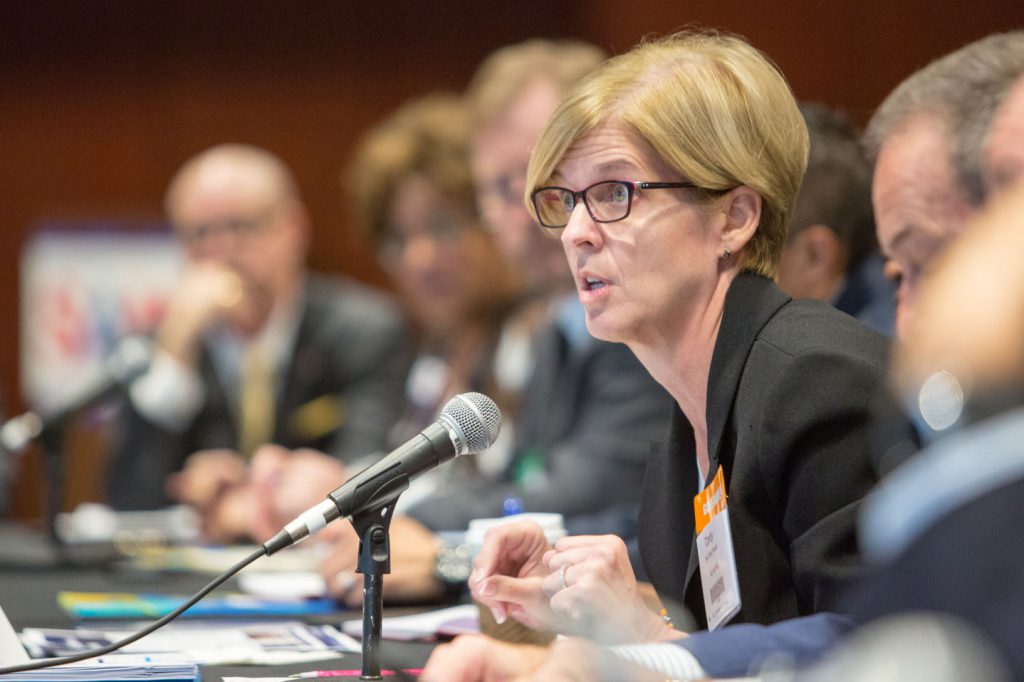
Submissions are collected from several sources, including the Executive Advisory Group (Engineering Service Chiefs and senior federal leaders), CEO Roundtables, Communities of Interest, Posts, strategic partners, and others. Submissions are presented to the Executive Committee for scoring, approval, and action by member volunteers (subject matter experts).
Making A Measurable Impact
Throughout SAME’s first century, the Society was instrumental in creating opportunities for individuals and organizations to become familiar with each other, allowing each party to prosper and build lasting relationships. It is time to apply that trust in redoubling our support of national security.
Now in SAME’s second century, in addition to our enduring legacy of bringing people together, the Society has the opportunity to impact some of the pressing issues of the day through IGE. Strengthened by the technical expertise of our membership; a diversity of thought, perspectives and experience; and a shared commitment to service, we are embracing that responsibility.
The IGE Blueprint
In addition to the local outreach conducted by our Posts, SAME is addressing many other pressing issues such as CPARS, PFAS, alternative delivery methods, and cybersecurity through our national IGE project framework.
During the 2022 Small Business Conference, SAME also began facilitating new listening sessions with agency partners, allowing for intentional conversations between industry members and government leaders on pressing issues and concerns. In addition, the conference marked one of the semi-annual meetings of the Executive Advisory Group to discuss shared areas of interest where we can play a role in resolution.
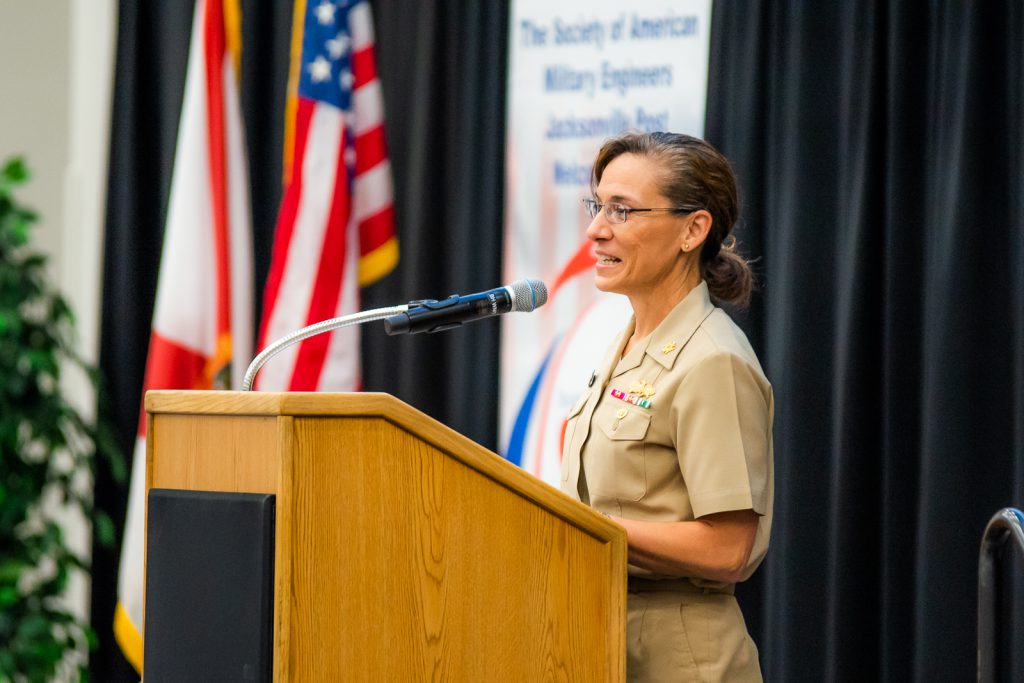
SAME’s unique network of Posts, with their century-long track record of forging relationships at the local level, coupled with a strong infrastructure through Communities of Interest that can leverage technical expertise at a national scale, offers a blueprint for the future of IGE.
Active IGE Projects
Project Managers:
- Victoria Mechtly, GFT, Assistant Vice President
- Pooja Jain, CEO, Innov8 Consulting LLC
- Ben Graf, PE, Chief Data Scientist, Matrix Design Group
- Mike Ramos, President, Raymond
Project Start: July 2024
Planned Finish: TBD
Current Status: Ongoing
Background:
Pressing Issue Description – What is the issue or problem: Describe the Pressing Issue to include the problem statement:
It’s commonly stated that the Federal Government is years behind industry in adopting new technologies. The rapid advancement of artificial intelligence (AI) technologies is challenging this common belief. Government and industry cannot sit by and wait for adoption. There is a pressing need for structured engagement between industry and government to ensure the effective and ethical implementation of AI in engineering projects, particularly those with military applications.
This Industry-Government Engagement (IGE) task force aims to change that by bringing together individuals from industry and key stakeholders from the government to discuss AI and its use cases. These conversations will be educational and based on experiences. The lack of coordinated efforts and standardized guidelines poses risks related to security, efficiency, and ethical considerations. All products, platforms, and capabilities of firms will only be used to reference implementation and lessons learned.
Proposed Project Scope: Specifically what part or parts of the problem or issue would this project address and not address:
This project will address the need for a formalized platform to facilitate collaboration between industry and government entities on AI initiatives. Specifically, the task force will:
- Facilitate knowledge-sharing between industry and government, and government to government.
- Address security concerns related to AI integration.
- Discuss guidelines for AI implementation in military engineering projects.
- Promote best practices for ethical AI usage.
The project will not cover proprietary AI developments. Conversations will start with Generative AI then move to focus on engineering-related AI applications.
Potential Impact: What is the impact if the issue or problem is solved; what does “Right” look like:
The impact is establishing a common space to discuss AI integration that enhances project outcomes, improves security, and upholds ethical standards between industry-government and government-government. This will increase the ability to ensure that AI technologies are implemented effectively and ethically within the engineering and military sectors.
Projected Outcome(s): What documents produced and their purpose (white papers, etc.), processes, policy, etc. requiring modification or revision, other:
- White papers outlining standardized guidelines and best practices.
- Policy recommendations for government and industry stakeholders.
- Reports on the state of AI integration in military engineering projects.
- Training materials and program outlines for knowledge sharing.
Involved Organizations: Which organizations within Industry, Government, Academia, other SAME Communities of Interest (COIs), etc. should be a part of a project team to address this problem or issue:
- Government agencies (e.g., AFCEC, NAVFAC, USACE)
- Individuals leading or implementing AI efforts in Engineering Firms
- Academic institutions specializing in AI and engineering
I’ve already approached individuals from USACE Omaha and they are interested in having representatives part of this IGE.
Timeframe for Resolution: Approximation of when this problem should be solved to remain relevant:
The goal of the IGE would be to publish a “State of AI within the DoD A/E/C” within the next year. Due to the evolving technology and learning curves this could take longer or be shorter. The Small Business Conference would provide an ideal environment to share a report and gather additional information from government and industry.
Project Managers:
- Col. John Mogge, Ph.D., RA, F.SAME (Dist.), USAF (Ret.)
- Col. Paula Loomis, Ph.D., LEED AP, AICP, FAIA, F.SAME, USAFR (Ret.)
Project Start: November 2023
Planned Finish: TBD
Current Status: Ongoing
Key Stakeholders:
A-E Firms, Construction Companies, Technology Providers, U.S. Army Corps of Engineers, Air Force Civil Engineer Center, Naval Facilities Engineering Systems Command, Office of the Secretary of Defense (Construction), Other Federal Agencies
Background:
The Installation of the Future IGE project will serve as a strategic planning forum that will attempt to address how five converging mega-trends will shape the nature of military and federal Installations in the future. Technology and innovation improvements, climate change, geopolitical shifts, population changes, labor and personnel needs, mission evolution: each of these, and more, will shape how government installations will be planned, designed, built, and maintained in the coming generation. This IGE project postulates that these trends are the one that will likely influence the nature of defense and installations in the future. It also will examine deeper rationale for why each of these trends are important and how the concept of convergence can create a wave of change. What does long-term change really look like for installations? Service leadership and supporting industry practitioners must to be ready to understand, exploit and employ a philosophy of innovation to the benefit of our national security.
Project Impacts:
- Define how to functionally address trend convergence and proposed updates to federal facility planning guidance
- Cross functional integration of stakeholders in actionable doctrinal, with policy and procedural changes to consider
- Introduction of new technologies, best practices, and access to expertise for federal facility planners.
Additional Resources:
Raising Awareness of Current and Emerging Cyber Threats to Smart Operational Technologies and Development of Effective Policy and Standards Enhancing Cybersecurity Resiliency for Federal Facilities and Infrastructure
Project Manager:
- Brian May, Michael Baker International | Lucian Niemeyer, Building Cyber Security
Project Start: August 2021
Planned Finish: Fall 2022
Project Status: Ongoing – Approved by Executive Committee
Project Type: Advocacy/Education
Key Stakeholders:
Resilience COI, Architectural Practice COI, Facility Asset Management COI, Uniformed Services
Background:
This IGE project has set out to create awareness on the subject of cybersecurity in the built environment and the interconnection between the advances created by smart technologies and the corollary risks to critical infrastructure that can arise unintentionally. This includes efforts in the long-run to set effective policy and standards for enhancing cybersecurity resiliency for federal facilities and infrastructure. Currently, the building cybersecurity methodology (an initial, companion aspect of the project) is being evaluated within the commercial sector and insurance industry. The intent as well is to bring on government and A/E/C industry representatives to the IGE project team and determine interest and potential application for the federal/defense sector. Ensuring that key stakeholders voice their requirements, challenges, and ideas into the development process is essential for the long-term adoption of a rating system for building cybersecurity. While not an exact comparison, one potential outcome in the future is a building cybersecurity rating system, similar to LEED, that facilities could qualify for and that leadership is able to advocate funding for to invest in great cybersecurity.
Project Impacts:
Raising awareness of current and emerging cyber threats to smart operational technologies used in federal facilities and infrastructure; facilitate development of effective policy and standards aimed at enhancing the cybersecurity and resilience of federal facilities and infrastructure.
Originating Source: Executive Advisory Group
Additional Resources:
Letter of Appointment | Cybersecurity Project Charter | IGE Presentation
Project Manager:
- Sal Nodjomian, Matrix Design Group
Project Start: Fall 2017
Planned Finish: May 2023
Project Status: Ongoing – Legacy Project
Project Type: Education
Key Stakeholders:
AFCEC, NAVFAC, USACE, OSD
Background:
Within Military Construction, recent years has seen a lack of consensual understanding and agreement about project outcomes, principally the effectiveness of both contractor and agency benefitting. This topic, and its concerns, were voiced at the SAME CEO Roundtable, leading to the development of a working group to address partnering, and a commitment from the agencies to recommit to the process. To address what had been a diminishing partnering mindset, and return to a more collaborative contractor/agency relationship that had been seen in prior decades, SAME has led a multi-year effort that recently has included delivery of a PMA tool for OSD use. Additionally, NAVFAC has recently rewrote its partnering instructions, and also provided a communication and collaboration platform to increase adoption of partnering principles. Lastly, USACE is readying to release in 2022 a Construction Project Partnering Playbook that is intended to provide guidance, best practices and scalable tools across the full spectrum of construction projects—emphasizing the processes and practices that made partnering successful back to its roots in the 1980s.
Project Impacts:
To provide a platform to shape project partnering within Military Construction programs, socialize the need for government stakeholders to embrace partnering, and to work within the SAME network, locally and nationally, to advance the concept for the betterment of project delivery.
Originating Source: CEO Roundtable
IGE Local Post Resources
Host an IGE Event
Interested in hosting an IGE event at your local Post? The SAME National Office can provide resources and best practices to help your Post plan and organize an impactful IGE event.
Certified IGE Mentors
An IGE Certified Mentor is a member of SAME who has successfully led industry-Government Engagement events and programs, with measurable outcomes. These members have agreed to assist Post Leaders with IGE efforts. Contact them to help your Post get started. To become considered for IGE Certified Mentor status, contact Ree Miskimon and share your experience in leading a local IGE event or program.
Industry-Government Engagement Across SAME
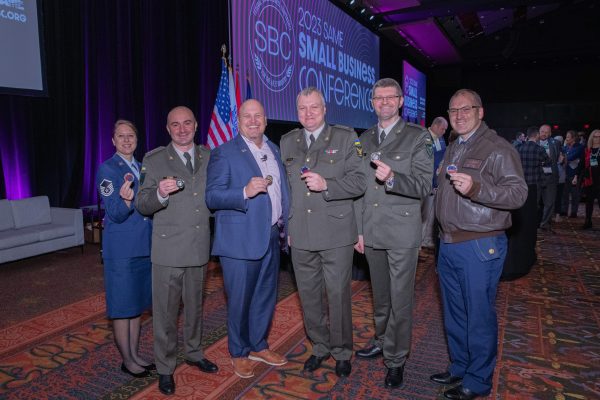
The need for focused industry-government engagement impacts national security at the highest levels of government. At the 2023 SAME Federal Small Business Conference in San Antonio, Texas, Gen. Laura Richardson, USA, Commander of U.S. Southern Command, detailed the importance of private sector engineering, technology, and infrastructure firms supporting international projects in the SOUTHCOM area of operations. The vital roles that a collaborative “Team America” can play in the region advances democratic interests, and is the ultimate return to be derived from driving partnership and industry-government engagement all the way down to the local agency and district levels.
2023 SBC Keynote
-

SAME’s Ukraine Field Chapter: Building Partnerships in a Time of War
-
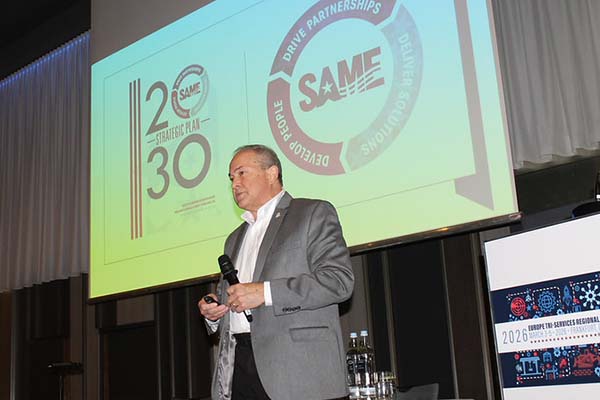
Recapping the 2026 Europe Tri-Services Regional Summit
-
Guest Post: Prioritizing the Warfighter Executive Order: How A/E/C Government Contractors Should Respond
“Even with our 40,00 employees, we can’t do it alone. So when you look around this room and see a bunch of SAME members, I look at it, and I see the possibilities.” – Maj. Gen. Richard Heitkamp, USA, Deputy Chief of Engineers and Deputy Commanding General of the U.S. Army Corps of Engineers at the 2023 SAME Capital Week’s DOD & Federal Agency Program Briefings