
Quick Links
Community Mission
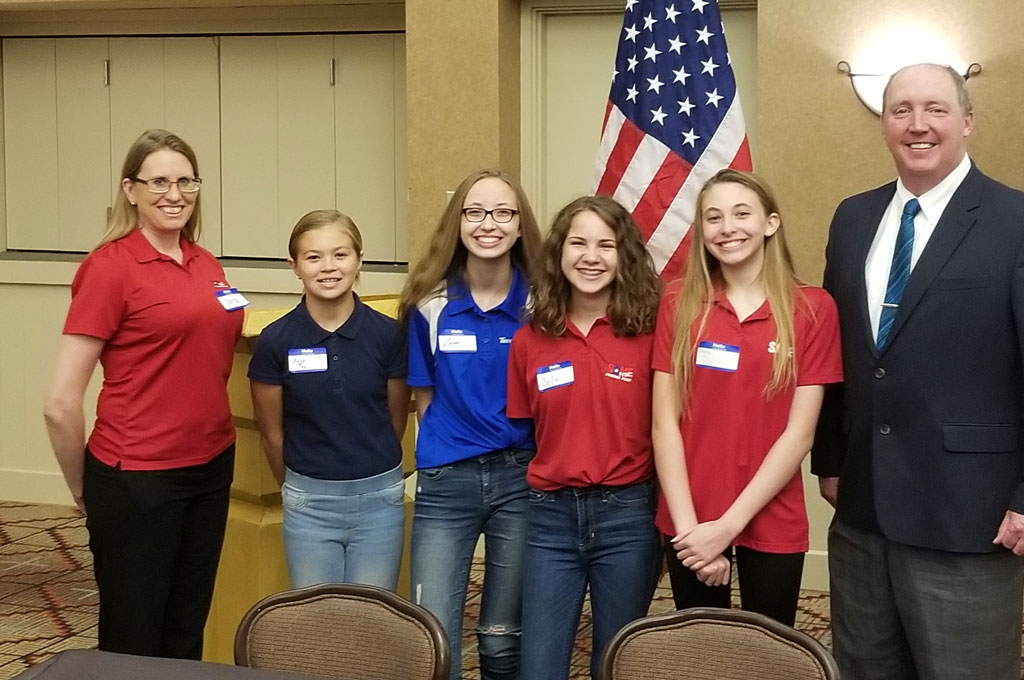
The K-12 STEM (Science, Technology, Engineering, and Mathematics) Outreach Community of Interest’s mission is to promote and support pathways to STEM degrees and STEM careers for K-12 students as part of the national strategic effort to produce more STEM professionals for the nation.
Join the SAME Engage K-12 STEM Outreach NetworkVision
The K-12 STEM Outreach Committee provides for the security of the nation by ensuring a robust STEM workforce.
Scope
K-12 students need to be exposed to STEM activities, degrees, and careers as they move up the academic ladder. The committee will work with the network of Posts, individual members, sustaining members, service branches, and strategic partners to increase opportunities for STEM exposure for K-12 students. The COI will also promote the Society’s STEM programming at local, regional, and national events, as resources allow.
Activities
- Categorize different examples of how the Post/individuals support K-12 STEM at the local level
- Identify and provide guest speakers/webinars on relevant topics
- Serve as a clearinghouse of STEM information
- Provide a calendar of STEM (SAME/Post and external) events and points of contacts
To learn more about the K-12 STEM Outreach Community of interest, contact a member of the Steering Committee, or reach out to Amy McGeever, STEM Coordinator.

Community Chair
Victoria Hernandez
Program Manager, AFCEC
Immediate Past Community Chair
Joshua Graham, P.E., PMP, F.SAME
Project Manager, HDR
Vice Chair, Strategic Alliance: Jeffrey Leonard, PE, CFPS, F.SAME
Vice Chair Programs: Lexi Lessaris
Vice Chairs, Communications and Outreach: Zayda Shavkatova and Roger Minyami
Vice Chair, Awards and Recognition: Traci Dewar
Upcoming National Webinars
-

- Webinar
Solving Complex CVOC Problems with ISTR– Field Proven Approaches
This webinar will first discuss the unique aspects of performance-based designs when considering procurement of thermal remediation services. Next, we will discuss how to evaluate criteria when selecting performance objectives, i.e., “ how do you define success?” -

- Webinar
The National Spatial Reference System: Modernizing Our Geodetic Foundation for the Future
The National Geodetic Survey (NGS), within the National Oceanic and Atmospheric Administration (NOAA), is in the process of making the critical transition from the current National Spatial Reference System (NSRS) to the upcoming, modernized (2022) system. -

- Webinar
CMMC Level 2: What A/E Firms Must Know Before November
Starting November 10, 2026, the Department of Defense will require CMMC Level 2 certification for contractors handling Controlled Unclassified Information (CUI). Unlike prior self-attestation requirements, this mandate requires verification by an accredited third-party assessor before a firm can be awarded or retain applicable DoD contracts.

Related TME Articles – K-12 STEM Outreach
-

Revising the Arctic and Subarctic Design and Construction Guidelines
With a renewed focus on the Arctic and subarctic areas of the world due to evolving national security needs and changing environmental conditions, an effort to revise outdated construction and facility criteria for military infrastructure in these remote regions is well underway in preparation for future projects. -

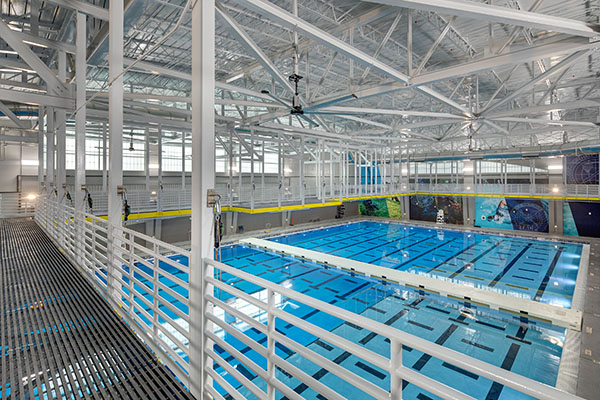
A Cutting-Edge Aquatic Center: Delivered Through Creative Collaboration
To construct a 76,000-ft2 state-of-the-art aquatic training center at Joint Base San Antonio-Lackland required overcoming various technical complexities and extensive teamwork between stakeholders. -
Sharpening MILCON Delivery Through the Design Charrette
A key element to improving military construction project delivery is the execution of high-quality charrettes—and the tools applicable to effective charrette facilitation can also be applied to industry-government engagements. -
Delivering Modular Indoor Firing Ranges for Federal Agencies
A pair of modular indoor firing ranges developed for two different federal agencies leveraged advancements in off-site construction and compartmentalized delivery to save time and funding despite logistics challenges, while also building flexibility that can meet future needs.