
Prioritizing the Warfighter Executive Order: How Will This New EO Affect Government Contractors?
Article contributed by Alex Rossino, Guest Contributor, Deltek

In January, the White House released an executive order (EO) titled “Prioritizing the Warfighter in Defense Contracting.” The intent is to put on notice those contractors who miss deadlines or neglect critical investments in their production capacity.
Below, we’ve offered a brief explanation of the context of this EO, how it may impact contractors selling to the federal government, and some actions all contractors should take to prepare themselves for this shift in GovCon priorities.
What’s In the “Prioritizing the Warfighter” EO?
The “Prioritizing the Warfighter in Defense Contracting” Executive Order represents a major shift in expectations for defense contractors, emphasizing production speed, contract prioritization, and measurable delivery performance. The Department of Defense is now explicitly focused on holding contractors “to the highest standards… with respect to the timeliness and quality of the defense items that they deliver,” while targeting firms that fail to invest adequately in production capacity or do not prioritize government work at the required pace.
This shift has significant financial implications. Contractors identified as underperforming may be immediately prohibited from issuing dividends or conducting stock buybacks until performance improves—though firms without such financial mechanisms will be unaffected. Compounding the pressure, underperforming contractors will have only 15 days to produce a board‑approved remediation plan, a requirement that may normalize emergency board meetings and rapid‑response governance structures.
The EO also introduces potential long‑term structural consequences that could reshape contractor governance and market positioning. Future contracts will directly link executive compensation to delivery outcomes, with potential salary caps during periods of underperformance, marking a dramatic evolution in how leadership accountability is enforced within defense firms. In addition, contractors deemed underperforming may face limitations on government advocacy for international sales.
Although some provisions may encounter legal challenges, the enforcement mechanisms and contract‑level amendments are expected to advance quickly, creating a high‑stakes, high‑scrutiny environment where even litigation becomes costly, unpredictable, and operationally disruptive. The result is an era in which performance is evaluated more closely, with enterprise‑wide consequences for firms that fail to adapt.
What Actions Should Contractors Take to Respond to the EO?
Contractors wanting to stay prepared for how this EO is implemented should also keep in mind recent shifts in the DOD contracting landscape.
It’s worth noting, for example, that this EO isn’t the only recent policy signal impacting contractors selling to DOD. In November 2025, the DOD released their Defense Acquisition Transformation Strategy, which prioritized accelerating the fielding of commercial technologies and modernized systems, increasing production capacity for capabilities, systems, weapons and munitions; and putting the acquisition system and the industrial base on a wartime footing that accepts greater risk.
Also, in February, the White House published a new executive order titled “Establishing an America First Arms Transfer Strategy.” While these kinds of EOs are not full strategies, they are important signals of how the government intends to reform the GovCon market.
Beyond simply maintaining preparedness, here are four steps that contractors should take to adapt to this new GovCon environment.
- Pay close attention to further market developments and potential legal challenges related to these EOs. Additionally, the final FY 2026 discretionary budget will provide more clarity on how the administration plans to carry out their spending and acquisition agenda.
- Monitor your target agencies and contract vehicles to identify new performance-based compensation clauses. Make sure you have a system that makes it easy to find and track best-fit contracts.
- Reevaluate your firm’s competitive position if there are major incumbents on contract vehicles that face operational or financial constraints. If you can understand where these competitors are lagging and can use your own reliability and performance as a competitive advantage, you’ll be well positioned to benefit.
- Assess whether your firm, your partnerships or your teaming relationships are at risk or involve contractors at risk. Do your priorities align with the new DoD priorities? And are you able to deliver products or services on time, consistently? If not, you may need to take action.
Related News
-

Guest Post: The Top Federal Opportunities for FY2026 in the Government Contracting Market
Deltek outlines the top federal opportunities for FY2026 and provides in-depth analysis for the government contracting market. -
Guest Post: Navigating Federal Procurement Shifts: What A/E/C Firms Need to Know
Deltek examines how Federal procurement reform is reshaping the contracting environment for every business that sells to the government. Understanding the implications of these changes are critical to delivering effective services to federal clients. -
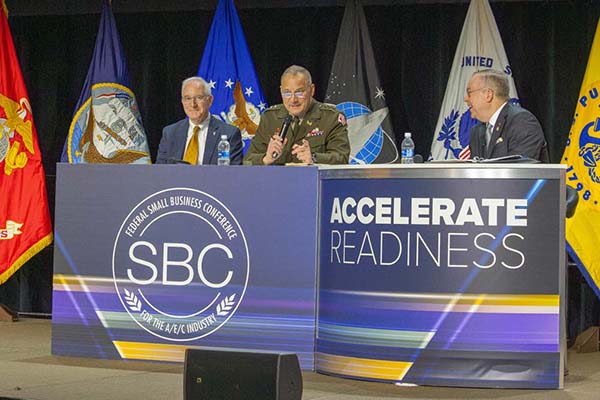
Connecting Industry and Government: SBC 2025 Delivers on the Mission
The 2025 SAME Small Business Conference in in Phoenix, Arizona, finished an amazing three days! Read the wrap-up and watch the videos of the week!


Stay up to date on all SAME news and more; download SAME Mobile today!