A Standardized Approach to Aircraft Fire Training Infrastructure
By Elizabeth Griffith, P.E., LEED AP, M.SAME, Bill Nieport, PMP, LEED AP, M.SAME, Daniel Ford, P.E., LEED AP, Jerry Kirila, and John Smith III
To support enterprise-wide airmen readiness, the U.S. Air Force is modernizing its standard design for aircraft fire training facilities—introducing digital controls, dual-fuel systems, and PFAS-conscious infrastructure.
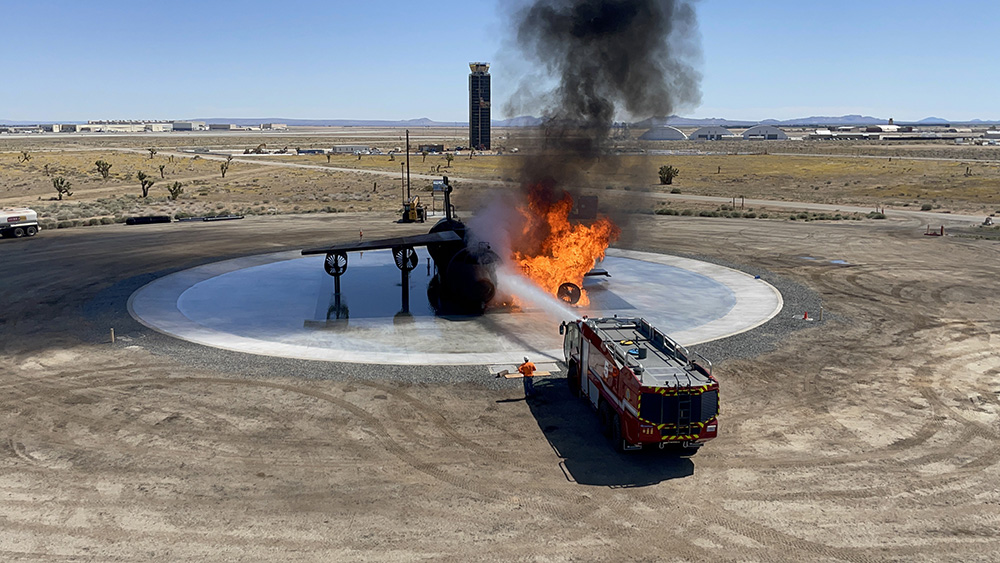
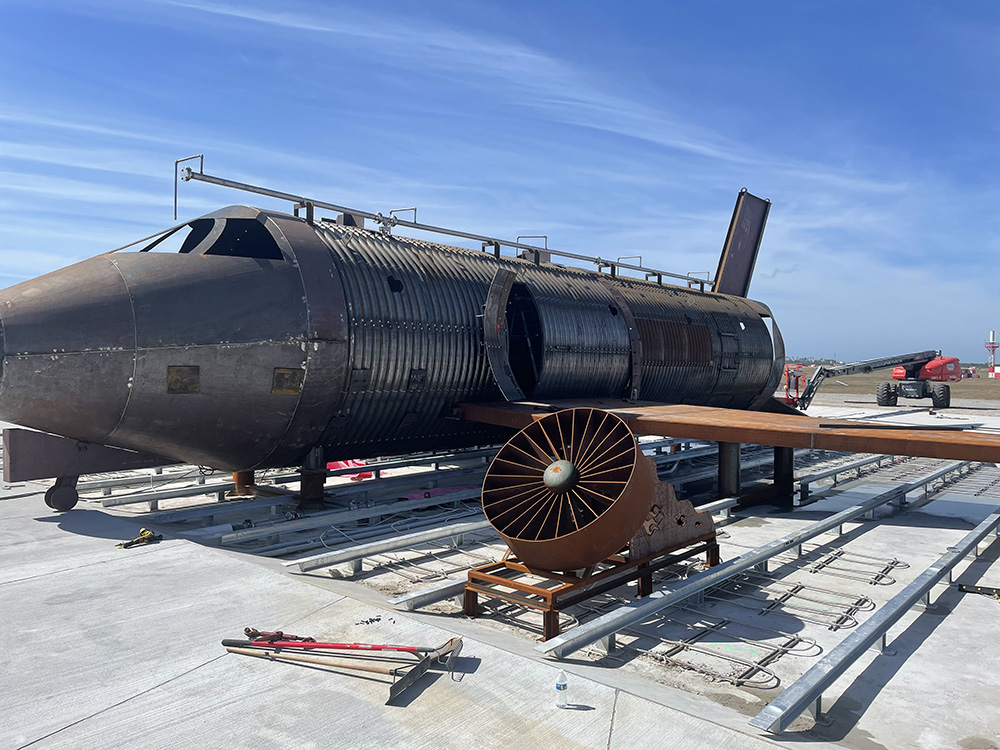
fire training facility concept used to train airmen firefighters integrates digital controls, dual-fuel systems, and PFAS-conscious infrastructure to deliver realistic, repeatable, and environmentally responsible conditions. Photos courtesy Kirila Fire Training Facilities Inc.
Across the U.S. Air Force, maintaining readiness is dependent on the ability to train for high-risk scenarios with both precision and consistency. This is especially crucial within firefighting response units, which are part of the overall civil engineering community.
An essential aspect of keeping these airmen mission-ready are aircraft fire training facilities (AFTFs). By simulating high-risk aircraft emergencies in a repeatable setting, these facilities give firefighters critical hands-on experience. However, many existing AFTFs date back decades, and their training scenarios no longer fully align with the techniques used in modern Air Force firefighting. To address this gap, the Air Force Civil Engineer Center (AFCEC) has launched a strategic initiative to establish a modernized standard design and ensure consistent, up-to-date training capabilities across the service.
Developed for enterprise-wide use, the new AFTF concept sets the stage for consistent, repeatable facility development while still allowing for site-specific flexibility. This is an important attribute given the highly varying geographies of Air Force installations and the types of weather-related impacts they endure.
The AFTF work is part of a broader infrastructure modernization initiative by the Department of the Air Force. The new design provides a scalable template that meets today’s operational needs and remains adaptable as future firefighting techniques and technologies evolve. The AFTF concept also will streamline planning and procurement processes for base engineers,
who can use the design as a foundation for issuing design-build construction task orders under existing contract vehicles.
The AFTF package, developed to the 35 percent to 65 percent design level, can be adapted for both new construction and retrofits. The concept supports improved readiness, modernized simulation equipment, updated environmental compliance, and long-term lifecycle performance.
Collaborative Journey
The updated AFTF standard (built by a team of engineers, fabricators, and subject matter experts from AFCEC in collaboration with Tetra Tech, CHA, and Kirila Fire Training Facilities) reflects decades of lessons from military firefighting. The result is a concept that combines digital precision with real-world fire behavior while addressing evolving safety and environmental constraints.
The previous standard design, last updated in 1996, relied on analog systems and propane-only training fires. The new standard incorporates propane and hydrocarbon (jet fuel) scenarios to better replicate actual crash responses, including smoke behavior, fire suppression tactics, and thermal conditions. This allows facilities to more accurately simulate high-risk fire evolutions that require tactical decision-making under pressure.
Location Adaptive. With design flexibility built in, the new AFTF concept can be site-adapted for different climates, base layouts, or operational constraints. Conducting fire training at one site may use propane only. Another location may incorporate jet fuel or adapt the fuel storage infrastructure to suit existing containment or environmental controls. This modularity allows installations to tailor solutions without compromising the intent of the standard design.
The AFTF concept includes two options for the control tower: a stick-built structure or a repurposed intermodal shipping container assembly. Both are designed to meet visibility, safety, and utility access needs while offering efficient options for remote sites or budget-conscious installations. Each tower includes a viewing deck, operator control room, mechanical spaces, and a two-story layout that provides a commanding view of the mockup and burn pit. Details, such as rooftop access, HVAC design, lighting, and interior finishes, are intended to meet defense standards while minimizing unnecessary features for a utilitarian structure.
At its core, the full-scale C-130 mockup is constructed of weathering steel for long-term durability. It features multiple internal fire locations (cockpit, cargo, passenger) as well as external props such as wheel wells, engines, and APU modules. Each of these components can be ignited independently and controlled through the programmable logic control system. The mockup itself sits atop a concrete foundation and is supported by steel framing designed to withstand repeated high-heat cycles.
With design flexibility built in, the new AFTF concept can be site-adapted for different climates, base layouts, or operational constraints.
Realistic Preparation
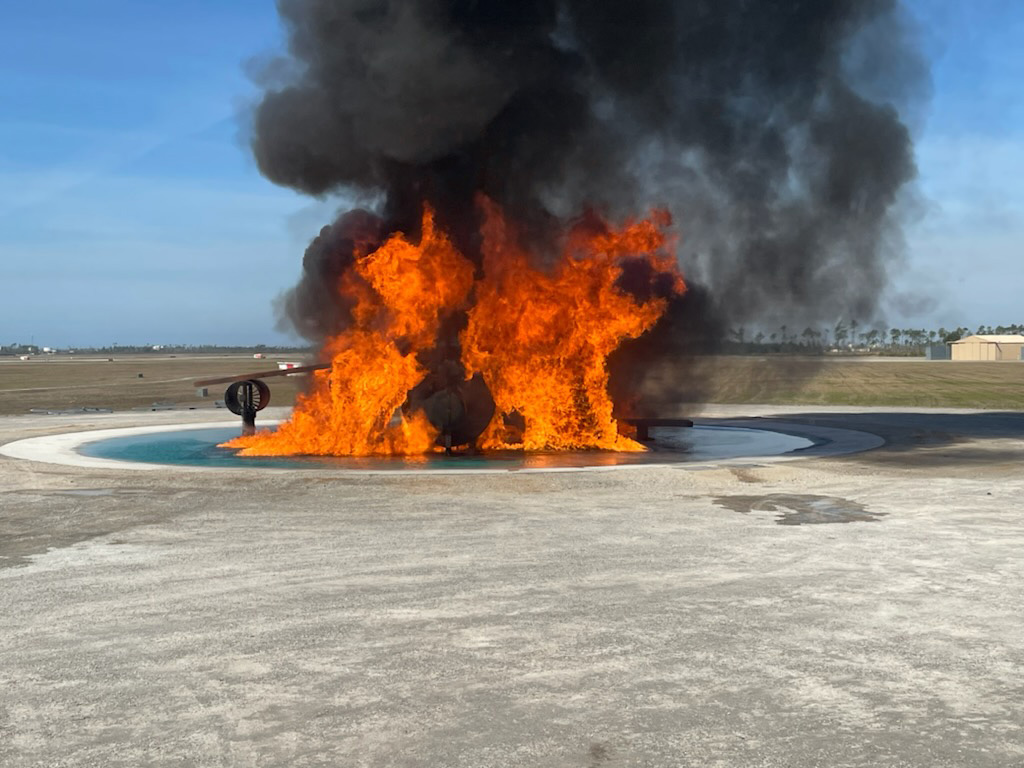
The reintroduction of hydrocarbon fires significantly enhances training effectiveness for airmen firefighters. While propane remains valuable for safety and repeatability, it lacks the realism needed to meet evolving training requirements. Propane fires can be shut off at a control panel; by contrast, hydrocarbon fires must be fully extinguished by the trainee using approved tactics.
In the new AFTF design, exterior fires are fueled by either propane or jet fuel, with a designated 30-by-30-ft hydrocarbon spill zone within a steel-grated burn pit. Liquid fuel is dispensed, ignited, and allowed to spread, creating a realistic scenario with obscured visibility, fuel pooling, and fire behind structural elements. Firefighters must assess conditions, deploy foam blankets, and execute proper extinguishment techniques as they would in a real-world emergency.
The updated AFTF concept also supports new firefighting agents, such as fluorine-free foam (F3), which behaves differently than the previously used aqueous film-forming foam (AFFF). Because F3 requires surface agitation to form a bubble wall and lacks the self-sealing properties of AFFF, the burn bed design had to be reimagined. The approach now combines a steel-grated walking surface above a shallow, inch-deep water layer. This design change allows fuel and foam to interact in a realistic way while still offering protection from heat degradation.
Integrating Digital
Another defining feature of the modernized AFTF design is its fully integrated programmable logic control system, which governs every training evolution. With real-time input from thermal imaging cameras, flowmeters, and safety interlocks, the system can simulate flame spread, extinguishment difficulty, and failure conditions, all with selectable training modes.
The use of touchscreens and automated controls marks a departure from legacy systems that relied on manual valve adjustments and switches. Now, training officers can program scenarios in advance, monitor activity in real time, and digitally record performance data for analysis and reporting.
A total of seven critical subsystems, including fuel delivery, water cooling, pneumatic control, and safety monitoring, are managed by a central system. This digitization improves repeatability and ensures fail-safes are in place before fuel release or ignition occurs.
Environmental Protections
The updated AFTF design includes numerous improvements to reduce environmental impact and improve system maintainability. For example, fire training runoff is now captured and treated in a closed-loop system that includes an oil-water separator, lift station, and up to three 50,000-gal aboveground water storage tanks. These tanks allow water to be reused for subsequent training evolutions, reducing overall water demand and ensuring that hydrocarbon-contaminated water is managed responsibly.
Given heightened awareness of environmental stewardship and increasing regulatory scrutiny, these considerations are critical. Evolving environmental regulations aimed at protecting water quality and reducing contamination risks require compliance today. Adherence also minimizes down-the-road risks particularly in relation to fuel handling and firefighting chemicals.
Site-Specific Planning. Facilities that incorporate jet fuel training must implement additional safeguards. These include high-density polyethylene liners beneath burn pits and concrete hardstands, pneumatic emergency shutoff valves, and isolated drainage systems. For installations conducting propane-only training, many of these components may be scaled back or removed, allowing for cost-effective adaptation to local operational needs.
The new AFTF design anticipates future requirements as well. While firefighting foams containing per- and polyfluoroalkyl substances have been largely phased out, future facilities may include filtration systems specifically targeting these compounds in discharged water. The modular nature of the drainage and storage systems makes it feasible to incorporate such upgrades without requiring a full redesign.
Advancing Mission Readiness
With nearly 11,000 firefighters across active duty units and the Guard and Reserve, many of whom are required to complete live burns at least twice a year, the need for reliable, realistic training facilities is critical. The new AFTF standard supports this by providing a flexible, maintainable, and repeatable design that installations can adapt and implement with reduced design lead time.
The modernized training facility improves safety, realism, and lifecycle efficiency. Equally important, it enables better alignment with current and future training doctrine, helping build muscle memory and essential decision-making instincts. By advancing the design quality and delivery framework, the revised AFTF concept offers a standardized template that strengthens readiness, streamlines acquisition, and supports long-term sustainment.
Elizabeth Griffith, P.E., LEED AP, M.SAME, is Vice President, Air Force & Space Force Programs, and Bill Nieport, PMP, LEED AP, M.SAME, is Vice President, Federal Operations, Tetra Tech. They can be reached at elizabeth.griffith@tetratech.com; and bill.nieport@tetratech.com.

Daniel Ford, P.E., LEED AP, is Principal Engineer VI, CHA; dford@chasolutions.com.

Jerry Kirila is Founder/President, Kirila Fire Training Facilities Inc.; jerry@kirilafire.com.

John Smith III is Program Manager, Air Force Civil Engineer Center; john.smith.233@us.af.mil.
Published in the November-December 2025 issue of The Military Engineer
Check Out Related Articles From TME
-

Innovative PFAS Remediation at Camp Grayling
For project stakeholders and remediation managers confronted with PFAS, Regenesis demonstrates the efficacy of using Regenesis’ PlumeStop® colloidal activated carbon (CAC) at Camp Grayling, Michigan. -
A Standardized Approach to Aircraft Fire Training Infrastructure
To support enterprise-wide airmen readiness, the U.S. Air Force is modernizing its standard design for aircraft fire training facilities—introducing digital controls, dual-fuel systems, and PFAS-conscious infrastructure. -
Delivering Energetic Materials Manufacturing Facilities
Designing and constructing facilities that manufacture, process, handle, or store explosives and energetic materials present some of the most challenging defense projects—requiring technical experience, strict safety protocols, and a comprehensive understanding of regulatory frameworks. -
Forging Tradition and Innovation: A New Design Standard at Camp Lejeune
The II MEF Headquarters at Camp Lejeune blends Georgian Revival architecture with modern sustainability—delivering durability, efficiency, and precision that meets contemporary functional requirements while honoring heritage. -

Balancing Efficiency and Fiscal Responsibility
The continuing contracts clause offers the U.S. Army Corps of Engineers a way to improve project delivery and enhance fiscal responsibility by aligning funding with project execution. -
Next Steps for Digital Twin Development
U.S. Forces Japan is laying the groundwork for future integration of digital twin technology in order to validate and collect data that will offer comprehensive insights into utility conditions at installations and enhance overall decision-making, efficiency, and resilience.