Atmospheric Water Generation to Support Indo-Pacific Operations
By Capt. Jose De La Serna, M.SAME, USAF, and Eric Mbonimpa, Ph.D., P.E.
Decentralized atmospheric water generators can support agile combat employment in contested, resource-scarce environments by harnessing ambient humidity and temperature to produce water supply at the point of need.
The Indo-Pacific poses immense logistical challenges for military operations. Vast distances, dispersed island geography, and contested lines of communication complicate the delivery of critical supplies.
As the U.S. strategy for this highly strategic region calls for a more agile and dispersed force posture to address near-peer competition, that means warfighters may need to operate from smaller, austere locations with limited infrastructure.
Ensuring a reliable water supply for distributed forces is essential for resilience and preparedness in these environments. Military engineers are now exploring decentralized water technologies to bolster water planning and management, with a promising approach being to harvest water from the atmosphere at the point of need by utilizing atmospheric water generators (AWGs).
Viable Solution
Water is among the most vital commodities to provision, and also the heaviest. Traditionally, treated water supply for deployed units is delivered by supply convoys or pre-positioned stockpiles. These methods are risky to personnel and logistically intensive. Convoys can become prime targets in a contested environment, and relying on local wells or rivers is not always possible in remote or drought-prone areas.
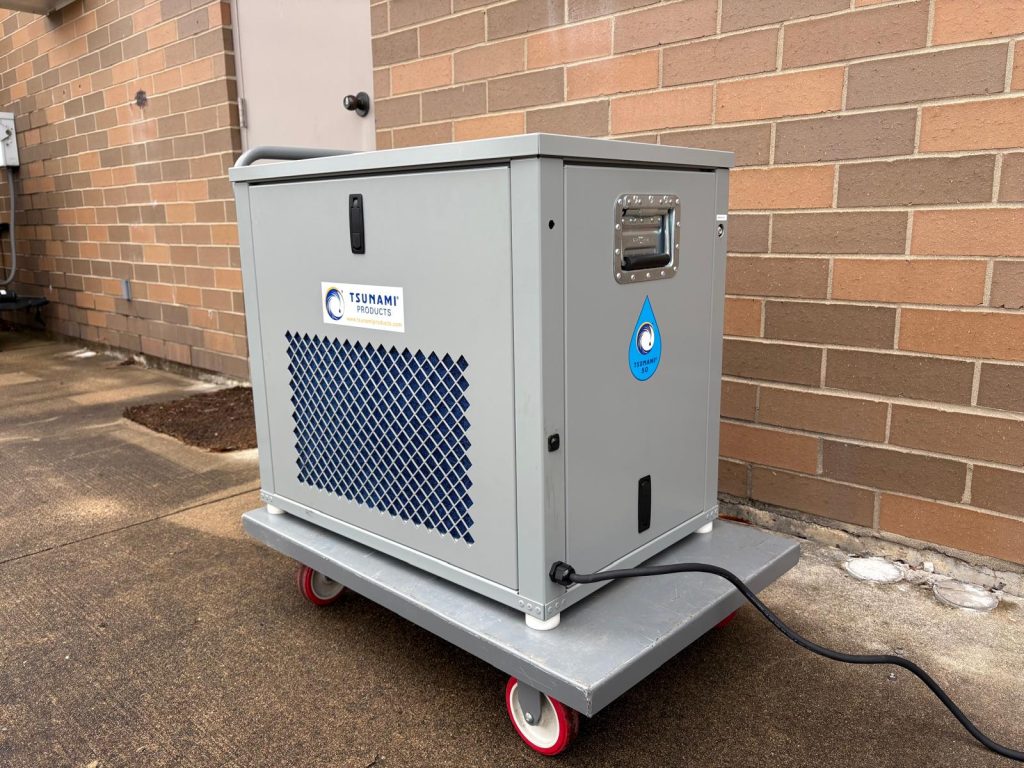
By extracting moisture from ambient air and condensing it into potable water, an AWG functions like a high-powered dehumidifier, drawing in humid air and cooling it to produce liquid water. This approach offers a viable alternative for water production in regions with limited or unreliable sources. With the capacity to produce on the order of tens of gallons of water per day, modern AWG systems could ensure a decentralized supply for small military units or even certain outpost locations, although other factors such as energy sources need to be accounted for.
In hot and humid conditions, AWGs operate most efficiently, roughly around 80°-F and 80 percent relative humidity. In these climates, the air holds abundant water vapor that a generator can readily capture. Conversely, in cool or arid environments, water yield drops sharply since the air carries less moisture. The Indo-Pacific spans a wide spectrum of climates—from tropical jungles to arid deserts, making the region an ideal testing ground for the technology’s viability.
Tropical deployments offer a double benefit of higher output and lower energy cost per gallon. This underscores the importance of energy-aware planning and considering both water yield and power supply when deploying AWG systems.
Water From Air
Recent research conducted at the Air Force Institute of Technology (AFIT) analyzed AWG output at four representative locations in the Indo-Pacific, each with a distinct climate. These included a hot desert in Western Australia, a humid subtropical area in central India, a tropical rainforest climate in the southern Philippines, and a temperate subtropical zone in southern Japan.
Using 38 years of historical weather data for these sites, along with performance measurements from a 15-gal/day unit, the study built a model to predict water generation under varied conditions. The analysis correlated key environmental factors (primarily humidity, temperature, and windspeed) with daily water yield to understand how the AWG would perform in each location. The findings confirmed that temperature and humidity are the dominant factors in system effectiveness. In hot, moisture-laden atmospheres, AWGs can produce water at a substantial fraction of their maximum capacity, whereas in dry air they struggle. For example, the tropical and coastal sites (like the Philippines and Indonesia) provided the most favorable conditions: the AWG often achieves over half of its rated output on average. In contrast, the desert location in Australia yielded only a small fraction of the device’s potential output. Average efficiency varied from under 10 percent up to nearly 70 percent of the rated capacity, depending on location.
Across all locations and seasons, average device efficiency (actual water produced versus rated capacity) ranged from roughly 9 percent in the driest conditions up to about 69 percent in the most humid periods. Seasonal swings were significant. Monsoon or wet seasons naturally boosted water production. Dry seasons and colder periods saw efficiency drop. In practical terms, an AWG in a place like the Philippines could reliably provide water almost year-round; in an arid inland spot, however, it might fall short for extended periods. Planners must account for these performance swings to ensure the availability of alternative water sources during low-yield periods.
To gauge reliability, the AFIT study examined how often an AWG would meet a modest daily demand over the decades of data. In the tropical and humid subtropical locations, a single unit could meet daily needs most of the time, indicating strong reliability. On the other hand, in the arid setting, there were frequent shortfalls, implying multiple units or supplemental sources would be necessary to ensure a continuous supply. By mapping these performance trends, the research gives planners a clear picture of where AWGs can be a dependable water source for the military and where they would require augmentation.
With the capacity to produce on the order of tens of gallons of water per day, modern AWG systems could ensure a decentralized supply for small military units or even certain outpost locations, although other factors such as energy sources need to be accounted for.
Powering Production
FIT also analyzed powering AWGs in the field. The results were encouraging: given the ample sunshine in much of the Indo-Pacific, a relatively small photovoltaic array can meet the sampled device’s needs. Depending on local sunlight levels, an array of roughly 2-m² to 4-m² of solar panels could fully power the 15-gal/day AWG for optimal output. In equatorial regions with high solar exposure (and often high humidity), even a minimal panel setup would suffice. A site with cloudier conditions or low-sunshine hours site might need a slightly larger array.
Notably, AWGs yield more water per unit of energy in humid conditions. Tropical deployments offer a double benefit of higher output and lower energy cost per gallon. This underscores the importance of energy-aware planning and considering both water yield and power supply when deploying AWG systems.

Resilient Operations
The usage of atmospheric water generation has broad implications for improving the resilience of military logistics. In an agile combat employment scenario, where forces are dispersed to austere forward bases, AWGs can serve as lifelines that reduce dependence on vulnerable supply convoys. By producing water at the point of need, they decrease the number of tanker trucks or airlift sorties required, which, in turn, lowers risk to personnel and mission. This capability is especially valuable when logistics are under stress, for instance, if an adversary is targeting supply lines or a natural disaster cuts off transportation routes. An AWG will not single-handedly sustain a large force, but as a component of a water supply network it adds redundancy and flexibility.
Enabling Deployed Forces
Investing in AWG potential is like an insurance policy for water security. These systems provide a measure of self-reliance and short-term risk mitigation in particular that can prove critical if infrastructure is damaged or resupply is delayed.
AWGs are not a silver bullet, but as part of overall water resource planning they can significantly boost the endurance and autonomy of deployed forces. When integrated into agile basing concepts, AWGs can help ensure that even in contested or resource-scarce environments, warfighters have access to the most essential of resources: water.
Environmental Factors
The local environmental conditions shape how AWGs can be used in contingency plans.
In high-humidity regions, AWGs could be deployed as primary water sources for small units or as augmentation for larger facilities. In drier regions, AWGs might be relegated to a backup role or used only during favorable seasons.
The predictive model from the AFIT research enables planners to estimate expected performance at a specific site, and decide how many units (and what backup supplies) are needed to meet expected demand.
Capt. Jose De La Serna, M.SAME, USAF, is Graduate Student, and Eric Mbonimpa, Ph.D., P.E. is Assistant Professor, Air Force Institute of Technology. They can be reached at jose.de_la_serna.1@us.af.mil; and eric.mbonimpa@us.af.mil.
Published in the July-August 2025 issue of The Military Engineer

Check Out Related Articles From TME
-

Innovative PFAS Remediation at Camp Grayling
For project stakeholders and remediation managers confronted with PFAS, Regenesis demonstrates the efficacy of using Regenesis’ PlumeStop® colloidal activated carbon (CAC) at Camp Grayling, Michigan. -
A Standardized Approach to Aircraft Fire Training Infrastructure
To support enterprise-wide airmen readiness, the U.S. Air Force is modernizing its standard design for aircraft fire training facilities—introducing digital controls, dual-fuel systems, and PFAS-conscious infrastructure. -
Delivering Energetic Materials Manufacturing Facilities
Designing and constructing facilities that manufacture, process, handle, or store explosives and energetic materials present some of the most challenging defense projects—requiring technical experience, strict safety protocols, and a comprehensive understanding of regulatory frameworks. -
Forging Tradition and Innovation: A New Design Standard at Camp Lejeune
The II MEF Headquarters at Camp Lejeune blends Georgian Revival architecture with modern sustainability—delivering durability, efficiency, and precision that meets contemporary functional requirements while honoring heritage. -

Balancing Efficiency and Fiscal Responsibility
The continuing contracts clause offers the U.S. Army Corps of Engineers a way to improve project delivery and enhance fiscal responsibility by aligning funding with project execution. -
Next Steps for Digital Twin Development
U.S. Forces Japan is laying the groundwork for future integration of digital twin technology in order to validate and collect data that will offer comprehensive insights into utility conditions at installations and enhance overall decision-making, efficiency, and resilience.