Complexities of PFAS Groundwater Interim Actions
By Col. William Myer, PG, M.SAME, USA (Ret.), and Lee dePersia
With funding from the Environmental Security Technology Certification Program and oversight by the Defense Innovation Unit, a six-month groundwater treatment pilot study at Biddle ANGB revealed key insights into managing the challenges encountered in executing non-time critical removal actions concerning per- and polyfluoroalkyl substances.
In 2015, the Air National Guard was issued a Safe Drinking Water Act administrative order as a result of contamination to residential wells downgradient from the 111th Attack Wing at Biddle ANGB, Horsham, Pa. The site, impacted by per- and polyfluoroalkyl substances (PFAS), is co-located with the former Naval Air Station Joint Reserve Base at Willow Grove, Pa., an installation closed through the Base Realignment and Closure Program, and which also has legacy PFAS groundwater impacts that has affected local residential drinking water wells. This site is on the Environmental Protection Agency’s National Priorities List.
Both the U.S. Navy and the Air National Guard are executing groundwater non-time critical removal actions. In fact, one of the Navy’s PFAS groundwater plumes has co-mingled with the National Guard’s PFAS groundwater release, which further complicates execution and regulatory coordination. As a result of the dual cleanup programs, the Air National Guard was able to capitalize on a PFAS treatment research effort/opportunity through the Environmental Security Technology Certification Program (ESTCP), overseen by the Defense Innovation Unit (DIU).
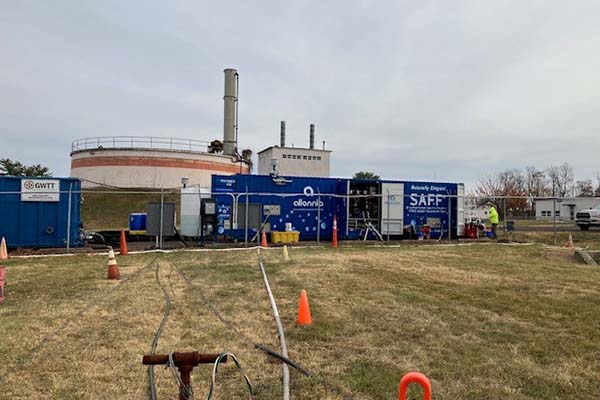
Beginning in June 2024 and through January 2025, a treatment system/technology utilizing foam fractionation groundwater developed by Allonia was conducted at Biddle. The project team identified challenges encountered by executing a groundwater non-time critical removal actions for PFAS contamination at a complex site, but also has found certain progress to date.
Legacy Contaminations
Biddle ANGB is located approximately 18-mi north of Philadelphia in Horsham Township, Montgomery County. What is now the Guard-operated installation was formerly occupied by the Navy, which had transferred 207-acres to the U.S. Air Force Reserve in 2005. As a result of deactivation in 2007, however, the Air National Guard became responsible for the land, and the official transfer of authority was completed in 2011.
Willow Grove also has two PFAS-release locations (Site 5, a former firefighting training area; and a series of facilities, including Building 680 and ground storage tanks that are immediately upgradient of Biddle). The release and PFAS groundwater plume associated with Building 680 is comingled with the PFAS release/groundwater plume from Building 201 at Biddle.
In August 2014, the Navy BRAC Office at the former Willow Grove installation confirmed the presence of PFAS in wells south and west of the installation. At the request of Region III of the Environmental Protection Agency, the Air National Guard tested samples from its drinking water production wells and identified PFAS at concentrations above federal provisional health advisory levels (70-ppt). In response, the government issued a Safe Drinking Water Act administrative order dated May 29, 2015, mandating the Air National Guard initiate a facility investigation at Biddle.
Since the issuance, a series of actions has been completed.
- Connected over 80 residents with impacted drinking water wells to a local water supply in three townships (Warrington, Horsham, and Warminster).
- Continued sampling of residential wells within the area of responsibility, and well head treatment of five production wells for the North Wales Water Authority and well head treatment of base water supply wells.
- PFAS facility investigation completed in 2018.
- PFAS surface water treatment at a retention pond on the base starting in 2018 with a temporary system and completion of a permanent 500-gpm system in August 2021.
- PFAS 30-day groundwater pilot test in November 2023.
- PFAS Phase I Remedial Investigation completed in 2024.
- DIU surface active foam fractionation pilot study (June 204 to January 2025).
- PFAS Non-Time Critical Removal Action Engineering Evaluation/Cost Analysis in August 2025.
Balancing Authorities
The Air National Guard, through negotiations with the Environmental Protection Agency and Pennsylvania Department of Environmental Protection, are in the process of transitioning to the Navy BRAC Federal Facility Agreement. As a result of the negotiations to support this move, it agreed to conduct an interim groundwater removal action at a former wash rack and Building 201 (a C-130 hangar that had a fire suppression system).
In November 2023, the Air National Guard completed a 30-day evaluation of the zone of influence in a complex hydrogeologic setting that has significant PFAS groundwater contamination. This resulted in a pilot test report that included numerical groundwater modelling, which identified a potential groundwater extraction network to support an interim groundwater action. Coordination and collaboration with Navy staff and contractors was critical to ensure that the Air National Guard’s proposed system would not interfere with or disrupt the Navy’s proposed system.
Prior to the 30-day test, the Navy was actively conducting PFAS pilots for Site 5 and Building 680. Then after the Air National Guard’s evaluation, Biddle was selected to conduct a six-month test. DIU had been tasked through the ESTCP to develop/field remediation and destruction technologies in support of an overall program to reduce significant PFAS environmental liabilities across the services. Normally, ESTCP executes the acquisitions that will field the technologies to the services; however, DIU was requested to execute the acquisitions to capitalize on its “Other Transaction Authority” capability. DIU is statutorily able to leverage Other Transaction Authority (10 USC 4022) to award prototype agreements in as few as 60 to 90 days. Additionally, vendors that execute a prototyping project to the satisfaction of the government customer and their contract commitments are awarded a Success Memo. This approval enables any federal agency to leverage the technology solution without having to recompete.
At the completion of Allonia’s pilot test, DIU issued the company a Success Memo. In addition to validating the surface active foam fractionation technology, DIU was evaluating several PFAS destruction technologies, which are still ongoing. The Air National Guard will be able to capitalize on these other destruction technologies that receive a Success Memo as part of the design.
Adjusting to Differences
Despite having two different regulatory drivers, both federal and state regulators have been supportive with their technical and regulatory reviews of the interim groundwater actions. However, the 111th Attack Wing has had some difficulties with respect to Air Force and Navy regulatory interpretations related to the National Pollutant Discharge Elimination System, which is a requirement under the Clean Water Act. This complication was identified in the effort to amend the Navy BRAC Federal Facility Agreement to include the Air National Guard and transition out the Safe Drinking Water Act administrative order.
Under the Comprehensive Environmental Response, Compensation, and Liability Act, no environmental permits are required; the installation only has to meet the substantive requirements of state regulations determined to be applicable or relevant and appropriate requirements. Yet, with the conflicting regulatory authorities, how to address a requirement of the Clean Water Act has been contentious. Each environmental statute provides different authorities to different regulators. This has led to the parties trying to find language and middle ground that is suitable for all. Finding this compromise becomes even more complicated when developing a road map to transition away from an administrative order.
Another challenge is that the public does not understand why there are separate cleanup actions for the same facility/installation. During the public comment period, the Air National Guard received comments requesting that the separate cleanup actions be integrated and executed under a single program. The Navy BRAC also received similar comments for its system.
Partners Through Progress
While the Air National Guard has encountered multiple challenges in the groundwater removal action at Biddle, the journey has spurred great synergy and collaborations with the Navy. This partnership has allowed the Air National Guard to develop a transition strategy from the administrative order to the Federal Facilities Agreement. In addition, the Air National Guard has been able to take advantage of the DIU process and have successful technologies evaluated, with the goal to incorporate them into the effort at Biddle and subsequent design work.
Although difficult at times and complex throughout, getting PFAS groundwater remediation executed is crucially important, to remove the source areas contributing to residential health risks and production well contamination.
Col. William Myer, PG, M.SAME, USA (Ret.), is Restoration Program Manager, Air National Guard; william.myer.2@us.af.mil.
Published in the January-February 2026 issue of The Military Engineer

Check Out Related Articles From TME
-

Innovative PFAS Remediation at Camp Grayling
For project stakeholders and remediation managers confronted with PFAS, Regenesis demonstrates the efficacy of using Regenesis’ PlumeStop® colloidal activated carbon (CAC) at Camp Grayling, Michigan. -
A Standardized Approach to Aircraft Fire Training Infrastructure
To support enterprise-wide airmen readiness, the U.S. Air Force is modernizing its standard design for aircraft fire training facilities—introducing digital controls, dual-fuel systems, and PFAS-conscious infrastructure. -
Delivering Energetic Materials Manufacturing Facilities
Designing and constructing facilities that manufacture, process, handle, or store explosives and energetic materials present some of the most challenging defense projects—requiring technical experience, strict safety protocols, and a comprehensive understanding of regulatory frameworks. -
Forging Tradition and Innovation: A New Design Standard at Camp Lejeune
The II MEF Headquarters at Camp Lejeune blends Georgian Revival architecture with modern sustainability—delivering durability, efficiency, and precision that meets contemporary functional requirements while honoring heritage. -

Balancing Efficiency and Fiscal Responsibility
The continuing contracts clause offers the U.S. Army Corps of Engineers a way to improve project delivery and enhance fiscal responsibility by aligning funding with project execution. -
Next Steps for Digital Twin Development
U.S. Forces Japan is laying the groundwork for future integration of digital twin technology in order to validate and collect data that will offer comprehensive insights into utility conditions at installations and enhance overall decision-making, efficiency, and resilience.