Delivering Energetic Materials Manufacturing Facilities
By Tyler Keel, P.E.
Designing and constructing facilities that manufacture, process, handle, or store explosives and energetic materials present some of the most challenging defense projects—requiring technical experience, strict safety protocols, and a comprehensive understanding of regulatory frameworks.
Military facilities that involve the manufacturing, processing, handling, or storage of energetic materials such as solid rocket motors and warheads present formidable challenges in engineering and construction. These projects demand not only technical experience but a relentless commitment to safety, meticulous planning, and a deep understanding of complex regulatory frameworks.
The stakes are exceptionally high: The ultimate measure of success is the uncompromising protection of everyone who works inside these facilities and the nearby communities.
Rigorous Requirements
A fundamental expectation for designers of these highly specialized facilities is understanding DOD 4145.26, Department of Defense Contractor’s Safety Manual for Ammunition and Explosives. Far more than a checklist, this document is a comprehensive safety framework that mandates rigorous processes, from initial planning through final facility turnover. Compliance with this manual is essential for any defense project involving energetic materials, requiring a thorough understanding of how explosives impact buildings, equipment, and personnel.
For federal properties, the manual’s requirements are enforced by the Department of Defense Explosives Safety Board, which sets strict standards for facility design and construction. On contracts fulfilled on private property, the Defense Contract Management Agency is the authority.
Proactive Approach
Taking a proactive approach to hazard identification can make or break project success. This includes evaluating flammable materials, high-risk processes, and the proximity to other industrial facilities, especially those containing similar explosive materials.
Compliance with recognized industry standards, such as those issued by the American Petroleum Institute, American Society of Civil Engineers, National Fire Protection Association, and International Organization for Standardization, yields alignment with best practices and regulatory requirements.
Before design work on these complex facilities begins, an extensive assessment of the specific energetics involved has to take place. This includes evaluating explosive properties, calculating net explosive weight, and modeling maximum credible event scenarios. A robust foundation for safety and design decisions is built on a thorough grasp of storage and handling protocols, as well as historical incident data.
Quantitative risk assessment is a cornerstone of the planning process. This hazard analysis involves detailed hazard assessments and blast modeling, providing critical insights to inform protective design measures and site layout.
Selecting the right site and obtaining necessary approvals are also key to long-term security controls. The layout must equate operational efficiency with stringent safety requirements.
To achieve this balance, three primary strategies are employed.
- Avoidance: Use quantity distance arcs to separate hazardous areas.
- Prescriptive design: Rely on preapproved designs for safety.
- Custom protective construction: Create tailored solutions based on detailed analysis and site-specific conditions.
Each of these planning and execution approaches requires rigorous documentation and close coordination with the procurement contracting officer.
Designing For Safety
In developing the design of explosives and energetic materials facilities, it is essential that the project team thoroughly understand the underlying chemistry of the operations that will be performed there. Only once the immense forces generated during potential explosions are grasped can robust safety protocols be implemented and the intricate regulatory environment that governs these high-stakes facilities be navigated.
These modern facilities incorporate fire- and blast-resistant materials, specialized wall substances, and innovative solutions such as liquid body armor and carbon nanotubes. Structural elements like high-performance laminated glass and layered concrete further enhance safety by dispersing blast energy and minimizing damage. Design principles include utilizing convex building exteriors to deflect shock waves, incorporating strategic ventilation systems to reduce pressure buildup, and avoiding reentrant corners to prevent shock wave amplification.
These measures, combined with advanced materials, create resilient structures capable of withstanding significant blast impacts.
Some facility safety features may seem basic. But they play a crucial role in reducing risks associated with electrostatic energy and electrical hazards. Lightning protection systems, whether installed on the roof or through dedicated masts, are essential for safely diverting electrical surges away from the building. Inside the facility, ordnance grounding systems help prevent the buildup of static electricity. Humidification equipment maintains optimal moisture levels to further reduce static discharge risks. Conductive flooring is also important, as it dissipates static charges and protects both personnel and sensitive equipment.
Operational safety is further enhanced by selecting equipment with nonsparking components, using explosion-proof electrical infrastructure in hazardous-rated areas, and relying on compressed air-driven tools where appropriate. While these measures may involve higher initial costs, they can significantly increase operational uptime. Adopting higher-quality solutions typically require less frequent inspection and maintenance as well, resulting in lower long-term costs and fewer disruptions.
It is important to recognize that value engineering exercises focused solely on minimizing upfront expenses may overlook these long-term advantages.
Leveraging Modern Tools
Computational tools play a transformative role in designing these mission-critical facilities. Both artificial intelligence and machine learning optimize designs by simulating various scenarios, while additive manufacturing enables rapid prototyping of structural components. Computational modeling provides precise predictions of blast effects, allowing designers to fine-tune protective measures.
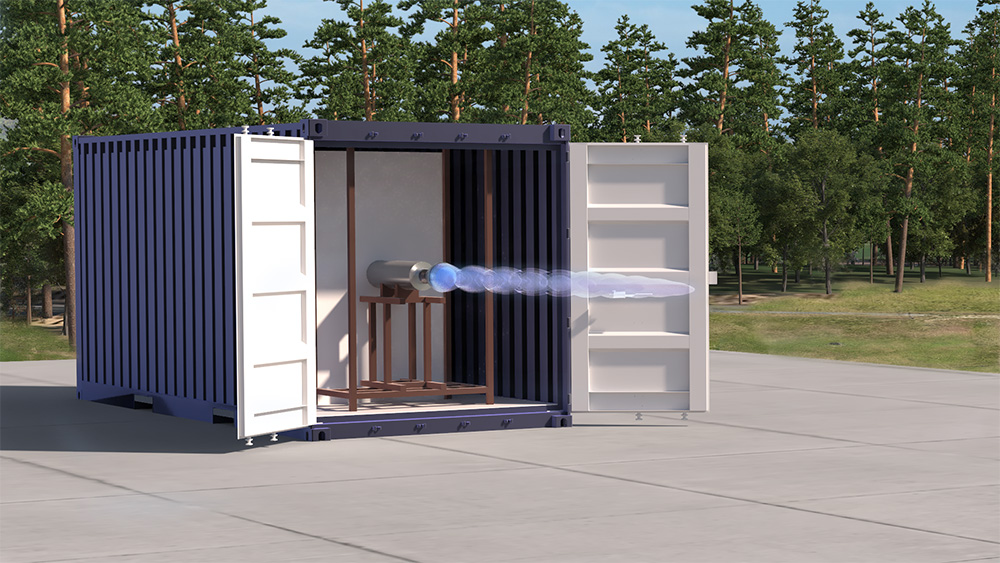
Analysis utilizing computational fluid dynamic (CFD) is an advanced analytical engineering tool that allows design teams to assess the aerodynamic and thermodynamic performance of a system prior to the start of physical construction. This kind of evaluation can be an efficient way to explore challenging and unique liquid or solid rocket test stand facility design. The performance of intended design and potential design alternatives can be explored, or a completed design can be modeled in a variety of scenarios. CFD technology enables detailed visualization of critical parameters like velocities, temperatures, and pressures at any location within the test environment, whether at the rocket itself, the blast deflectors, or inside the facility structure.
CFD can be a great benefit when pushing designs of these facilities to the limit, whether due to environmental limitations, facility space constraints, or simply grappling with the unique challenges of advanced aerospace products. This approach not only enhances confidence in the design, but also promotes faster, safer, and more cost-effective facility development.
Avoiding Project Pitfalls
Despite all the right intentions, certain mistakes can occur with surprising regularity in the design and operation of energetics manufacturing facilities. Recognizing and addressing such pitfalls early is vital to project success and safety.
- Overlooking fragmentation hazards.
- Misapplying inhabited building distance or intraline distance standards.
- Ignoring the compatibility of mixed substances.
- Failing to account for backup power requirements, such as diesel tanks.
- Failing to document distance to common utility needs.
- Locating areas in proximity to sensitive uses off campus.
Avoiding these common errors requires a thorough understanding of both regulatory requirements and the unique risks associated with each site. Diligent planning, relevant knowledge, and strict adherence to safety standards are essential for safeguarding lives and assets.
Lives, Assets, Mission
Success in explosives facility design hinges on a multidisciplinary, experienced team. From calculating blast effects to maintaining regulatory compliance, developing a balanced design results from working with subject matter leaders that prioritize security without compromising functionality.
Designing facilities for explosives is a high-stakes endeavor. Every element, from site selection to material choice, plays a crucial role in safeguarding lives, assets, and the mission. Thorough preparation and unwavering commitment to safety are not just best practices on these projects: they are nonnegotiable.
Tyler Keel, P.E., is Design-Build Project Manager – Aerospace, Space & Defense, Burns & McDonnell; tkeel@burnsmcd.com
Published in the November-December 2025 issue of The Military Engineer
Check Out Related Articles From TME
-

Innovative PFAS Remediation at Camp Grayling
For project stakeholders and remediation managers confronted with PFAS, Regenesis demonstrates the efficacy of using Regenesis’ PlumeStop® colloidal activated carbon (CAC) at Camp Grayling, Michigan. -
A Standardized Approach to Aircraft Fire Training Infrastructure
To support enterprise-wide airmen readiness, the U.S. Air Force is modernizing its standard design for aircraft fire training facilities—introducing digital controls, dual-fuel systems, and PFAS-conscious infrastructure. -
Delivering Energetic Materials Manufacturing Facilities
Designing and constructing facilities that manufacture, process, handle, or store explosives and energetic materials present some of the most challenging defense projects—requiring technical experience, strict safety protocols, and a comprehensive understanding of regulatory frameworks. -
Forging Tradition and Innovation: A New Design Standard at Camp Lejeune
The II MEF Headquarters at Camp Lejeune blends Georgian Revival architecture with modern sustainability—delivering durability, efficiency, and precision that meets contemporary functional requirements while honoring heritage. -

Balancing Efficiency and Fiscal Responsibility
The continuing contracts clause offers the U.S. Army Corps of Engineers a way to improve project delivery and enhance fiscal responsibility by aligning funding with project execution. -
Next Steps for Digital Twin Development
U.S. Forces Japan is laying the groundwork for future integration of digital twin technology in order to validate and collect data that will offer comprehensive insights into utility conditions at installations and enhance overall decision-making, efficiency, and resilience.