Delivering Water Resilience at Twentynine Palms
By Chad Weaver, P.E., David Staats, and Alissa Nadolski, CF APMP
A new wastewater treatment plant at the Marine Corps Air Ground Combat Center will enhance water reuse and sustainability in the arid environment of the Mojave Desert.
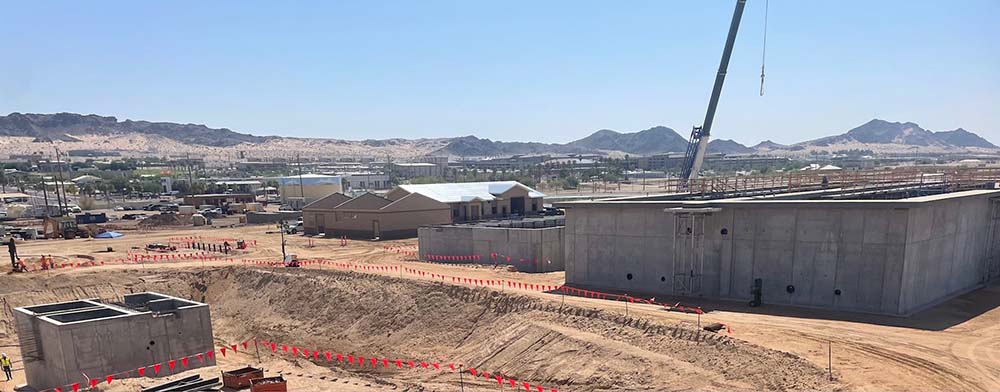
The largest air-ground combat center across the U.S. Marine Corps sits in the Mojave Desert, approximately 140-mi east of Los Angeles. Spanning 1,100-mi², Marine Corps Air Ground Combat Center, Twentynine Palms, Calif., is designed to mimic many wartime combat environments. Through expansion projects, the base has become among the largest military training centers in the nation and is supported by a population of more than 8,400 personnel and family members.
With growth comes increased demand for water, which is most scarce in the middle of a desert. Implementing modern sustainability practices to preserve what limited resources are available is an absolute necessity at Twentynine Palms, since water resources are easily depleted in such an arid environment. To meet this demand, Naval Facilities Engineering Systems Command Southwest awarded the design-build team of A&R Pacific–Garney Federal JV and Dewberry the contract to deliver a new wastewater treatment plant that supports the base’s expanded mission.
Reuse Challenges
An existing 0.75-million-gal/day lagoon system at Twentynine Palms provides chemical flocculation, clarification, and disinfection that serves some irrigation to the installation but loses substantial amounts of water to evaporation in the desert climate. Additionally, the plant, termed “Lake Bandini” locally, treats water to standards set by Title 22 Disinfected Secondary Recycled Water, which limits reuse. Problematically, the facility lacks both capacity and redundancy, with periods of high flow and equipment failures that require retention of large volumes of wastewater.
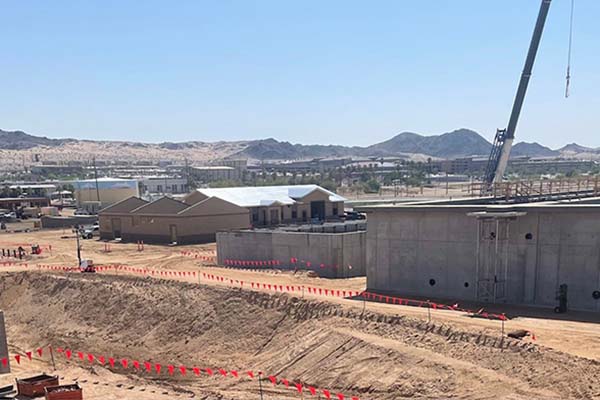
The new $155 million wastewater treatment plant will feature a 2-million-gal/day system and produce Tertiary Title 22 Disinfected Recycled Water, which can be used more broadly on the base. Once complete, the new and expanded plant will significantly increase non-potable water capacity for irrigation, vegetation, and utility systems across Twentynine Palms.
Operational Flexibility
Redundancy and resilience are central to the system’s design. Covered tanks reduce evaporation, and sludge drying beds leverage the nearby desert environment. The equipment selected has full redundancy to allow for operational flexibility. A sodium hypochlorite system minimizes external chemical deliveries, which can be a concern for secure military facilities. Sludge drying beds take advantage of the arid climate to dry solids instead of more energy-intensive digestion processes. Additionally, the recycled water storage is being converted from lagoons to covered tanks to reduce evaporation.
Given the location of Twentynine Palms in Southern California, seismic activity poses a significant risk; a fault line, in fact, runs directly near the southwest boundary of the plant. During a seismic event, water in a concrete basin creates hydrodynamic loading, increasing the demand on the concrete walls. Additionally, because these basins must hold water, it is necessary to control both natural cracking and cracking caused by seismic loading. To mitigate this risk, the plant design calls for larger reinforcement sizes and tighter spacing than a typical design. Other technical challenges include developing the design of instrumentation and controls systems to comply with cybersecurity requirements and harsh environmental conditions.
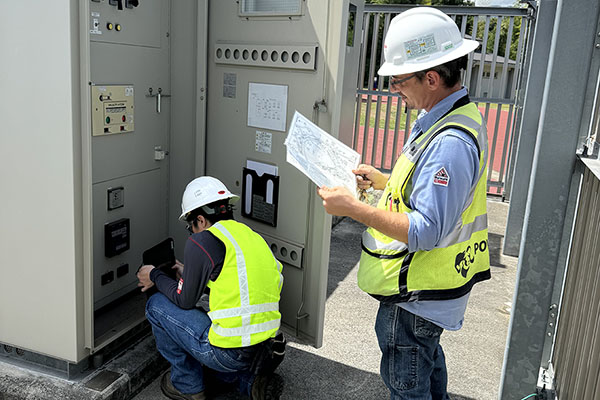
Security and Access. The majority of the treatment process, equipment, and instrumentation is positioned outdoors at locations distributed throughout the site. The new design approach balanced the operational preference of locating control panels outdoors near the driven equipment with protection and access control for more sensitive devices and electrical components.
Some process equipment is furnished as part of a package with vendor-supplied controls that commonly use programmable logic controllers and various communication protocols. These can pose a risk for unauthorized entry. Compliance with cybersecurity requirements required a case-by-case approach that considered modifying standard control panels, furnishing third-party control panels that use hardwired controls and minimal field devices, and locating select panels in conditioned and secure locations.
Successful Integration
For Twentynine Palms, design-build was selected to foster early team integration and allow for flexibility throughout the concurrent design and construction process.
Bringing together highly specialized technical resources to develop effective solutions from the onset set the team up for success, minimized cost and schedule, and allowed for the procurement of long-lead electrical material. Early coordination also enabled earthwork to begin ahead of schedule and site improvements to be addressed prior to final design completion.
The team continues to address challenges, predict future concerns, and mitigate risk. Engineers will work with the building team to review submittals, answer questions, and address concerns as they arise. The design team will remain engaged when the project nears completion in order to develop and observe a thorough startup and foster a smooth commissioning process.
Because the design-build delivery method involves selection of the design-build team and sets a firm fixed price contract value at an early stage, the contract documents establish performance requirements, including effluent water quality limits. This means the government receives a system capable of meeting treatment objectives while providing the design-build team the freedom to determine the most appropriate treatment technologies.
Mitigating Setbacks. The project at Twentynine Palms includes the operation of the treatment system during a 30-day performance verification period and the first six months after completion. The performance guarantees and operational period, however, present a potential risk to the contractor. In an effort to mitigate potential liability, the design-build team relied on proven processes and technologies, established appropriate performance guarantees for equipment vendors, and performed influent sampling to verify design assumptions. The request-for-proposal indicated a preference for an oxidation ditch design, but, importantly it also allowed for alternatives.
During proposal development, the design-build team gained approval for an alternative and more effective treatment technology: an anoxic/oxic extended aeration process. This configuration, with submersible mixers, fine bubble diffusers, and pumped internal recycle and return activated sludge systems, offers greater reliability and operational flexibility.
The team also specified performance guarantees for several equipment vendors, sharing project risk with those who best can understand and troubleshoot issues. Additionally, early water quality sampling will help verify that influent wastewater characteristics are consistent with criteria defined in the contract.
Long-Term Demands
The new wastewater treatment plant at Twentynine Palms will help meet water demands for operational and training needs in a hot, dry environment as well as apply enhanced sustainability measures.
The facility will optimize performance, increase redundancy, and support enhanced water reuse practices for decades to come.
Site-Adaptive Solution
The new wastewater treatment plant at Twentynine Palms represents a modern facility with highly innovative features.
Given the hot, dry desert environment, the design maximizes a number of water reuse opportunities.
- Headworks with mechanical bar screening and grit removal
- Influent and equalization lift stations
- 450,000-gal equalization tank
- Biotrickling filter odor control
- AO bioreactors with secondary clarifiers
- Coagulant feed and cloth media tertiary filtration
- On-site sodium hypochlorite generation and chlorine contact basins
- Two 1.5-million-gal recycled water storage tanks
- Irrigation and recycled water pump stations
- Solids handling with rotary drum thickeners and drying beds
- Process and operations buildings
Chad Weaver, P.E., is Senior Associate and Project Manager, and Alissa Nadolski,
CF APMP, is Senior Marketing Manager, Dewberry. They can be reached at cweaver@dewberry.com; and anadolski@dewberry.com

David Staats is Senior Project Manager, Garney; dstaats@garney.com.
Published in the January-February 2026 issue of The Military Engineer

Check Out Related Articles From TME
-

Innovative PFAS Remediation at Camp Grayling
For project stakeholders and remediation managers confronted with PFAS, Regenesis demonstrates the efficacy of using Regenesis’ PlumeStop® colloidal activated carbon (CAC) at Camp Grayling, Michigan. -
A Standardized Approach to Aircraft Fire Training Infrastructure
To support enterprise-wide airmen readiness, the U.S. Air Force is modernizing its standard design for aircraft fire training facilities—introducing digital controls, dual-fuel systems, and PFAS-conscious infrastructure. -
Delivering Energetic Materials Manufacturing Facilities
Designing and constructing facilities that manufacture, process, handle, or store explosives and energetic materials present some of the most challenging defense projects—requiring technical experience, strict safety protocols, and a comprehensive understanding of regulatory frameworks. -
Forging Tradition and Innovation: A New Design Standard at Camp Lejeune
The II MEF Headquarters at Camp Lejeune blends Georgian Revival architecture with modern sustainability—delivering durability, efficiency, and precision that meets contemporary functional requirements while honoring heritage. -

Balancing Efficiency and Fiscal Responsibility
The continuing contracts clause offers the U.S. Army Corps of Engineers a way to improve project delivery and enhance fiscal responsibility by aligning funding with project execution. -
Next Steps for Digital Twin Development
U.S. Forces Japan is laying the groundwork for future integration of digital twin technology in order to validate and collect data that will offer comprehensive insights into utility conditions at installations and enhance overall decision-making, efficiency, and resilience.