Empowering Decision-Making with BUILDER Dashboards
By Eli Smith, P.E.
A newly developed interactive BUILDER SMS dashboard gives military leaders the power to make faster, smarter decisions by turning complex facility condition data into easy-to-understand visuals—helping streamline planning, optimize resources, and improve readiness.
Infrastructure sustains mission readiness, at home and downrange. For the Department of Defense (DOD), where facility performance is inseparable from operational effectiveness, built assets and physical networks must be managed as a strategic priority. This calls for a seismic shift in how we collect, interpret, and apply data. We need to move from isolated technical assessments to mission-aligned intelligence.
At the center of this transformation is BUILDER Sustainment Management System (SMS). Developed by the U.S. Army Engineer Research & Development Center (ERDC), the tool has long served as a cornerstone of asset management strategy for the defense community, modeling facility degradation over time and helping asset owners predict maintenance needs and prioritize investments. BULIDER SMS is a powerful system, but whose value is often limited by the complexity of its data. Too often, the insights that BUILDER SMS generates remain locked away in dense reports, inaccessible to decision-makers. What is needed is not just better data, but a better way to interact with it.
The solution may have arrived. A recently developed dashboard interface has been designed specifically for the BUILDER SMS environment, custom-built to make data more understandable, usable, and actionable through dynamic, interactive visualization. From strategic planning to day-to-day operations, stakeholders are now able to see and shape their infrastructure story in ways that drive readiness across the enterprise.
From Data To Action
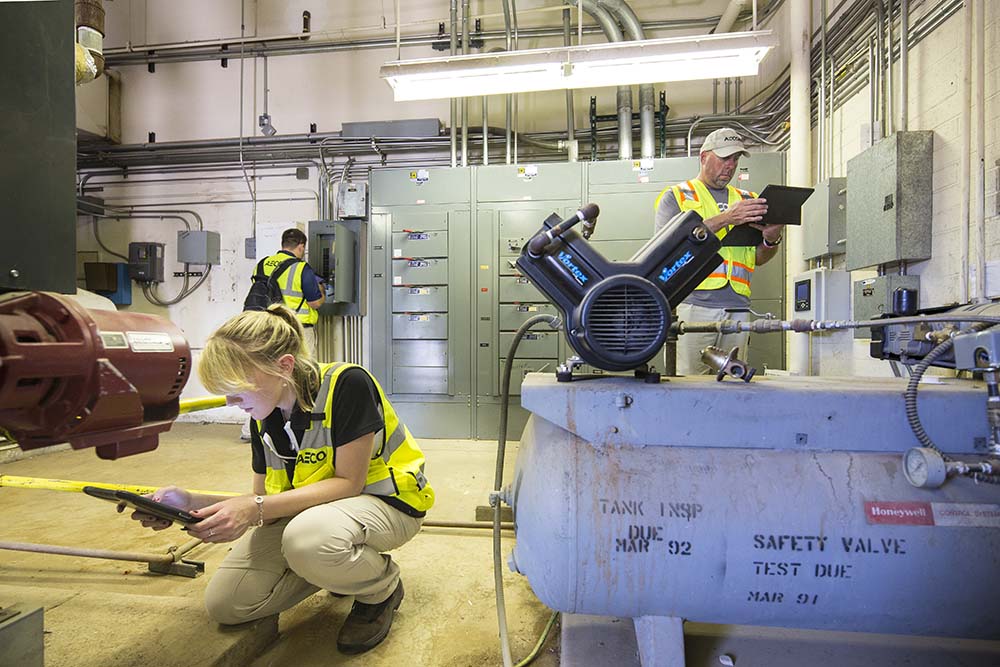
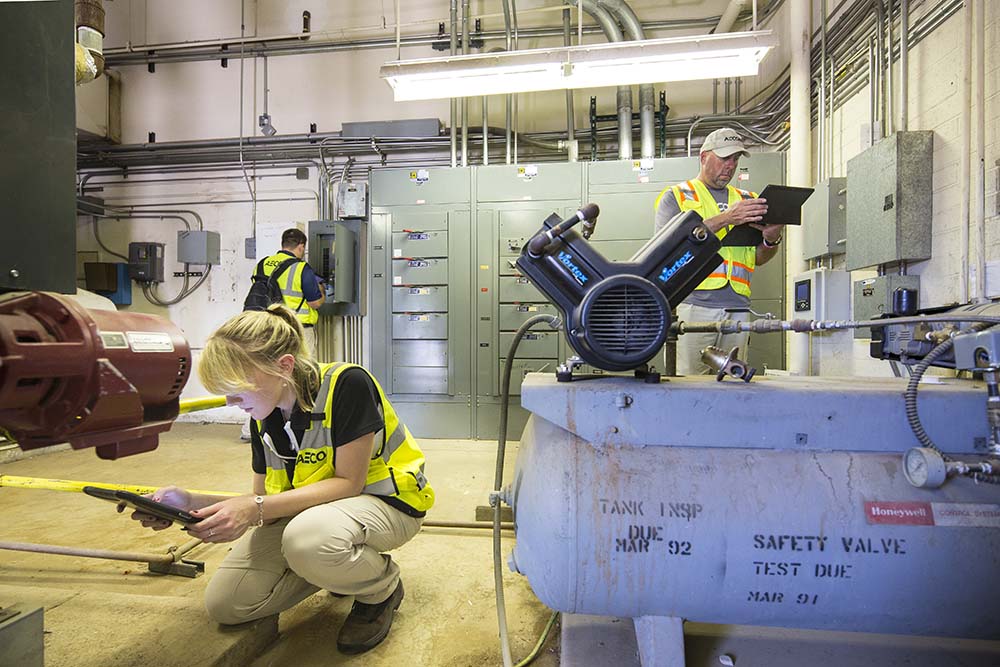
BUILDER SMS excels at collecting and modeling facility data. Its outputs, however, often remain underutilized due to the difficulty of interpretation. Engineering assessments, condition indices, and component breakdowns are highly technical outputs. For site planners, executive leaders, or even installation commanders without a background in facility management or data analytics, understanding and acting on these insights can be daunting.
As government organizations accumulate years of data, the challenge compounds. What should be a strategic asset becomes a sprawling, under-navigated repository. The result is fragmented communication, inconsistent prioritization, and missed opportunities to optimize investment strategies across portfolios.
To fully harness its value, BUILDER SMS requires an interactive interface that empowers stakeholders of all levels to explore and analyze data through multiple lenses.
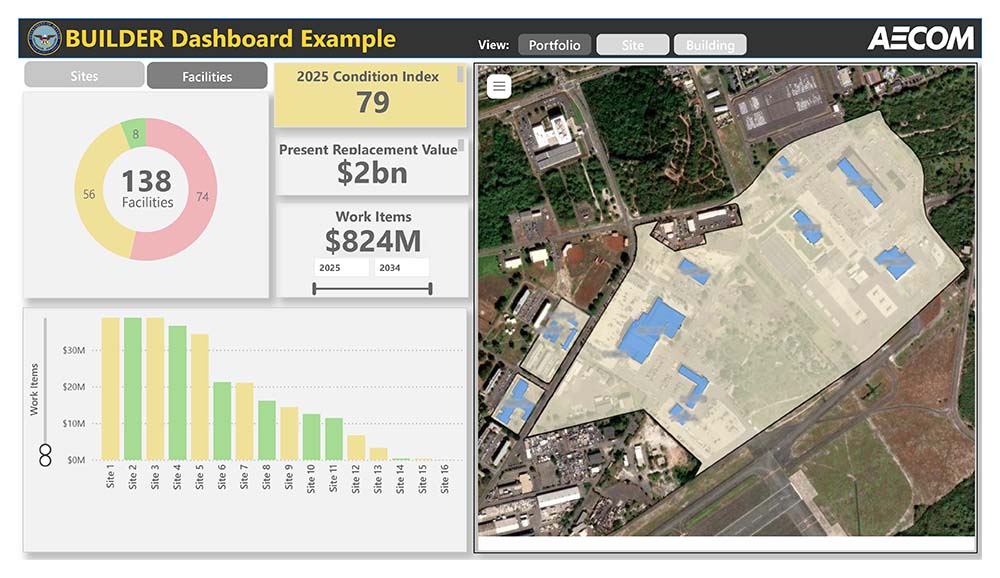
The new BUILDER SMS dashboard, developed by AECOM, represents a critical evolution in how facility data is accessed, understood, and acted on. Instead of parsing static reports or interpreting spreadsheets, users interact with visual representations of their assets at the portfolio, installation, site, or building level. The dashboard is able to function as an intuitive front-end for the highly analytical BUILDER SMS engine—transforming raw data into strategic intelligence.
More than just visual aids, the dashboard empowers actionable decisions: it provides real-time access to facility condition trends, deferred maintenance burdens, and building component insights. The new tool fosters collaboration among engineers, financial planners, and command leadership, making certain that everyone speaks the same language of infrastructure readiness.
To fully harness its value, BUILDER SMS requires an interactive interface that empowers stakeholders of all levels to explore and analyze data through multiple lenses.
Interactive Integration
Importantly, the dashboard does not stand alone, but integrates directly with the BUILDER SMS engine. By tapping into the management system’s authoritative data, the dashboard verifies continuity, data integrity, and auditability while introducing a dramatically improved user experience.
The interactive dashboard is designed to work with BUILDER SMS outputs, providing visualization and decision-support capabilities without altering or storing client data. BUILDER remains the system of record. All data access and control stay with the client. This approach reinforces DOD’s data governance protocols, ensuring that potentially sensitive facility information is managed exclusively within the client’s own secure systems.
The integration eliminates the need for duplicative workflows or separate tools. Visualizations are dynamic, accurate, and directly reflect the most current BUILDER SMS assessment outputs. Whether embedded in capital planning sessions, maintenance scheduling, or executive briefings, the dashboard enhances every stage of asset lifecycle management.
The tool is also scalable. Whether supporting a single installation or an enterprise portfolio, the dashboard adapts. Users maintain visibility across a system or can drill into detail where needed.
Designed For Impact
Effective visualization is not just about aesthetics. The dashboard makes BUILDER SMS data more usable and impactful for all stakeholders, regardless of their technical background. Rather than overloading users with complexity, it surfaces what matters most, at the right level, for the right decision, at the right time.
Each layer of the dashboard (portfolio, site, and building) caters to distinct roles. This flexibility fosters unified discussions across departments and promotes alignment around shared priorities.
- A base commander can gain enterprise-wide visibility into trends and readiness risks.
- Facility engineers can drill into system-level conditions and prioritize interventions.
- Planners and budget officers evaluate cost scenarios against mission needs.
Since its introduction, the interactive dashboard has supported faster planning cycles, improved coordination, and more effective advocacy for funding. Maintenance teams now target urgent needs with greater precision. Leadership can engage with the data through intuitive visuals that tell a strategic story.
Decision-Support Ecosystem
Users can leverage the BUILDER SMS dashboard to interact with generated outputs such as simulated funding scenarios and building-level work item recommendations. While these features allow stakeholders to assess the long-term impacts of investment decisions and prioritize maintenance with greater clarity and confidence, further advancements are ahead.
The future lies in expanding the decision-support ecosystem around BUILDER SMS, layering in predictive analytics, integrating data from complementary sustainment systems, and embedding artificial intelligence into the dashboard experience.
Imagine an environment where users can receive predictive alerts for emerging maintenance needs, instantly simulate funding scenarios across entire portfolios, score facilities based on mission-critical readiness and operational risk, and automatically generate capital planning recommendations based on real-time conditions and priorities.
Each of these enhancements builds on BUILDER SMS’s robust data engine, reinforcing a central truth: data only creates value when it drives action. By transforming data into dynamic, intuitive insights, BUILDER SMS becomes the center of a living, evolving, mission-aligned infrastructure intelligence platform.
Too often, the insights that BUILDER SMS generates remain locked away in dense reports, inaccessible to decision-makers. What is needed is not just better data, but a better way to interact with it.
Visualizing Strategic Readiness
The BUILDER SMS dashboard illustrates what is possible when technical depth meets thoughtful design. By transforming a complex dataset into an interactive, user-centered platform, the tool has expanded the reach and impact of BUILDER SMS across DOD.
More than just a reporting upgrade, the dashboard represents a shift toward smarter, mission-aligned infrastructure management.
DOD’s facilities house our warfighters, store critical equipment, power networks and systems, sustain operations, and serve as projection platforms. By investing in ways to further leverage BUILDER, the outcome is a culture of collaboration, agility, and accountability, where every user, from the field to the Pentagon, can engage with the data and make decisions that matter.
Meeting Needs & Challenges
Developing the new interactive dashboard for BUILDER SMS revealed several key practices for successfully translating data into action. These principles set the foundation for a dashboard that addresses today’s needs while remaining adaptable to tomorrow’s challenges.
- Design for the user: Every element of the interface should serve a purpose and speak directly to user needs.
- Build on trusted systems: Integrating with BUILDER reinforces credibility, minimizes redundancy, and preserves institutional knowledge.
- Emphasize clarity over complexity: Prioritize insights over information; focus users on the “so what?”
- Enable feedback loops: Involve end-users early and often to refine utility and usability.
- Plan for scale: A flexible, modular design allows the solution to grow with changing portfolios and requirements.
Eli Smith, P.E., is BUILDER SMS Program Manager – Asset Management, AECOM;
elias.smith@aecom.com.
Published in the September-October 2025 issue of The Military Engineer
Check Out Related Articles From TME
-

Innovative PFAS Remediation at Camp Grayling
For project stakeholders and remediation managers confronted with PFAS, Regenesis demonstrates the efficacy of using Regenesis’ PlumeStop® colloidal activated carbon (CAC) at Camp Grayling, Michigan. -
A Standardized Approach to Aircraft Fire Training Infrastructure
To support enterprise-wide airmen readiness, the U.S. Air Force is modernizing its standard design for aircraft fire training facilities—introducing digital controls, dual-fuel systems, and PFAS-conscious infrastructure. -
Delivering Energetic Materials Manufacturing Facilities
Designing and constructing facilities that manufacture, process, handle, or store explosives and energetic materials present some of the most challenging defense projects—requiring technical experience, strict safety protocols, and a comprehensive understanding of regulatory frameworks. -
Forging Tradition and Innovation: A New Design Standard at Camp Lejeune
The II MEF Headquarters at Camp Lejeune blends Georgian Revival architecture with modern sustainability—delivering durability, efficiency, and precision that meets contemporary functional requirements while honoring heritage. -

Balancing Efficiency and Fiscal Responsibility
The continuing contracts clause offers the U.S. Army Corps of Engineers a way to improve project delivery and enhance fiscal responsibility by aligning funding with project execution. -
Next Steps for Digital Twin Development
U.S. Forces Japan is laying the groundwork for future integration of digital twin technology in order to validate and collect data that will offer comprehensive insights into utility conditions at installations and enhance overall decision-making, efficiency, and resilience.