Expanding a Sacred Legacy at Arlington National Cemetery
By Isabel Peña Alfaro
The design for Arlington National Cemetery’s Southern Expansion focused on seamlessly integrating the project with the historic site’s landscape, increasing burial capacity, and enhancing accessibility, resilience, and security.
Arlington National Cemetery, just outside Washington, D.C., is a place of solemn remembrance, where families lay loved ones to rest and the nation honors its military veterans for their service and sacrifice. It is a living landscape where history, honor, and reflection converge.
For the cemetery to continue fulfilling its mission for generations to come, expanding the site, already 640-acres, is essential. The ongoing Southern Expansion will help extend the life of the cemetery well into the future while enhancing the visitor experience and preserving the site’s iconic character.
This project will add much-needed capacity and support ongoing operations, but it also needed to blend into the historic fabric of the cemetery and enhance resilience and accessibility. The architectural vision, completed by HNTB as the designer of record, aims to do just that. According to Karen Durham-Aguilera, SES, Executive Director of the Office of Army Cemeteries and Army National Military Cemeteries, the work overall “reflects a commitment to honor those who are currently laid to rest here and to ensure Arlington National Cemetery will continue to represent the military service and sacrifice of future generations.”
Preserving History
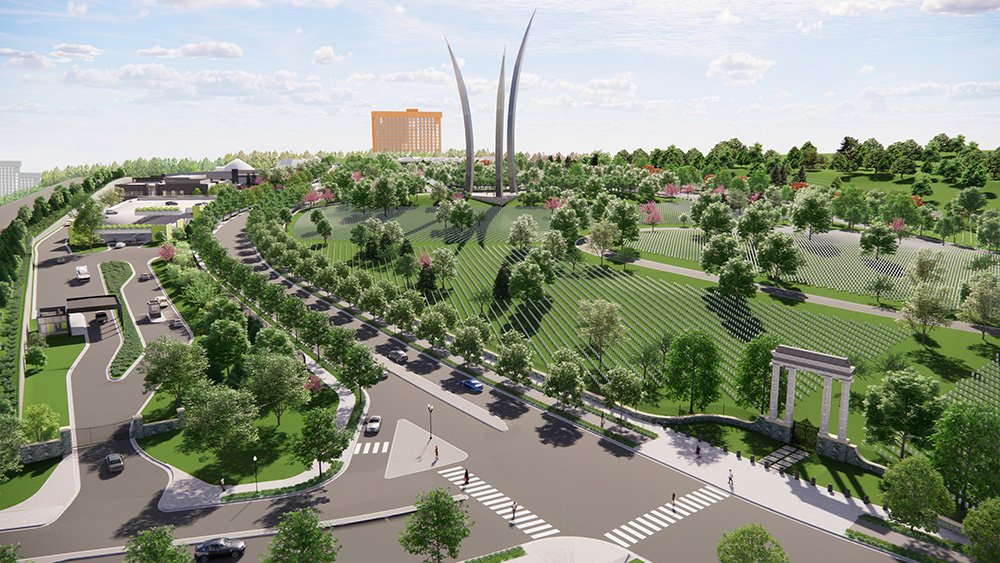
As visitors make their way through Arlington National Cemetery, situated adjacent to the Potomac River overlooking the nation’s capital, it is the quiet dignity of the landscape that leaves a lasting impression: gentle slopes, orderly rows of headstones, and a sense of reverence. The Southern Expansion builds on this timeless legacy, preserving the cemetery’s iconic rolling hills while thoughtfully enhancing the experience for every person who comes to pay their respects.
The expansion project will add more than 80,000 new interment opportunities. These include traditional casketed burials, in-ground cremated remains, and above-ground columbarium courts. The complex infrastructure initiative requires the reconfiguration of roadways, advanced drainage systems, site balancing, and significant earthwork. All of this must be executed with precision alongside the operational cemetery, where daily services and visits continue uninterrupted year-round and thousands of America’s fallen are laid to rest.
The design of the expansion was driven by a commitment to the full burial ceremony, an experience that captures the arrival and procession, the service itself, military funeral honors, and moments of condolence. This holistic focus reinforces a central principle: cemeteries are ultimately for the living. That understanding has guided the incorporation of the burial ritual into every aspect of Arlington expansion’s design.
Increasing Accessibility
Accessibility is at the heart of the new design. Features such as widened sidewalks, integrated pathways, and careful grading ensure all visitors, including those with mobility challenges, can move through the site with dignity and ease.
The expansion also integrates the existing Air Force Memorial with the cemetery grounds, enhances transit and accessibility along Columbia Pike (SR 244), and introduces a new operations complex. The new, purpose-built operations facility, connected to the cemetery by an underground tunnel and dedicated roadway, will preserve and optimize contiguous land use.
Ensuring Endurance
Details in the Southern Expansion, from site layout to granite selection, were made with durability, resilience, and sustainability in mind. The project team approached the design with a shared core principle: this space must have a long future and function seamlessly every day. Some who travel to the cemetery may only be able to attend the cemetery once, for the burial ceremony; taking that into account gives the designers the appreciation to make sure the site is welcoming and usable at all times.
Resiliency features are woven throughout. Headstones are precisely located using GIS technology to ensure accurate tracking. Soil scientists were engaged to help maintain soil integrity during extreme weather events, with the benefit of reducing erosion and safeguarding the site’s landscape for future generations. Given that the cemetery is also an active installation, security was carefully integrated into the design. The team collaborated closely with military security personnel to ensure the site remains safe while preserving its welcoming and reflective atmosphere for visitors and families.
Designing Character
Beyond pathways and processions, the expansion project at Arlington embraces the living landscape that defines the cemetery’s character. Landscape architects worked hand-in-hand with horticulturists to create a plan that not only maintains the site’s serene beauty but strengthens it. Native and resilient plant species were carefully chosen to thrive in the region’s climate, while a custom soil blend and advanced drainage system support both sustainability and long-term health of the grounds.
Every design decision—down to the strategic placement of preset crypts—was made to preserve the site’s calm, contemplative atmosphere, and to uphold its Level III Arboretum status.
Collaborative Effort
The Southern Expansion is the result of an extraordinary level of coordination between federal, state, and local entities, united by a shared commitment to honoring service and preserving legacy. The project team includes the Army National Military Cemeteries, U.S. Army Corps of Engineers, U.S. Air Force, Federal Highway Administration (FHWA), Virginia Department of Transportation, Arlington County, the Pentagon 9/11 Memorial Fund, and others.
Additionally, to create the contiguous space needed for the expansion, the first phase of work began with the Defense Access Roads Project, managed by FHWA. This project focused on realigning local roads and utilities. It also introduces multimodal transportation features such as widened sidewalks and dedicated bike lanes, enhancing safety and accessibility for pedestrians and cyclists. Together, these improvements safeguard the cemetery’s legacy while making space for generations to come, ensuring that utility relocations and roadway enhancements support the cemetery’s evolving mission.
The collaborative environment on this expansion project has enabled the team to effectively address anticipated concerns as well as unforeseen challenges. A key focus was integrating the Air Force Memorial into the program in a way that felt intentional and cohesive, as if the two sites had always been adjoined. The team’s strong communication and trust proved essential in navigating unexpected issues, such as discovering uncharted utility lines near the Pentagon or managing extended material lead times. These obstacles required adaptive planning and deep coordination across the multiple agencies involved.
This unified approach has not only enabled progress on a complex and sensitive site, but also underscores the deep sense of shared purpose driving each decision.
Honored and Remembered
The phased construction plan for the Arlington expansion was developed with an eye toward the distant future as much as for those who will visit in the coming decades The master plan is thinking 50 to 100 years ahead, anticipating how developments later on will interact with today’s work.
Through innovative design, seamless interagency collaboration and meticulous attention to detail, the Southern Expansion ensures that Arlington National Cemetery remains a timeless place where sacrifice is honored and remembered, always.
Isabel Peña Alfaro is Writing Consultant (in support of HNTB); isabel@ipenaalfaro.com.
Published in the November-December 2025 issue of The Military Engineer

Check Out Related Articles From TME
-

Innovative PFAS Remediation at Camp Grayling
For project stakeholders and remediation managers confronted with PFAS, Regenesis demonstrates the efficacy of using Regenesis’ PlumeStop® colloidal activated carbon (CAC) at Camp Grayling, Michigan. -
A Standardized Approach to Aircraft Fire Training Infrastructure
To support enterprise-wide airmen readiness, the U.S. Air Force is modernizing its standard design for aircraft fire training facilities—introducing digital controls, dual-fuel systems, and PFAS-conscious infrastructure. -
Delivering Energetic Materials Manufacturing Facilities
Designing and constructing facilities that manufacture, process, handle, or store explosives and energetic materials present some of the most challenging defense projects—requiring technical experience, strict safety protocols, and a comprehensive understanding of regulatory frameworks. -
Forging Tradition and Innovation: A New Design Standard at Camp Lejeune
The II MEF Headquarters at Camp Lejeune blends Georgian Revival architecture with modern sustainability—delivering durability, efficiency, and precision that meets contemporary functional requirements while honoring heritage. -

Balancing Efficiency and Fiscal Responsibility
The continuing contracts clause offers the U.S. Army Corps of Engineers a way to improve project delivery and enhance fiscal responsibility by aligning funding with project execution. -
Next Steps for Digital Twin Development
U.S. Forces Japan is laying the groundwork for future integration of digital twin technology in order to validate and collect data that will offer comprehensive insights into utility conditions at installations and enhance overall decision-making, efficiency, and resilience.