Forging Tradition and Innovation: A New Design Standard at Camp Lejeune
By Lt. Col. Roy Selvidge, AIA, LEED AP, M.SAME, USA (Ret.), and Jennifer Anne Dillon, M.SAME
The II MEF Headquarters at Camp Lejeune blends Georgian Revival architecture with modern sustainability—delivering durability, efficiency, and precision that meets contemporary functional requirements while honoring heritage.
Like most forms of classical architecture, Georgian Revival relies heavily on standards along with strict adherence to proportion. Violate those principles or ratios, and it is immediately apparent. While a user or passerby may not know the rules as to why, they know something is off.
Located along the Atlantic Ocean on the south-central coast of North Carolina, Camp Lejeune has several examples of Georgian Revival on the base, which was first constructed in 1941, including the beautiful and historic building at Hospital Point that housed II Marine Expeditionary Force (MEF). Unfortunately, Camp Lejeune also suffers from a few buildings, many of them modern, that were intended to be Georgian Revival, but do not measure up, due to poor materials choices, lack of adherence to proportions and ratios, or that they are out of scale compared to historic structures like Building 1 or Hospital Point.
When a request-for-proposal was issued to build a new headquarters for MEF, the solicitation included a mandate to design and construct a facility that reflected the base standard of masonry construction and Georgian Revival architecture. However, that was not the only stipulation. The request called for mission-critical requirements and a tight timeline, requiring a close attention to detail to deliver a facility reflecting the values, tradition, and innovation central to the U.S. Marine Corps.
Throughout, the project remained on schedule and within budget, an achievement made possible by precast systems, early contractor involvement, and disciplined project management.
Masonry Sourcing
The new building, P1800, would need rigid discipline from the selected design team. The masonry requirement was a particularly noteworthy risk due to the tight construction timeline and lack of masons in the greater geographic area. To meet the schedule, the work would require multiple masonry sub-contractors, a reality that would have increased both cost and complexity. In preparing a response to the request-for-proposal, LS3P and Walsh Federal looked for alternative solutions to meet the project requirements while reducing the specific need for masons. While several options were considered, insulated precast concrete panels with embedded thin brick quickly emerged as the clear solution.
Partnering with Gate Precast during the proposal phase, LS3P/Walsh developed a panel system and approach that allowed not only the masonry look and feel of brick and stone but also larger masonry unit sizes typical of cut stone, which would otherwise be unaffordable within the budget. In addition, due to the plasticity of the concrete, it could be used for reveals, headers, sills, and varying orders of building elements for no additional cost as long as it was worked within the plane of concrete panel limits.
Standard and Scaled
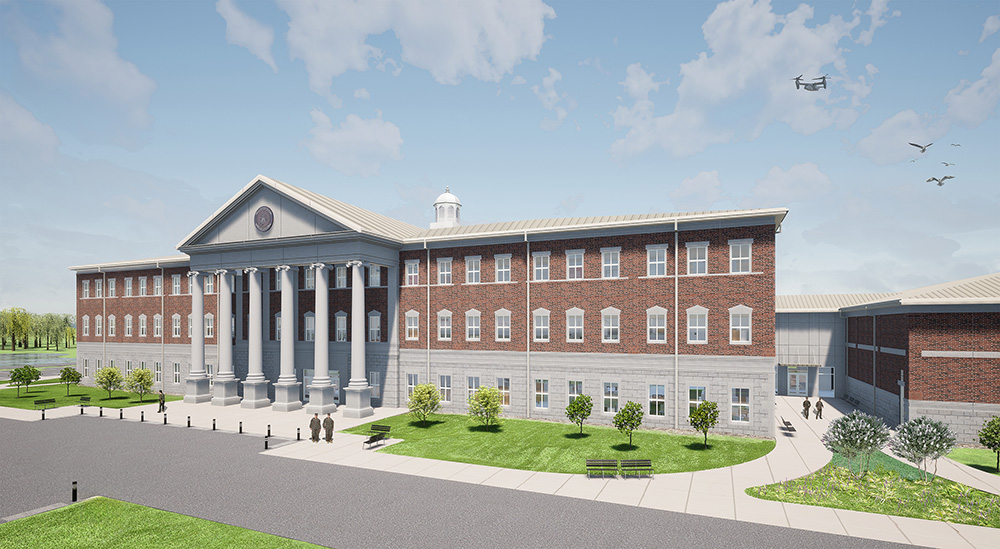
Work got underway to develop a concept, pulling out the reference standards to ensure that Georgian Revival aesthetics and proportions were maintained. The team established a design based on historical precedents but scaled it so that it worked with the large volume of the building. Typically, Georgian Revival civic buildings are between 10,000-ft² and 25,000-ft². In contrast, the II MEF Headquarters would be significantly larger at approximately 180,000-ft². This meant that elements had to be scaled to match the proportions of the building while staying proportional to the human form as well. To do this, LS3P pulled the training component of the request-for-proposal into a separate, more subdued structure and kept the focus on the main facility by creating a tiered structure with a stone blockwork first story topped by two stories of brick. In the design, the center was pulled forward with additional detailing. A pediment with flanking wings maintains the dress right dress order as the windows march down to the right and left as the building faces the parade ground to its front.
This visual concept, not unlike the current Hospital Point building, was presented at the charrette, where a collaborative, narrative-driven process engaged stakeholders and ensured that the final specifications and plan met technical requirements and resonated with the base’s cultural and institutional values.
Pivoting With Changes
After acceptance at the charrette, it was decided that a building with a projected colonnade was desired—an element that was not included in the original design or budget. Through partnership with the agency of record, Naval Facilities Engineering Systems Command Mid-Atlantic (NAVFAC MIDLANT), additional funding was allocated to enhance the design and update the scope following this new direction. The team again cracked the books to ensure the design stayed consistent and in proportion. The building façade was modified to include a raised colonnade with a pediment, complemented by additional stylistic enhancements. Staying consistent with proportions was important. The original desire to use Doric order columns was set aside for Ionic, as the shorter Doric order was not slender enough to match the proportions of the large, three-story building.
For a building that has to remain operational under any circumstance (and Lejeune has endured significant weather events over the decades, most recently in 2018 caused by Hurricane Florence), the added durability brought meaningful reassurance to the staff inside and will enhance readiness for II MEF into the future.
Material Benefits. LS3P/Walsh looked at multiple materials for the column and pediment pricing and selected precast for its durability, authenticity, and cost-effectiveness. This approach maintained material consistency and helped guarantee uniform weathering. The use of insulated precast panels also meant that a superior thermal mass wall assembly was being provided, which allowed for a tight, easy to seal building envelope, contributing to energy efficiency, thermal comfort, and long-term durability. This will help meet sustainability goals and reduce operating costs.
The durability of the concrete skin provided added force protection and hurricane resistance properties as well. For a building that has to remain operational under any circumstance (and Lejeune has endured significant weather events over the decades, most recently in 2018 caused by Hurricane Florence), the extra durability brought meaningful reassurance to the staff inside and will enhance readiness for II MEF into the future.
Integrated Teamwork. The partnership between LS3P, Walsh Federal, and Gate Precast, working in support to NAVFAC MIDLANT, exemplified the benefits of integrated project delivery. Early coordination enabled design optimization, cost control, and schedule alignment. Off-site fabrication accelerated assembly and minimized weather-related delays. The controlled manufacturing environment delivered consistent quality and reduced on-site labor risks.
Throughout, the project remained on schedule and within budget, an achievement made possible by precast systems, early contractor involvement, and disciplined project management.
Stature, Outside and In
The building’s classical form and material authenticity reinforce the identity and mission of the Marine Corps. The II MEF Headquarters stands as a dignified presence on a storied military installation and reflective of the stature of the institution it serves.
The discipline to maintain classical order, the taller proportion of windows and openings, and the crisp lines of the building reflect, in built form, the ethos of the Marines who will call it theirs for the next 50 years and beyond. Overall, the design reinforces the Georgian Revival aesthetic of Camp Lejeune and establishes a successful precedent for future structures on the base—serving as a reminder to what is possible when architecture is guided by purpose and executed with precision.
Lt. Col. Roy Selvidge, AIA, LEED AP, M.SAME, USA (Ret.), is Federal Marker Leader
and Principal, and Jennifer Anne Dillon, M.SAME, is Federal Marketing Manager, LS3P. They can be reached at royselvidge@ls3p.com; and jenniferdillon@ls3p.com.
Published in the November-December 2025 issue of The Military Engineer
Check Out Related Articles From TME
-

Innovative PFAS Remediation at Camp Grayling
For project stakeholders and remediation managers confronted with PFAS, Regenesis demonstrates the efficacy of using Regenesis’ PlumeStop® colloidal activated carbon (CAC) at Camp Grayling, Michigan. -
A Standardized Approach to Aircraft Fire Training Infrastructure
To support enterprise-wide airmen readiness, the U.S. Air Force is modernizing its standard design for aircraft fire training facilities—introducing digital controls, dual-fuel systems, and PFAS-conscious infrastructure. -
Delivering Energetic Materials Manufacturing Facilities
Designing and constructing facilities that manufacture, process, handle, or store explosives and energetic materials present some of the most challenging defense projects—requiring technical experience, strict safety protocols, and a comprehensive understanding of regulatory frameworks. -
Forging Tradition and Innovation: A New Design Standard at Camp Lejeune
The II MEF Headquarters at Camp Lejeune blends Georgian Revival architecture with modern sustainability—delivering durability, efficiency, and precision that meets contemporary functional requirements while honoring heritage. -

Balancing Efficiency and Fiscal Responsibility
The continuing contracts clause offers the U.S. Army Corps of Engineers a way to improve project delivery and enhance fiscal responsibility by aligning funding with project execution. -
Next Steps for Digital Twin Development
U.S. Forces Japan is laying the groundwork for future integration of digital twin technology in order to validate and collect data that will offer comprehensive insights into utility conditions at installations and enhance overall decision-making, efficiency, and resilience.