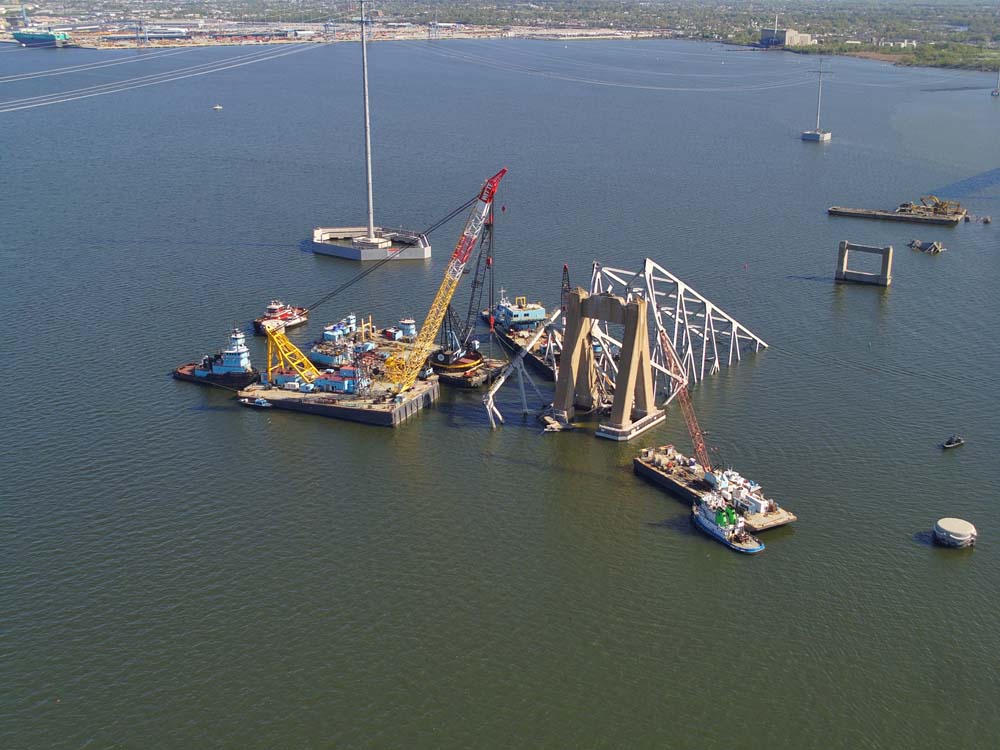
Unified in Response: The Historic Salvage Operation of the Francis Scott Key Bridge
By Col. Francis Pera, USA
When the Francis Scott Key Bridge collapsed after being struck by a massive container ship in the overnight hours of March 26, 2024, an extensive multi-agency salvage and recovery effort cleared the federal navigation channel and restored access to the Port of Baltimore in just 76 days.
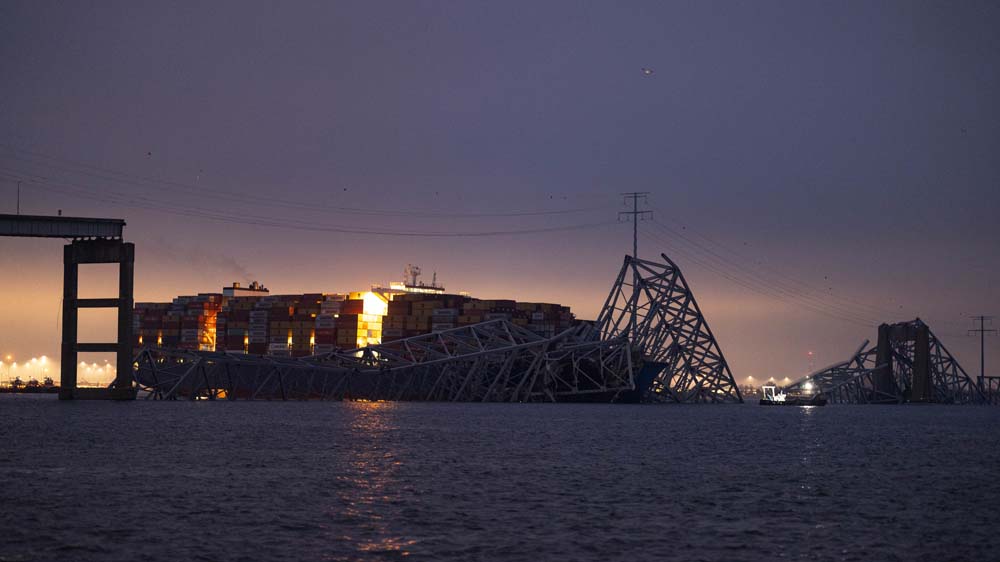
In the early morning of March 26, 2024, the M/V DALI collided with the Francis Scott Key Bridge outside the Port of Baltimore, sending the main span crashing into the Fort McHenry Channel and tragically resulting in the deaths of six maintenance workers who had been conducting road repairs.
The Baltimore District of the U.S. Army Corps of Engineers (USACE), in its statutory role that includes maintaining 290-mi of federal channels, delivers vital engineering solutions in collaboration with local, state, and federal partners to serve and strengthen the nation, energize the economy, and reduce disaster risks. That fateful day in March 2024, and throughout the tumultuous weeks and months afterward, USACE set out to accomplish that exact mission.
The Fort McHenry Channel is operated and maintained by USACE Baltimore District. Authorized by Section 101 of the Rivers and Harbors Act of 1958 and the Water Resources Act of 1996, the passage is regularly surveyed and dredged to an authorized depth of 50-ft and a minimum width of 700-ft. The channel provides safe and efficient navigation through the Port of Baltimore, the ninth busiest port in the country for international cargo, and the 17th largest port overall. Following the impact of the M/V DALI, almost 1-mi of the 80-ft wide bridge crumbled and collapsed within seconds. An immense section measuring approximately 500-ft long, 80-ft wide, and weighing as much as 600-T, fell onto the DALI’s bow, pinning the ship to the bottom of the channel. With the waterway blocked and no route for ships to pass through the Port of Baltimore, a catastrophic ripple in economic impact was created instantaneously both across the Mid-Atlantic and throughout the nation. All the while, six families grieved the loss of loved ones, whereabouts unknown.
Immediate Mobilization
In the immediate response to the bridge collapse, Baltimore District activated its Emergency Operations Center. This allowed engineering, construction, contracting, and operation specialists to begin to strategize the complex clearing of wreckage and debris alongside the Unified Command. Additionally, an existing interservice agency agreement with the U.S. Navy’s Supervisor of Salvage and Diving (SUPSALV) cleared the way to mobilize extensive high-level resources, including salvage expert contractor Donjon Marine Co.
More than 350 uniformed personnel and civilian workers from a group of 56 federal, state, and local agencies deployed to Baltimore. The Unified Command consisted of six agencies and organizations: USACE, U.S. Coast Guard, Maryland Department of the Environment, Maryland Transportation Authority, Maryland State Police, and Witt O’Brien’s, representing Synergy Marine. This vast team, totaling over 1,200 people, also consisted of an additional 553 contract specialists serving in a variety of jobs related to activities such as dive, crane, and vessel control.
A trio of concurrent salvage operation priorities were established by Unified Command in the early days of the response mission. These needed to be met in order to restore the Port of Baltimore to normal operations at the initial stage of response.
- Priority One: Clear the Channel (the Federal Channel and then Priority 1A, the Limited Access Channel)
- Priority Two: Refloat the Vessel (Moving the M/V DALI out of the Federal Channel)
- Priority Three: Remove the Remaining Wreckage
Unified Command also remained laser-focused on recovering those lost during the collapse, with a goal of the dignified return of the victims interwoven into operational planning and execution.
USACE contributed a range of technical expertise and abilities to the Unified Command in support of accomplishing the three standing priorities (clear the channel, refloat the DALI, and remove the remaining wreckage). Other capabilities the agency provided included certified underwater assessments, structural engineering, urban search and rescue, bridge inspections, contract support, and waterway wreckage management. These all were facilitated by advanced hydrographic and topographic sonar tools on a fleet of highly specialized survey vessels.
Aligning Data Streams
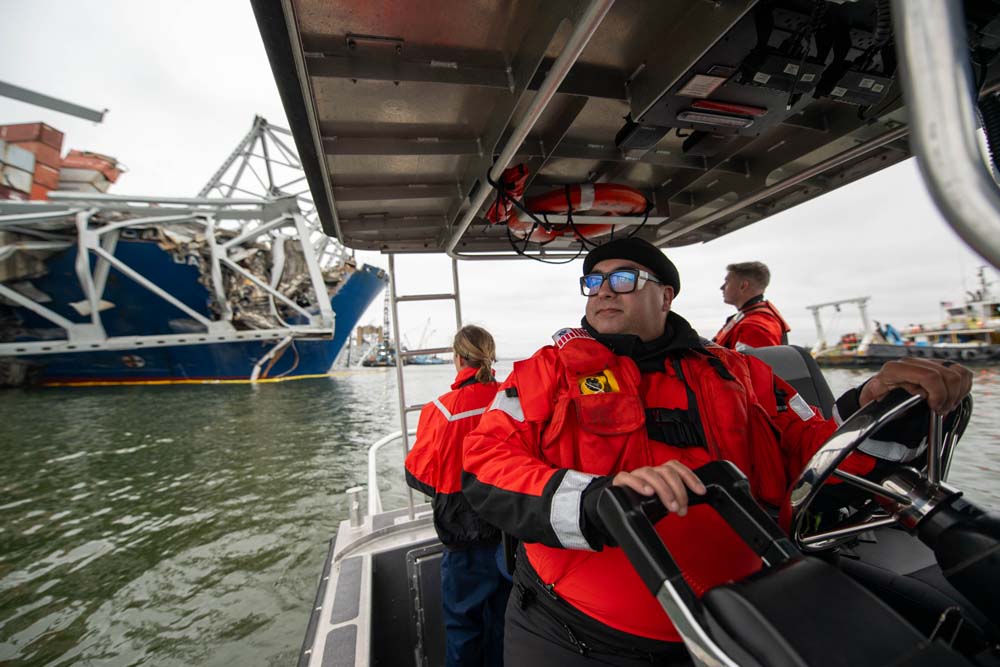
Within six days of the collapse, a new channel was opened for shallow-draft vessels. This was done through the partnerships within Unified Command and the expertise that came with it. At the Unified Command Center, key data was being added to a geographic information system dashboard, allowing stakeholders to be updated with a constant flow of new inputs.
Agency Collaboration. USACE was responsible for adding bathymetric channel survey data to monitor changes as pieces of the bridge were removed. The National Oceanic & Atmospheric Administration provided sensor data from buoys, which monitor water currents, and depth data from multibeam sonar surveys to update nautical charts. The Maryland Transportation Authority, City of Baltimore, and other state agencies joined the effort and began coordinating missions and updates. Each organization maintained data that they had the authority for. Viewing access was granted to divers doing the salvage work, surveyors mapping out the channel, and officials from the White House who were monitoring the progress being made.
The real-time data that was being shared across agencies was instrumental in the teams successfully clearing Fort McHenry Channel back to its original condition. The complexity of debris, wreckage, and blocked cargo ship provided unique challenges throughout the salvage. The total weight of steel and concrete across the collapsed span was estimated at 50,000-short-T, equivalent to 100-million-lbs of wreckage.
The navigation teams with USACE Baltimore District played a crucial part in the early days of the response as well. Survey Vessel CATLETT provided sonar imagery of debris beneath the waterline. Debris Vessel REYNOLDS removed smaller debris from the waterway.
Taking a Closer Look
During the salvage and recovery operation, advanced imaging technologies such as LIDAR, sonar, and PhoDAR allowed engineers to see the positioning and location of the wreckage underwater. However, teams could not rely on technology alone; some elements of the devastation might not be detectable. Having physical divers in the water to survey wreckage was paramount.
Agency Collaboration. USACE worked in a joint effort with SUPSALV to oversee the commercial dive companies performing the work underwater. There were three overarching steps to the underwater salvage response: survey and map the underwater hazards; develop and execute the salvage plan; and safely execute the salvage work. Each of these steps was repeated after every round of removal of debris or wreckage, creating a delicate, iterative cycle.
The Unified Command completed 79 missions to gather sonar and laser images for mapping the wreckage and marking safe transit routes, and a total of 109 dive missions, not including those performed during the initial 48 hours after the collapse. Once the wreckage and debris beneath the water’s surface was assessed, the removal work could begin.
Achieving Limited Access
The immense tension in the steel created a series of potential hazards to work through. When a single piece was cut and moved, it directly affected the pieces around it and they were then liable to move on their own. The crews had to analyze the steel and anticipate how each piece would move in order to mitigate potential hazards while clearing the wreckage.
With the weight removed from the bow of the ship and the refloat sequence steps complete, the vessel was refloated and moved by Unified Command on May 20 at 7 a.m. With the assistance of five tugboats and other support craft, the DALI was towed and pushed 2.5-mi, arriving at a local marine terminal around 9 a.m.
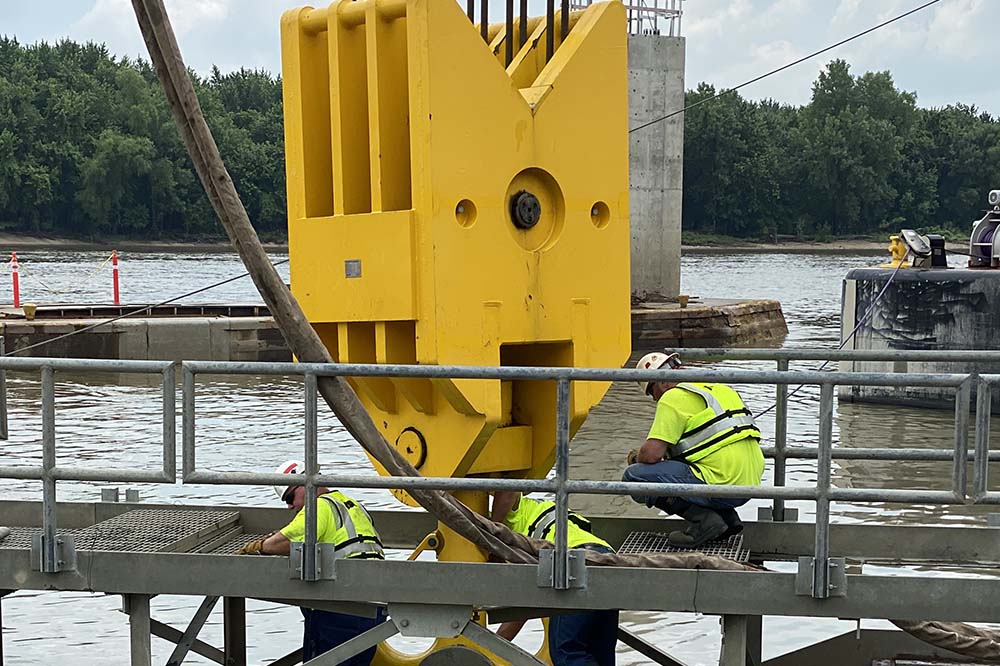
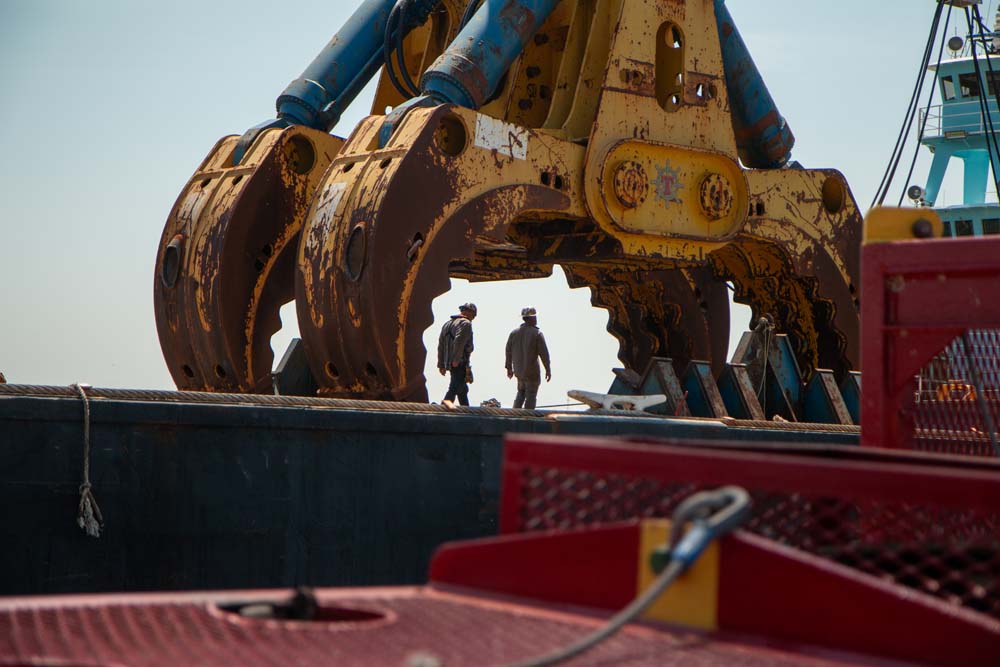
The salvage team divided the collapsed bridge truss into five damaged sections to be removed systematically. In addition to divers, floating cranes were brought in from around the East Coast to remove wreckage after it was cut into smaller pieces. The sheer size and weight of the bridge spans were too heavy for even the largest of floating cranes to lift. A 165-MT hydraulic wreck grab, the largest in the United States, attached to the Chesapeake 1000 crane, was brought in with the lifting capability of 1,000-MT at a time. Even it could not withstand the weight capacity of some of the wreckage.
The work continued, despite the extensive sunken damage and protracted challenges. Once USACE had enough wreckage cleared, the Unified Command’s Priority 1A was met with the opening of the Limited Access Channel during the week of April 22. This passageway had a 300-ft horizontal clearance, running the northern portion of the wider federal channel, and allowed five of the deep draft vessels and other smaller deep draft vessels that were trapped in the port to transit out of the area.
Continuing Salvage Dives
The next priority was to refloat the M/V DALI from being pinned down to the riverbed. A number of containers on the ship first needed to be offloaded and “Section Four,” a downed portion of the Key Bridge truss, needed to be removed to lessen the weight of the ship and free it for movement.
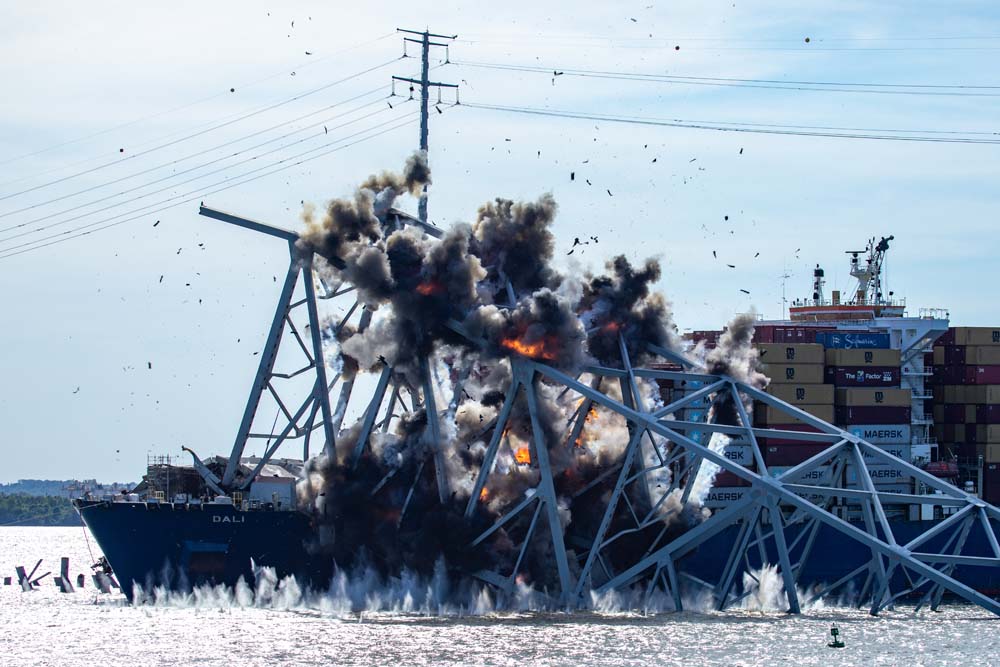
Of the 4,700 containers aboard the cargo ship, 182 were carefully removed, while teams moved on to strategizing the best way to remove the Section Four segment. Due to the sheer size of the truss, Unified Command determined a precision cutting technique was the safest and most efficient method of removal. This industry-standard technique involves the use of small charges that, when detonated, create pressure that separates metal into multiple, smaller sections. For the Francis Scott Key Bridge, salvors pre-cut the truss at strategic locations determined by engineers, and small metal-covered explosive cores were placed inside the cuts.
A notice of detonation went out to the public in advance. The charges were detonated on May 13. What initially appeared as a bright flash with several puffs of smoke was followed by sounds like a short round of fireworks coming seconds later. Many of the smaller pieces fell into the water, where salvors later used the cranes and barges already on scene to remove them.
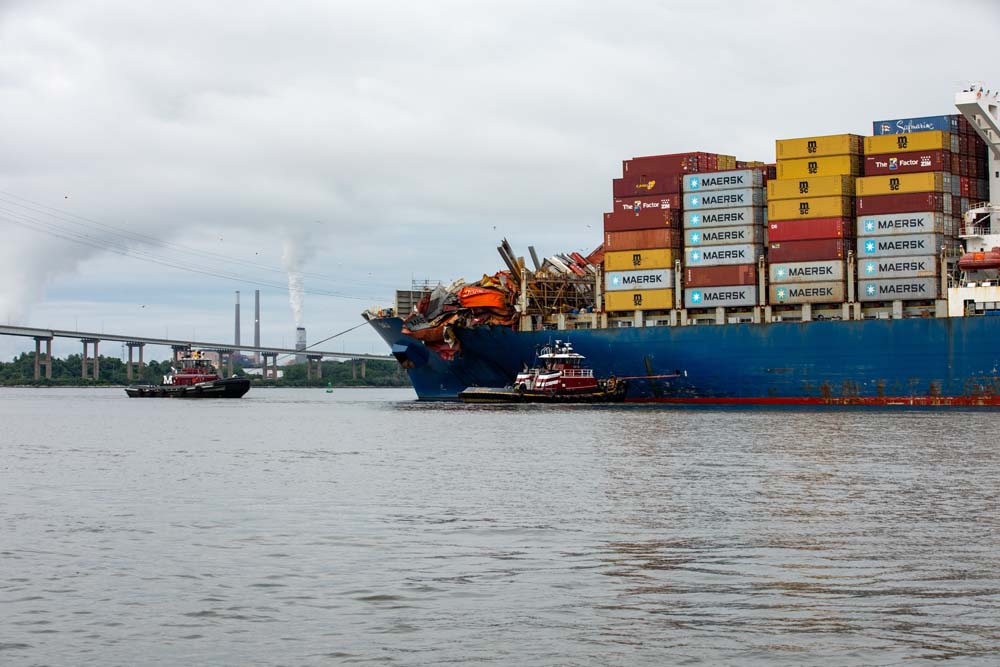
The refloat and transit sequence was deliberately designed to ensure the refloat crews and support personnel around the DALI remained in complete control of the vessel and its movement to the Seagirt Marine Terminal in the Port of Baltimore.
With the weight removed from the bow of the ship and the refloat sequence steps complete, the vessel was refloated and moved by Unified Command on May 20 at 7 a.m. With the assistance of five tugboats and other support craft, the DALI was towed and pushed 2.5-mi, arriving at a local marine terminal around 9 a.m. This milestone allowed all pre-collapse, deep-draft commercial ships to successfully enter and exit the Port of Baltimore for the first time since March 26.
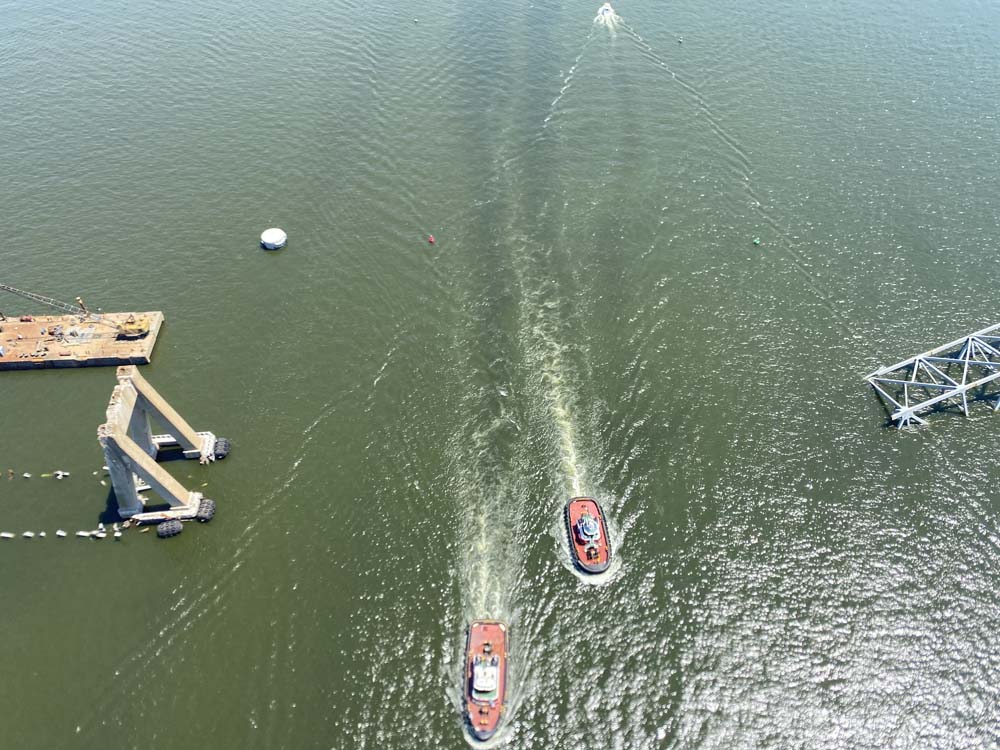
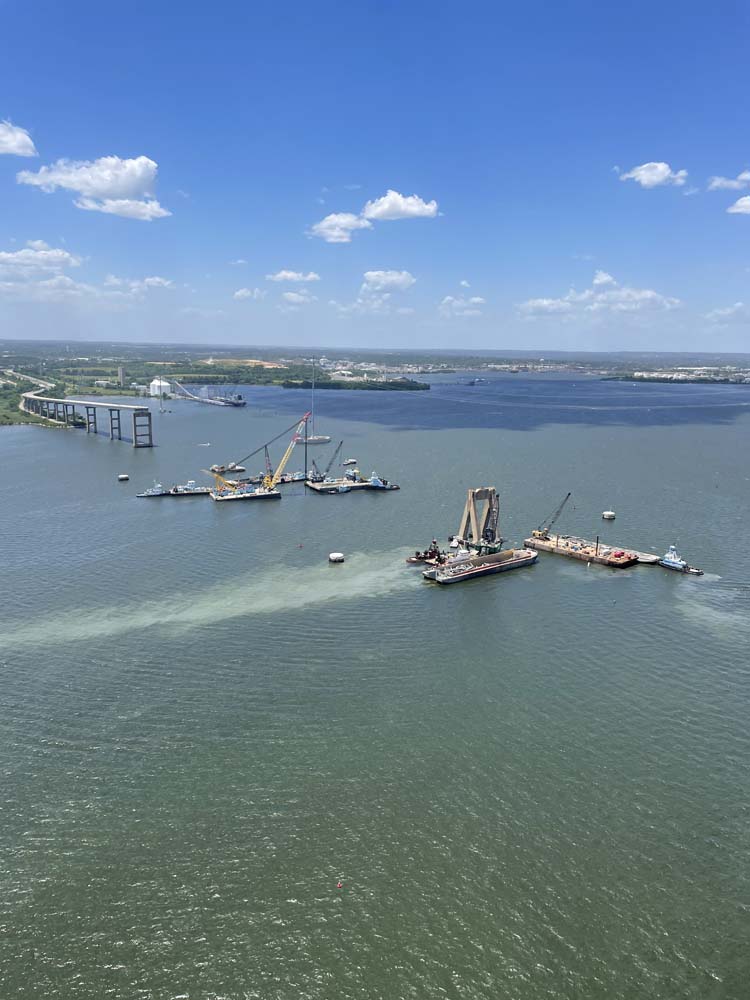
With the removal of the M/V DALI, salvage crews with Unified Command, using crane and barge assets already on site, worked to remove the remaining wreckage and debris from the water. A fleet of dredges removed mud and debris down to 60-ft, to a solid clay layer with no bridge wreckage, in order to ensure thorough removal. The dredged material was transferred to Sparrow’s Point for processing. SUPSALV, in collaboration with state officials, planned for expedited permitting and design support to hold and dry the material, with relocation handled by a third party.
After just 76 days, USACE and SUPSALV restored the Fort McHenry Channel to its original operational dimensions of 700-ft wide and 50-ft deep, reaching capacity that would once again enable full maritime transit through the Port of Baltimore.
Speeding Reconstruction
The assistance and support that USACE received from the partnerships within Unified Command was invaluable to mission success. Between six agencies and organizations, the combined operation was able to accomplish an extraordinary feat. Roughly 1,600 responders and 500 technical specialists from 56 federal, state, and local agencies brought in 36 barges, 27 tugboats, 22 floating cranes, 44 vessels, 10 excavators, a dredger, a skimmer, and a Coast Guard cutter to remove 50,000-T of bridge wreckage.
However, even with the federal channel back to its original operating status, allowing the Port of Baltimore to resume its economic impact on the nation’s economy, Baltimore District’s work still is not done. Reconstruction of the Francis Scott Key Bridge requires permitting through the Baltimore District Regulatory Branch. In early March 2025, a Section 10/404/408 permit decision was issued for the rebuild, granting Maryland Transportation Authority permission to construct the replacement structure that will reconnect the I-695 Baltimore Beltway and improve community accessibility. A USACE permit modification was issued in October 2025 to authorize a slight shift of the bridge alignment downstream and to modify the authorized work description based on further project design.
Section 10 of the Rivers and Harbors Act of 1899 requires authorization from the Secretary of the Army, acting through USACE, for construction in or over any navigable water of the United States (this includes dredging or disposal of dredged materials, excavation, or any other modification). The legislation applies to all structures, from the smallest floating dock to the largest commercial undertaking. It also includes elements like dolphins, trestles, jetties, pilings, and aerial or subaqueous power transmission lines.
As currently designed, the new bridge will incorporate reinforced pier foundations, pier protection islands, and six dolphins, to permanently impact 12.71-acres of the tidal Patapsco River. A temporary trestle for construction access will be built and involves approximately 1,200 36-in steel piles, covering an above-water area of 400,000-ft². The top of the pile will be about 10-ft above the approximate mean high-water line of the Patapsco. In addition, around 300 temporary mooring or template piles (measuring 36-in) will be installed in the river. The trestle and template piles will temporarily impact an estimated 9-acres of the waterway.
The land-side demolition of the old bridge is complete and construction of the temporary trestle has begun. In-water work on the replacement bridge is underway as well with production piles being driven for the main span navigational piers. This project also requires similar permit verification from the Coast Guard.
Committed to Service
USACE Baltimore District is proud to have provided fair and efficient permitting efforts to enable the construction of a new bridge beginning less than one year after the catastrophic collapse.
Following the impact of the M/V DALI, almost 1-mi of the 80-ft wide bridge crumbled and collapsed within seconds.
The fact that our dedicated team has helped lead such a focused partnership that successfully both removed the bridge wreckage and issued necessary permits for its reconstruction to begin on an accelerated timeline is a testament to our dedicated Regulatory Branch and the commitment of our people to support an energetic economy across the region.
The Safe Way Around
In April 2024, the U.S. Army Engineer Research & Development Center’s Coastal and Hydraulics Laboratory conducted the Fort McHenry Limited Access Channelship Simulation Study to evaluate whether a temporary bypass around the wreckage of the M/V DALI could safely accommodate the deep draft vessels that normally utilize the Port of Baltimore.
Using the ship tow simulator, five representative vessel models (loaded and ballasted RoRo, bulk carrier, tanker/bulker, container ship, and cruise ship) were run through 36 transits under varying wind, current, and buoy placement scenarios, with pilots rating maneuverability and safety. The results showed that all vessel classes could transit the 280-ft wide channel safely, provided that two tugs were employed and wind speeds were limited to 15-kt beam wind.
Buoy placement was deemed adequate after minor adjustments were made. The study recommended opening what would be the Fort McHenry Limited Access Channel under the two tug/15-kt wind restriction, installing the finalized buoy layout, and maintaining vigilant tug coordination to protect the channel and the damaged bridge structure.
Col. Francis Pera, USA, is Commander, USACE Baltimore District; francis.b.pera@
usace.army.mil.
Published in the March-April 2026 issue of The Military Engineer
Check Out Related Articles From TME
-

A Standardized Approach to Aircraft Fire Training Infrastructure
To support enterprise-wide airmen readiness, the U.S. Air Force is modernizing its standard design for aircraft fire training facilities—introducing digital controls, dual-fuel systems, and PFAS-conscious infrastructure. -
Delivering Energetic Materials Manufacturing Facilities
Designing and constructing facilities that manufacture, process, handle, or store explosives and energetic materials present some of the most challenging defense projects—requiring technical experience, strict safety protocols, and a comprehensive understanding of regulatory frameworks. -
Forging Tradition and Innovation: A New Design Standard at Camp Lejeune
The II MEF Headquarters at Camp Lejeune blends Georgian Revival architecture with modern sustainability—delivering durability, efficiency, and precision that meets contemporary functional requirements while honoring heritage. -

Balancing Efficiency and Fiscal Responsibility
The continuing contracts clause offers the U.S. Army Corps of Engineers a way to improve project delivery and enhance fiscal responsibility by aligning funding with project execution. -
Next Steps for Digital Twin Development
U.S. Forces Japan is laying the groundwork for future integration of digital twin technology in order to validate and collect data that will offer comprehensive insights into utility conditions at installations and enhance overall decision-making, efficiency, and resilience. -
Generating Agile Technology
Through a collaborative program with the Naval Facilities Engineering and Expeditionary Warfare Center, a team of engineering students designed and prototyped a generator powered by ocean movement, with the aim to support the energy needs of warfighters in contested logistics environments.