Implementing Statewide Master Planning for Army Reserve Readiness
By Heather Mendenall, AICP, M.SAME, Ben Zitelli, AICP, M.SAME, and Katie Benzel, AICP, M.SAME
A statewide master planning initiative driven by the U.S. Army Reserve integrates advanced data analysis, GIS technology, and collaborative workshops to optimize every site for readiness, efficiency, and long-term sustainability.
Master planning for the military plays a critical role in ensuring that facilities serving the armed forces are well-positioned on sites, properly maintained overly the long term, and effectively aligned with strategic objectives, while also remaining potentially agile enough to be adapted, if needed. The U.S. Army Reserve, under the direction of Dominique Norman, Chief Master Planner of the Office of the Chief of Army Reserve, and contracted through USACE Louisville District, has embraced a statewide master planning initiative—recognizing the need for a more comprehensive perspective of its readiness and maintenance facilities.
This approach shifts the focus from individual metropolitan cores to a comprehensive statewide strategy. The motivation is to ensure that every facility is contributing to enhance mission readiness and operational effectiveness while also positioning new facilities in areas where local industry aligns with the military occupational specialty of assigned units.
Holistic Approach
For decades, Army Reserve master planning focused on metropolitan areas, and often unintentionally overlooked the unique needs of rural, less populated, dispersed facilities. The current statewide approach ensures that every site, regardless of size or location, receives a thoughtful, data-backed plan based on local expert knowledge of unit representatives and local facility operation specialists.
This comprehensive strategy allows master planners to evaluate every facility’s role, condition, and alignment with long-term readiness goals based on the Army Facility Investment Plan and Facility Investment Guidance. It also enables the Army Reserve to address statewide challenges, such as recruitable cohorts and population shifts, with precision and foresight based on empirical data.
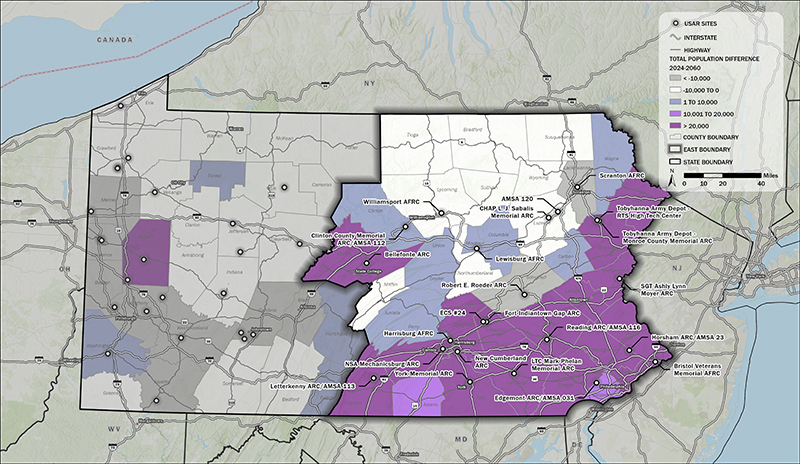
The transition to a statewide master plan approach emphasizes inclusivity by considering all aspects of Army Reserve operations, from soldier recruitment to infrastructure resilience. Taking this broader perspective encourages decisions that are more proactive and less reactive—aligning resources with mission objectives and future needs. For example, underpopulated areas with minimal recruitment potential can be objectively analyzed to assess their impact and determine whether facility investment is warranted.
Leveraging Data
A key innovation has been leveraging geographic information systems (GIS), a tool that transforms complex data into actionable insights through graphic visualization. By mapping soldier home locations, analyzing demographic trends, and evaluating drive times and other day-to-day variables, planners can optimize facility locations to reduce commuting burdens for reservists and ensure proximity to recruitable, fully qualified, military age populations. This data-driven methodology includes population growth projections through 2060—enabling long-term strategic investment both in areas with sustained recruitment potential and areas projected for future growth.
GIS technology plays a critical role in visualizing environmental risks and community impacts. By overlaying climate risk data with facility locations, the Army Reserve can anticipate challenges such as flooding and other natural disasters. This foresight not only enhances readiness but it ensures that resources are allocated efficiently to maintain mission-critical operations.
The statewide master planning process integrates diverse data sets, including client-provided Army facility data, U.S. Census demographics, Woods & Poole economic forecasts, and resilience indices from the Federal Emergency Management Agency. By analyzing these inputs alongside facility condition data, the Army Reserve is positioned to make objective, data-driven decisions about which facilities to invest in, divest from, or consolidate. This approach minimizes subjective biases. Every decision aligns with ensuring mission readiness and fiscal responsibility.

Reducing Expenditures
By adopting a statewide approach to master planning, the Army Reserve maximizes the efficiency of its sustainment and construction budgets. Taking steps to consolidate and modernize facilities reduces redundant expenditures and ensures that investments are directed toward sites with the highest potential for mission success. Additionally, this planning framework enables the Army Reserve to align its assets with regional and national readiness goals, facilitating the strategic relocation of units when necessary.
By identifying underutilized facilities and prioritizing high-impact investments, the Army Reserve can reduce maintenance costs and at the same time enhance the quality of its infrastructure in strategic locations. For example, integrating renewable energy solutions and energy-efficient designs into facility upgrades not only reduces operating expenses but also supports the organization’s sustainability goals. With nearly 190,000 soldiers across all 50 states and five territories, the Army Reserve is not just an essential component of the nation’s defense—it is present and very visible throughout the country, which makes the efficacy of its real estate profile even more important.
Blueprint for the Future
The statewide approach to master planning exemplifies how technology, collaboration, and forward-thinking strategies converge to redefine readiness for the 21st century. By considering every facility’s role and its alignment with citizen-soldier needs and community resources, investments are impactful, sustainable, and aligned with future demands.
This ongoing effort sets a new standard for military planning, offering a model for other organizations looking to optimize their infrastructure and readiness. With a roadmap grounded in robust data and collaborative engagement, the Army Reserve is well-positioned to meet both the anticipated and unexpected challenges of tomorrow while maintaining its commitment to service and excellence.
Collaborating on Challenges
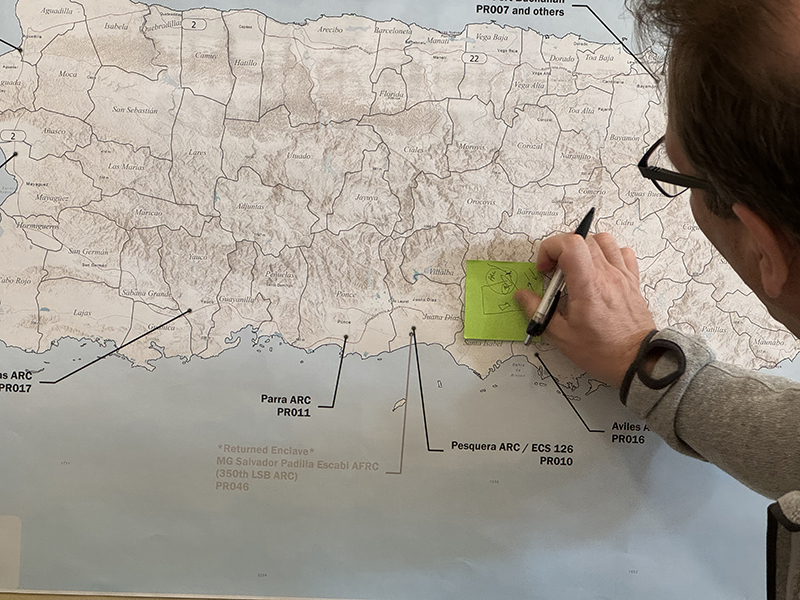
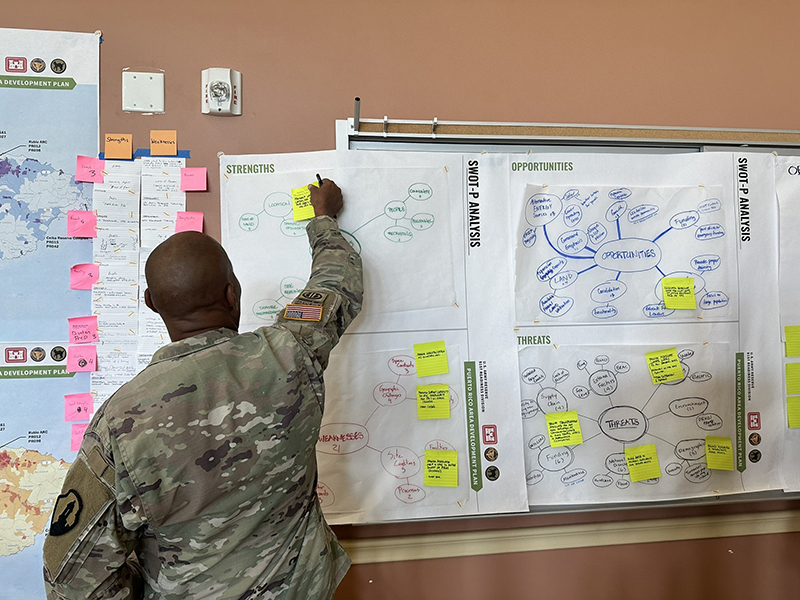
A critical element of the process for the Army Reserve and statewide master plan project partners, Tetra Tech and Pond & Company, has been uniting stakeholders scattered across vast distances. These efforts have been able to gain critical mass through interactive planning workshops, as the team uses digital engagement tools to enhance collaboration among in-person attendees and serve as a bridge to overcome geographic barriers between unit leadership and workshop locations for those unable to attend in person. These hybrid workshops utilize platforms like MURAL, which allows for real-time collaboration and data visualization. Participants engage in SWOT analyses, live polling, and the development of actionable objectives, fostering a unified approach to decision-making.
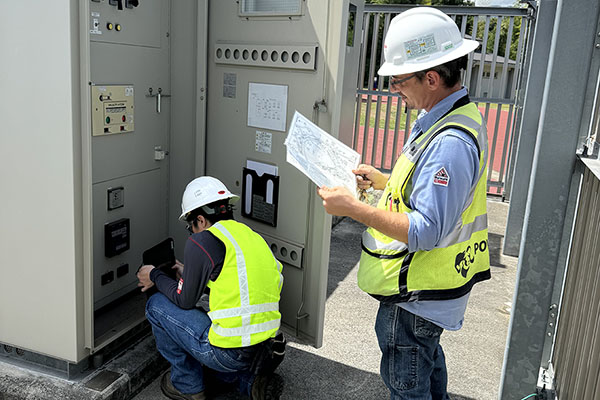
Workshops are week-long processes. They often begin with a day of site visits where the assembled cohort of stakeholders from the U.S. Army Corps of Engineers, Office of the Chief of Army Reserve, local facility managers, and consultant teams conduct detailed evaluations and gather firsthand insights in an analysis of the conditions of the sites strategically selected for review. This combination of virtual and physical engagement ensures that every aspect of a facility’s condition and potential is thoroughly considered. For example, charrette-style workshops bring together engineers, planners, and community stakeholders to generate solutions tailored to each state’s unique needs.
Another challenge lies in enhancing resiliency at a statewide level. For example, coastal facilities may face flooding and stormwater vulnerabilities. Inland sites contend with groundwater availability or aging infrastructure. Statewide analyses that incorporate stakeholder knowledge enable the Army Reserve to identify and develop strategies to mitigate risks. This collaborative approach helps ensure that facilities remain operational and resilient in the face of environmental challenges.
Heather Mendenall, AICP, M.SAME, is Director, Federal Master Planning, Ben Zitelli, AICP, M.SAME, is Senior Planner and Landscape Architect, and Katie Benzel, AICP, M.SAME, is Senior Planner and Project Manager, Tetra Tech. They can be reached at heather.mendenall@tetratech.com; ben.zitelli@tetratech.com; and katie.benzel@tetratech.com.
Published in the May-June 2025 issue of The Military Engineer
Check Out Related Articles From TME
-

Innovative PFAS Remediation at Camp Grayling
For project stakeholders and remediation managers confronted with PFAS, Regenesis demonstrates the efficacy of using Regenesis’ PlumeStop® colloidal activated carbon (CAC) at Camp Grayling, Michigan. -
A Standardized Approach to Aircraft Fire Training Infrastructure
To support enterprise-wide airmen readiness, the U.S. Air Force is modernizing its standard design for aircraft fire training facilities—introducing digital controls, dual-fuel systems, and PFAS-conscious infrastructure. -
Delivering Energetic Materials Manufacturing Facilities
Designing and constructing facilities that manufacture, process, handle, or store explosives and energetic materials present some of the most challenging defense projects—requiring technical experience, strict safety protocols, and a comprehensive understanding of regulatory frameworks. -
Forging Tradition and Innovation: A New Design Standard at Camp Lejeune
The II MEF Headquarters at Camp Lejeune blends Georgian Revival architecture with modern sustainability—delivering durability, efficiency, and precision that meets contemporary functional requirements while honoring heritage. -

Balancing Efficiency and Fiscal Responsibility
The continuing contracts clause offers the U.S. Army Corps of Engineers a way to improve project delivery and enhance fiscal responsibility by aligning funding with project execution. -
Next Steps for Digital Twin Development
U.S. Forces Japan is laying the groundwork for future integration of digital twin technology in order to validate and collect data that will offer comprehensive insights into utility conditions at installations and enhance overall decision-making, efficiency, and resilience.