In Guam, Infrastructure Resilience, Integrated Response, and Collaboration
By Komal Dewan, LEED AP, M.SAME, and Avinash Srivastava, M.SAME
In rebuilding from the devastation of Super Typhoon Mawar, the Territory of Guam adopted an integrated master planning approach, powered by a real-time digital platform, to better align infrastructure and resilience with mission.
The Indo-Pacific is at the center of U.S. national defense strategy, and the Territory of Guam in the South Pacific, nearly 6,000-mi from California but just 2,900-mi from China, stands as a linchpin for power projection capabilities and maintaining regional stability.
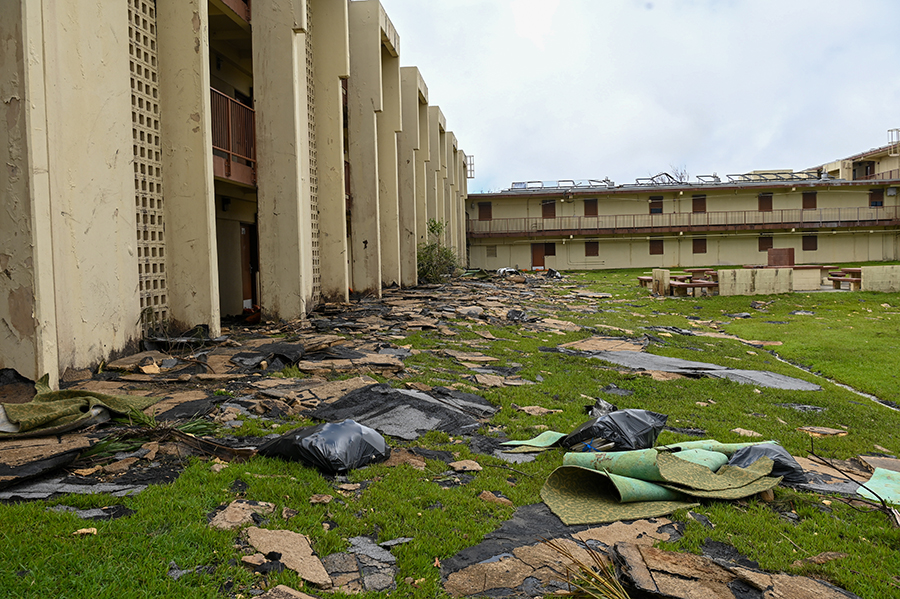
When Super Typhoon Mawar devastated the island in 2023, the aftermath revealed the vulnerabilities of Guam’s civilian and military infrastructure, but also their resilience. Power grids, water systems, roadways, and communications were severely damaged, threatening daily life and the operational readiness of U.S. forces. However, from this adversity emerged a powerful catalyst for change. The disaster spurred a coordinated response among U.S. Indo-Pacific Command, Joint Region Marianas, the Government of Guam, and industry partners. Their shared goals of not just rebuilding but building back better sought to create a model of theater resilience and integrated warfighting capability.
Central to this effort has been a new era of collaboration, digital innovation, and integrated planning, embodied by the Guam Capacity & Project Synchronization Tool (GCAPS). This innovative platform is designed to enable comprehensiveness, agility, and transparency into the island’s infrastructure recovery and modernization initiatives.
Driving Change
Guam’s geography makes it vital for U.S. operations. Yet the advantages of its strategic location are also why it faces significant risks from both natural disasters and regional instabilities. True resilience demands rapid recovery, flexible infrastructure, and seamless coordination across military, civilian, and industry sectors. Super Typhoon Mawar served as a compelling case study, highlighting how adversity can drive transformative change.
Mawar, a Category 4 storm with 140-mph winds, devastated Guam on May 24, 2023. It was the strongest typhoon in over two decades. Widespread damage and destroyed structures lined the island. Power was knocked out for most residents and water unsuitable for use. The commercial sector alone reported $112 million in damages. Thousands of residents were displaced, and they faced an uncertain path to recovery.
While miraculously no lives were lost, the typhoon severely tested military and civilian response capabilities, a reality that underscored the urgent need for resilient infrastructure and agile recovery processes. Mawar overwhelmed local capacities and necessitated an immediate and comprehensive external response. In the immediate response phase, a total of 19 crucial repair contracts, 91 additional repair packages, and 22 essential military construction projects were planned through the FY2025 Disaster Supplemental. This coordinated effort would reveal a critical need for a fundamental strategic shift. The new paradigm required rapid resource mobilization, comprehensive capacity assessment, and a forward-looking planning methodology—moving beyond reactive efforts and toward a more intentional proactivity. This strategic pivot, in the form of an Integrated Master Plan (IMP), has become the bedrock for future resilience.
Comprehensive Plan
On Guam, the IMP has emerged as a systematic and collaborative foundation for strategic development. This process is aligning critical infrastructure development, dynamic operational requirements, and future growth projections into a single, cohesive strategy. The IMP begins where traditional master plans end: with a comprehensive list of projects supporting the Government of Guam and Department of Defense (DOD). This comprehensive scope ensures that every investment supports critical U.S. mission needs and proactively addresses evolving national defense demands in the Indo-Pacific, in collaboration with community priorities.
The IMP offers insightful and logistical benefits for the community to move forward, and accept its critical responsibility at the nexus of U.S. national strategy.
- Fosters a unified vision, integrating diverse elements (from core mission operations to community needs) into a single overarching roadmap that provides the space for stakeholders to work toward common objectives and minimize conflicts.
- Enhances decision-making support by providing timely information—empowering leaders to make informed, strategic choices about priorities, resource allocation, and project timelines, optimizing outcomes and minimizing waste.
- Allows stakeholders to respond to evolving requirements, creating adaptable and scalable infrastructure development that avoids costly overhauls.
Finally, it enables stakeholder synergy, promoting collaboration among DOD, local government, and industry partners, maximizing opportunities for joint-use facilities and shared resources.
Historically, master planning has focused on static physical layouts and rigid construction priorities. In contrast, the IMP, as applied to Guam, is dynamic, data-driven, and continuously responsive. Its primary focus is the precise and timely implementation of critical mission priorities, coordinated with the evolving needs of the surrounding community. This approach defines priorities, readiness, and dependencies, which can align with strategic objectives. IMP incorporates detailed scheduling for efficient project sequencing and early identification of dependencies to mitigate risks. Unlike static plans, IMP documents are living and updated as missions, threats, or environmental conditions shift. This capability will prove essential for installations in volatile regions facing persistent natural disasters and regional threats.
Digital Innovation
On Guam’s journey toward enhanced resilience is a real-time digital platform, GCAPS, that demonstrates the power of technology in strategic planning and execution. The innovative tool supports leadership in aligning defense priorities with those of the local government, tracks complex project dependencies, and enables agile adjustments as conditions change. Its advanced capabilities are fundamental to Guam’s “build back better” ethos.
GCAPS offers centralized data and visibility by consolidating all project information into a single, accessible source. Leadership gains access to critical details and are able to facilitate deconfliction, promote unity, and embrace transparent, evidence-based decision-making. The platform features dynamic sequencing and resource optimization. Adjustments can be made in real time to project sequencing in response to threats, funding changes, or logistical challenges. GCAPS provides robust decision support through intuitive dashboards and analytics—identifying project status, potential bottlenecks, and progress. Valuably, integrated risk management is an intrinsic component of GCAPS, building risk assessment and mitigation throughout the project.
Following Typhoon Mawar, GCAPS proved invaluable. It facilitated critical program and site-level deconfliction and provided the space for recovery and development initiatives to proceed smoothly. Resources were effectively allocated, especially relating to capacity management for construction throughput and workforce availability. GCAPS empowered data-driven prioritization based on funding, workforce capacity, and local constraints. Ultimately, it provided military and civilian leadership with insights for rapid, data-driven decisions, helping maximize the island’s resilience and providing uninterrupted mission continuity.
Long-Term Growth
The importance of IMP extends far beyond the Pacific Ocean. In today’s dynamic global security landscape, military installations worldwide need to support immediate operations and continuously evolving mission-sets. Guam’s experience offers lessons to apply: proactive infrastructure investments are essential. The IMP enhances resilience through infrastructure redundancy and maximizes efficiency by reducing waste and fostering collaboration.
Guam’s growing strategic significance is reflected in unprecedented infrastructure investment. From 2024 to 2028, DOD plans to invest $9 billion in military projects, including $7.3 billion for new construction and $1.7 billion to develop an integrated missile defense system. This, coupled with the transfer of 5,000 U.S. Marines from Okinawa in Japan to Guam, will intensify demands on the island’s infrastructure.
The monumental buildup underscores the necessity of robust, adaptable master planning and sophisticated digital coordination. The surge in personnel and resources will test Guam’s existing capacity, making tools like GCAPS and comprehensive integrated planning processes essential for managing this growth, minimizing disruption, and sustainably addressing long-term needs.
Coordinated Recovery
Guam’s recovery from Super Typhoon Mawar was deeply human. Thousands of people endured immense hardship and prolonged displacement. The island’s enduring resilience stems not just from robust infrastructure, but from an unwavering spirit of its citizenry, strong community bonds, and deep cultural values.
The government’s proactive foresight accelerated recovery, having formally requested federal assistance before Mawar made landfall. This, combined with the pre-storm presence of federal agencies, enabled an immediate, coordinated road to recovery. Joint Region Marianas and Naval Facilities Engineering Systems Command worked closely with local leaders and the community. Additionally, the strategic adoption of new, forward-thinking building codes (such as requiring more resilient concrete telephone poles) instrumentally reduced infrastructure damage and expedited restoration of essential services.
The 2024 Guam Hazard Mitigation Plan further demonstrates the island’s commitment to proactive disaster preparedness and long-term safety. The plan incorporates rigorous risk assessments and outlines mitigation strategies for increasing extreme weather events and their impacts. Its development involved extensive collaborative engagement among government entities, non-profit organizations, and the private sector—reflecting a truly integrated, community-centric approach to safety and resilience.
Global Blueprint
Guam’s progress toward recovery and enhanced resilience offers an attainable blueprint for other forward-operating locations facing similar threats.
- Deepen collaborative partnerships among industry, the Government of Guam, and DOD to ensure shared understanding and optimized resource allocation.
- Shift from traditional, static planning to dynamic, execution-focused, and highly collaborative approaches, emphasizing actionable strategies.
- Enhance digital integration through the further refinement of project induction processes, robust data consistency across platforms, and centralized adjudication mechanisms.
Guam’s ongoing recovery since Mawar demonstrates that genuine resilience transcends physical infrastructure. Fundamentally, it is about the intricate interconnectedness of robust systems, efficient processes, and strong, trusting relationships among stakeholders. The GCAPS model, the embrace of integrated master planning, and the cultivation of a deeply ingrained culture of collaboration is setting an unprecedented new standard for military engineering and mission assurance in an increasingly unpredictable and challenging world.
Komal Dewan, LEED AP, M.SAME, is Senior Vice President, Global Leader, National Governments, Buildings and Places, and Avinash Srivastava, M.SAME, is Vice President, Global Director, Center of Excellence for Urban Analytics, AECOM. They can be reached at komal.dewan@aecom.com; and avinash.srivastava@aecom.com.
Published in the July-August 2025 issue of The Military Engineer
Check Out Related Articles From TME
-

Innovative PFAS Remediation at Camp Grayling
For project stakeholders and remediation managers confronted with PFAS, Regenesis demonstrates the efficacy of using Regenesis’ PlumeStop® colloidal activated carbon (CAC) at Camp Grayling, Michigan. -
A Standardized Approach to Aircraft Fire Training Infrastructure
To support enterprise-wide airmen readiness, the U.S. Air Force is modernizing its standard design for aircraft fire training facilities—introducing digital controls, dual-fuel systems, and PFAS-conscious infrastructure. -
Delivering Energetic Materials Manufacturing Facilities
Designing and constructing facilities that manufacture, process, handle, or store explosives and energetic materials present some of the most challenging defense projects—requiring technical experience, strict safety protocols, and a comprehensive understanding of regulatory frameworks. -
Forging Tradition and Innovation: A New Design Standard at Camp Lejeune
The II MEF Headquarters at Camp Lejeune blends Georgian Revival architecture with modern sustainability—delivering durability, efficiency, and precision that meets contemporary functional requirements while honoring heritage. -

Balancing Efficiency and Fiscal Responsibility
The continuing contracts clause offers the U.S. Army Corps of Engineers a way to improve project delivery and enhance fiscal responsibility by aligning funding with project execution. -
Next Steps for Digital Twin Development
U.S. Forces Japan is laying the groundwork for future integration of digital twin technology in order to validate and collect data that will offer comprehensive insights into utility conditions at installations and enhance overall decision-making, efficiency, and resilience.