Integrating Backup Generators as a Virtual Power Plant
By Mina Yousef, P.E., PMP, CEM
Instead of building new power plants to strengthen mission assurance and energy security, many military installations may be positioned to uniquely leverage existing assets they have in surplus like standby generators in a new way.
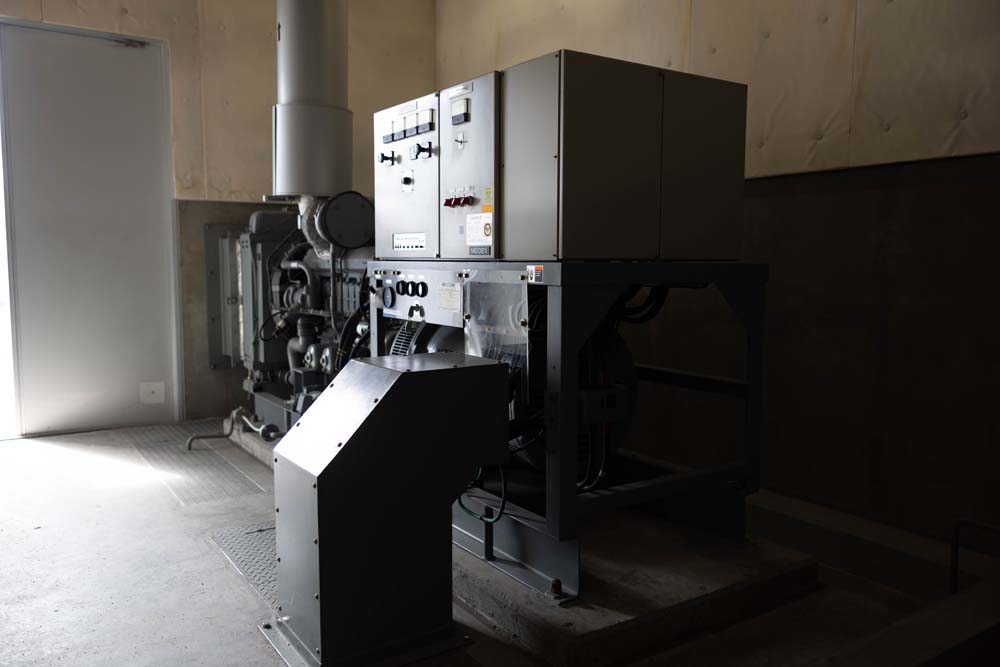
For military installations, energy resilience has become a core requirement for mission assurance. To ensure energy security, most bases rely on standby generators that perform well during short disruptions but are usually operated as isolated assets with limited coordination.
These same installations often sit where the electric system is stressed by electrification, changing generation sources, weather events, and now surging demand from data centers. Additionally, bases often have power generation that sits idle most of the year while the surrounding grid struggles to maintain reserves.
Existing standby generators can be integrated into a virtual power plant that is built on a resilient microgrid to become a self-dependent power system capable of sustaining critical missions in islanded mode for extended periods. Any support to the external grid remains strictly secondary and conditional on mission priorities.
Operating Instances
The foundation of a generator-based virtual power plant is a microgrid that can operate in two distinct cases. The first case is a totally islanded, self-dependent operation; the second provides for limited support to the external grid when mission risk allows.
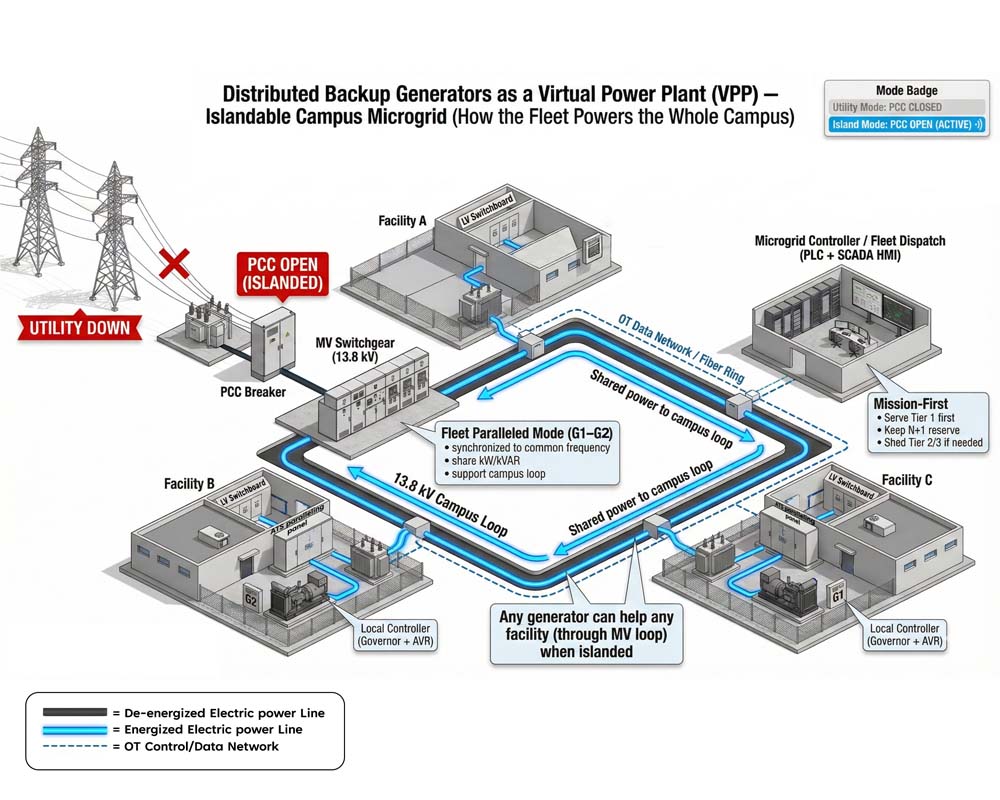
At a high level, installations connect to the serving utility at a main substation or point of common coupling. Downstream of that point, a microgrid controller supervises generator banks, critical and non-critical feeders, and key switching equipment.
If the microgrid is operating as the first case, when the external grid is unavailable, or when the installation intentionally separates during a disturbance, the point of common coupling breaker opens and the base becomes electrically independent. Designated black-start generators energize the distribution system and establish the reference voltage and frequency. Additional generators then synchronize and pick up prioritized feeders according to a load-restoration plan. The installation acts as its own mini-utility, balancing internal generation and load.
If the microgrid is operating in the second case, generators may run in parallel with the utility at the point of common coupling, following IEEE 1547 principles for voltage and frequency behavior and trip thresholds. In this mode, the microgrid behaves like a single, well-behaved resource: the installation can shave peaks, support local reliability events, or provide limited export, but only after adequate reserve is preserved for Case 1. Any grid support then becomes an optional overlay, constrained by mission-first limits and interconnection agreements.
Options For Control
Control is where the virtual power plant concept becomes real. It follows a hierarchical structure that separates fast local control from slower supervisory decisions.
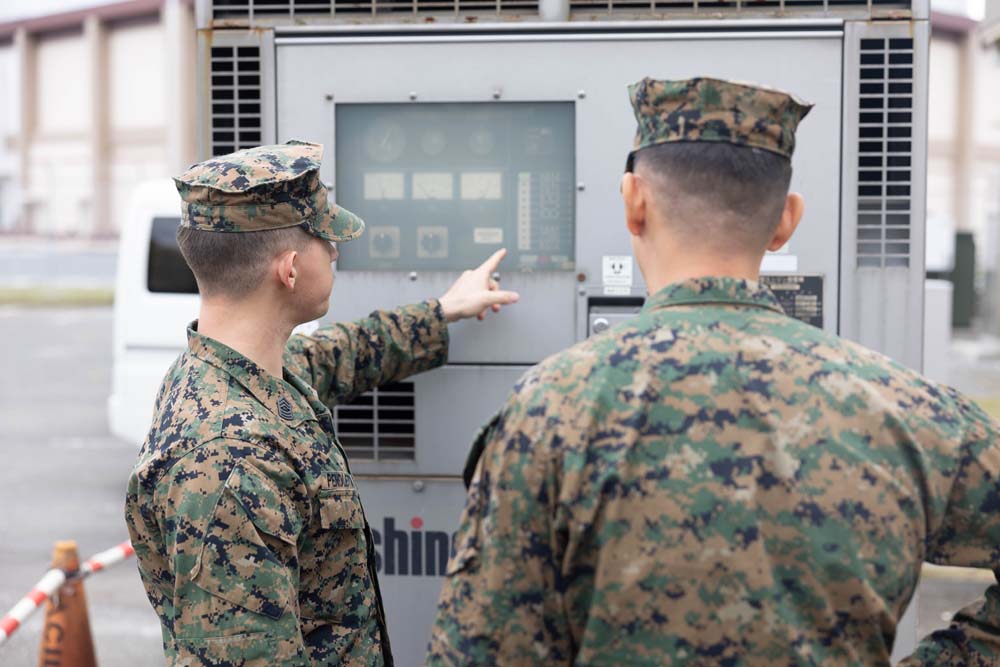
At the fastest level, each generator has its own controller integrated with the engine governor and automatic voltage regulator to maintain power sharing, enforce droop characteristics, and handle protective functions. Above them sits the microgrid controller, the “brain” at installation scale. This is usually implemented as an industrial computer or programmable logic controller-based platform specified in accordance with UFGS 26 37 13. It decides which generators start and stop in each operating case, how much load each generator carries, and when and how to transition between modes, including black-start and resynchronization sequences.
Installations are typically chosen among three control arrangements.
- In a centralized scheme, generator controllers communicate with a single microgrid controller that dispatches setpoints.
- In a distributed scheme, generator controllers share information peer-to-peer and the microgrid controller sets operating limits and schedules.
- Lastly, in a manual-assist scheme, supervisory control and data acquisition provides visibility and field operators follow a playbook, assigning fixed blocks of load to some units and using others to follow fluctuations.
Maintaining Readiness
Regardless of the control architecture, dispatch logic must enforce a simple hierarchy: mission assurance comes first.
In normal conditions, the microgrid or virtual power plant controller maintains readiness by exercising generators under realistic loading conditions and verifying transitions between grid-connected and islanded states. It optimizes runtime and fuel use—avoiding low-load operation and unnecessary starts.
Where policy and interconnection agreements allow, it may also enable limited grid-support activities, but only after contingency reserves for islanded operation are protected. During Case 1, islanded operation, objectives narrow to the survival of critical missions. The controller, or an operator team in a manual-assist scheme, starts and loads generators in a staged manner, locks in priority feeders, and sheds or defers non-critical loads according to pre-defined tiers. The fuel use is managed to extend autonomy.
Cybersecurity is integral. UFC 4-010-06 requires facility-related control systems to follow the DOD Risk Management Framework and apply defense-in-depth to operational technology. In practice, that means segregated control networks; strong authentication and role-based access control; encrypted and monitored communications where remote access is required; and defined cyber incident response playbooks.
Default behaviors are conservative. If communications with external entities are lost or anomalies detected, the system reverts to a mission-focused islanded mode not reliant on external signals.
Implementation Path
Constructing a new dedicated power plant sized to cover all critical and important installation loads requires significant capital expenditure and land footprint. By contrast, most military bases already own fleets of standby generators. A generator-based microgrid and virtual power plant leverages this existing generation capacity, focusing new investment on controls, communications, and switchgear upgrades rather than on additional prime movers. This approach can deliver comparable or better resilience at a fraction of the cost, more quickly, and with minimal additional land required, since generators are already embedded in existing facilities.
To streamline implementation, a phased approach can be taken.
- Phase 0 – Assessment: During this phase, an inventory of transfer switches, control systems, and generators is conducted, critical and non-critical loads are mapped, and fuel autonomy and cyber posture is reviewed.
- Phase 1 – Internal microgrid: In this phase, a microgrid controller and central monitoring is implemented. Switchgear is upgraded and protected in order to network existing standby generators into an islandable installation microgrid without exporting power to the grid; then black-start, islanded, and resynchronization sequences are validated.
- Phase 2 – Optional grid-interactive virtual power plant: Where mission risk, policy, and interconnection agreements allow, controlled parallel operation with the grid is enabled in this phase. Operation should only be for limited services such as peak shaving or emergency support, and have strict rules that preserve islanding capability and reserves for critical missions.
During implementation, governance is as important as hardware. Clear guidance at the installation level should codify that mission assurance always takes precedence over any grid-support activity. Dispatch rules, protection settings, and contractual arrangements must reflect that hierarchy. Additionally, training exercises should be used to validate and refine those rules under realistic conditions.
Mission-First Resilience
Across the world, at both enduring sites and more contingency locations, military installations already own significant on-site generation capacity. Much of that capacity, however, is locked into a narrow, building-by-building standby role that is activated only when the grid fails. By integrating these generators into a UFC-compliant microgrid and operating it as a virtual power plant, bases can create self-dependent, long-duration power systems that support mission assurance first and, where appropriate, contribute to broader grid stability.
The path forward does not require starting from scratch. It builds on existing generators, exercises, and established guidance. A handful of pilot installations, especially those with emerging microgrids, can demonstrate and refine the approach. From there, a generator-based virtual power plant model can scale across the defense enterprise, turning today’s standby assets into tomorrow’s strategic energy infrastructure.
Enforcing Energy Security
Issued in April 2025, Executive Order 14262, Strengthening the Reliability and Security of the United States Electric Grid, directs federal owners facilities to enhance their facility resilience as well as their contribution to national energy security. For the U.S. military, DOD Instruction 4170.11, Installation Energy Management, further defines energy resilience as essential to mission assurance.
The Unified Facilities Criteria translates these policy goals into design requirements.
- UFC 3-550-04, Resilient Installation Microgrid Design, provides criteria for “networked, islandable standby power systems.”
- UFGS 26-37-13, Microgrid Control System, covers specification of the control platform.
- UFC 4-010-06, Cybersecurity of Facility-Related Control Systems, sets cybersecurity requirements for operational technology.
When grouped together, policy and standards form a pathway for generator-based microgrids and virtual power plants.
Mina Yousef, P.E., PMP, CEM, is Energy Manager, Camp Lemonnier, Djibouti; mina.m.yousef.ctr@mail.mil.
Published in the March-April 2026 issue of The Military Engineer

Check Out Related Articles From TME
-

A Standardized Approach to Aircraft Fire Training Infrastructure
To support enterprise-wide airmen readiness, the U.S. Air Force is modernizing its standard design for aircraft fire training facilities—introducing digital controls, dual-fuel systems, and PFAS-conscious infrastructure. -
Delivering Energetic Materials Manufacturing Facilities
Designing and constructing facilities that manufacture, process, handle, or store explosives and energetic materials present some of the most challenging defense projects—requiring technical experience, strict safety protocols, and a comprehensive understanding of regulatory frameworks. -
Forging Tradition and Innovation: A New Design Standard at Camp Lejeune
The II MEF Headquarters at Camp Lejeune blends Georgian Revival architecture with modern sustainability—delivering durability, efficiency, and precision that meets contemporary functional requirements while honoring heritage. -

Balancing Efficiency and Fiscal Responsibility
The continuing contracts clause offers the U.S. Army Corps of Engineers a way to improve project delivery and enhance fiscal responsibility by aligning funding with project execution. -
Next Steps for Digital Twin Development
U.S. Forces Japan is laying the groundwork for future integration of digital twin technology in order to validate and collect data that will offer comprehensive insights into utility conditions at installations and enhance overall decision-making, efficiency, and resilience. -
Generating Agile Technology
Through a collaborative program with the Naval Facilities Engineering and Expeditionary Warfare Center, a team of engineering students designed and prototyped a generator powered by ocean movement, with the aim to support the energy needs of warfighters in contested logistics environments.