Leaning Into AI for Energy Systems Control
By Mina Yousef, P.E., PMP, CEM
The integration of artificial intelligence is emerging as a powerful tool to help military installations manage their increasingly complex and more distributed energy systems.
For unstructured data, such as schematics and equipment manuals, documents were converted into machine-readable text by optical character recognition. Named entity recognition and custom parsers were used to extract component labels, circuit IDs, and equipment types.
Across the Department of Defense, military installations are transitioning toward digital microgrids, on-site renewable generation, energy storage, and advanced control systems. The increasingly more decentralized and complexity of the energy calculus also has coincided with the emergence of artificial intelligence (AI), which can be leveraged as a powerful tool to help optimize system performance, predict failures, and ensure resilience.
AI can enhance military energy operations by forecasting loads, detecting system faults in advance, autonomously managing distribution, and reducing demand charges. With the ability to learn from real-time and historical data, algorithms can support operational efficiency and the continuity of mission-critical systems.
Transforming Opportunities
Integrating AI presents a variety of transformative applications for base energy infrastructure that are increasingly aligned with defense initiatives such as smart installations and microgrid modernization programs.
- Predictive Load Forecasting: AI models trained on historical load profiles, weather patterns, seasonal trends, and real-time occupancy data can produce highly accurate demand forecasts. This enables smarter generator scheduling, energy purchasing, and battery dispatch strategies that optimize cost and readiness.
- Fault Detection and Diagnostics: Advanced machine learning techniques can identify subtle anomalies in electrical waveforms, power factor data, or heat signatures that precede equipment failure. By integrating this with digital twin models of substations or switchgear, AI can be used to simulate fault locations and recommend actions before breakdowns occur.
- AI-Assisted Operator Support: When large language models are fine-tuned on data specific to a given base, they can assist operators in interpreting anomalies, tracing fault paths, and proposing likely causes. These models can serve as decision-support copilots, providing insights in natural language and clearly explaining suggestions.
- Autonomous Energy Optimization: Reinforcement learning systems continuously adapt to the optimal way to balance loads, shift demand, and dispatch assets. This not only minimizes peak charges but enhances energy resilience during grid interruptions or cyber events.
- Building-Level Efficiency Improvements: Smart building systems with embedded AI can interpret sensor data and control the HVAC, lighting, and plug loads to maintain comfort while reducing unnecessary consumption. AI can also compare building performance over time and alert operators to maintenance issues.
- Outage Prediction and Grid Resilience: AI can analyze environmental data like storms, temperature swings, load fluctuations, and equipment health metrics to forecast grid instability or localized outages. This early warning provides critical lead time for mitigation and allows bases to preemptively shift to islanded microgrid operation.
Deployment Challenges
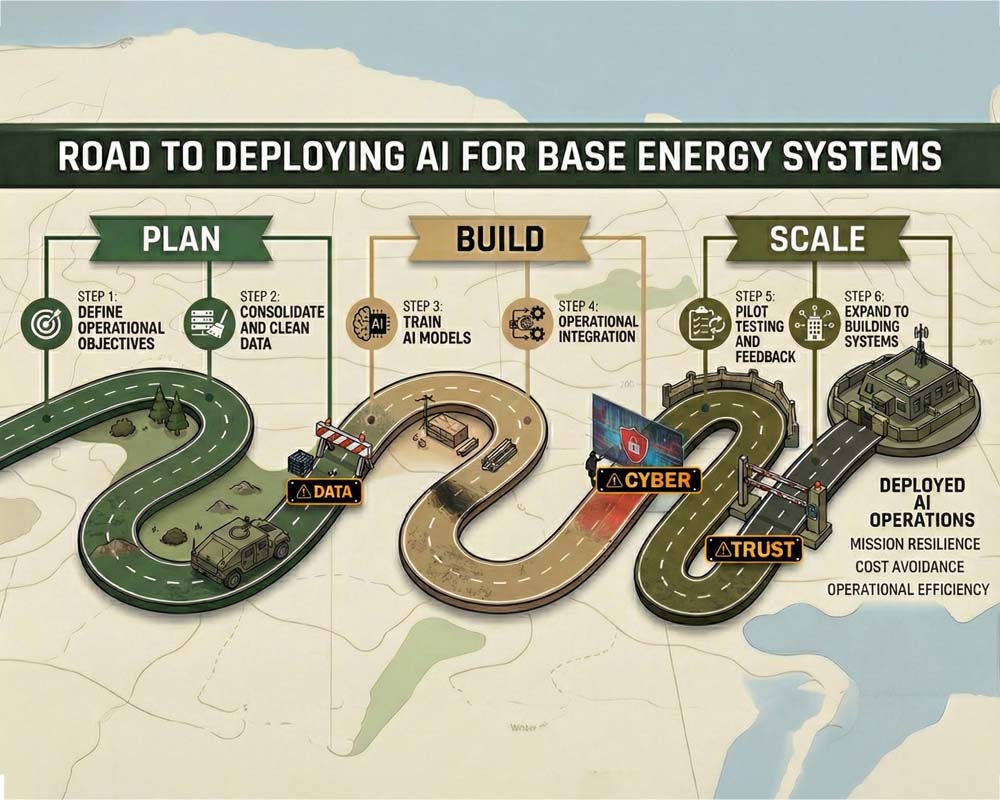
While AI presents significant opportunities, integrating it into mission-critical infrastructure introduces challenges that must be addressed for safe and effective use.
- Data Quality and Availability: AI relies on large volumes of clean, labeled data. In legacy energy systems, data may be inconsistent, missing, or siloed across platforms. Inaccurate data input leads to poor model performance, false alerts, or missed events.
- Model Transparency and Explainability: Many AI algorithms operate as black boxes. For mission-critical systems, operators and commanders need confidence in why a system recommends a particular control action. Lack of interpretability may lead to hesitation or underuse, or lack of assuredness in a decision.
- Cybersecurity Risks: AI components introduce new vectors for attack, especially when models ingest data from Internet of Things sensors or when communication occurs over unsecured protocols. Adversaries may try to spoof data, corrupt models, or hijack decision logic.
- Operational Trust and Adoption: The cultural barrier of trusting automated systems in defense environments is significant. Personnel accustomed to manual control may be resistant to ceding authority to an AI model, especially without maintaining clear oversight protocols.
To manage these risks while unlocking new potential, a combination of technical and organizational strategies is needed. Model architectures that allow operators to understand how conclusions were reached should be used. Techniques such decision trees, rule-based AIs, or SHAP values make outputs more transparent.
Maintaining human-in-the-loop governance is also key. Layered control strategies should be implemented, especially during initial deployment phases. Over time, automation can increase as trust builds—on this timeline, sustaining personnel involvement preserves human agency in decision liability.
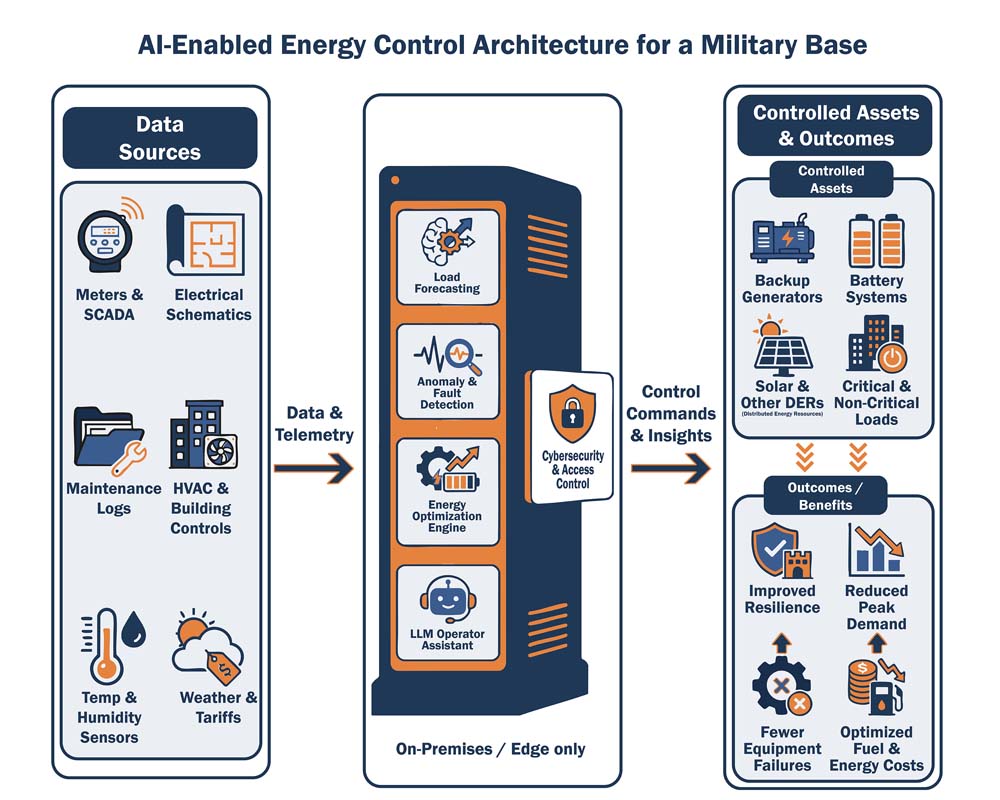
Additionally, models should be local or edge-based trained (with cloud-based training avoided). On-premises computational resources should be used to train and refine models with base-specific data, drawings, and layouts. This reduces latency, improves contextual performance, and enhances data security. When deployment begins, it should be incremental, starting with passive monitoring and alerting. Greater autonomous operation should only be advanced to after extensive testing and validation. Feedback loops should include operator review, performance auditing, and continual refinement.
To protect the physical components for the AI architecture, the systems should be placed within secured and isolated networks, with unnecessary internet connectivity avoided and practices applied following the DOD Risk Management Framework.
Studying Implementation
Recently, a representative military base with aging energy infrastructure and increasing operational demands initiated a phased effort to implement AI for energy resilience and system reliability. The initiative aimed to detect faults earlier, improve response time to anomalies, and optimize preventive maintenance workflows, all while complying with security and operational mandates.
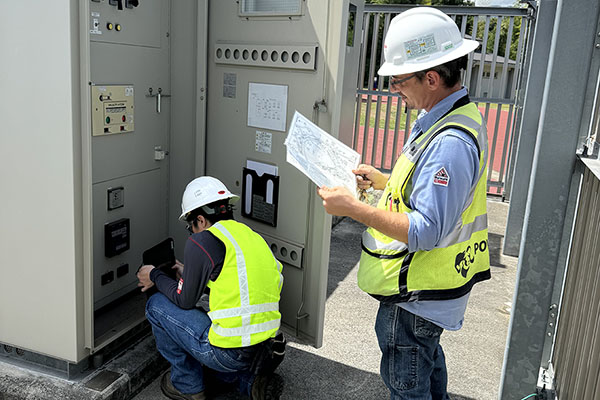
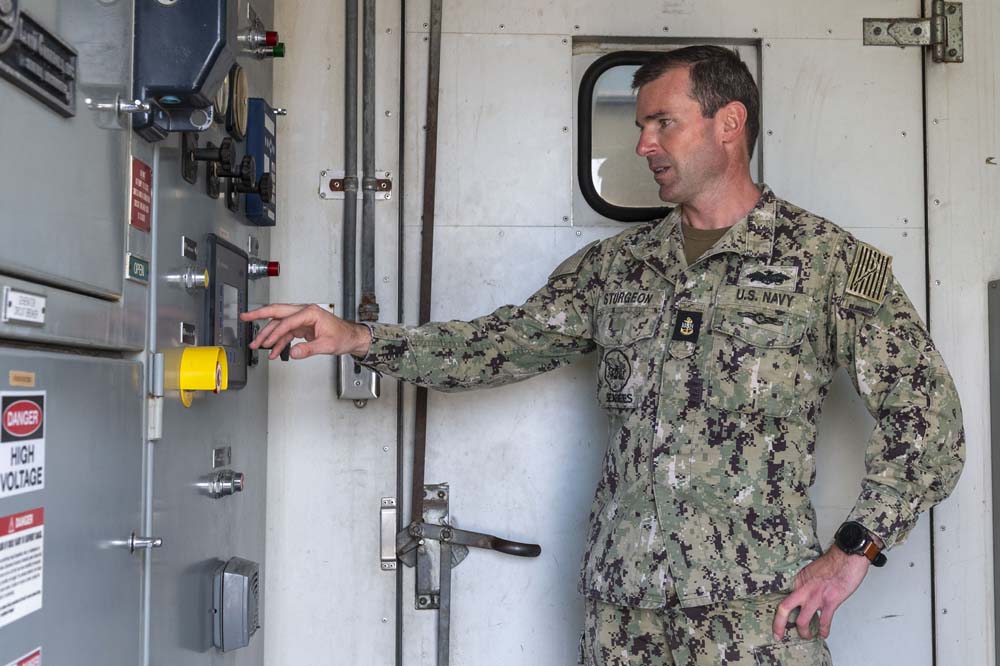
The energy management team first identified three priorities: reduce electrical equipment failures, strengthen anomaly detection, and improve maintenance planning. Early attention focused on medium‑voltage distribution systems, substations, and critical support facilities.
Next, data was collected from supervisory control and data acquisition systems, smart meters, maintenance logs, GIS layouts, and digitized engineering drawings. Sensors included in the data collection process comprised voltage, current, and frequency meters across feeders and switchgear; thermal sensors on transformers and in substations; environmental sensors capturing temperature, humidity, and air quality; and occupancy sensors within building systems.
Following data collection, engineers and technicians synchronized time series across sensor platforms to align operational events. They corrected inconsistent readings by filtering out spikes and filling gaps using interpolation and standardizing units and scales. They tagged operational states such as peak demand, maintenance mode, and normal load. Finally, they cross-validated sensor data against field observations and manual logs. These steps cleaned and prepared the data to train the AI model.
For unstructured data, such as schematics and equipment manuals, documents were converted into machine-readable text by optical character recognition. Named entity recognition and custom parsers were used to extract component labels, circuit IDs, and equipment types. Geolocation data from GIS was matched to schematic elements to create spatially aware models.
Leveraging Data
Once the data had been fully cleaned, the next step was to train the AI models. Unsupervised anomaly detection models helped establish baselines for normal system behavior and flag deviations, while fine-tuned large language models trained on technical documentation to interpret schematics and assist in identifying likely fault locations. This work all took place on secure, isolated edge-compute hardware within the base network. Encryption and role-based access was enforced to maintain security throughout the pipeline.
Once validated offline, the AI system was deployed within the base’s energy dashboard. It began generating real-time anomaly alerts and recommending specific cable segments or components for inspection. These alerts included explanations and confidence scores. Throughout a 90-day pilot phase, each alert was reviewed by the base energy and maintenance teams. Correct diagnoses were logged and model predictions were refined with new labeled data. Feedback from technicians helped calibrate thresholds and tune large language models prompts.
After successful validation, the team expanded it to HVAC and building systems. The AI identified inefficient scheduling patterns and faulty sensors. Once corrected, energy usage declined by more than 10 percent in targeted zones without affecting comfort or operations. From this deployment, the installation gained reduced reactive maintenance, earlier issue detection, better alignment of technician actions, and stronger mission resilience.
Securing Operations
As base energy systems grow more autonomous, energy managers must be equipped to lead AI adoption—bridging engineering and data science to enable resilient, efficient, and secure operations.
Leadership can support this evolution by funding cross‑functional pilots, expanding smart‑installation initiatives, enforcing cybersecurity oversight, and empowering installation teams to experiment, evaluate, and scale what works. By beginning with small, well‑scoped deployments and then building incrementally, military bases can develop secure, trustworthy systems that deliver real energy resilience.
Mina Yousef, P.E., PMP, CEM, is Energy Manager, Camp Lemonnier, Djibouti; mina.m.yousef.ctr@mail.mil.
Published in the March-April 2026 issue of The Military Engineer

Check Out Related Articles From TME
-

A Standardized Approach to Aircraft Fire Training Infrastructure
To support enterprise-wide airmen readiness, the U.S. Air Force is modernizing its standard design for aircraft fire training facilities—introducing digital controls, dual-fuel systems, and PFAS-conscious infrastructure. -
Delivering Energetic Materials Manufacturing Facilities
Designing and constructing facilities that manufacture, process, handle, or store explosives and energetic materials present some of the most challenging defense projects—requiring technical experience, strict safety protocols, and a comprehensive understanding of regulatory frameworks. -
Forging Tradition and Innovation: A New Design Standard at Camp Lejeune
The II MEF Headquarters at Camp Lejeune blends Georgian Revival architecture with modern sustainability—delivering durability, efficiency, and precision that meets contemporary functional requirements while honoring heritage. -

Balancing Efficiency and Fiscal Responsibility
The continuing contracts clause offers the U.S. Army Corps of Engineers a way to improve project delivery and enhance fiscal responsibility by aligning funding with project execution. -
Next Steps for Digital Twin Development
U.S. Forces Japan is laying the groundwork for future integration of digital twin technology in order to validate and collect data that will offer comprehensive insights into utility conditions at installations and enhance overall decision-making, efficiency, and resilience. -
Generating Agile Technology
Through a collaborative program with the Naval Facilities Engineering and Expeditionary Warfare Center, a team of engineering students designed and prototyped a generator powered by ocean movement, with the aim to support the energy needs of warfighters in contested logistics environments.