Measuring Readiness for Power Projection Platforms
By Maj. Linda Kuster, P.E., M.SAME, USAF
A cross-functional working group established by the Air Force Installation & Mission Support Center set out to validate and operationalize a new infrastructure readiness tool that would be designed to monitor installations as power projection platforms.
The combat support community has produced several installation health reporting tools to help leaders make more informed risk-based resourcing decisions. However, while efforts to surface the right type of data have been extensive, the tools were often disjointed—making a holistic vision of resourcing risks to critical capabilities difficult to depict. Additionally, the risk to the lethality of the installation as a power projection platform has routinely been outweighed by other organizations better at communicating resourcing risks to their critical missions.
To fill this critical gap for the combat support community, the Air Force Installation & Mission Support Center (AFIMSC), in 2024, conceptualized a groundbreaking tool, the Power Projection Platform Readiness and Installation Support Metrics (PRISM), to provide a mechanism for fully encompassing readiness measuring and monitoring of the installation as a power projection platform. The outcome is clear: to enable analysis of resourcing decisions and their impact on current and future readiness.
To finalize the development of PRISM, a 27-member cross functional working group was established in February 2025 and asked to identify and threshold enterprise readiness metrics for the Department of the Air Force.
The working group was given a three-step priority:
- Minimize the creation of new data gathering calls
- Maximize usage of existing metrics from enterprise databases
- Support the maturation of the PRISM framework
Through its research, the working group was able to align the tool’s framework with both service and joint doctrine, ultimately creating and sourcing metrics that will populate PRISM with informative, enterprise resourcing information.
Once fully operationalized, PRISM will provide a cross-functional representation of the capabilities that the combat support community should supply to equip lethality at a power projection platform. This design is intended to minimize stove-piping mission requirements based on career field; instead, entire capabilities, which often require a multitude of career fields, now will be more accurately depicted.
Sprinting For Success
The composition of the AFIMSC working group represented 12 different career fields, from the base and headquarters levels. Its initial review began getting an understanding of the mission sets that PRISM intended to capture. The group leads then set to align the PRISM framework with Air Force Policy Directive 4-0, Combat Support and Joint Publication 4-0, Joint Logistics. This gives more credibility to PRISM and ensures that the tool completely covers the core functions that an installation must provide as a power projection platform, agnostic of assigned missions at the base. The final framework consists of Provide Statements, Capabilities, and Readiness Metrics.
To operationalize PRISM, the group leads established three main objectives. First, draft metrics to best encompass the combat support community readiness for an installation as a power projection platform. Next, identify enterprise data sources for the desired metrics. Finally, review each metric to define specific thresholds. Once these objectives were set, the leads organized a series of three one-week, in-person sprints.
Finalizing the Framework. The first sprint session consisted of a gap analysis and working to finalize the framework. Once complete, the group leads facilitated assessment of sessions that asked for input from all members of the team against identified “Provide Statement” and “Capabilities.” The group members were then given time to reach out to others within their functional communities to draft and recommend metrics. At the end of Sprint One, a second group assessment reviewed each metric.
This step was critical to ensure that what should be measured was consistently applied throughout PRISM (and also what should not be measured). For example, the working group decided against measuring the readiness or performance of individuals and focused on whether units were adequately resourced to do their assigned tasks. The group members were tasked to continue brainstorming and developing metrics when they returned to their duty stations.
Identifying Data Sources. The group leads began the second sprint with a collective review of the proposed metrics and any additions to resynchronize the efforts. During this round, the working group found that that some of the proposed metrics were not tracked at an enterprise level, even though the subject matter experts believed the data had enterprise value. The working group decided to label these metrics as aspirational, indicating that while not currently tracked at an enterprise level, a valid requirement existed for readiness resourcing decisions to drive the creation of a new central database.
Throughout Sprint Two, team members identified enterprise data sources and recommended thresholds. When metric thresholds did not exist, the team leveraged the definitions of optimal, standard, minimum, and critical capabilities from the Air Force’s Capability Level Playbook to develop appropriate thresholds. At the conclusion of this sprint, 60 percent of the metrics identified were sourced and given thresholds, leaving 40 percent requiring further development.
Reporting Out. During the final sprint, the leads worked with AFIMSC-contracted data analysts to transform the PRISM model into the desired enterprise tool. They crafted three vignettes for the final out-brief that showcased PRISM’s ability to organize metrics into a useful hierarchy, analyze funding and policy courses of action across a future years defense program, and show the impact of manning cuts and reorganization on specific base capabilities.
In total, 19 “Provide Statements,” 110 “Capabilities,” and 443 “Readiness Metrics” were proposed.
Developing The Metrics
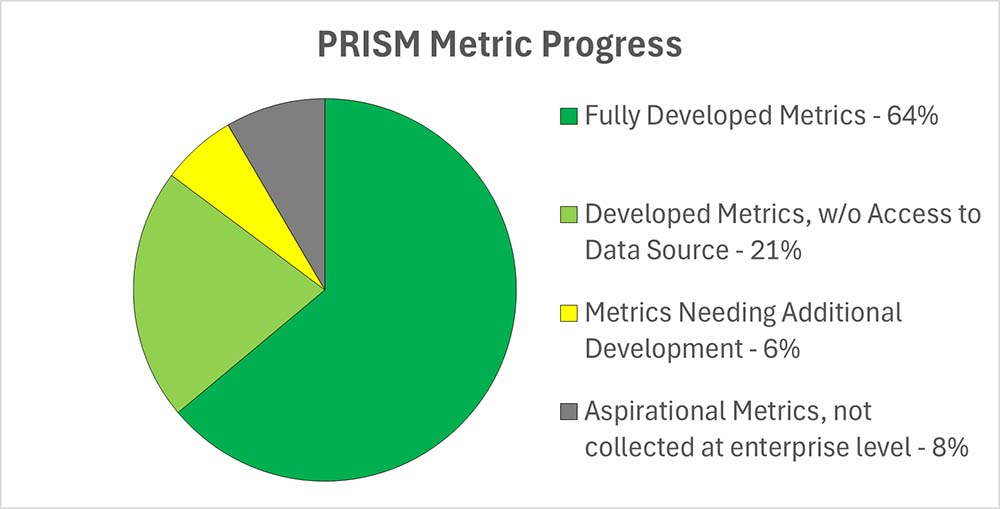
By the end of the three sprints, the working group fully developed 64 percent of the 443 Readiness Metrics by not only defining thresholds and data sources, but also ensuring that data sources were made available to the data analyst contract team through the defense data platform, ADVANA.
Of the metrics, 21 percent have a source data identified but were not yet available through ADVANA, and 6 percent of the metrics require additional development to either locate the source data or develop thresholds. Finally, 8 percent of the metrics were identified as aspirational, meaning that they are not currently tracked at the enterprise level but the working group believed they should be.
Currently, 70 data sources have been identified, while 35 of the 443 recommended metrics do not have a data source identified.
Risk-Informed Decisions
Once fully operationalized, PRISM will provide a cross-functional representation of the capabilities that the combat support community should supply to equip lethality at a power projection platform. This design is intended to minimize stove-piping mission requirements based on career field; instead, entire capabilities, which often require a multitude of career fields, now will be more accurately depicted. Once released, decision-makers will be able to use risk-informed data to make resourcing and policy tradeoffs.
While PRISM can be a great advantage, the tool is only as good as the data it receives. The working group recommended further development in the areas of data quality, standards, and update frequencies. Gathering quality data may require training to ensure that it is collected and reported in a consistent, reliable manner.

The AFIMSC-led working group also arrived at several other conclusions through its reviews, including recommending coordination of the proposed PRISM framework and metrics to headquarters-levels major commands. This coordination would ensure stakeholder buy-in of proposed thresholds as well as a review to determine that the right metrics were proposed to accurately capture each capability and provide statement.
Additionally, the working group identified three areas for future analysis. First, aspirational metrics should be reviewed and considered for development. Second, the group suggested that the PRISM tool quantify data confidence and conduct an aggregate security classification review. Third, data from enterprise sources could be refined to ensure that only units directly supporting the readiness of each power projection platform be considered.
PRISM is a promising asset for senior leadership to make risk-informed resourcing decisions. With the help of the supplying it with quality, relevant data, the tool will provide the combat support community with the empirical leverage needed to advocate for resourcing at an enterprise level.
Maj. Linda Kuster, P.E., M.SAME, USAF, is Basing & Beddown Branch Chief, Air Force Installation & Mission Support Center - Detachment 7; linda.kuster.1@us.af.mil.
Published in the September-October 2025 issue of The Military Engineer

Check Out Related Articles From TME
-

Innovative PFAS Remediation at Camp Grayling
For project stakeholders and remediation managers confronted with PFAS, Regenesis demonstrates the efficacy of using Regenesis’ PlumeStop® colloidal activated carbon (CAC) at Camp Grayling, Michigan. -
A Standardized Approach to Aircraft Fire Training Infrastructure
To support enterprise-wide airmen readiness, the U.S. Air Force is modernizing its standard design for aircraft fire training facilities—introducing digital controls, dual-fuel systems, and PFAS-conscious infrastructure. -
Delivering Energetic Materials Manufacturing Facilities
Designing and constructing facilities that manufacture, process, handle, or store explosives and energetic materials present some of the most challenging defense projects—requiring technical experience, strict safety protocols, and a comprehensive understanding of regulatory frameworks. -
Forging Tradition and Innovation: A New Design Standard at Camp Lejeune
The II MEF Headquarters at Camp Lejeune blends Georgian Revival architecture with modern sustainability—delivering durability, efficiency, and precision that meets contemporary functional requirements while honoring heritage. -

Balancing Efficiency and Fiscal Responsibility
The continuing contracts clause offers the U.S. Army Corps of Engineers a way to improve project delivery and enhance fiscal responsibility by aligning funding with project execution. -
Next Steps for Digital Twin Development
U.S. Forces Japan is laying the groundwork for future integration of digital twin technology in order to validate and collect data that will offer comprehensive insights into utility conditions at installations and enhance overall decision-making, efficiency, and resilience.