Measuring Success of an Onsite Wastewater System
By Steve Thibaudeau, P.E., and Isaiah Weilbaker, P.E.
The Louisville District of the U.S. Army Corps of Engineers played a critical role in designing an innovative septic mound system for the St. Charles Army Reserve Center, with recent evaluations indicating acceptable performance has been maintained years later.
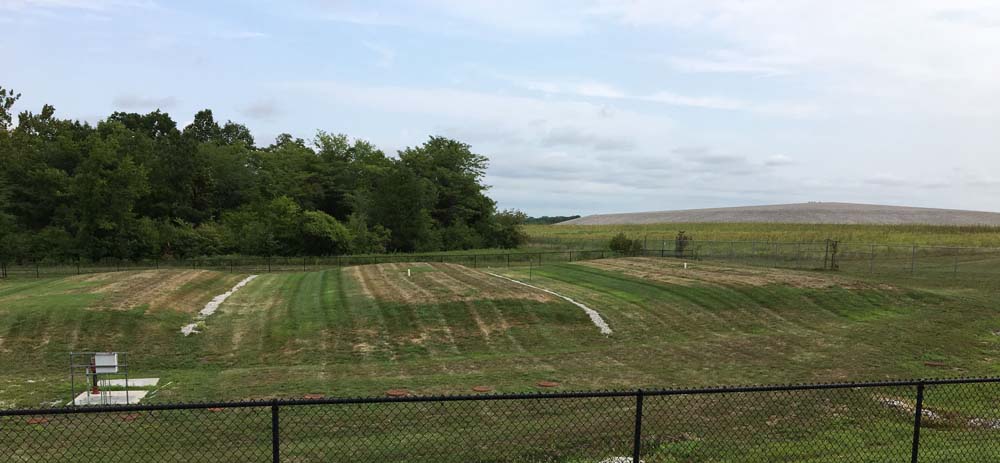
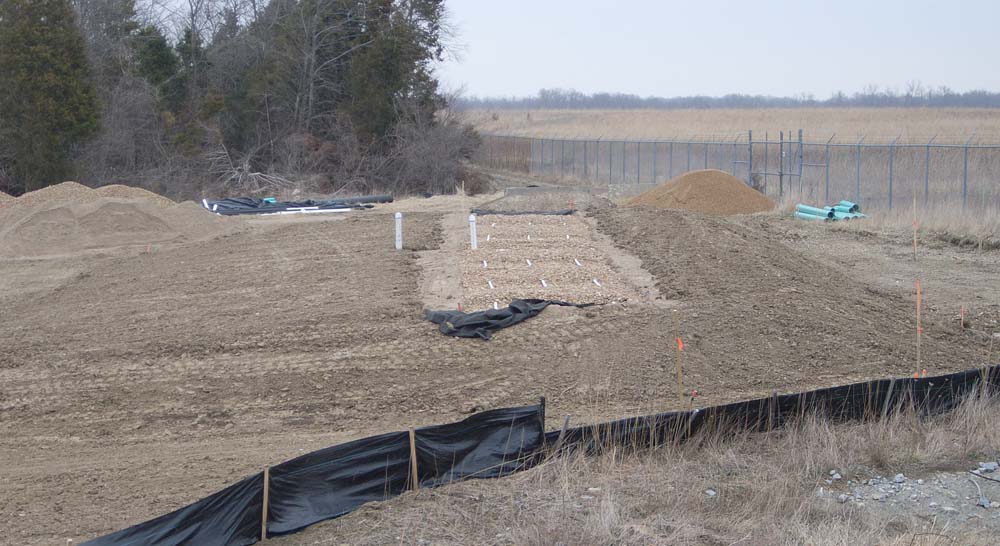
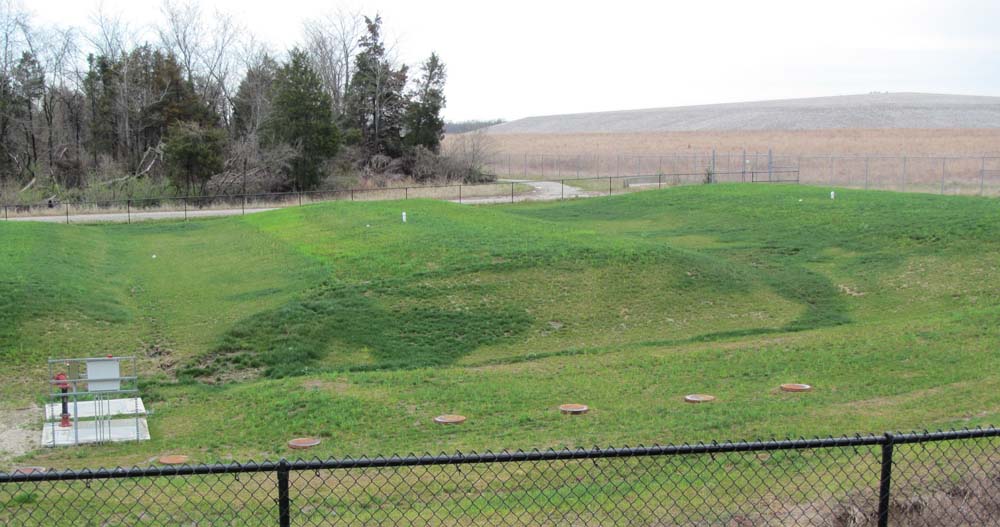
due to poor soil conditions that would not support a traditional septic system. Photos courtesy USACE Louisville District.
In the end, subgrade remediation, specifically pneumatic subgrade fracturing, was chosen as the optimal solution because it offered rapid, minimally invasive, and economical results.
Completed in June 2014, the St. Charles Army Reserve Center in Weldon Spring, Mo., consolidated several previous facilities across greater St. Louis, providing a collaborative space to support 600 servicemembers. A maintenance shop with several work bays and administrative areas were also part of the project, as well as a storage building. Adjacent infrastructure included parking for military vehicles and privately owned cars and trucks.
In order to efficiently utilize project funding, the 88th Reserve Division chose to locate the St. Charles Army Reserve Center on existing government property at the Weldon Spring Training Area, an Army Reserve facility located within the former Weldon Spring Ordnance Works in St. Charles County.
The ordnance works site, about 30-mi west of St. Louis and 14-mi southwest of the City of St. Charles, was originally built to produce explosives during World War II. During demolition of the original locomotive house and garage, and associated abandoned railroad tracks, crews noted that the site soils were saturated and soft in many areas. A track hoe even became stuck and sank up to the cab. Subsequent environmental and geotechnical investigations identified wetlands onsite, with clayey soils consisting of a lean clay stratum underlain by a high plasticity, “fat” clay.
To provide proper wastewater treatment, the Louisville District of the U.S. Army Corps of Engineers (USACE) played a critical role in designing an innovative septic mound system. This solution addressed unique site challenges such as poor soil conditions and environmental considerations and was instrumental in ensuring the facility’s sustainable operation moving forward.
Challenging Geology
The remote nature of the area required that the center have onsite wastewater treatment. An adjacent Army Reserve project constructed a few years earlier (St. Louis Army Reserve Center) had installed a typical septic tank and septic lateral field. However, the facility immediately encountered issues with the lateral field and assessed it to be non-functional. Failure of the lateral field necessitated the pumping of the septic tank about every four months, which has continued to the present.
The design team with Louisville District, after considering the challenges with the St. Louis Army Reserve Center septic system, the location of wetlands, the results of additional geotechnical field exploration, and the site topography, chose the most reasonable location at Weldon Spring for the septic system to support the St. Charles facility. Percolation testing in the area of the proposed septic field indicated poor soils for infiltration, having an average rate of about 118-min/in compared to the minimum desired value between 10-min/in to 60-min/in, according to the Missouri Department of Health and Senior Services.
While the soil conditions ruled out a conventional subsurface, trench type drain field, it was determined that a septic mound system could function properly, despite the site constraints.
Innovative Solution
A septic mound system places the effluent treatment area above the ground to overcome limits imposed by slowly permeable soils. The Missouri Department of Health & Senior Services allows elevated sand mounds “whenever site conditions preclude the use of absorption trenches.” Prior to finalizing a mound system design, Louisville District provided design calculations and plans to the wastewater system inspector, then met onsite to discuss. The county considered the design “an alternative septic system” and related requirements for the septic installer to have an advanced state license. These requirements were added to the project specifications.
Components of the onsite sewage disposal system consist of gravity sanitary sewer collection, grease trap, septic tanks in series, a triplex dosing chamber, and three elevated sand mounds.
- The septic tanks remove solids by settling and floatation, with some of the solids transformed into soluble material.
- They are then captured by a final effluent filter prior to entering the dosing chamber.
- The dosing chamber consists of two interconnected rectangular precast vaults and three alternating pumps.
- These transfer effluent, under pressure, to a distribution network of small diameter perforated PVC pipes installed in a gravel bed surrounded and underlain by coarse sand fill, then covered with topsoil.
- The pressure pipe network distributes the effluent uniformly over the absorption area of the mound.
- The effluent percolates through the mound sand fill and infiltrates into underlying soils.
- Finally, interceptor drains were constructed to divert surface and groundwater around the mound structures.
Controlling Seepage
About 10 months after the St. Charles Army Reserve center opened, a general site visit was conducted in April 2015 to identify any outstanding issues or new concerns covered under a standard one-year warranty. During the assessment, seepage, odors, and soft rutted soils (from mowing equipment) were observed at the toe of the mounds during this assessment. Knowing there was an issue affecting the septic system performance, construction personnel with the district continued to monitor the mounds.
In November 2015, designers investigated the cause and extent of the mound seepage. They conducted pumping volume testing, dye testing, and soil testing to determine the extent of the seepage issue. A local soil consulting firm obtained a total of nine soil samples from borings advanced within the mound footprints and adjacent to the mounds. Its evaluation concluded that the ground within the mound footprint was graded with unclassified fill material and compacted during construction, which created an impermeable surface that would not infiltrate effluent at the bottom of the sand fill media. Inflows from the perforated pressure pipes continued to enter the top layer of mound sand fill. Since this effluent could not penetrate the compacted soil interface at the bottom, the sand and topsoil mass became saturated. This increased internal hydraulic pressure until it exceeded the topsoil confinement pressure and became expressed as seepage.
The design team and facility staff considered a series of system restoration/reconstruction alternatives, but budgetary limitations and lack of additional land to accommodate construction or expansion of the septic system created challenges in selecting an appropriate repair action. In the end, subgrade remediation, specifically pneumatic subgrade fracturing, was chosen as the optimal solution because it offered rapid, minimally invasive, and economical results. This process deploys a long, narrow probe with a pneumatic hammer to penetrate soil to varying depths of 3-ft to 6-ft. Compressed air and polystyrene pellets are simultaneously injected into the soil at a controllable rate of up to 300-psi, which loosens compacted soils and creates a network of horizontal and vertical fissures. The pellets maintain open passages created by the injections of air.
In February 2016, the pneumatic fracturing operation was repeated in a predetermined, regular pattern over the affected area. In carrying out the operation, it was observed that the soil below the mounds was very difficult to penetrate with the machine probe. The unusual difficulty in penetrating the subgrade required an additional day of work. Positively, however, after the fracturing operation there was an immediate response of initial success as the water level in the monitoring wells dropped by about two inches.
Ongoing Performance
In August 2018, a follow-on site evaluation to Weldon Springs confirmed ongoing improvement of the septic system performance. No soft rutted soils or odors were observed at the toe of the mounds. Most recently, a visit in September 2025 showed acceptable system performance, with indications of some seepage. Initial evaluations point to either the system overloading due to significant water use increase at the facility, formation of a dense biomat causing reduced subgrade infiltration, or a combination of these factors.
Even so, through the collective efforts of the design and construction engineers, the septic system was successfully restored to expected functionality without loss of service to users and continues to meet the facility needs. Moving forward, additional operations and maintenance activities, as well as broader evaluation of increased site water usage, may be warranted to maintain reliable system functionality.
Steve Thibaudeau, P.E., is Civil Engineer, and Isaiah Weilbaker, P.E., is Civil Engineer, USACE Louisville District. They can be reached at stephen.c.thibaudeau@usace.army.mil; and isaiah.a.weilbaker@usace.army.mil.
Published in the January-February 2026 issue of The Military Engineer

Check Out Related Articles From TME
-

Innovative PFAS Remediation at Camp Grayling
For project stakeholders and remediation managers confronted with PFAS, Regenesis demonstrates the efficacy of using Regenesis’ PlumeStop® colloidal activated carbon (CAC) at Camp Grayling, Michigan. -
A Standardized Approach to Aircraft Fire Training Infrastructure
To support enterprise-wide airmen readiness, the U.S. Air Force is modernizing its standard design for aircraft fire training facilities—introducing digital controls, dual-fuel systems, and PFAS-conscious infrastructure. -
Delivering Energetic Materials Manufacturing Facilities
Designing and constructing facilities that manufacture, process, handle, or store explosives and energetic materials present some of the most challenging defense projects—requiring technical experience, strict safety protocols, and a comprehensive understanding of regulatory frameworks. -
Forging Tradition and Innovation: A New Design Standard at Camp Lejeune
The II MEF Headquarters at Camp Lejeune blends Georgian Revival architecture with modern sustainability—delivering durability, efficiency, and precision that meets contemporary functional requirements while honoring heritage. -

Balancing Efficiency and Fiscal Responsibility
The continuing contracts clause offers the U.S. Army Corps of Engineers a way to improve project delivery and enhance fiscal responsibility by aligning funding with project execution. -
Next Steps for Digital Twin Development
U.S. Forces Japan is laying the groundwork for future integration of digital twin technology in order to validate and collect data that will offer comprehensive insights into utility conditions at installations and enhance overall decision-making, efficiency, and resilience.