Navigating Challenges When Building Abroad
By Dan Lavarnway, P.E., S.E.
As U.S. strategic interests abroad evolve and require greater military construction investment, understanding the challenges and pitfalls that building abroad can pose is crucial in order to best control the cost and scheduling of a project.
When completing military construction projects within the United States, navigating obstacles is not easy, but often, concerns are familiar, anticipated, and can be worked into the cost and schedule. Overseas, however, new sets of challenges are frequently encountered—and they can be extremely difficult to navigate.
Understanding these varying pitfalls is crucial to maintaining the security and readiness of both missions and servicemembers.
Accessing Material
Sourcing quality-controlled material is a common variable faced when working internationally. Different countries favor other materials, steel shapes, and quality control procedures/measures that are unlikely to meet U.S. standards. This presents a challenge since most clients stateside, including the federal government, want conforming building materials and quality control measures.
Detailed specifications and general notes are the main vehicles used to convey the correct materials and quality control. Specifications must be edited carefully to meet the reality of local availability while still maintaining acceptable quality assurances.
In design-build, this can be assessed early on through conversations with the contractor and preliminary submissions, reducing the amount of rework. In design-bid-build projects with bridging documents, some re-designing may be required if steel grades or U.S. customary sizes are not locally available or are more costly than alternative options. Given the differences in materials, shapes, and quality control, engineers must review submittals and selected fabricators carefully to ensure the standards set by the specifications are met.
Steel Sourcing. It can be difficult to find steel fabricators that are ASTM/AWS/AISC-certified in remote areas, especially for smaller projects. In most cases, steel will have to be fabricated in a neighboring country and shipped to the site, as that is more cost-effective than shipping from the United States. It is usually acceptable to have a non-certified steel fabricator as long as they have previous experience in similar construction and an independent third-party testing agency is engaged to verify that the steel provided meets U.S. code/quality requirements.
For example, on a small steel canopy project in Baghdad, Iraq, the high seismicity of the region required the design to utilize a special lateral force resisting system (LFRS). As a result, steel special cantilever columns were selected for the construction. The Seismic Provisions for Structural Steel Buildings (AISC 341) has strict requirements for the material properties used in a special LFRS. The Turkish steel fabricator selected by the contractor could only provide grade S275 JR steel. This is similar to A36 steel, which is permitted to be used in a special LFRS by AISC 341, but only for W-Sections. To comply with the U.S. code requirements, the design of the special cantilever columns was changed from HSS sections to wide flange HE-sections to accommodate the shape and grade of steel that was locally available. The client was shown a comparison of the S275 JR steel to A36 steel, detailing how they are similar in chemical composition, yield and tensile strength, weldability, and with a similar prolonged yield curve.
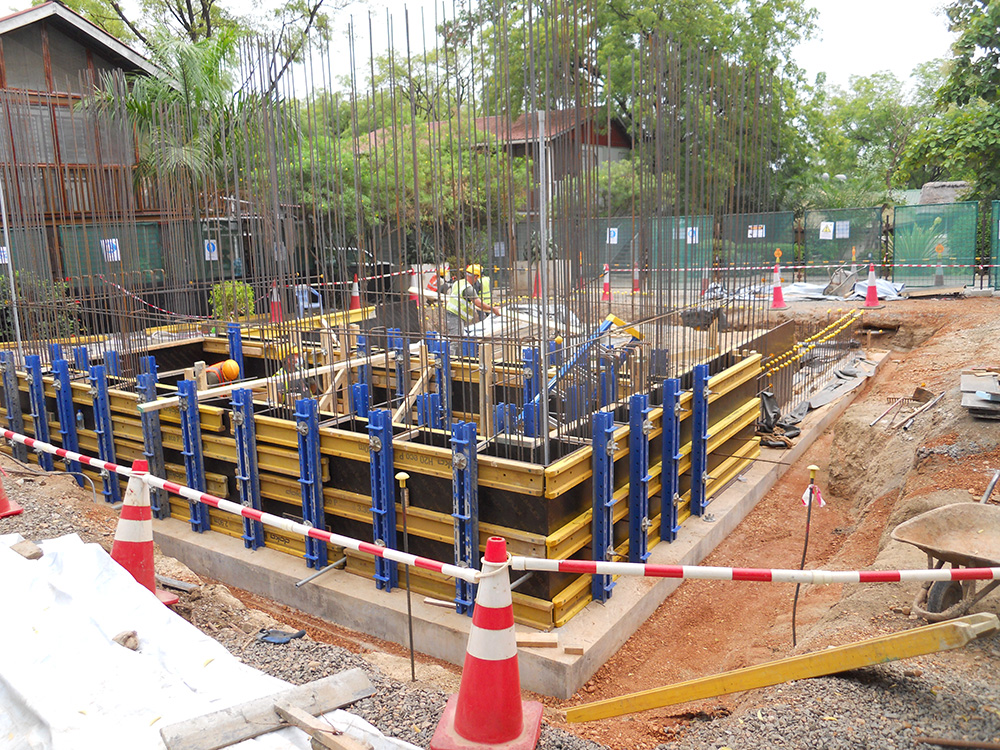
Concrete Sourcing. It is similarly difficult to obtain concrete in remote countries. Unlike steel, however, there are usually concrete batch plants in the host nation that can provide the required mix design. The main challenge with concrete in remote locations is reliable delivery. Many contractors have opted to have a small concrete batching plant on site that allows them to ensure there are no delays in production or delivery that could impede construction. Still, with this approach, the contractor and inspector must ensure that quality control procedures are in place, taking and testing concrete samples from each batch.
On a recent contract in Juba, South Sudan, a small onsite concrete batch plant was used to produce all the concrete required. The contractor provided sample cores for each batch, stored them for a period of seven and 28 days, and tested them in an onsite testing lab under the supervision of a third-party inspector. The contractor also coordinated the sourcing of all the material, testing agencies, and inspectors to ensure everything was in line with the specifications. These seemingly great lengths were required due to the absence of dependable concrete production in country.

Regional Hazards
While the United States has extreme weather conditions and natural hazards, U.S.-based engineers are largely familiar with the domestic environment and these hazards are codified in ASCE 7. Construction overseas faces many of the same hazards, but design information and severity can be difficult to obtain. Engineers must rely on local codes, client-provided information, or first-person accounts to get a working understanding of the regional hazards.
On a recent project for a lease fit-out of an existing building in Banja Luka, Bosnia and Herzegovina, completing the work first required the determination of the level of seismicity of the region. While onsite, the team was able to obtain the original design calculations (which is very rare); the building was designed to the Eurocode, which uses the Mercalli scale for seismicity and is not analogous to the seismic coefficients used in U.S. codes. Fortunately, the calculations listed the peak ground acceleration of the site. The team was able to convert this to Ss and S1 values used in the U.S. codes. The client found this approach acceptable and the retrofit design proved successful.
The main challenge with concrete in remote locations is reliable delivery. Many contractors have opted to have a small concrete batching plant on site that allows them to ensure there are no delays in production or delivery that could impede construction. Still, with this approach, the contractor and inspector must ensure that quality control procedures are in place, taking and testing concrete samples from each batch.
Codes and Permits
Local codes and permits are another unique facet of building abroad. In most overseas projects, engineers will need to provide a design that meets the more stringent of U.S. codes and local codes. While the U.S. codes are likely to govern, it is up to the engineer to verify which is more stringent and then align to that. Depending on the host country, translated versions of the local code can be difficult to obtain. For the same lease fit-out in Banja Luka, a local translator was employed to help translate pertinent sections of the code and existing drawings.
Permits can impact the schedule as well, especially when dealing with historic structures. For a recent project at the U.S. Embassy in Bern, Switzerland, because of historically significant features, the locality had to be involved for review at every stage of the project; this also restricted alterations to the building exterior. Due to the intricate nature of the historical reviews, a local architect was engaged to help navigate this process and the paperwork. Engaging with local subject matter experts is often the best practice when dealing with local code questions, local municipalities, and permits.
Successful Delivery
While there are unique challenges to building abroad, it is crucial to overcome them and provide construction that is delivered on schedule, with as few impediments as possible, and built to the U.S. government’s standards for quality, longevity, and durability.
Many U.S. facilities overseas are not just mission-critical; they offer a place of refuge for American citizens. Ensuring they are constructed to the required level of quality and security within the planned schedule is vital to continuity of operations.
Trusted Partnership
Using a trusted contractor is integral to delivering the design on time and up to standards for overseas projects. The demands placed on material quality, review comments, submittals, and inspections go above what most domestic projects require.
It is highly reasoned to engaged contractors that have experience working in country and globally, working with U.S.-based clients, and are familiar with both U.S. requirements and local code standards. Controlling these conditions will make a project more likely to find success in the end, in terms of operational capability and time/cost control.
Dan Lavarnway, P.E., S.E., is Senior Structural Engineer, Mason & Hanger; dan.lavarnway@masonandhanger.com.
Published in the November-December 2025 issue of The Military Engineer
Check Out Related Articles From TME
-

Innovative PFAS Remediation at Camp Grayling
For project stakeholders and remediation managers confronted with PFAS, Regenesis demonstrates the efficacy of using Regenesis’ PlumeStop® colloidal activated carbon (CAC) at Camp Grayling, Michigan. -
A Standardized Approach to Aircraft Fire Training Infrastructure
To support enterprise-wide airmen readiness, the U.S. Air Force is modernizing its standard design for aircraft fire training facilities—introducing digital controls, dual-fuel systems, and PFAS-conscious infrastructure. -
Delivering Energetic Materials Manufacturing Facilities
Designing and constructing facilities that manufacture, process, handle, or store explosives and energetic materials present some of the most challenging defense projects—requiring technical experience, strict safety protocols, and a comprehensive understanding of regulatory frameworks. -
Forging Tradition and Innovation: A New Design Standard at Camp Lejeune
The II MEF Headquarters at Camp Lejeune blends Georgian Revival architecture with modern sustainability—delivering durability, efficiency, and precision that meets contemporary functional requirements while honoring heritage. -

Balancing Efficiency and Fiscal Responsibility
The continuing contracts clause offers the U.S. Army Corps of Engineers a way to improve project delivery and enhance fiscal responsibility by aligning funding with project execution. -
Next Steps for Digital Twin Development
U.S. Forces Japan is laying the groundwork for future integration of digital twin technology in order to validate and collect data that will offer comprehensive insights into utility conditions at installations and enhance overall decision-making, efficiency, and resilience.