NO WATER, NO MISSION: Water Resilience is a Readiness Concern
By Nancy Balkus, P.E, SES, M.SAME, and Lauren Taylor
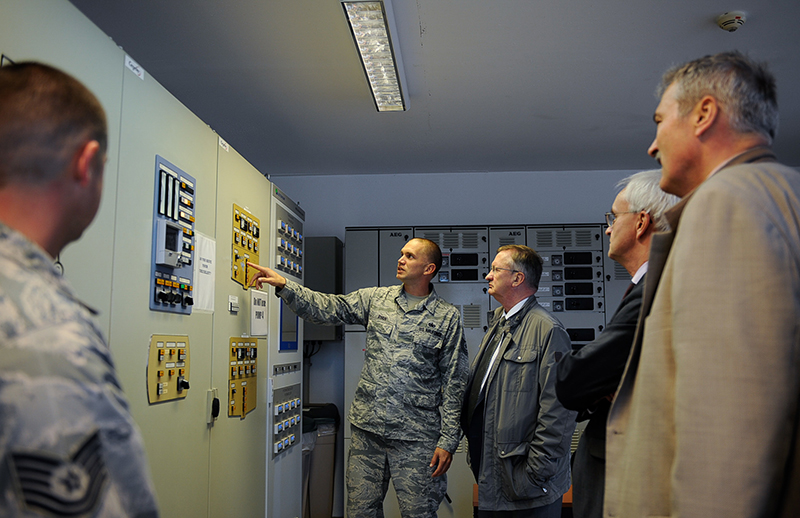
By helping to identify gaps in water resource infrastructure and procedures, water resilience readiness exercises across the Department of the Air Force represent the latest step toward greater mission assurance.
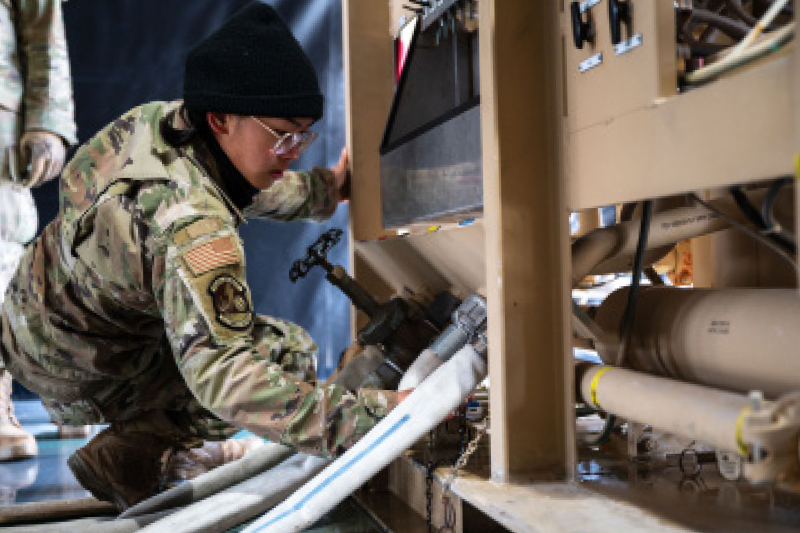
Photo courtesy SAF/IEE.
Water serves as a mission-critical resource, driving flightline operations, facility management, and base support functions across the Department of the Air Force. It powers essential systems, from aircraft wash racks and fire suppression units to dormitories and data centers. Its availability as well as proper wastewater and sewer maintenance are essential to the health and safety of airmen. Installations, however, have historically overlooked water system resilience compared to energy systems. Aging infrastructure, rising regional competition for water resources, supply disruptions, and deteriorating water quality pose serious risks to operational continuity.
As both global and regional pressures on water availability intensify, the department is taking decisive action to ensure installations can withstand water-related disruptions.
The Office of the Assistant Secretary of the Air Force for Infrastructure, Energy, and Environment (SAF/IEE) has launched a pilot program to conduct water resilience readiness exercises (WRREs). This investment marks a major strategic step toward integrating water resourcing considerations into mission assurance planning across the enterprise.
Roadmap to Success
The WRRE program launched in FY2023 with a strategic roadmap workshop where Department of the Air Force stakeholders defined pilot objectives, outlined desired outcomes, and aligned long-term efforts with mission goals. The workshop established a standardized, scalable program to serve installations with diverse mission sets and water system configurations.
In FY2024, SAF/IEE developed baseline WRRE exercise guidance that was based on additional feedback workshops. This step codified the approach, methodology, and key elements of the pilot WRREs and ensured consistent implementation across participating sites. Following the final pilot exercise at Kirtland AFB, SAF/IEE will refine this guidance to support future self-assessed water-mission resilience efforts.
Spanning FY2024 through FY2025, the WRRE program facilitated water tabletop exercises and generated installation-specific lessons-learned reports. These analyses identified water system vulnerabilities and highlighted opportunities to enhance resilience. Each report not only informs immediate base-level planning but also shapes broader policy development.
During FY2025 and FY2026, SAF/IEE will evaluate the effectiveness of WRREs in identifying water resilience gaps and guiding future policy. This phase will include developing tailored guidance for enterprise policy updates, education and training requirements, and funding prioritization. The goal is to translate WRRE findings into actionable pathways that connect planning, budgeting, and policymaking across the department.
Testing Preparedness
WRREs actively simulate water disruption events through scenario-based table-top exercises to assess their impact on mission operations. By mirroring energy resilience readiness exercises, WRREs stress-test the preparedness of installations, promote coordinated planning, and identify gaps in infrastructure and procedures before disruptions occur.
These exercises, with a shared end-goal, unite installation stakeholders (including civil engineers, mission owners, emergency managers, utility partners, and leadership) to collaboratively work through potential responses and consequences in a low-risk setting. Participants analyze how a disruption unfolds, evaluate the speed of existing systems and teams in responding, and assess potential secondary consequences. After the completion of each exercise, the WRRE generates a tailored after-action report that highlights key vulnerabilities and strengths as well as opportunities for improving resilience.
Strengthening Security
The WRRE pilot program will play a pivotal role in the Department of the Air Force’s water resilience initiatives by directly enhancing mission resilience against short-term water supply disruptions at the installation level. In contrast, the broader Water Security Program is designed to tackle long-term water availability challenges across the enterprise, such as declining aquifers and reduced surface water flows, that could threaten mission assurance over time.
While WRREs validate operational readiness through scenario-based exercises, the Water Security Program provides a strategic framework to identify, mitigate, and adapt to systemic water risks. Together, these initiatives empower the department to respond effectively to immediate water disruptions while securing essential long-term water resources for mission success.
WRREs actively strengthen mission assurance goals by delivering multiple benefits.
Mission-Centric Risk Assessment: Installations map water usage directly tied to mission functions, allowing them to identify and prioritize their most critical dependencies.
Enhanced Preparedness: Holding table-top exercises builds awareness of response roles and stress-tests contingency plans in low-risk environments.
Cross-Functional Collaboration: WRREs unite diverse stakeholders, fostering joint planning that ensures rapid, coordinated response.
Scalable Policy Development: Findings from WRREs shape policy guidance, strengthen future exercises, and guide infrastructure planning across the enterprise.
Ultimately, WRREs do not focus on solving isolated challenges at individual bases. Instead, they equip every location with a strategic roadmap to strengthen resilience against water disruptions that could impact mission readiness.
Support for Mission Assurance and Planning: WRREs provide clear insight into how water system vulnerabilities can disrupt operations and degrade mission execution. By pinpointing gaps in preparedness and response capabilities, WRREs justify resilience planning, prioritize actions that safeguard mission continuity, and enable leadership to align future resilience activities with operational requirements.
Each WRRE pilot engages installations with diverse water systems and operational characteristics. An installation, for example, may rely on a utility provider as its primary water source, while the Department of the Air Force owns the water treatment, storage, and distribution systems. Local community partners actively participate in table-top exercise discussions, strengthening regional coordination. Another installation may operate a privatized water system with on-site wells and backup utility supply lines, alongside water and industrial wastewater treatment systems that directly support mission activities.
The WRRE pilot program goes beyond one-off tabletop exercises. It is a deliberate, phased effort to embed water resilience into mission assurance planning at the installation level and service-wide. This process depends on collaboration with a range of department stakeholders, ensuring WRRE outcomes integrate into policy and programming across all relevant functional areas. Reporting mechanisms will include installation-level after-action reports shared with personnel and, when applicable, with the Office of Local Defense Community Cooperation. Broader enterprise insights will be accessible through CE DASH’s “Water Resilience” webpage and the Water Dashboard.
The WRRE pilot program goes beyond one-off tabletop exercises. It is a deliberate, phased effort to embed water resilience into mission assurance planning at the installation level and service-wide.
Enterprise Impact
Ultimately, WRREs do not focus on solving isolated challenges at individual bases. Instead, they equip every location with a strategic roadmap to strengthen resilience against water disruptions that could impact mission readiness.
SAF/IEE will continue expanding the program through FY2025 and beyond. The focus will be on developing training materials, standardizing the exercise process, and creating self-guided tabletop formats for installations to use. The department plans to integrate WRRE findings with geospatial water risk assessments, utility interdependence modeling, and other advanced tools under the water security program. This will deliver deeper insights into resilience challenges and solutions.
By institutionalizing water resilience alongside energy assurance, mission continuity is strengthened.
Significant Shift
WRREs mark a significant shift in how the Department of the Air Force approaches mission assurance in a resource-constrained world.
By bringing water into the resilience conversation and linking site-level insights with enterprise-wide policy, the WRRE program reinforces the ability to project power, ensure warfighter lethality, and operate effectively anytime, anywhere. Through WRREs, installations will better be able to withstand disruptions caused by natural conditions, infrastructure failures, or adversarial actions.
WRREs in Action
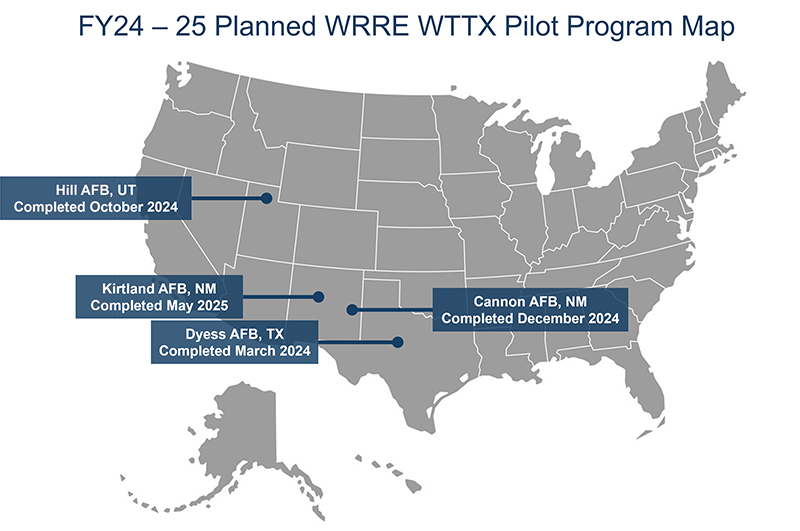
The WRRE pilot program launched its first exercise in March 2024 at Dyess AFB, Texas, following a full year of planning and coordination. This inaugural event set a critical foundation for future implementation across the enterprise.
Building on this momentum, SAF/IEE led tabletop exercises at Hill AFB, Utah, in October 2024, applying lessons learned from Dyess and leveraging insights from the ERRE programs. These efforts demonstrated how water system vulnerabilities vary by region and mission type, reinforcing the need for a scalable, adaptable WRRE framework.
More recently, SAF/IEE collaborated with MIT Lincoln Laboratory to conduct two additional pilots, both in New Mexico—at Cannon AFB in December 2024 and at Kirtland AFB in May 2025. These installations each provide unique opportunities to evaluate resilience strategies in highly arid environments with distinct water supply challenges.
Nancy Balkus, P.E, SES, M.SAME, is Deputy Assistant Secretary of the Air Force for Infrastructure, Energy, and Environment, and Lauren Taylor, is Strategic Communications Analyst, Office of the Deputy Assistant Secretary of the Air Force for Infrastructure, Energy, and Environment. They can be reached at nancy.balkus@us.af.mil; and lauren.taylor.10.ctr@us.af.mil.
Published in the July-August 2025 issue of The Military Engineer
Check Out Related Articles From TME
-

Innovative PFAS Remediation at Camp Grayling
For project stakeholders and remediation managers confronted with PFAS, Regenesis demonstrates the efficacy of using Regenesis’ PlumeStop® colloidal activated carbon (CAC) at Camp Grayling, Michigan. -
A Standardized Approach to Aircraft Fire Training Infrastructure
To support enterprise-wide airmen readiness, the U.S. Air Force is modernizing its standard design for aircraft fire training facilities—introducing digital controls, dual-fuel systems, and PFAS-conscious infrastructure. -
Delivering Energetic Materials Manufacturing Facilities
Designing and constructing facilities that manufacture, process, handle, or store explosives and energetic materials present some of the most challenging defense projects—requiring technical experience, strict safety protocols, and a comprehensive understanding of regulatory frameworks. -
Forging Tradition and Innovation: A New Design Standard at Camp Lejeune
The II MEF Headquarters at Camp Lejeune blends Georgian Revival architecture with modern sustainability—delivering durability, efficiency, and precision that meets contemporary functional requirements while honoring heritage. -

Balancing Efficiency and Fiscal Responsibility
The continuing contracts clause offers the U.S. Army Corps of Engineers a way to improve project delivery and enhance fiscal responsibility by aligning funding with project execution. -
Next Steps for Digital Twin Development
U.S. Forces Japan is laying the groundwork for future integration of digital twin technology in order to validate and collect data that will offer comprehensive insights into utility conditions at installations and enhance overall decision-making, efficiency, and resilience.