Advancing Energy Security
for Agile Combat Employment in the Indo-Pacific
By Col. Douglas Tucker, M.SAME, USAF (Ret.), and Caitlin Jones
New research conducted by the Office of the Deputy Assistant Secretary of the Air Force for Infrastructure, Energy, and Environment focused on the unique energy security challenges within the Indo-Pacific and their implications for operational capabilities.
Energy is a common thread for every mission the Department of the Air Force undertakes. From powering intelligence systems and surveillance assets to fueling aircraft for global strike missions, energy is an indispensable enabler for national defense. The department is critically dependent on reliable and resilient energy to deliver each of its five core missions: air and space superiority; intelligence, surveillance, and reconnaissance; rapid global mobility; global strike; and command and control.
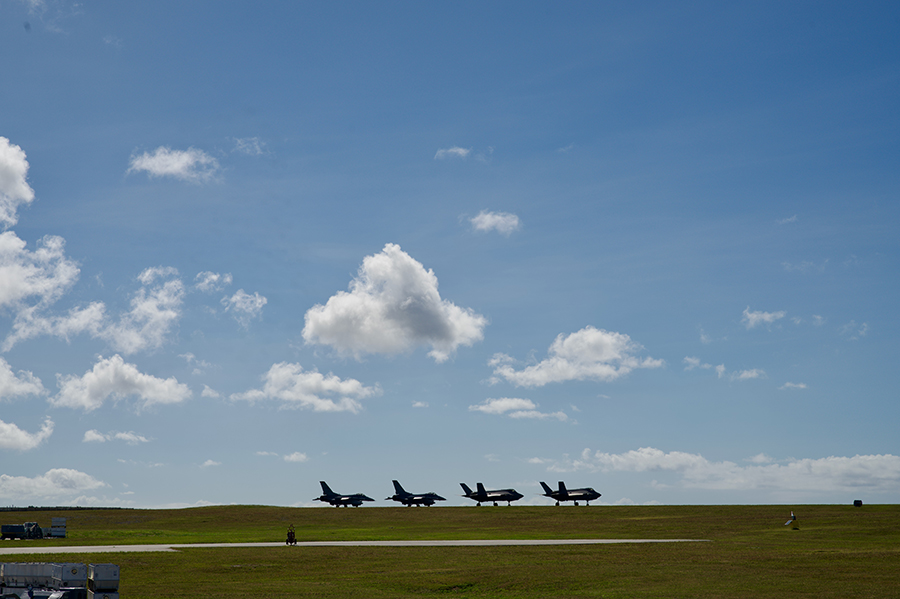
Unlike other military services that may maneuver forces across a battlespace, the U.S. Air Force fights from its installations. These physical platforms, whether temporary forward-operating or established airfields, serve as the foundation for projecting combat power. Therefore, the resilience and reliability of energy systems at these sites directly impacts operational success. Energy must be available in contested, degraded, and austere environments, where traditional supply chains may be disrupted or infeasible. At the same time, missions increasingly are relying on complex information systems, growing the overall energy demand in expeditionary environments. The Department of the Air Force defines energy security as “the state of having assured access to reliable supplies of energy and the ability to protect and deliver sufficient energy to meet mission requirements” in Air Force Policy Directive 90-17.
The Indo-Pacific is increasingly recognized as a central theater in strategic competition, particularly between the United States and China. U.S. strategy in the region hinges on a combination of deterrence, strategic depth, and allied cooperation. Key to this is what the Department of Defense refers to as the First and Second Island Chains, which are geographic constructs used to describe layers of regional defense and power projection.
The First Island Chain includes countries and territories such as Japan, Taiwan, and the Philippines. The Second Island Chain encompasses Guam, the Commonwealth of the Northern Mariana Islands, and Palau. Where the First Island Chain focuses on denying adversarial advances, the Second Island Chain provides strategic depth for reconnaissance, logistics, and strike capabilities. Sustaining dispersed operations across these chains poses significant logistical challenges, particularly related to energy.
Agile Combat Employment was developed as a response to this emerging threat environment. It calls for the deployment of smaller, agile teams to a network of dispersed locations, intending to complicate an adversary’s decision-making while preserving the ability to generate combat power.
While bolstering survivability, this scheme of maneuver also introduces complex, dynamic energy demands. It requires mobile, scalable, and autonomous energy solutions capable of operating independently or in concert with host-nation infrastructure. Energy becomes not simply a logistical concern, but a strategic asset central to force projection and sustainment.
The department aims to adapt proven resilience principles to unique geopolitical, environmental, and infrastructural realities. This includes not only updating planning metrics and criteria but fostering partnerships with allies and local stakeholders.
Encountering Challenges
Historical context underscores the magnitude of energy challenges in the Indo-Pacific. During World War II, the United States maintained over 90 overseas air bases globally. Today, that number has dwindled to just 33. Many of the former sites in the Pacific have been reclaimed by nature, degraded by time, or rendered inoperable by corrosion and lack of infrastructure investment.
In evaluating the region’s current energy security landscape, the Office of the Deputy Assistant Secretary of the Air Force for Infrastructure, Energy, and Environment (SAF/IEE) reviewed more than 30 sources of literature from academia, government, and industry. This research illuminated a complex and unique set of energy challenges faced by Pacific Island countries and territories. These challenges are of interest to the Department of the Air Force, as many of the territories and host nation islands serve as strategic nodes in Agile Combat Employment and other distributed operations.
Geographic Limitations. The region’s energy systems are characterized by a high dependence on imported oil and diesel. The Pacific Centre for Renewable Energy and Energy Efficiency found that in 2016, more than 80 percent of energy consumption from Pacific Island countries and territories was from imported oil. These supplies are subject to global price fluctuations and are typically delivered “just-in-time” due to limited storage infrastructure. Bulk fuel storage is often in poor condition and located in low-lying coastal areas vulnerable to flooding.
Beyond fuel, the electric grid infrastructure is well beyond its 30-year useful service life, is under-resourced, and possibly insufficient for supporting modern military operations. Limited interconnection across islands, reliance on overhead power lines, and vulnerability to high typhoon winds and floods all pose challenges to reliability and resilience. When electric infrastructure does break down, restoration timelines are significant. Energy system components are often unavailable locally and have long shipping times to the Pacific. The region also lacks the technical workforce to build, operate, and maintain advanced energy systems without external support.
Even as microgrid systems gain traction, their integration into the energy portfolios of Pacific Island countries and territories presents its own set of challenges. In many cases, the high upfront investment needed for advanced energy systems limits adoption, particularly for island governments that may be dealing with narrow economic bases and high public debt.
Critical transportation and communications infrastructure further complicate energy resilience within the vast region. Limited road networks and port capabilities restrict the delivery of equipment and supplies. Patchy communications networks hinder energy monitoring, grid control, and coordination. In remote island communities, these challenges are magnified as the digital divide widens.
Metrics For Security
The Department of the Air Force has a structured approach to energy and water resilience through the 5Rs Framework, as outlined in Air Force Policy Directive 90-17 and DAF Instruction 90-1701. The five key attributes of resilience (Robustness, Redundancy, Resourcefulness, Response, and Recovery) guide the development, assessment, and implementation of energy resilience measures across installations.
These attributes are divided into preventative and performance categories. Preventative attributes describe how a system plans and prepares for disruptions. Performance attributes focus on how well the system operates during a crisis event. Together, the framework informs planning for installations globally, offering a consistent and adaptable framework for energy risk management.
Quantitative Analysis. From the 30 pieces of literature SAF/IEE reviewed, more than 260 metrics, both qualitative and quantitative, were identified that were posited as being important measures or considerations for regional energy security in the Indo-Pacific. For organizational benefits, SAF/IEE assigned 20 metrics tags to bundle similar metrics such as those related to energy cost, risk, or demand. Metrics also were classified as either quantitative or qualitative. Quantitative metrics were defined as those that could be numerically measured, whereas qualitative metrics were defined as those with binary response options.
SAF/IEE reviewed and mapped the metrics to each of the 5Rs and their subcategories to examine what unique regional considerations should complement decision-making and analysis in the Indo-Pacific. Of the over 260 total quantitative and qualitative metrics identified in literature, SAF/IEE was able to map 60 to the framework by aligning similar metrics characteristics.
Energy security in the theater is a multi-dimensional challenge that intersects national security, logistics, infrastructure, and diplomacy. Strategic investments in modular microgrids, containerized power solutions, and deployable energy storage systems could offer immediate benefits while laying the groundwork for longer-term transformation.
Comparing Factors
Among the quantitative metrics analyzed, SAF/IEE determined that the metrics associated with energy sources, infrastructure, imports, and energy demand were well-accounted for in the 5Rs. Conversely, metrics associated with energy costs, transportation infrastructure, information technology connectivity, education, training, and jobs may have unique regional factors for consideration. From the qualitative metrics, SAF/IEE determined that metrics associated with cyber security, energy diversity, and recovery were accounted for in the framework, but that opportunities exist to improve coordination in areas such as policy and plans development and finance and contracting where Pacific Island countries and territories may be lacking institutional capacity.
This analysis revealed that the 5Rs framework could be enhanced in regional-specific applications by considering metrics such as transportation infrastructure, information technology connectivity, and the importance of relationships for partnerships and planning.
Comprehensive Approach
The integration of regional considerations into the Department of the Air Force’s resilience approach reflects a broader shift toward contextualized planning and decision-making. The department aims to adapt proven resilience principles to unique geopolitical, environmental, and infrastructural realities. This includes not only updating planning metrics and criteria but fostering partnerships with allies and local stakeholders. Host-nation engagement, interagency collaboration, and industry participation are all critical to building energy systems that are secure and resilient in the Indo-Pacific.
Energy security in the theater is a multi-dimensional challenge that intersects national security, logistics, infrastructure, and diplomacy. Strategic investments in modular microgrids, containerized power solutions, and deployable energy storage systems could offer immediate benefits while laying the groundwork for longer-term transformation. For the Department of the Air Force, ensuring mission assurance in the Indo-Pacific requires a comprehensive approach to energy assurance that incorporates the full range of regional variables, from infrastructure vulnerabilities to geopolitical realities.
A region-specific lens will enable the department to deliver energy and project power where and when it is needed most. SAF/IEE’s efforts to assess, map, and integrate regional energy considerations into the 5Rs framework represent a crucial step in tailoring energy resilience to support Agile Combat Employment and other operational priorities. As the Department of the Air Force evolves its approach moving forward, continued research, stakeholder engagement, and innovation will be critical to meeting the energy needs of tomorrow’s missions.
Col. Douglas Tucker, M.SAME, USAF (Ret.) is Director of Installation Energy Policy & Programs, Department of the Air Force, douglas.tucker.4@us.af.mil.

Caitlin Jones is Senior Energy Resilience Analyst, Concurrent Technologies Corp.; jonesca@ctc.com.

The views expressed are those of the authors and do not reflect the official guidance or position of the United States Government, Department of Defense, U.S. Air Force or U.S. Space Force.
Published in the July-August 2025 issue of The Military Engineer

Check Out Related Articles From TME
-

Innovative PFAS Remediation at Camp Grayling
For project stakeholders and remediation managers confronted with PFAS, Regenesis demonstrates the efficacy of using Regenesis’ PlumeStop® colloidal activated carbon (CAC) at Camp Grayling, Michigan. -
A Standardized Approach to Aircraft Fire Training Infrastructure
To support enterprise-wide airmen readiness, the U.S. Air Force is modernizing its standard design for aircraft fire training facilities—introducing digital controls, dual-fuel systems, and PFAS-conscious infrastructure. -
Delivering Energetic Materials Manufacturing Facilities
Designing and constructing facilities that manufacture, process, handle, or store explosives and energetic materials present some of the most challenging defense projects—requiring technical experience, strict safety protocols, and a comprehensive understanding of regulatory frameworks. -
Forging Tradition and Innovation: A New Design Standard at Camp Lejeune
The II MEF Headquarters at Camp Lejeune blends Georgian Revival architecture with modern sustainability—delivering durability, efficiency, and precision that meets contemporary functional requirements while honoring heritage. -

Balancing Efficiency and Fiscal Responsibility
The continuing contracts clause offers the U.S. Army Corps of Engineers a way to improve project delivery and enhance fiscal responsibility by aligning funding with project execution. -
Next Steps for Digital Twin Development
U.S. Forces Japan is laying the groundwork for future integration of digital twin technology in order to validate and collect data that will offer comprehensive insights into utility conditions at installations and enhance overall decision-making, efficiency, and resilience.