Clearing the Fog:
Path to Environmental Recovery at NAAS Arcata
By Sommer Carter, PMP, M.SAME, Lori Kropidlowski, M.SAME, and Antonio Lippa, M.SAME
After an intensive seven-year effort to remove contaminants from historical training practices and remediate Naval Auxiliary Air Station Arcata in Northern California, the base is no longer listed for cleanup as a Formerly Used Defense Site.
California’s northern coast is synonymous with massive redwoods, sweeping forests, rugged shoreline, and breathtaking views. Aircraft pilots know it for another reason: pervasive fog. Naval Auxiliary Air Station (NAAS) Arcata, located in Humboldt County, south of the Oregon border, is so frequently socked in that the U.S. Navy used the installation to test defogging systems and train aviators to fly in limited visibility conditions during World War II and in the years after.
The use of a fuel-fired defogging system also was a key factor that led to NAAS Arcata being classified as a Formerly Used Defense Site (FUDS). This federal list denotes prior military bases that have been flagged for cleanup. A seven-year remediation effort at Arcata concluded in June 2025, when the site achieved a coveted status: No Further Action/Case Closure.
Overcoming Prior Impacts
The Landing Aids Experiment Station at Arcata was a joint project of the Navy along with the U.S. Air Force and Civil Aeronautics Administration. It was coordinated by the Navy Bureau of Aeronautics to test different landing aids, including the Fog Investigation and Dispersal Operation (FIDO), a system designed to support aircraft in adverse flying conditions. Notably, a Southwest Airways Douglas DC-3 made the world’s first blind landing at Arcata in December 1947, relying on ground-controlled approach radar, instrument landing system, and FIDO.
FIDO operated like a large, open gas grill with burners lining the airport’s two runways, which allowed the flames to “burn off” the fog. By churning through fuel at the rate of 100,000-gal/hour, FIDO could produce sufficient heat to lift fog and enable pilots to take-off and land safely. The system was used at 15 airfields around the United Kingdom, as well as a few in the United States and in the Aleutian Islands.
The property comprising NAAS Arcata was transferred to Humboldt County in 1956 through a quit-claim deed, and the county has since operated a regional airfield (California Redwood Coast-Humboldt County Airport) with commercial airlines and aeronautical businesses on the grounds along with a U.S. Coast Guard station.
When FUDS was created in the mid-1980s, NAAS Arcata was placed on the list. Through that program, over 5,400 military sites were identified for investigation and cleanup, with the work overseen by the U.S. Army Corps of Engineers (USACE). As of May 2024, more than 3,800 FUDS locations had been closed out, but that still leaves 1,600 requiring cleanup.
Removing the FIDO system and supply lines was the last FUDS project linked to the Arcata site. USACE Sacramento District contracted Ahtna Solutions LLC Southwest Environmental Team to perform a remedial site investigation, remove waste and artifacts related to FIDO, and conduct the site remediation.
Flying Without Plans
While the 676-acre site had no as-built drawings of the FIDO system, there were design drawings indicating about 40,000-ft of buried and exposed distribution pipeline flanking both sides of the runways. Another 2,000-ft of buried supply pipeline connected a railcar unloading station across Highway 101 from the airport to a tank farm with six 50,000-gal above-ground storage tanks.
Cleanup work at Arcata had started back in 1995 and began with the removal of some underground storage tanks and a small section of FIDO piping. This was followed by additional underground tank removals and groundwater monitoring through 2006. Several years later, both USACE and airport stakeholders held meetings between 2016 and 2018 to determine the path forward for investigation and remediation of the remaining FIDO system infrastructure.
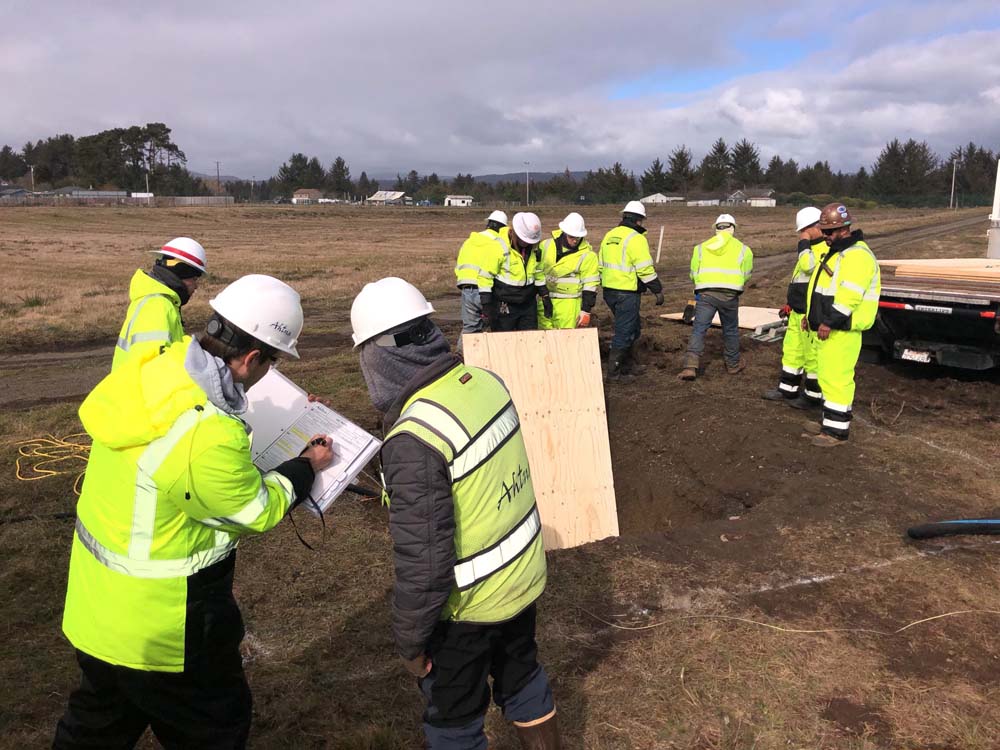
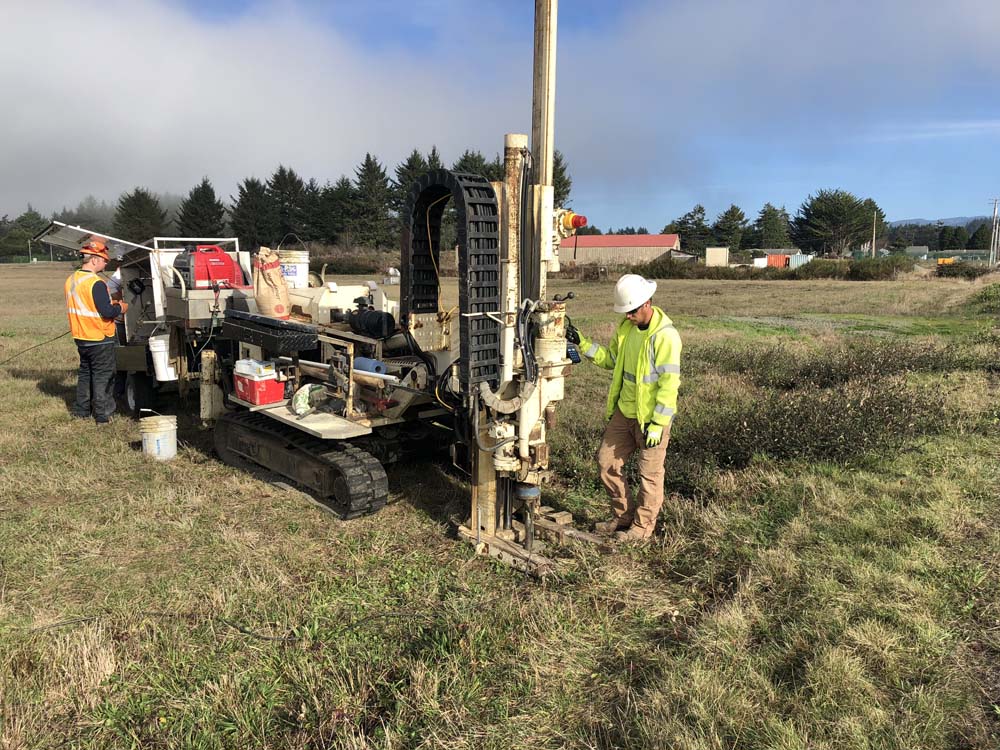
Once onsite, the Ahtna-led team first conducted characterization efforts, including soil and groundwater sampling, geophysical surveys, and historical research, to better understand the area and any potential contaminants. Crews excavated petroleum-impacted soils, inspected roughly 35,000-ft of pipeline, removed FIDO components and petroleum-impacted pipes, and flushed out long runs of buried pipeline to clear both hazardous and nonhazardous waste.
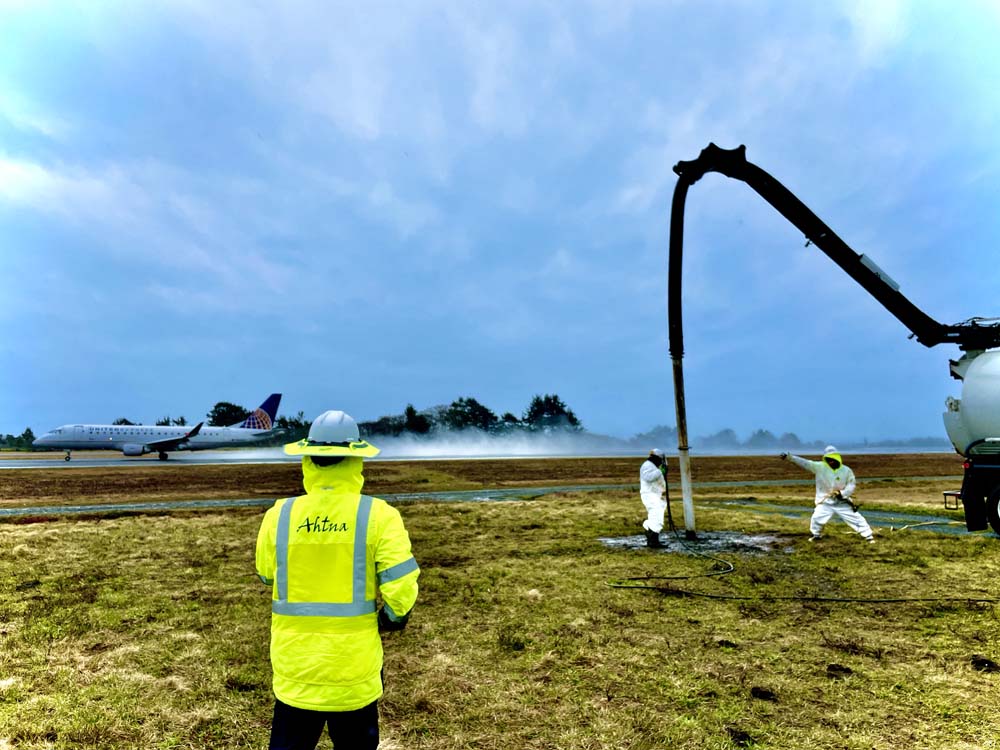
To remove the petrochemicals, field personnel drilled small holes in the pipelines and vacuumed or flushed out the contents while monitoring for potential spills. Air quality was checked around the pipe before drilling to identify flammable vapors. Sampling and video logging were used to confirm that contaminants and sediment had been removed.
The remediation team, in total, removed 45,000-gal of non-hazardous liquid waste and over 2,800-gal of hazardous liquid waste, along with other equipment related to the FIDO project.
Challenges and Coordination
As work progressed, the project team discovered that the conceptual FIDO system design drawings did not always match site conditions. In nearly one-third of the locations, field crews found pipeline segments that were much longer than expected. Ground-penetrating radar was used to determine the actual project scope. The site team conducted video surveys of pipeline segments and used an ultraviolet optical screening tool to detect potential petrochemical spills.
In addition to the potential risks of conducting remediation at a place with hazardous materials, the site work needed to be carried out while the airport remained in active use. This meant extensive coordination and partnerships with Humboldt County, Humboldt County Airport, USACE, Federal Aviation Administration, and the Coast Guard.
To minimize impacts, field crews often performed at night or during off-peak hours. Most of the work was done in inclement conditions, with the site receiving between 40-in to 50-in of rain annually. Excavating pipelines just feet away from a runway, while also avoiding utility lines, required operating with surgical precision. This sensitive work made excavating and trenching a slow, deliberate process.
Despite the challenges, Ahtna and its subcontractors maintained a safe jobsite—completing 150 field days onsite with zero reported injuries.
Along with the technical challenges, two issues were revealed during the site investigation that required adaptation. The first was the possibility that the site contained a Native American burial site. A forensic canine survey was conducted, and while the presence of a historic cemetery was not found the project area was shifted to eliminate work in the areas surveyed as a precautionary measure.
Additionally, the Arcata site is home to a thriving population of coast Checkerbloom, a perennial herb listed by the California Native Plant Society as rare and “fairly endangered.” In coordination with several agencies, a management plan was developed to protect the habitat. The mitigation measures included avoiding the area whenever practical, relocating soil borings and groundwater wells, limiting equipment within the habitat area, and placing high-density sand mats when access could not be avoided.
Landing on a Solution
The remediation team, in total, removed 45,000-gal of non-hazardous liquid waste and over 2,800-gal of hazardous liquid waste, along with other equipment related to the FIDO project. Crews remediated the site and filed for closure through the North Coast Regional Water Quality Control Board, itself a lengthy and challenging process due to the high environmental standards set by California.
The successful remediation at Arcata, along with more complete mapping of site features, opens the door to a more comprehensive use of the airport property by Humboldt County.
Beyond the technical achievement at NAAS Arcata, the successful cleanup, decades in the making, highlights what can be accomplished through strong partnership and motivated leadership. Working collaboratively and leveraging effective solutions helped to transform an historic military site into a safe and sustainable asset for the community—turning prolonged environmental challenges into an opportunity for renewal.
Sommer Carter, PMP, M.SAME, is Director of Area Operations, Lori Kropidlowski, M.SAME, is Senior Business Development and Marketing Group Manager, and Antonio Lippa, M.SAME, is Environmental Engineer II, Ahtna Solutions LLC. They can be reached at scarter@ahtna.net; lorik@ahtna.net; and alippa@ahtna.net.
Published in the January-February 2026 issue of The Military Engineer
Check Out Related Articles From TME
-

Innovative PFAS Remediation at Camp Grayling
For project stakeholders and remediation managers confronted with PFAS, Regenesis demonstrates the efficacy of using Regenesis’ PlumeStop® colloidal activated carbon (CAC) at Camp Grayling, Michigan. -
A Standardized Approach to Aircraft Fire Training Infrastructure
To support enterprise-wide airmen readiness, the U.S. Air Force is modernizing its standard design for aircraft fire training facilities—introducing digital controls, dual-fuel systems, and PFAS-conscious infrastructure. -
Delivering Energetic Materials Manufacturing Facilities
Designing and constructing facilities that manufacture, process, handle, or store explosives and energetic materials present some of the most challenging defense projects—requiring technical experience, strict safety protocols, and a comprehensive understanding of regulatory frameworks. -
Forging Tradition and Innovation: A New Design Standard at Camp Lejeune
The II MEF Headquarters at Camp Lejeune blends Georgian Revival architecture with modern sustainability—delivering durability, efficiency, and precision that meets contemporary functional requirements while honoring heritage. -

Balancing Efficiency and Fiscal Responsibility
The continuing contracts clause offers the U.S. Army Corps of Engineers a way to improve project delivery and enhance fiscal responsibility by aligning funding with project execution. -
Next Steps for Digital Twin Development
U.S. Forces Japan is laying the groundwork for future integration of digital twin technology in order to validate and collect data that will offer comprehensive insights into utility conditions at installations and enhance overall decision-making, efficiency, and resilience.