Powering Operations at Hill AFB
By Jonathan Eveleth, P.E., CEM, LEEP AP
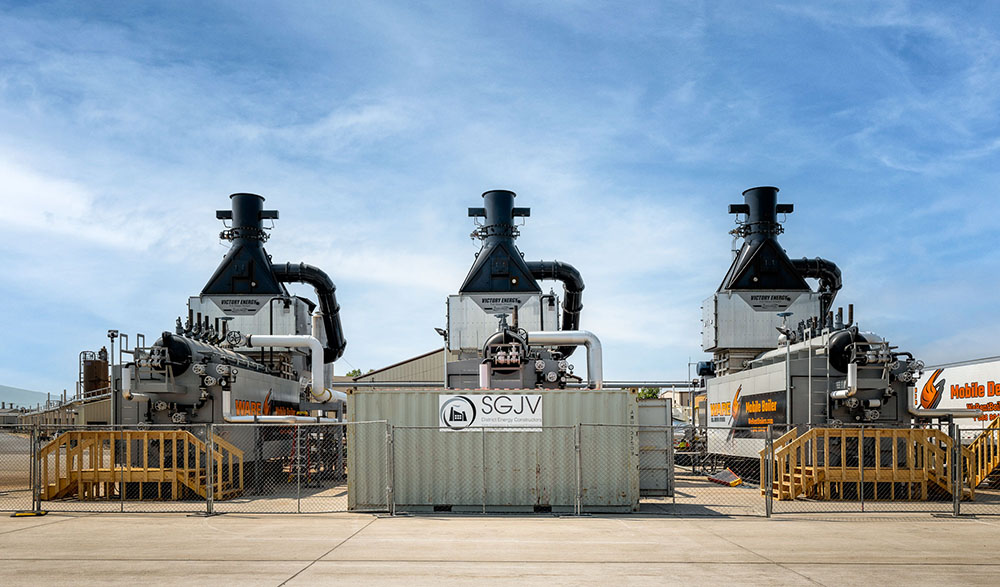
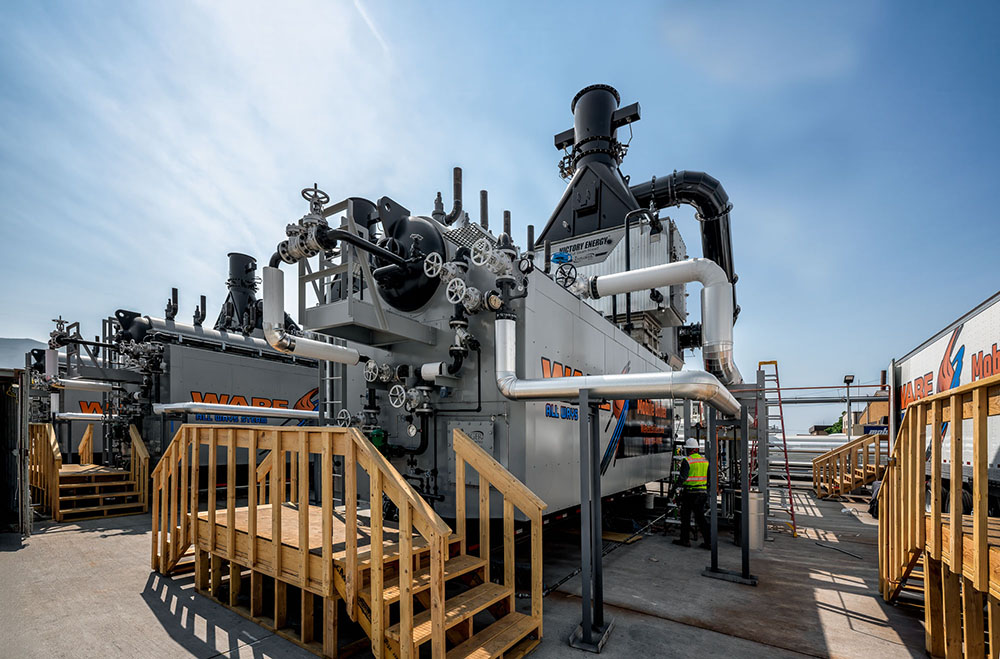
A temporary boiler plant installed at Hill AFB, achieved through a design-build approach that allowed for onsite completion in 90 days, ensured uninterrupted continuance of critical services during the large-scale modernization of the installation’s permanent steam plant.
Because the boilers for the temporary plant at Hill AFB were custom-built, the first time they were operated was when they were installed. This made performance testing especially challenging.
Tracing its founding to 1934 as a 3,000-acre air depot directly east of the Great Salt Lake in Utah, Hill AFB has grown to encompass more than 6,000-acres and is the state’s leading employer with over 20,000 military and civilian personnel within the Ogden Air Logistics Complex, 75th Air Base Wing, 388th Fighter Wing, and 419th Fighter Wing, among 40 additional tenant organizations.
Ensuring that the base’s infrastructure remains effective, resilient, and ready to meet its worldwide engineering and logistics mission is of critical importance to national security.
As a key aspect of an $80 million boiler plant renovation, a new temporary boiler plant project was constructed in just 90 days. The project marked a pivotal moment in the overall renovation as its completion allows for the existing boilers with high emissions to be taken offline, significantly reducing the base’s environmental footprint and making way for the next phase of construction. The modernization of the existing plant will replace eight water tube boilers with five new ultra-low nitrous oxide 49,000-PPH boilers. In addition, support systems (including fully redundant deaerators, plant controls, surge tank, water treatment, fuel oil, and ventilation) will be replaced during full construction.
To support the entire campus while the permanent plant is under renovation, the temporary plant is optimally designed to prevent any disruption to operations. The design-build team, challenged with a strict deadline and complex site conditions, overcame (and at times completely avoided) potential obstacles through efficient planning, strategic design, and cohesive teamwork. RMF Engineering is serving as designer of record for the steam plant renovation, with design-build partners Greenland Enterprises, and SAW Contracting (part of SGJV, LLC).
Delivered With Speed
The existing boilers had to be taken offline according to a tight scheduling window. As the work was a design-build project, the team used an integrated design and construction approach and collaborated at an iterative level, which helped streamline the process.
Employing design-build allowed the team to procure as efficiently as possible in anticipation of lengthy lead times. Equipment, such as the boilers that take around two years to build, was ordered as soon as it was sized and specified. This ensured it was onsite and ready in time for install. By ordering the boilers early and continuing the design for another 14 months, the team minimized back-end delays and could move ahead with installing the boilers when they were ready.
The temporary plant includes three boilers with a total installed capacity of 168,000-PPH. This required capacity had already been determined by the client, a decision that streamlined the design process by allowing the team to focus on implementation. To meet specifications efficiently, it was decided to use three large boilers instead of four smaller ones, which also helped reduce the footprint on what was a tight site. In addition, boilers were selected to operate below thresholds that would require additional monitoring by the Environmental Protection Agency.
No rental options were available that met the required size or low emissions for this design. As a result, the equipment used in the temporary plant needed to be custom-built. This approach, however, did help the project require less permitting and regulatory steps, further accelerating the process of getting the plant online. Constructing the plant outside rather than in an enclosure simplified the progression of getting the plant up and running. As it is a temporary plant, there were fewer concerns about aesthetics or long-term functionality.
With a well-structured plan and a skilled installation team, the project was designed and completed within a 90-day period, meeting the deadline to decommission the existing boilers.

Site-Specific Challenges
Selecting the location for the plant required careful attention to various siting considerations. Because the temporary plant is built on a tarmac, equipment would need to easily maneuver around. It also needed to be close enough to the existing plant to tie into the steam, power, and water systems while remaining far enough away to avoid interfering with construction. The team ultimately identified a location that met the criteria but required it being situated in front of an adjacent airplane hangar.
Energy recovery devices were incorporated into the temporary plant to capture heat from flue gas and redirect it back into the system. This repurposes what would otherwise be wasted energy to preheat other system components. However, the piping connections needed to be redesigned to bypass the existing plant and extend up the building and across the roof, in order to route steam to all the different points of connection. This enables the demolition and reconstruction of the interior systems without continued disruptions of utilities to the base.
Accommodating temperatures found in Utah necessitated unique considerations, since freezing temperatures can affect operations of the exposed equipment. Protective measures were built in for certain components susceptible to freezing. The project team heat-traced vulnerable piping to ensure the system remains operational despite harsh weather conditions.
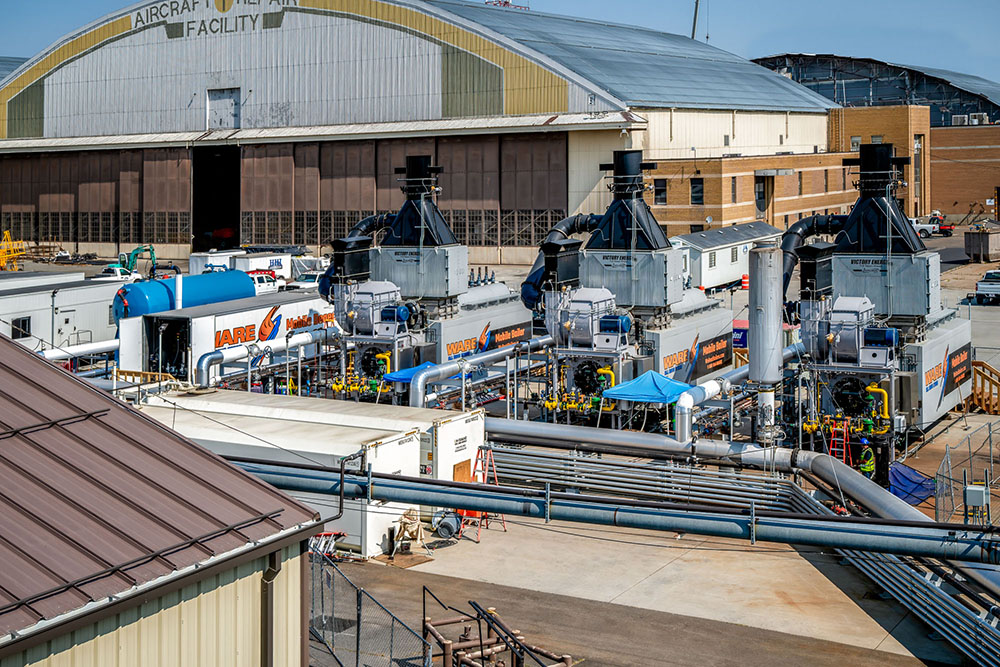
temporary boiler plant, the installation team leveraged a variety of designs-and technology-specific solutions.
Continuous Operations
Because the boilers for the temporary plant at Hill AFB were custom-built, the first time they were operated was when they were installed. This made performance testing especially challenging. Given the precise nature of the controlled burners, any necessary adjustments during initial operation proved to be finicky. Having resources from the boiler manufacturer, owner, builder, and engineering team available was critical for success and kept the process moving toward a successful startup.
Having a skilled team of contractors on the ground was essential to keeping the project on track as well. Daily communication has ensured a seamless process so far and reinforced the value of having trusted partners in the field, especially for cross-country projects.
The renovation of the existing steam plant at Hill AFB is expected to be finished by 2026. Once complete, there will be a proving period during which it will run in parallel with the temporary plant. After testing is concluded and all elements of the boiler plant have confirmed their functionality, the decommissioning process for the temporary plant will begin. The major equipment that is on rental will be returned for future use and the section of tarmac at Hill will resume its regular operations
Jonathan Eveleth, P.E., CEM, LEEP AP, is Principal, RMF Engineering; jonathan.eveleth@rmf.com.
Published in the September-October 2025 issue of The Military Engineer

Check Out Related Articles From TME
-

Innovative PFAS Remediation at Camp Grayling
For project stakeholders and remediation managers confronted with PFAS, Regenesis demonstrates the efficacy of using Regenesis’ PlumeStop® colloidal activated carbon (CAC) at Camp Grayling, Michigan. -
A Standardized Approach to Aircraft Fire Training Infrastructure
To support enterprise-wide airmen readiness, the U.S. Air Force is modernizing its standard design for aircraft fire training facilities—introducing digital controls, dual-fuel systems, and PFAS-conscious infrastructure. -
Delivering Energetic Materials Manufacturing Facilities
Designing and constructing facilities that manufacture, process, handle, or store explosives and energetic materials present some of the most challenging defense projects—requiring technical experience, strict safety protocols, and a comprehensive understanding of regulatory frameworks. -
Forging Tradition and Innovation: A New Design Standard at Camp Lejeune
The II MEF Headquarters at Camp Lejeune blends Georgian Revival architecture with modern sustainability—delivering durability, efficiency, and precision that meets contemporary functional requirements while honoring heritage. -

Balancing Efficiency and Fiscal Responsibility
The continuing contracts clause offers the U.S. Army Corps of Engineers a way to improve project delivery and enhance fiscal responsibility by aligning funding with project execution. -
Next Steps for Digital Twin Development
U.S. Forces Japan is laying the groundwork for future integration of digital twin technology in order to validate and collect data that will offer comprehensive insights into utility conditions at installations and enhance overall decision-making, efficiency, and resilience.