Rising From the Ashes: Recovering Tyndall AFB
By Col. Robert Bartlow Jr., M.SAME, USAF
In the weeks following the destruction caused by Hurricane Michael in 2018 to Tyndall AFB and the Florida Panhandle, later estimated at $4.7 billion, hundreds of military and civilian engineers worked around the clock on immediate response activities to recover and begin rebuilding the installation—collaboratively executing one of the most difficult engineering challenges in U.S. Air Force history.
Editor’s Note: This is the first in a series of articles describing the recovery and rebuild of Tyndall AFB following Hurricane Michael, which struck the Florida Panhandle on Oct. 10, 2018. The multi-part series will cover the engineering challenges encountered by the U.S. Air Force, U.S. Army Corps of Engineers, and multiple private sector architectural-engineering firms and contractors to not only restore the base to operational status, but to transform it into the “Installation of the Future.”
Hurricane Michael was historic in strength—even for residents of the Florida Panhandle, where hurricane season is a way of life. Each year, from June 1 to November 30, area communities keep an eye on the constant stream of disturbances coming off the coast of Africa or tropical lows developing in the Gulf of America. Since 1851, a total of nine major hurricanes have hit the Florida Panhandle. In early October 2018, a tropical disturbance began to form near the Yucatan Peninsula and quickly reached hurricane strength.
Michael would become the most powerful storm to hit the region in recorded history and the fourth most powerful hurricane to strike the United States. The eye passed over Tyndall as a Category 5 storm, with maximum sustained wind speeds at 161-mph.
Personnel had been preparing for an extreme storm event for several days, going through their Hurricane Condition Checklist. As the base evacuated aircraft, Col. Brian Laidlaw, USAF, 325th Fighter Wing Commander, issued orders for the approximately 3,600 individuals living or working at the base and an estimated 11,000 family members to evacuate at least 100-mi away.
The only group remaining at Tyndall throughout the storm was a 93-member Rideout Team made up primarily of installation leadership, civil engineers, and security forces. What they saw when they emerged from their shelter was almost unbelievable, with trees down everywhere, roofs torn off, collapsed buildings, and debris scattered on roads. The damage was extensive, and significant. Recovery operations began immediately.
Putting Assets in Motion
Surrounded by devastation, the Rideout Team quickly went into action. Following Michael, Tyndall had no power or water. Its communication capability was severely limited. When the wing commander wanted to know the condition of the flightline, leaders with the 325th Civil Engineer Squadron, Lt. Col. Mike Askegren, USAF, and Brian Stahl, hopped on an all-terrain vehicle and made their way across Highway 98 to the north side of the base. The runway was intact but missing the required markings and navigational aids.
The 325th Civil Engineer Squadron worked right away to remove debris so that outside help could land and boost recovery efforts. At first, the team was in a challenging position since, for safety reasons, nearly everyone who operated and maintained the base and would normally conduct recovery operations had been told to evacuate at least 100-mi away and were dealing with their own damaged or destroyed homes.
However, Tyndall was in an almost optimal geographic location to accept support. Resources that could assist were available within just a few hours of driving distance. Additionally, officials in the Pentagon; at HQ Air Combat Command at Joint Base Langley-Eustis, Va.; and at HQ Air Force Installation & Mission Support Center (AFIMSC), Joint Base San Antonio, Texas, had been tracking the storm’s progress and also immediately put recovery assets in motion.
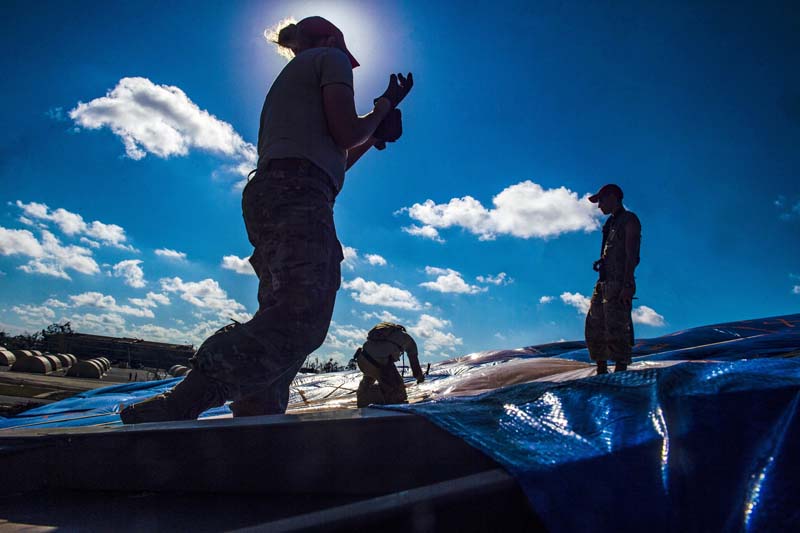
Stationed at nearby Hurlburt Field, Fla., the 823rd RED HORSE Squadron was anxious to help fellow airmen. The day following Hurricane Michael, the unit had a team on the road to provide support. Tyndall was home to the 823rd’s Detachment 1, which operated the Silver Flag Exercise Site at the east end of the base and had nearly 200 pieces of engineering equipment that could be used in recovery operations. When they reached the site and found the equipment in good shape, the airmen fired up the front-end loaders and headed to the main base, pushing trees off Highway 98 and beginning their role in the response. That same day, the 23rd Special Tactics Squadron, also from Hurlburt Field, flew in on a pair of CV-22 Ospreys to reopen the airfield. Soon, a steady stream of aircraft brought people, vehicles, and equipment to provide expeditionary basing assets for the recovery team.
Response Tempo Increases
The damage from Michael directly affected base security, making it a priority to restore. The fences and gates were down across the installation. Help was soon on the way. The 822nd Base Defense Squadron, located at Moody AFB, Ga., normally only 3.5-hours away, put a convoy on the road on October 11 for what became an 11-hour journey, avoiding debris as it neared Panama City. The 822nd set up security, then began screening the first of what would become hundreds of contractors arriving at Tyndall.
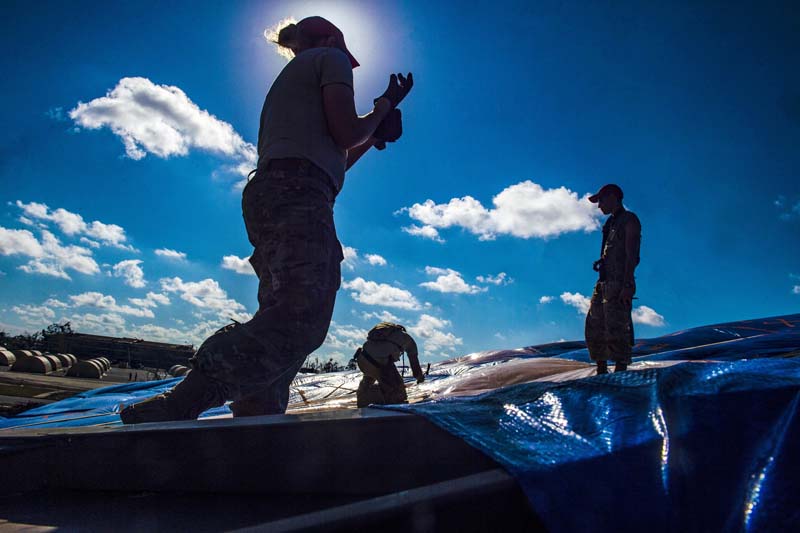
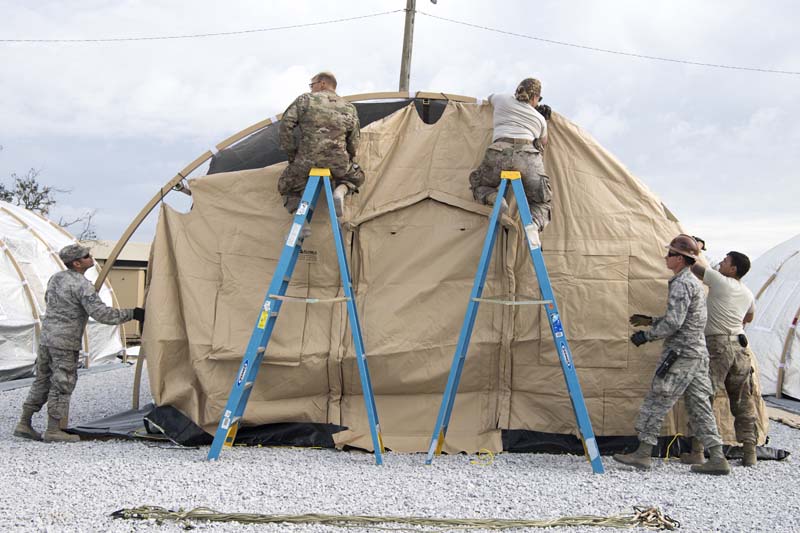
The contractors were part of the Air Force Contract Augmentation Program (AFCAP), a rapid response contingency contract mechanism designed to meet urgent mission requirements. KBR was the pre-qualified vendor next in line when the Air Force issued a letter contract with $500,000 seed money on October 11. Over the next few months, KBR would have more than 2,000 contractors at Tyndall, performing damage assessment, debris removal, roof repair and replacement, The company also provided temporary lodging and dining tents, shower units and latrines, meals, and vehicle services.
Within a few weeks, Tyndall was a beehive of activity. It was clear additional help was needed organize the recovery and rebuild.
Organizing Task Forces
As the recovery and rebuild grew, Air Combat Command established three task forces to take control of different aspects.
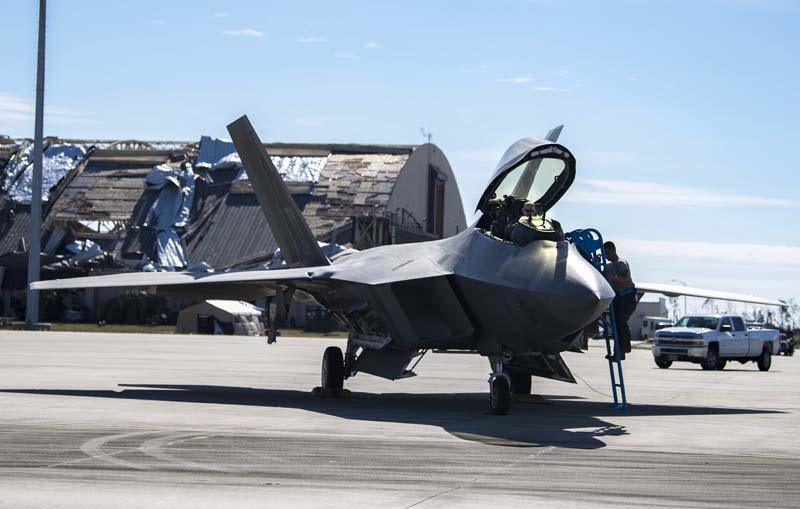
Task Force Raptor was set up to recover the 17 F-22A aircraft that were unable to evacuate and were being housed in damaged facilities. Raptor was a combined effort between pilots, aircraft maintainers, and civil engineers to extricate the jets without further damage from debris hanging over the planes.
Task Force HARP (Housing, Assignments, Relocation, and Posture) provided needed support for the thousands of displaced Tyndall airmen and families as they put their lives back together.
Lastly, as the magnitude of the effort and paucity of people available to carry out the work became evident, Gen. James Holmes, USAF, Commander, Air Combat Command, requested that AFIMSC establish Task Force Phoenix in partnership with the 325th Civil Engineer Squadron because of its familiarity with the base and leadership. Task Force Phoenix, led by then-Col. Patrick Miller, USAF, AFIMSC Vice Commander, was to continue to assess the damage, repair recoverable facilities, and clear debris. The personnel who formed Phoenix arrived at Tyndall 10 days after the hurricane and brought additional structure to the recovery elements. These included airmen from the host 325th Civil Engineer Squadron, three Prime BEEF teams, the 823th RED HORSE Squadron, and 635th Materiel Maintenance Squadron, the U.S. Army Corps of Engineers, a privatized housing contractor, a privatized utility contractor, and AFCAP. Later, U.S. Navy Seabees from Naval Mobile Construction Battalion 133 and soldiers from the 46th Engineer Battalion arrived and were brought under Task Force Phoenix. The undertaking was truly a joint effort.
Balancing Considerations
In the first weeks after the storm, no formal decision had been made on the base’s future. There was some pressure to not rebuild from Congressional leaders and the defense community, given the possibility of future weather events damaging even a rebuilt installation. Air Force leadership, however, understood the importance of Tyndall to national defense because of the valuable adjacent overwater Gulf Test and Training Range that provided unique capabilities to test, train, and evaluate high-altitude supersonic air combat training, air-to-air missile testing, and drone targeting. Tyndall also maintains a multimillion-dollar economic impact on the surrounding communities, and rebuilding the base received strong support from the Bay Defense Alliance.
On Oct. 25, 2018, then-Vice President Mike Pence visited Tyndall and announced the installation would be rebuilt. Still, questions remained about which missions would return or if any new missions would be coming. A few days later, on November 2, Secretary of the Air Force Heather Wilson announced that most Tyndall-based units would resume operations, with the exception of the F-22s and support personnel, which would be allocated to other F-22 units worldwide. The Air Force also announced that Tyndall would be built back as the model “Installation of the Future”—although what that future looked like remained rather uncertain.
On Dec. 7, 2018, Secretary Wilson announced that the Air Force would recommend that Congress fund the rebuild of Tyndall to receive three squadrons of F-35 Lightning II fighters.
Planning the Next Phase
Almost from the start of Task Force Phoenix getting underway, there were plans to transition to a Program Management Office that would assume responsibility for the long-term recovery and eventual rebuild. In mid-November, Col. Scott Matthews, USAF, AFCEC Facility Engineering Director, arrived at Tyndall to serve as the director of the office, along with other replacement personnel. Later that month, on November 26, Task Force Phoenix stood down and was replaced by the Tyndall AFB Hurricane Recovery Program Management Office, with the mission to Repair, Reshape, and Rebuild Tyndall.

Working in cooperation with the 325th Civil Engineer Squadron, Task Force Phoenix successfully carried out an urgent mission to assess damage, determine whether facilities were worth saving, preserve what should be saved, and clear debris. While years of work still lay ahead, the base was on the road to recovery. Equally important, Task Force Phoenix had given breathing space to the airmen and families living and working at Tyndall to get their own homes, possessions, and lives back in order.
As a signal to the Air Force and the local community about the progress made so far, Col. Laidlaw officially reopened Tyndall on Dec. 10, 2018, just two months after it was hit by the fourth most powerful hurricane in U.S. history. The considerable efforts completed to get to this point were significant.
But in many ways, the work at Tyndall was just beginning.
Devastating, Widespread Impact
Good progress was made in recovering Tyndall in the early phase right after Hurricane Michael, but the work often proved overwhelming in scope. Nearly every facility had suffered some degree of damage and required repair or demolition. The initial assessments the response teams conducted were broken down into green, yellow, or red categories. Of the 693 structures evaluated, 308 were green and listed as preserved or saved; 247 were listed as yellow with a potential to save; and 138 were listed as destroyed. Facilities often moved between categories over time with further assessments.
The amount of debris cleanup and removal work done to clear roads, parking lots, sidewalks, and open spaces was prodigious. Hundreds of personnel worked long hours every day to gather up the downed trees and other materials. The total amount collected was estimated at 792,450-yd³ of material, enough to fill the Capitol Rotunda more than 16 times.
Air Force Civil Engineer Center, Tyndall AFB, Fla.; robert.bartlow@us.af.mil.

Ronald Hartzer, Ph.D., Historian, AFCEC Natural Disaster Recovery Division, contributed to this article.
Published in the September-October 2025 issue of The Military Engineer

Check Out Related Articles From TME
-

Innovative PFAS Remediation at Camp Grayling
For project stakeholders and remediation managers confronted with PFAS, Regenesis demonstrates the efficacy of using Regenesis’ PlumeStop® colloidal activated carbon (CAC) at Camp Grayling, Michigan. -
A Standardized Approach to Aircraft Fire Training Infrastructure
To support enterprise-wide airmen readiness, the U.S. Air Force is modernizing its standard design for aircraft fire training facilities—introducing digital controls, dual-fuel systems, and PFAS-conscious infrastructure. -
Delivering Energetic Materials Manufacturing Facilities
Designing and constructing facilities that manufacture, process, handle, or store explosives and energetic materials present some of the most challenging defense projects—requiring technical experience, strict safety protocols, and a comprehensive understanding of regulatory frameworks. -
Forging Tradition and Innovation: A New Design Standard at Camp Lejeune
The II MEF Headquarters at Camp Lejeune blends Georgian Revival architecture with modern sustainability—delivering durability, efficiency, and precision that meets contemporary functional requirements while honoring heritage. -

Balancing Efficiency and Fiscal Responsibility
The continuing contracts clause offers the U.S. Army Corps of Engineers a way to improve project delivery and enhance fiscal responsibility by aligning funding with project execution. -
Next Steps for Digital Twin Development
U.S. Forces Japan is laying the groundwork for future integration of digital twin technology in order to validate and collect data that will offer comprehensive insights into utility conditions at installations and enhance overall decision-making, efficiency, and resilience.