
Signaling Security: Designing a New Communications Headquarters
By Nick Steyn, M.SAME
The Consolidated Communications Facility at Barksdale AFB blends historic architectural context with modern design to effectively support mission continuity and digital operations.
A mission-critical transformation has taken shape in the historic heart of Barksdale AFB, La. The newly completed Consolidated Communications Facility marks a major milestone in the modernization of the installation’s communications infrastructure, uniting operational readiness with heritage preservation.
At 47,658-ft², the three-story structure serves as the headquarters for the 2nd Communications Squadron, helping promote operational continuity for more than 7,000 users across the base and U.S. Strategic Command.
Bringing History Forward
The project was led by Pond & Company, as part of an integrated design-build team with Bristol Prime Contractors LLC. The new communications facility at Barksdale stands on a site layered with legacy—located in a registered historic district defined by French Colonial Revival architecture from the 1930s and 1940s. The installation’s master plan, shaped in a Radial Beaux Arts tradition, required that any new development honor the past.
The project team leading the work was experienced in conducting facility planning within sensitive contexts and coordinated early and often with the State Historic Preservation Office to ensure compatibility with existing structures and streetscapes. A number of historic features such as a concrete steam trench and a cherished base gazebo were either preserved or relocated. Additionally, a multitude of signature period-appropriate design elements were incorporated such as ornate ledges, textured facades, and symmetrical massing to echo the character of neighboring buildings. These features were balanced alongside modern precast concrete wall panels with integrated closed cell spray foam insulation to meet current energy performance standards while maintaining a historic appearance.
A centrally located main entrance opens into a primary circulation corridor that runs the full length of the building. Stairs were placed at each end to provide balanced and efficient egress. Offices are located along the perimeter to maximize daylight and shared support spaces are placed along the building core for efficiency.
From the Ground Up
From the earliest stages of design, the team approached the Consolidated Communications Facility as a mission tool. Work began with an intensive design charrette and site investigation involving stakeholders from across Barksdale to define programmatic requirements, clarify roles, and refine the schedule. This early alignment positioned the facility to meet not only spatial and functional needs but also the operational tempo of the 2nd Communications Squadron.
The design concept shaped a stacked, symmetrical layout with planned adjacencies among secure and administrative functions. HVAC systems were selected through life-cycle cost analysis. Waste diversion strategies were developed to reduce environmental impact. Smart meters were integrated into building systems to track real-time resource use.
The facility was designed to meet Risk Category IV, which requires enhanced resistance to extreme events. Engineers used full moment connections at perimeter beams and incorporated tie forces for progressive collapse resistance. The foundation system for the building included 14-in diameter drilled auger cast piles that extended approximately 58-ft, supporting pile caps and grade beams placed in a monolithic pour. This approach will provide for greater long-term stability and increased durability.
Integrated and Functional
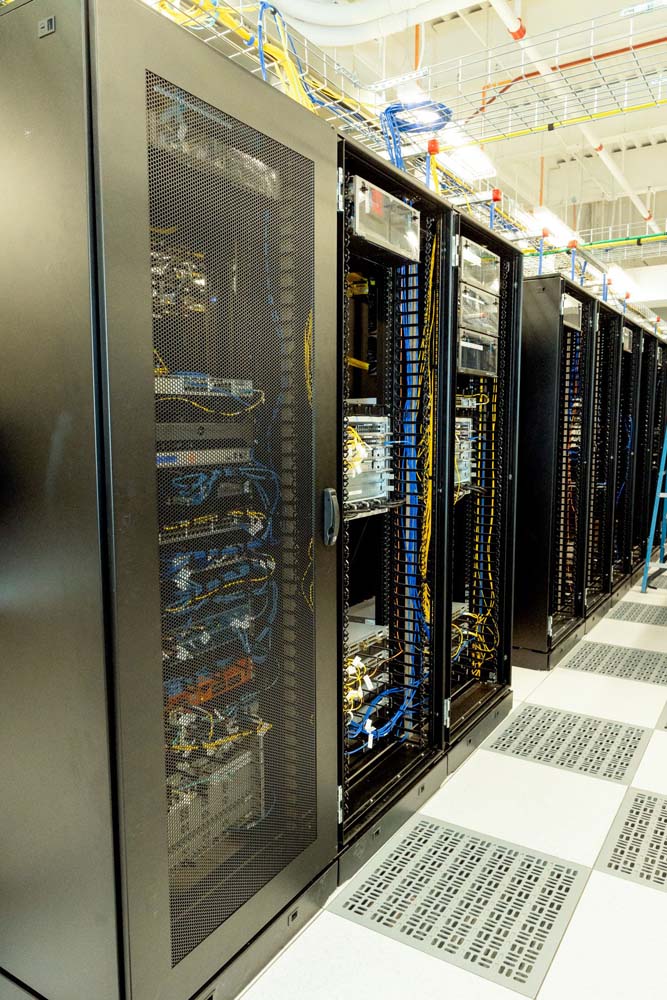
At the core of the Consolidated Communications Facility are its secure areas, which include three ICD 705 compliant spaces, a SIPRNET enclave, a raised floor server room, and a COMSEC storage vault. These features were integrated with intrusion detection, electronic access controls, and cybersecurity infrastructure in accordance with UFC 4 010 06.
The design included a Headquarters Command Suite, training and conference rooms, and flexible office areas. All spaces were protected with layered safety systems that include fire alarms, a mass notification system, redundant power generation, and a 600-kVA uninterruptible power supply.
Security measures have been incorporated throughout the facility’s exterior and design, and with its standoff distances maintained in compliance with UFC 4 010 01. The building carries specified antiterrorism/force protection-rated exterior glazing while designed utility yards and equipment enclosures serve to resist forced entry and protect mission-essential systems.
Power continuity systems were designed to exceed standard Unified Facilities Criteria. While typical designs provide 15-min of battery runtime, Barksdale required 30-min to provide uninterrupted communications during extended transfers to generator power. The design specified a 600-kVA, 480-V three-phase uninterruptible power supply with an expanded battery cabinet bank and dual feed redundancy.
To address thermal loads, dedicated computer room air conditioning units were installed on emergency power. These direct expansion systems operate independently of the chilled water plant; they provide continuous cooling of sensitive equipment even if the primary HVAC is offline. Additionally, an uninterruptible power supply integrates with the facility’s 1.25-MW diesel generator through a life safety automatic transfer switch. This redundancy creates a three-tiered power architecture with overlapping coverage to eliminate any risk of power loss.
Construction Coordination
Throughout the course of the project, architects and engineers conducted regular site visits and hold coordination meetings to support the commissioning of systems, ranging from the building automation platform to protected cabling pathways. Pond, the Designer of Record, provided post-construction award services in accordance with strict military construction standards. Personnel reviewed submittals, responded to requests-for-information, and verified work in mission-critical areas, particularly the secure communications zones and structural elements designed to resist progressive collapse.
The team also managed final acceptance of the work. This phase included resolving punch list items, overseeing deferred seasonal testing, and training end users so the facility’s systems would perform exactly as intended.

Commanding Support
The Consolidated Communications Facility at Barksdale AFB is more than a place of work. It is a cornerstone of digital command, engineered and designed for resilience and rooted in the installation’s storied history. From preserving architectural character to reinforcing critical support systems, the new facility reflects the U.S. Air Force’s priorities of operational readiness and stewardship.
By uniting thoughtful planning, historic preservation, and engineering excellence, the project team created a facility that will safeguard the missions of today and the people who lead them, while being adaptable to the demands of tomorrow.
Ensuring Continuity
Before new construction could begin for the Consolidated Communications Facility, the project team needed to resolve a complex civil, structural, and telecommunications challenge. A group of three existing buildings on the site, each housing components of the base’s communications mission, remained in operation throughout the build and were demolished only after the new complex was complete. Beneath one of these facilities, Building 3447, a hardened underground vault contained active telecommunications infrastructure that could not be taken offline.
To overcome this, the internally accessed vault was transformed into a standalone asset with external access.
A new reinforced concrete roof was installed to carry loads without the lateral support of the former building, reprofiled the slab above for positive drainage, and incorporated redundant sump pumps to maintain a dry environment.
Utility lines then were rerouted away from the new building footprint and a new concrete encased ductbank was constructed to connect the vault to the facility, providing capacity for current and future communications needs. This work maintained uninterrupted mission-critical operations throughout construction.
Nick Steyn, M.SAME, is Director of Federal Marketing, Pond & Company; steynn@pondco.com.
Published in the November-December 2025 issue of The Military Engineer

Check Out Related Articles From TME
-

Innovative PFAS Remediation at Camp Grayling
For project stakeholders and remediation managers confronted with PFAS, Regenesis demonstrates the efficacy of using Regenesis’ PlumeStop® colloidal activated carbon (CAC) at Camp Grayling, Michigan. -
A Standardized Approach to Aircraft Fire Training Infrastructure
To support enterprise-wide airmen readiness, the U.S. Air Force is modernizing its standard design for aircraft fire training facilities—introducing digital controls, dual-fuel systems, and PFAS-conscious infrastructure. -
Delivering Energetic Materials Manufacturing Facilities
Designing and constructing facilities that manufacture, process, handle, or store explosives and energetic materials present some of the most challenging defense projects—requiring technical experience, strict safety protocols, and a comprehensive understanding of regulatory frameworks. -
Forging Tradition and Innovation: A New Design Standard at Camp Lejeune
The II MEF Headquarters at Camp Lejeune blends Georgian Revival architecture with modern sustainability—delivering durability, efficiency, and precision that meets contemporary functional requirements while honoring heritage. -

Balancing Efficiency and Fiscal Responsibility
The continuing contracts clause offers the U.S. Army Corps of Engineers a way to improve project delivery and enhance fiscal responsibility by aligning funding with project execution. -
Next Steps for Digital Twin Development
U.S. Forces Japan is laying the groundwork for future integration of digital twin technology in order to validate and collect data that will offer comprehensive insights into utility conditions at installations and enhance overall decision-making, efficiency, and resilience.