Tackling PFAS in the Groundwater at Cannon AFB
By James Mark Stapleton, Ph.D., P.E., BCEE, M.SAME, Christipher Gierke, M.SAME, Kate McSherry, M.SAME, and Corey Schwabenlander, PG, M.SAME
A pilot groundwater treatment system at Cannon AFB demonstrates an innovative, sustainable approach to remediating PFAS by combining advanced technology, flexible design, and reinjection strategies to protect the Ogallala Aquifer and public health.
Photos courtesy Brice Environmental.
The concentrations were concerning. They indicated the PFAS contamination had likely spread beyond the base’s southeast boundary. A bench-scale treatability study assessed the effectiveness of various treatment media for targeting key PFAS compounds, including PFOS, PFOA, and perfluorobutanesulfonic acid.
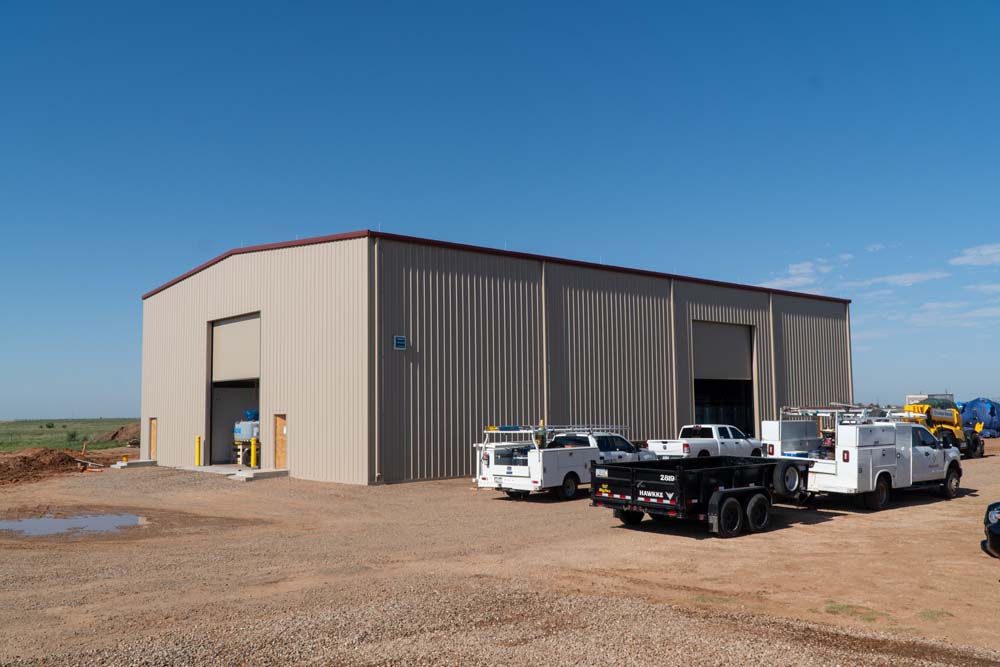
One of the most advanced groundwater treatment systems within the U.S. Air Force operates a monumental mission each day at Cannon AFB, N.M. And while those looking at the Southeast Playa Groundwater Treatment Facility may think they are seeing just another defense warehouse, the similarities end once inside.
Located near the eastern border of New Mexico, Cannon AFB occupies 3,789-acres of high plains terrain in its service as home to the 27th Special Operations Wing, The Steadfast Line. The installation’s highly specialized groundwater treatment facility houses an advanced system designed to address the most pressing environmental Ochallenge of today: contamination from per- and polyfluoroalkyl substances (PFAS).
The system was designed to extract nearly 2-million-gal of contaminated groundwater daily from depths of up to 400-ft below ground surface. The impacted water is piped more than 0.5-mi, treated to remove the harmful PFAS, then reinjected into the Ogallala Aquifer for beneficial reuse without water loss or negatively impacting the surrounding communities. The multi-phase process is an unprecedented challenge to safeguard public health and protect the future of groundwater resources.
Adaptive and Responsive
The Southeast Playa Groundwater Treatment Facility moves well beyond the static nature of traditional pump-and-treat systems. Its configuration of extraction, injection, and adaptable monitoring wells allows for interchangeable use based on performance data, optimizing operation while protecting the aquifer and nearby irrigation wells. Additionally, variable frequency drives, managed through supervisory control and data acquisition (SCADA), featuring a cloud-based programmable logic controller and human machine interface, provide control and real-time monitoring.
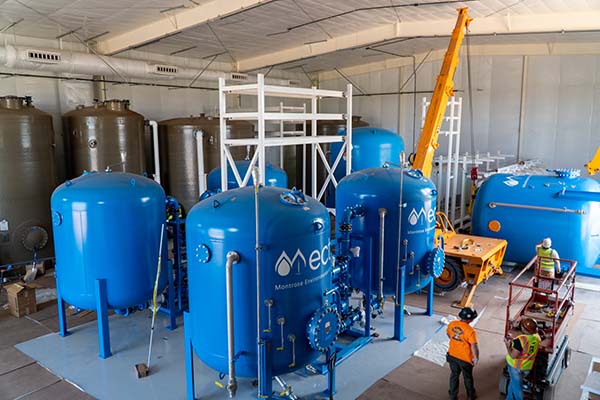
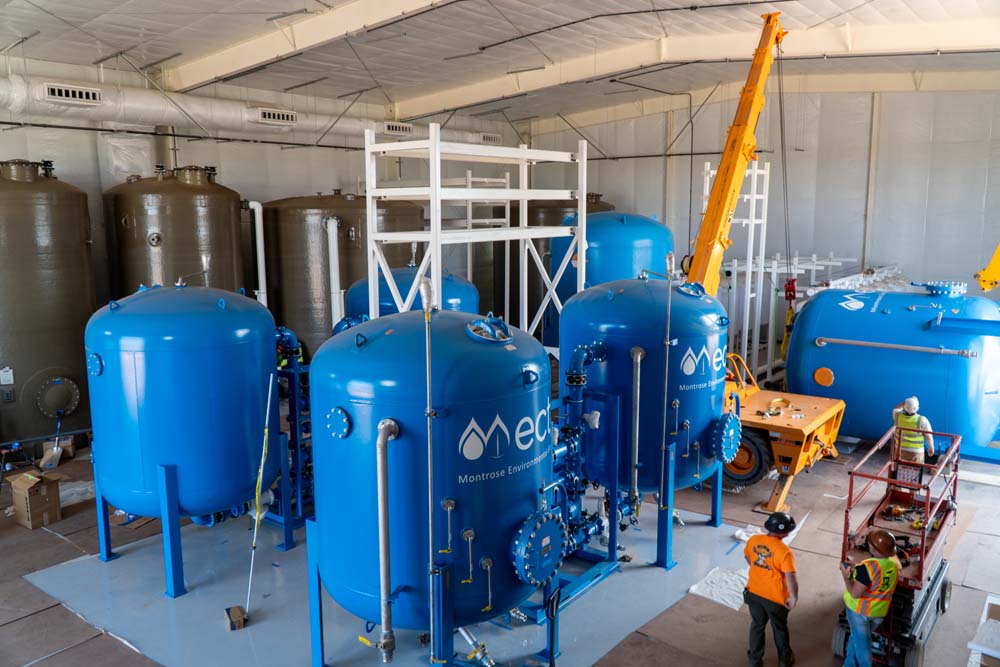
The treatment train includes oxidant dosing, liquid granular-activated carbon filtration, and ion exchange resin (IXR) vessels in lead/lag configuration, which enables uninterrupted operation during resin changeouts. Collectively, these features create a robust, flexible, and technology-driven system that is capable of adapting quickly to changing site conditions.
Analyzing the Need
The complexity of PFAS contamination at Cannon AFB necessitated a collaborative approach. In February 2021, subject matter experts from the Air Force Civil Engineer Center (AFCEC), working with Noblis, performed a critical process analysis. This effort evaluated available site data and provided the technical foundation for a pilot study, eventually leading to an interim response developed as a non-time-critical removal action under the Comprehensive Environmental Response, Compensation, and Liability Act. Recommendations from the critical process analysis included the use of both extraction wells and injection wells to create a fence-line containment system that would contain the PFAS plume and prevent further migration off-base.
Site reconnaissance and data collection of groundwater samples for analysis followed. The goal was to evaluate the extent of PFAS contamination in the groundwater and fill in critical data gaps in baseline chemical concentrations and geochemical conditions. Multiple samples were collected from monitoring wells in the southeast corner of Cannon, which showed concentrations of perfluorooctanesulfonic acid (PFOS) and perfluorooctanoic acid (PFOA) that exceeded the federal Health Advisory Level of 70-ng/L at the time of sampling. The maximum concentrations of PFOA and PFOS were 1,850-ng/L and 29,700-ng/L.
The concentrations were concerning. They indicated the PFAS contamination had likely spread beyond the base’s southeast boundary. A bench-scale treatability study assessed the effectiveness of various treatment media for targeting key PFAS compounds, including PFOS, PFOA, and perfluorobutanesulfonic acid. These results informed the need to design a treatment system that could effectively remove PFAS from groundwater while also being adaptable to different field conditions and avoiding negative impacts to the Ogallala Aquifer.
Designed to Deliver
Aquifer testing was performed to evaluate the hydrogeological properties of the Ogallala Formation in the area slated for the pilot study treatment system. This testing revealed key characteristics such as transmissivity, hydraulic conductivity, and storage coefficients. This information helped quantify the aquifer’s ability to deliver contaminated water to the extraction wells, and to define the hydraulic capture zone. That would ensure the system could manage the volume of contaminated water while maintaining the integrity of the surrounding aquifer.
A design workshop followed the aquifer testing. Key stakeholders participated, including AFCEC, Noblis, Brice Environmental, and the U.S. Army Corps of Engineers (USACE). The session comprised a detailed evaluation of the potential designs and two distinct treatment system layout options. The first option consisted of groundwater extraction along Cannon’s southern boundary and injection on the eastern boundary. The second option evaluated extraction wells along the eastern boundary and injection wells on the southern boundary.
After much discussion and risk analysis, the evaluation team chose to proceed with the first option, which included four extraction wells along the southern boundary, six injection wells along the eastern boundary, and additional adaptable monitoring wells that could be converted into extraction or injection wells. Brice Environmental then began the design process, and, in parallel, the construction of the Southeast Playa Groundwater Treatment Facility to house the treatment system.
Flexible Operation. The facility’s flexible design allows wells to be used interchangeably based on performance data. Extraction wells remove contaminated groundwater while injection wells reinject treated water. That ensures that the system’s operation does not adversely affect the aquifer or surrounding irrigation wells. Based on the results of the aquifer pump test and the hydraulic containment evaluation, the treatment system was designed to operate with a target flowrate per well from 150-gal/min to 200-gal/min. It can handle a total throughput of 600-gal/min, with the potential to increase to 1,200-gal/min.
To transport the influent and effluent from each manifolded injection, extraction, and adaptable monitoring well back and forth to the treatment system building, the design specified the use of 10-in conveyance piping.
- Each extraction well pump is connected to a 3-in stainless-steel drop pipe manifolded at the wellhead to the conveyance piping.
- Pump speed at each extraction well is regulated by variable frequency drives, which are managed through the SCADA system that controls flowrates at each well to maintain a consistent water level above the pump.
- The entire system includes electrical and telecommunications components, SCADA, and a programmable logic controller with a human machine interface for system control.
The treatment system employs IXR, which was selected after a lifecycle assessment demonstrated that it offered the most cost-effective, long-term solution. It was designed to meet the maximum allowable contaminant levels for PFAS, ensuring that the treated water would be safe for reinjection into the Ogallala Aquifer. To maximize effectiveness, the treatment train included several pre-treatment steps, such as oxidant dosing for metals removal and filtration through liquid granular-activated carbon vessels to remove any impurities that could affect the IXR media.
Continuous Treatment. The IXR system design uses a lead-lag configuration. This allows for continuous operation while resin changeouts take place and treatment goes on uninterrupted. Monitoring points are incorporated at critical locations, including the inlet and outlet of each liquid granular-activated carbon and IXR vessel, as well as within the bed of the vessels. This monitoring setup allows operators to track performance and ensures that PFAS concentrations remained less than the maximum contaminant levels.
Once treated, the groundwater is safely reinjected into the aquifer through the six injection wells. This process is critical: it ensures the aquifer is restored without adverse impacts to the surrounding agricultural wells. The injection wells were constructed to handle flowrates per well of up to 200-gal/min. Flow to each injection well is regulated by actuated valves; these are also controlled through the SCADA system and monitored for flowrate and water level. The efficient reinjection of treated water helps to maintain the natural flow of the aquifer while preventing further PFAS migration.
To maintain system performance, a total of eight performance monitoring wells are installed around the treatment area. They monitor the hydraulic capture system and ensure that the PFAS plume is fully contained. Data that is collected helps in fine-tuning the treatment system operation and support future decision-
making of a full-scale remedy.
Advancing Remediation
In March 2025, the treatment system startup and shakedown began, going fully operational in May 2025. Over the next few months, the system was optimized and balanced to environmental conditions. Initial results suggest the facility has been effectively designed to realize its mission. Specifically, treatment monitoring sampling results indicate that all PFAS constituents in the treated groundwater were less than maximum contaminant levels (non-detect) following treatment and prior to injection. To date, the system has processed approximately 125-million-gal of contaminated groundwater and returned it to the aquifer for beneficial reuse.
The pilot treatment system at Cannon represents a significant step forward in efforts to address PFAS contamination. By integrating advanced treatment technologies, flexible operational features, and comprehensive monitoring, the facility represents a critical new tool for environmental remediation for the military.
James Mark Stapleton, Ph.D., P.E., BCEE, M.SAME, is Senior Environmental Remediation Engineer, Noblis | Defense; mark.stapleton@noblis.org.

Christipher Gierke, M.SAME, is Restoration Project Manager, 27th Special Operations Civil Engineer Squadron, Cannon AFB, N.M.; christipher.gierke@us.af.mil.

Kate McSherry, M.SAME, is Senior Project Manager, and Corey Schwabenlander, PG, M.SAME, is Program Manager, Brice Environmental Services. They can be reached at kate.mcsherry@briceeng.com; and cschwabenlander@briceeng.com.
Published in the November-December 2025 issue of The Military Engineer

Check Out Related Articles From TME
-

Innovative PFAS Remediation at Camp Grayling
For project stakeholders and remediation managers confronted with PFAS, Regenesis demonstrates the efficacy of using Regenesis’ PlumeStop® colloidal activated carbon (CAC) at Camp Grayling, Michigan. -
A Standardized Approach to Aircraft Fire Training Infrastructure
To support enterprise-wide airmen readiness, the U.S. Air Force is modernizing its standard design for aircraft fire training facilities—introducing digital controls, dual-fuel systems, and PFAS-conscious infrastructure. -
Delivering Energetic Materials Manufacturing Facilities
Designing and constructing facilities that manufacture, process, handle, or store explosives and energetic materials present some of the most challenging defense projects—requiring technical experience, strict safety protocols, and a comprehensive understanding of regulatory frameworks. -
Forging Tradition and Innovation: A New Design Standard at Camp Lejeune
The II MEF Headquarters at Camp Lejeune blends Georgian Revival architecture with modern sustainability—delivering durability, efficiency, and precision that meets contemporary functional requirements while honoring heritage. -

Balancing Efficiency and Fiscal Responsibility
The continuing contracts clause offers the U.S. Army Corps of Engineers a way to improve project delivery and enhance fiscal responsibility by aligning funding with project execution. -
Next Steps for Digital Twin Development
U.S. Forces Japan is laying the groundwork for future integration of digital twin technology in order to validate and collect data that will offer comprehensive insights into utility conditions at installations and enhance overall decision-making, efficiency, and resilience.