The Benefits of Defensive Wetlanding
By Brian Schmidt, JD, and Sam Jelliman
The practice of strategically creating wetlands to enhance defensive terrain can have significant environmental benefits in addition to increasing defensive military advantages.
While it is well understood that military actions and their aftermath can trigger environmental issues, physical terrain also can be purposefully enhanced for both environmental and defensive value. This enhancement could be called “defensive rewilding.”
More narrowly considered, combining the responsibilities of protecting, restoring, and creating wetlands with the military tactical capability to cross difficult terrain like wetlands creates the concept of “defensive wetlanding,” a particularly effective subset of defensive rewilding.
Actively using wetland restoration expertise to help allies enhance defensive terrain through wetland creation and expansion simultaneously yields both defensive benefits and environmental returns.
Ecological Impacts
Terrain critically affects defensive preparations. This is understood at an instinctual level and dates back to hunter-gatherers. Military actions can affect the environment negatively, such as the opposing sides attempting to set the other’s forests on fire during World War II. However, it can also be positive, as, in the case of the Korean Demilitarized Zone, by providing a gigantic, high-quality nature refuge.
Concepts like warfare ecology and warwilding encompass a range of relations between war and the environment. These broader concepts sometimes mention how intentional environmental improvements can have military benefits. However, that is not their primary focus. Defensive rewilding, on the other hand, focuses on the opportunities in planning and combining defensive and environmental value.
For instance, an effective form of defensive rewilding is to create covering terrain by growing trees near roads. The ongoing war in Ukraine shows the value of treelines as defenders have used them as locations for trench emplacements and ambush points.
The concept also goes beyond this tactical level and recognizes that the environment can be manipulated to improve defensive capabilities, such as pre-emptively growing trees for defense. Failing to plant trees where they would be useful for defense is functionally equivalent to failing to dig a trench where it might be useful. The advantages include the fact that environmental benefits are near-immediate; the military benefits start accruing as soon as plants are tall enough to hide infantry. Even in more attritional warfare, as seen in Ukraine, preexisting treelines, although not designed for defense, have proven critical. Strategically planted treelines with greater width, faster-growing species, and better winter concealment could further enhance defensive value.
Along with the military benefits, the environmental rewards of defensive rewilding can be significant. Trees provide ecological opportunities for a wide array of species that would otherwise be absent. These areas offer habitat for small animals and vital corridors for larger species to avoid isolation and extinction. In addition, these lands would absorb excess fertilizer and road run-off, improving water quality, and they could cover vast areas, including road margins, hilltops, and riparian zones.

Tactical Techniques
An especially effective aspect of defensive rewilding includes security-prioritized wetland restoration and expanded riparian zones. Wetlands, often too wet for land vehicles and not wet enough for boats, severely restrict movement. They funnel attackers into ambushes and limit vehicles to mined roads. Wetland creation mirrors the historic tactic of flooding land to repel imminent invasion, most recently seen with the improvised flooding of land north of Kyiv that contributed substantially to defeating the Russian advance in Ukraine.
Planned wetland creation, by contrast, could be done as part of a long-term strategy and include permanent environmental benefits. When combined with giving rivers room to flood (as opposed to tightly constricted levees), this approach could create further river crossing dilemmas.
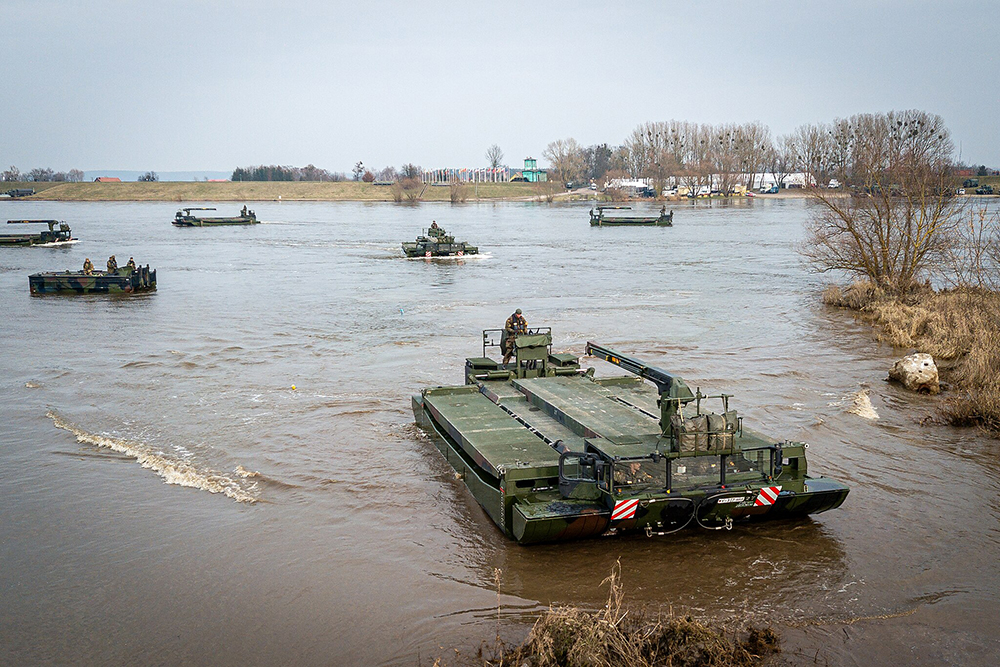
Modern armored vehicle-launched-bridges can quickly bridge distances of 20-m to 26-m, making narrow rivers easy to cross. However, if even a 10-m wide river has 10-m of wetlands along each side, then crossing becomes exponentially more difficult. For points where wetlands are infeasible, defenders can focus preparations on those chokepoints. Wetland creation along many small creeks could transform a non-obstacle into an asset that requires armored vehicle-launched-bridges to cross, over and over again. While attackers could use pontoons to attempt long crossings through wetlands, those are generally in short supply and vulnerable. Causeways are more durable, but they take much longer to construct and leave invaders concentrated and exposed to attack for longer distances. Bridges, even when destroyed, are favored crossing points due to road access and topography. Wetland creation along the roads and approach points would create long, constricted “kill boxes” for effective defense.
The U.S. Army Field Manual on Countermobility is clear on the defensive value of wetlands: “Swamps, marshes, and bogs severely restrict mobility and force the canalization of vehicular movement onto causeways, greatly increasing vulnerability to air attack, artillery, or direct fire weapons. Historically, swamps have been avoided by attacking armies. Swamps and marshes over 1-m deep may be more effective obstacles than rivers, since causeways are usually more difficult to construct than bridges.”
The manual also lists the countermobility tactic of “blowing dams to create flooded areas.” Along with providing these defensive values, wetlands bring a range of environmental benefits, including flood prevention, water purification, and wildlife sanctuary. They are among the landscapes with the greatest number of co-benefits.
Wetland creation mirrors the historic tactic of flooding land to repel imminent invasion, most recently seen with the improvised flooding of land north of Kyiv that contributed substantially to defeating the Russian advance in Ukraine.
Combining Responsibilities
Creating long-term, planned flooded areas through wetland establishment is the next logical step.
While defensive rewilding is a much broader concept than defensive wetlanding, wetlands are the ideal habitat for implementing this approach since they provide significant environmental and military value, especially as they have become increasingly rare.
The U.S. Army Corps of Engineers (USACE) has a unique domestic environmental responsibility. Section 404 of the Clean Water Act mandates the agency to regulate the dredge and fill of the Waters of the United States. For decades, wetland protection, wetland restoration, and wetland creation have been components of its scope of authority.
While the United States may be unlikely to face enemy nation invasion at home, USACE also supports allies in vulnerable regions internationally. Large areas of the border territory in Ukraine, the Baltic states, and Finland are suitable for the restoration of wetlands and bogs for both defensive and environmental benefit. USACE’s domestic expertise in wetland restoration and military expertise in mobility and countermobility makes it ideally placed for wetland creation for use in defensive wetlanding overseas. As an initial step, USACE could do a demonstration study of defensive wetlanding potential, either at a U.S. military base or in cooperation with a foreign partner.
Establishing a practice of defensive wetlanding would simultaneously deter invasion and generate huge environmental benefits. If deterrence fails, wetlands can make a successful defense more likely. Defensive wetlanding should become an accepted practice within the military, led by the Corps of Engineers.
Brian Schmidt, JD, is Environmental Policy Analyst; schmidtb98@gmail.com.

Sam Jelliman is Researcher, Sustainability Research Institute, University of East London; s.jelliman@uel.ac.uk.
Published in the July-August 2025 issue of The Military Engineer

Check Out Related Articles From TME
-

Innovative PFAS Remediation at Camp Grayling
For project stakeholders and remediation managers confronted with PFAS, Regenesis demonstrates the efficacy of using Regenesis’ PlumeStop® colloidal activated carbon (CAC) at Camp Grayling, Michigan. -
A Standardized Approach to Aircraft Fire Training Infrastructure
To support enterprise-wide airmen readiness, the U.S. Air Force is modernizing its standard design for aircraft fire training facilities—introducing digital controls, dual-fuel systems, and PFAS-conscious infrastructure. -
Delivering Energetic Materials Manufacturing Facilities
Designing and constructing facilities that manufacture, process, handle, or store explosives and energetic materials present some of the most challenging defense projects—requiring technical experience, strict safety protocols, and a comprehensive understanding of regulatory frameworks. -
Forging Tradition and Innovation: A New Design Standard at Camp Lejeune
The II MEF Headquarters at Camp Lejeune blends Georgian Revival architecture with modern sustainability—delivering durability, efficiency, and precision that meets contemporary functional requirements while honoring heritage. -

Balancing Efficiency and Fiscal Responsibility
The continuing contracts clause offers the U.S. Army Corps of Engineers a way to improve project delivery and enhance fiscal responsibility by aligning funding with project execution. -
Next Steps for Digital Twin Development
U.S. Forces Japan is laying the groundwork for future integration of digital twin technology in order to validate and collect data that will offer comprehensive insights into utility conditions at installations and enhance overall decision-making, efficiency, and resilience.