The Importance of a Commitment to Partnership
By Robert Williamson, and Meredith Koons, M.SAME
Overcoming the unexpected challenges that arose during a rehabilitation and modernization project at Naval Support Activity Naples demonstrates how an effective partnering program can transform potential obstacles into opportunities for innovation and success.
Partnership in military construction extends well beyond traditional government-contractor relationships. It represents a proactive approach to project management that aligns common goals among stakeholders through enhanced communication, shared problem-solving, and a mutual commitment to success.
This collaborative philosophy proved invaluable during an ongoing $42 million rehabilitation and modernization project at Naval Support Activity Naples, Italy. From the outset, the team encountered significant challenges while working inside of occupied spaces with active missions.
Naval Support Activity Naples was established in 1951. As with many aging structures, this vital hub for U.S. naval operations along Italy’s western coast required significant facility upgrades. Adding challenges to this renovation was the timing. The initial design phase coincided with the height of the COVID-19 pandemic, severely restricting the design team’s access to facilities to assess as-built conditions. This limitation resulted in numerous significant gaps in the renovation plans that could have severely impacted the overall timeline and budget.
Through intensive partnership between Naval Facilities Engineering Systems Command Europe-Africa-Central and Conti Federal, along with other partners and stakeholders involved in the project, these potential setbacks were transformed into opportunities for innovative problem-solving.
Innovation Emerges
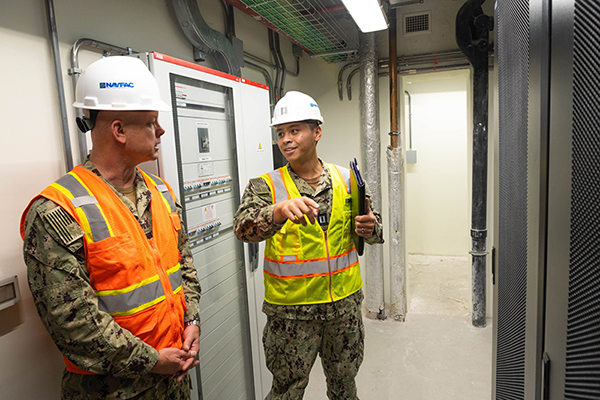
An especially challenging aspect of the project involved the replacement of chilled water system piping throughout a four-story occupied structure. The scope of work required coordinating with 13 tenant commands, both secure and non-secure spaces, all while maintaining continuous 24-hour operations. However, before this aspect of the job even began, it was discovered there were no isolation valves on the existing system that would allow for replacement of the piping. The entire building would need to be shut down, the system drained, and new valves installed. This would significantly impact critical missions: all computer room air conditioning units would be unavailable to keep the servers from overheating. It was apparent this piece of the puzzle had to be solved before any original work of piping replacement could even begin.
The project team exemplified the power of partnership through their approach to this challenge. Leadership initiated an intensive eight-week planning period, conducting weekly stakeholder meetings that grew to twice-weekly sessions as execution approached. These meetings, averaging 30 to 40 participants, brought together representatives from the 13 tenant commands, Public Works Department, Sixth Fleet, security personnel, and multiple base operating support contractors.
The combined effort yielded innovative solutions. The team conducted comprehensive surveys to address inaccuracies in as-built drawings. Detailed one-line diagrams of the entire building’s chilled water system were created to clearly communicate impacts. A total of 14 strategic locations were identified for installing supply and return isolation valves. This approach not only solved immediate construction challenges, but it also provided long-term benefits through no-cost design changes that would facilitate future maintenance with minimal operational impact.
The team invested approximately two months of meticulous preparation, demonstrating how effective partnership enables comprehensive project planning. This work included carefully coordinating access to secure spaces, establishing protective measures for sensitive equipment, and staging materials and tools strategically throughout the facility.
An emphasis on thorough preparation extended to developing detailed contingency plans for critical systems. For example, temporary cooling solutions were arranged for approximately 20 server rooms. This ensured continuous operation of mission-critical systems and equipment throughout the upgrade process. Intense coordination among multiple stakeholders, including security personnel, information technology specialists, and facility managers, kept the work progressing while maintaining operational continuity.

Delivering Results
Completing the chilled water system renovation/upgrade in Naples demonstrates how effective partnerships translate into tangible results.

The carefully orchestrated execution included draining the entire building’s chilled water system, maintaining continuous monitoring in all spaces requiring temporary cooling for 72-hours, installing and testing all isolation valves, and returning the system to full operation. The project team completed all work safely, on schedule, with no rework required—a testament to the thorough planning and coordination efforts.
- The success extended beyond immediate construction goals. Through collaborative problem-solving, several long-term benefits were achieved.
- Installation of strategically placed isolation valves that enables future maintenance with minimal impact on operational readiness.
- Development of comprehensive one-line diagrams and as-built conditions that provide clear visualization of system impacts for future operations.
- Value-engineered design changes that generate ongoing time and cost savings for the government.
- Creation of a more robust design that reduced the need for future temporary cooling measures.
These improvements show how an effective partnership can deliver value beyond the initial scope of work, with enduring benefits for operations and maintenance.
Completing the chilled water system renovation/upgrade in Naples demonstrates how effective partnerships translate into tangible results.
Supporting Readiness
The successful modernization of Naval Support Activity Naples demonstrates the transformative power of partnership in military construction. Effective partnering can turn complex technical challenges, like a chilled water system upgrade, into opportunities for long-term improvement. By embracing collaborative approaches and maintaining focus on mission requirements, project teams can overcome significant challenges while delivering high-quality facilities that support warfighter readiness.
As military construction continues to evolve and challenges become more acute and complex, the lessons learned from successful projects often underscore the importance of strong partnerships. The approach demonstrated at Naples provides a model for future projects—showing how effective partnering can turn constraints into opportunities and ensure that mission capability remains uncompromised throughout construction execution.
Challenges to Opportunities
The renovation project at Naval Support Activity Naples exemplifies how the Warrior Lean construction management system combines lean construction principles with the decision-making prowess of the military to execute mission-critical projects. Adherence to four key pillars (Alignment, Planning, Execution, and Assessment) helps maintain communication, collaboration, and congruence throughout a project lifecycle.
By utilizing this four-pronged framework, the project team successfully navigated complex challenges while maintaining mission readiness at an overseas location.
Early Integration and Continuous Communication. From inception, the project team established clear communication channels and maintained continuous dialogue with all parties. This alignment proved crucial during the chilled water system upgrade. Stakeholder coordination enabled seamless integration of construction activities with minimal interruption to operations. By fostering collaboration from the start, the team created an environment where mission requirements drove decision-making at every level.
Leveraging Collective Expertise. Following lean construction methodologies, the team employed pull planning to optimize resource allocation and workflow. The chilled water system upgrade demonstrated this approach, as the team leveraged diverse expertise to identify innovative installation materials and methods. This collaborative planning process compressed the work window to just four days, showcasing how proper planning can dramatically reduce operational impacts.
Flexible Problem-Solving. The project team embodied Observe-Orient-Decide-Act loop principles through an adaptive approach to challenges. When confronted with the complex chilled water system upgrade, personnel demonstrated the rapid decision-making capability that is essential to maneuver warfare. Installing 14 pairs of isolation valves during a precise weekend operation showcased an ability to observe changing conditions, orient to new challenges, decide on optimal solutions, and act decisively.
Mission-First Mindset. Consistent with Warrior Lean’s emphasis on transparent communication and continuous assessment, the team maintained focus on operational readiness. Regular evaluation of progress enabled early risk identification and proactive problem-solving. This led to the development of a more robust chilled water system design that not only met immediate needs but reduced future operational disruptions.
Robert Williamson is Project Manager, and Meredith Koons, M.SAME, is Director of Marketing and Small Business Programs, Conti Federal. They can be reached at
rwilliamson@contifederal.com; and mkoons@contifederal.com.
Published in the May-June 2025 issue of The Military Engineer

Check Out Related Articles From TME
-

Innovative PFAS Remediation at Camp Grayling
For project stakeholders and remediation managers confronted with PFAS, Regenesis demonstrates the efficacy of using Regenesis’ PlumeStop® colloidal activated carbon (CAC) at Camp Grayling, Michigan. -
A Standardized Approach to Aircraft Fire Training Infrastructure
To support enterprise-wide airmen readiness, the U.S. Air Force is modernizing its standard design for aircraft fire training facilities—introducing digital controls, dual-fuel systems, and PFAS-conscious infrastructure. -
Delivering Energetic Materials Manufacturing Facilities
Designing and constructing facilities that manufacture, process, handle, or store explosives and energetic materials present some of the most challenging defense projects—requiring technical experience, strict safety protocols, and a comprehensive understanding of regulatory frameworks. -
Forging Tradition and Innovation: A New Design Standard at Camp Lejeune
The II MEF Headquarters at Camp Lejeune blends Georgian Revival architecture with modern sustainability—delivering durability, efficiency, and precision that meets contemporary functional requirements while honoring heritage. -

Balancing Efficiency and Fiscal Responsibility
The continuing contracts clause offers the U.S. Army Corps of Engineers a way to improve project delivery and enhance fiscal responsibility by aligning funding with project execution. -
Next Steps for Digital Twin Development
U.S. Forces Japan is laying the groundwork for future integration of digital twin technology in order to validate and collect data that will offer comprehensive insights into utility conditions at installations and enhance overall decision-making, efficiency, and resilience.