Transforming Tasks Through Technology
By Megan Saxton
The Information Technology Laboratory at the U.S. Army Engineer Research & Development Center is helping federal partners incorporate machine learning and artificial intelligence, with recent application, in both contingency response operations and construction management support, showing valuable savings of time and resources.
The adoption of artificial intelligence (AI), beyond acceptance in the workplace and everyday citizenry use, has become potent in the hands of experts with national security challenges to solve. For teams with the Information Technology Laboratory at the U.S. Army Engineer Research & Development Center (ITL-ERDC), tapping into AI and machine learning (ML) to advance efforts supporting the U.S. Army Corps of Engineers (USACE) has seen overwhelmingly positive results.
In particular, the use of AI/ML to augment construction management coordination and contingency operations recovery, especially emergency response, is allowing users to interact with data in effective new ways. For users in the field and in reachback support, being able to utilize AI/ML to quickly and efficiently provide solutions to a wide range of obstacles (especially those classified as critical or catastrophic) is more important than ever.
Improving Assessments
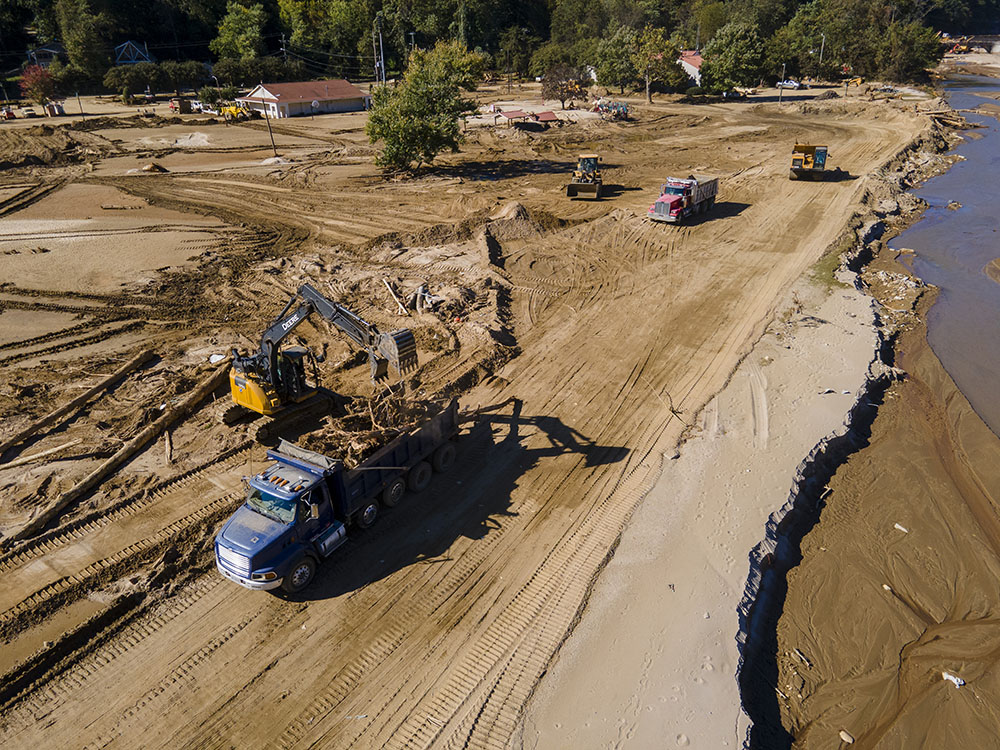
In its proof-of-concept approach to implementing AI/ML, ITL, working with the USACE Directorate of Contingency Operations, selected two contingency use cases: debris and asset management, and data crunching to support existing and future response efforts.
Specifically, team members worked to enable more accurate assessments of debris amounts during a contingency response and to provide a better approach for determining accurate load calls. This would be achieved by identifying anomalies in debris composition and also prioritizing the provision of data needed to ensure AI/ML can be used to respond to potential events of varying destructions.
Overall, the work aims to significantly improve the consistency and effectiveness of emergency response. Before, responders were asked to manually sift through numerous reports, relying on their own experiences to determine what was relevant. By utilizing AI/ML tools, responders can quickly get summarized insights from past operations, complete with identified sources and image descriptions. This means faster access to critical information, more informed decision-making, and a possible increase in response consistency.
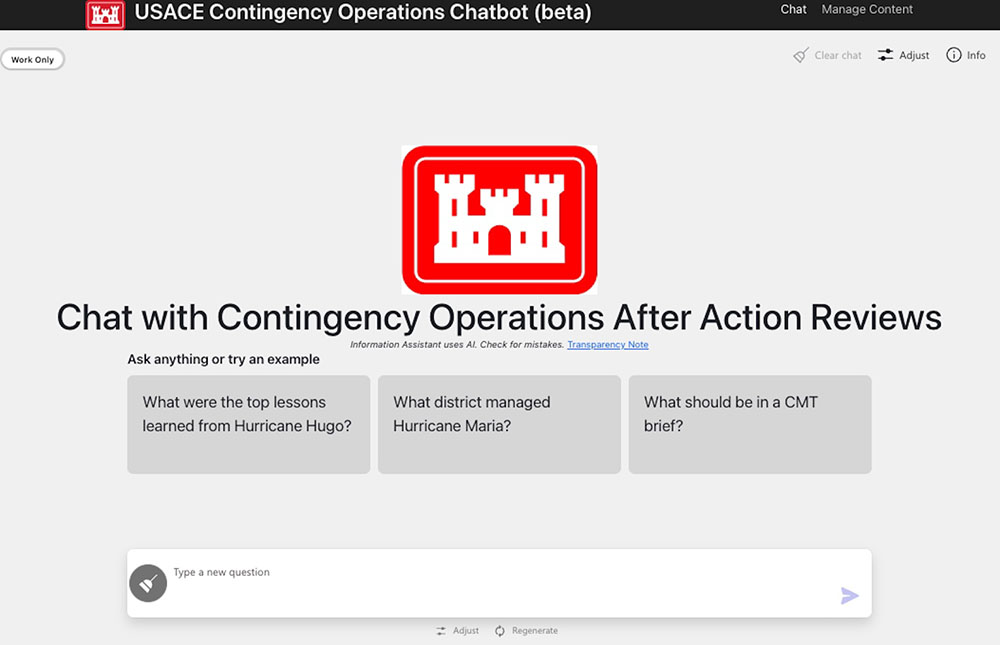
Generating Efficiencies. For debris and asset management, the researchers developed a web-based application that allows contingency response personnel to leverage photographs from multiple sources and gain insights into localized damage and conditions ahead of deployment. Generative AI models are being used to automatically process and tag images, allowing users to query images and classify debris. In the data crunching use-case, the team developed an AI-powered chatbot that was optimized for analyzing and extracting insights from after action reviews and other relevant documents to improve training, planning, documentation and data management processes within contingency operations.
USACE generates massive amounts of data before, during, and after catastrophic events. This collection of information captures areas for improvement, and is supremely useful when a new response occurs. Traditionally, data had been in disparate locations, which made it hard to parse quickly.
In the end, ITL sought a better way to access and communicate with data, then utilized advances in AI/ML to achieve it.
Building In More Time
The Construction Management Administration Application (CMA2) is a recently developed knowledge base designed to be a single point of access for validated information and to mitigate time lost searching for construction management information across multiple sources. USACE, having fielded many inquiries over the years from staff looking for the most up-to-date construction management information, had identified a need for a streamlined way to provide users with what they were looking for.
As part of the initial concept that drove development of what became CMA2, the agency aimed to write 435 articles to aid users in their quest for related construction management data. USACE turned to ITL for a solution that would increase efficiency and effectiveness during the writing process. In response, ITL developed the Jobsite Assisted Quality Intelligence Tool (JAQI), a conversational chat capability that utilizes large language models to query documents for information related to topics of interest, as well as assist in outlining and drafting articles.
JAQI allows personnel to ask questions about construction-related topics, and it can be used to help develop draft articles on various related subjects. These are then verified and validated by a human subject matter expert. Each query response by a user returns source document references so that the subject matter experts can quickly review what the tool outputs.
Streamlining Support. JAQI is projected to save 1,600-hours over the course of the CMA2 project. Additionally, on average, employees across the enterprise spend three hours each week looking for information. This means thousands of hours could be saved yearly across nearly 4,000 construction management teammates now that everything is in a single location. Access to consolidated data with accelerated delivery through AI assistance is estimated by USACE to result in $14 million in savings.
In addition to its usage in construction management, JAQI has the potential to offer aid in other areas. Projects that could benefit are those that have applicable, available and quality data, as well as well-defined goals—and which need assistance with repetitive tasks, complex decision-making and/or pattern recognition.
The Next Frontier, Now
ITL is home to technical experts with a unique combination of skills. Leveraging AI/ML will allow the organization to customize innovative solutions for USACE and additional partners and customers utilizing the latest advancements.
Where these capabilities go next, and what will emerge beyond them, is an exciting realm of opportunity and imagination.
Well-Researched Resources
USACE estimated that six hours would be spent, on average, researching relevant data sources such as engineer regulations, engineering and construction bulletins, and UFC specifications and then draft an article in support of CMA2. JAQI was developed because while the agency did not have the person-power available to deliver on the substantial scope of CMA2, it did have a wealth of information and resources that it could surface through AI/ML.
The JAQI tool is reliable because it is able to take advantage of existing vetted construction management training and reference documents. Given the essential importance of safety to construction management, the validity of the results that JAQI produces is as crucial as time and money conserved.
Megan Saxton is Communication Lead, Information Technology Laboratory – U.S. Army Engineer Research & Development Center; megan.h.saxton@usace.army.mil.
Published in the September-October 2025 issue of The Military Engineer
Check Out Related Articles From TME
-

Innovative PFAS Remediation at Camp Grayling
For project stakeholders and remediation managers confronted with PFAS, Regenesis demonstrates the efficacy of using Regenesis’ PlumeStop® colloidal activated carbon (CAC) at Camp Grayling, Michigan. -
A Standardized Approach to Aircraft Fire Training Infrastructure
To support enterprise-wide airmen readiness, the U.S. Air Force is modernizing its standard design for aircraft fire training facilities—introducing digital controls, dual-fuel systems, and PFAS-conscious infrastructure. -
Delivering Energetic Materials Manufacturing Facilities
Designing and constructing facilities that manufacture, process, handle, or store explosives and energetic materials present some of the most challenging defense projects—requiring technical experience, strict safety protocols, and a comprehensive understanding of regulatory frameworks. -
Forging Tradition and Innovation: A New Design Standard at Camp Lejeune
The II MEF Headquarters at Camp Lejeune blends Georgian Revival architecture with modern sustainability—delivering durability, efficiency, and precision that meets contemporary functional requirements while honoring heritage. -

Balancing Efficiency and Fiscal Responsibility
The continuing contracts clause offers the U.S. Army Corps of Engineers a way to improve project delivery and enhance fiscal responsibility by aligning funding with project execution. -
Next Steps for Digital Twin Development
U.S. Forces Japan is laying the groundwork for future integration of digital twin technology in order to validate and collect data that will offer comprehensive insights into utility conditions at installations and enhance overall decision-making, efficiency, and resilience.