Upgrading the VA Austin Information Technology Center
By Cynthia Brantley, M.SAME
A multi-year program in support of the Department of Veterans Affairs sought to modernize electrical systems and upgrade workspaces to enhance reliability, redundancy, and the user experience.
The VA Austin Information Technology Center in Texas is a workplace, data facility, and hub for staff and veterans. Totaling more than 250,000-ft², the complex houses one of the largest core data centers within the Department of Veterans Affairs (VA). It supports veteran claims and applications, critical missions, and IT applications for facilities across the country.
To support the needs of veterans across the country and around-the-clock data access, agency leadership sought to overhaul the data center’s entire electrical system. The primary purpose was to enhance functionality and create redundancy.
A recent modernization initiative at the technology center comprised a total of 13 projects that encompassed nearly every system and space within the property. The scope included significant engineering work to add electrical connectivity and reliability for 24/7 operations, modernization of mechanical systems, and renovations of offices and workspaces to enhance the user experience. Areas were upgraded for space accommodation, increased functionality, privacy, ease of use, and comfort as well as a complex undertaking to ensure continuity of operations surrounding data center cooling. Studies began in 2019, with design completion in April 2025. Construction stages will continue through 2026. Final completion is planned for 2027.
Powering Operations
To support the needs of veterans across the country and around-the-clock data access, agency leadership sought to overhaul the data center’s entire electrical system. The primary purpose was to enhance functionality and create redundancy. Because the facility houses critical data, it needs multiple layers of electrical capability in case of utility interruptions or unforeseen technology issues.
The facility is required to operate continuously while maintaining a 99.999 percent availability for all IT systems. To institute a second act of redundancy, engineers designed an expansion of the water-cooled central plant to keep the technology operating at full capacity constantly.
The power system was redesigned to connect to multiple utility sources within the city. If one substation were to fail for any reason, the service can transfer to a different source. In addition, it has a generator and uninterruptible power supply capabilities to ensure redundancy in maintaining power.
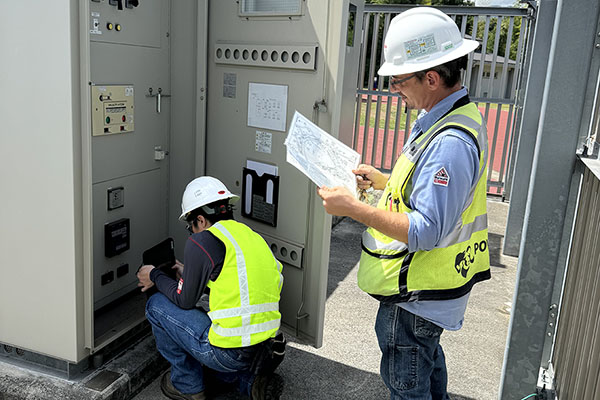
The project team, led by Cushing Terrell, also conducted a thorough electrical study of the center and redesigned part of the power system in accordance with the Uptime Institute standards for a Tier 3 Data Center. For the Austin Information Technology Center, the selected rating was N+2; this level stipulates minimum required tools needed to operate, plus two backups. (Uptime Institute is the prevailing authority on digital infrastructure performance standards. An “N” rating consists of the minimum required tools for an IT system to operate.)
Always-On Resiliency
At the Austin Information Technology Center, data is accessed and stored on a massive scale. The facility is required to operate continuously while maintaining a 99.999 percent availability status for all IT systems. To institute a second act of redundancy, engineers designed an expansion of the water-cooled central plant to keep the technology operating at full capacity constantly.
A chilled-water system was incorporated to provide N+2-rated cooling for the data center. The project also was scoped to include computer room air handlers that use chilled water to reduce the amount of electrical power needed to operate the data center. And, since the facility is reliant on having a constant water source, the team investigated the inclusion of backup water sources as part of a feasibility study. This work included evaluating the potential of adding a water tower as well as an on-site deep-water well, and a second water connection.
Energizing Workspaces
From an interior design perspective, the project paid special attention to creating spaces where local in-
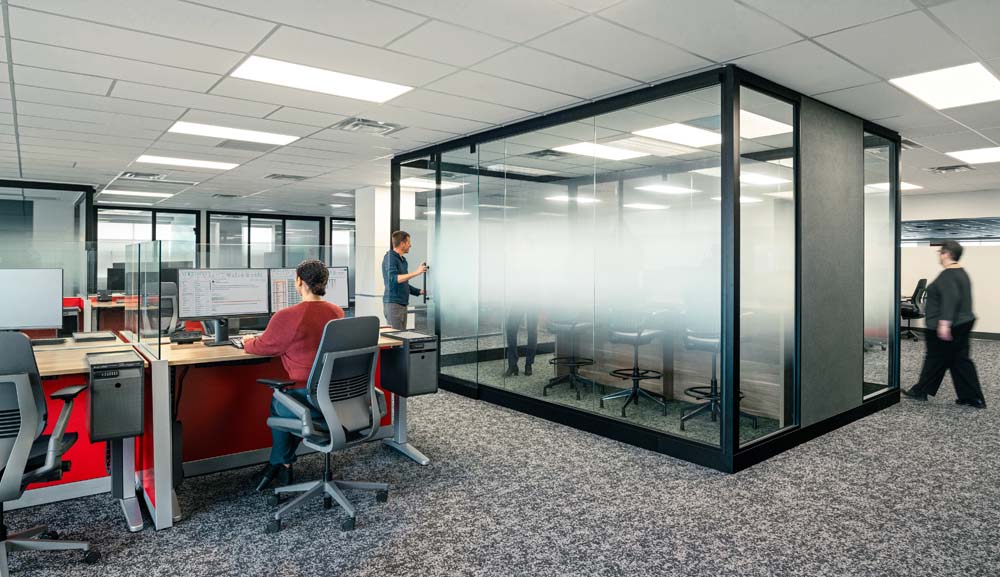
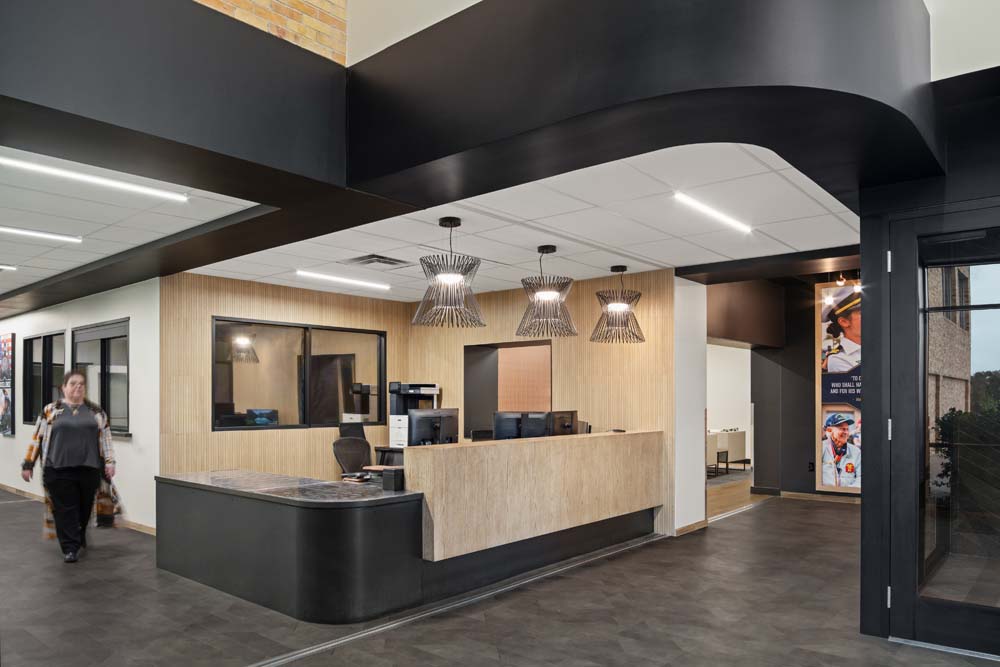
office staff along with teams from across the country can come together and collaborate. This phase included incorporating Austin’s vibrant culture, with colors and textures that are unique in character yet appropriate for a federal space. The use of glass and metal, mixed with the energetic color palette, produced a warm and welcoming space. The design took full advantage of large existing windows to create open, light-filled interior spaces. Demountable glass partitions were utilized wherever possible.
The same treatment was applied to the building’s entryway, executive suites, open spaces, waiting rooms, and shared areas such as cafeterias, breakrooms, and restrooms to offer an inviting experience for visitors and staff.
In the office areas, special attention was paid to power routing, spatial needs, and work-style flexibility. By incorporating various types of gathering spaces (conference rooms, lounge spaces, and customizable tables), the renovation has enabled community, collaboration, and focused work. Movable furniture, implied zones, and sliding doors all contribute to balanced functionality.
For the entryway redesign, the existing soffit above the security checkpoint was replaced with an archway that is clad in a wood veneer wallcovering finish, which creates a grand two-story entrance to the building. The design features hot-rolled-steel archways at three locations in the entry area to designate the major access points to the departments.
Practical Sustainability
The renovations of the Austin Information Technology Center include modifications to the existing HVAC and fire protection systems to ensure a more comfortable environment with improved air quality and life-safety infrastructure. Targeted adjustments support tighter temperature and humidity control for equipment spaces and better ventilation for occupied areas. Improvements to fire protection enhance occupant safety and support maintainability with minimal disruption.
Practical sustainability measures are integrated across the campus as well, such as low-flow fixtures with water metering and energy-efficient lighting with controls and metering. Materials with recycled content were utilized where possible.
Functional Upgrades
Operational practices complement the design. Storage and collection areas for recyclables are provided with easy access for occupants. Indoor air quality strategies also were utilized, such as low-VOC paints, stains, and other low-emitting materials selected. Thermal comfort and lighting quality/control strategies further contribute to a safe, comfortable workplace.
The upgrades at the Austin Information Technology Center represent a comprehensive investment in reliability, resiliency, and in the people who rely on the facility every day. By modernizing critical infrastructure, expanding redundancy for onsite operations, and improving workspaces for staff and visitors, the multi‑year program strengthens the VA’s resilience to be able to deliver uninterrupted services to veterans nationwide while maintaining security over data integrity.
Comprehensive Overhaul
Overall, the full scope of the architectural and infrastructure upgrades at the VA Austin Information Technology Center encompassed the renovation, creation, and improvements of a variety of spaces—from mission-critical systems to common areas.
- A command center, telecommunications room, imaging center, staging center, mail room, and loading dock area.
- The building entryway (with check-in, scanning, guard post, and waiting rooms), executive suites, open office spaces and conference rooms, breakrooms, cafeteria and kitchenettes, refreshed patio, and restrooms.
- A staff library, human resources suite, personal identity verification suite, and an expanded security office.
- New electrical system and the addition of a chilled water system to ensure a constant supply of water to the data center’s cooling system.
Cynthia Brantley, M.SAME, is Senior Project Manager and Architect, Cushing Terrell; cynthiabrantley@cushingterrell.com.
Published in the March-April 2026 issue of The Military Engineer

Check Out Related Articles From TME
-

A Standardized Approach to Aircraft Fire Training Infrastructure
To support enterprise-wide airmen readiness, the U.S. Air Force is modernizing its standard design for aircraft fire training facilities—introducing digital controls, dual-fuel systems, and PFAS-conscious infrastructure. -
Delivering Energetic Materials Manufacturing Facilities
Designing and constructing facilities that manufacture, process, handle, or store explosives and energetic materials present some of the most challenging defense projects—requiring technical experience, strict safety protocols, and a comprehensive understanding of regulatory frameworks. -
Forging Tradition and Innovation: A New Design Standard at Camp Lejeune
The II MEF Headquarters at Camp Lejeune blends Georgian Revival architecture with modern sustainability—delivering durability, efficiency, and precision that meets contemporary functional requirements while honoring heritage. -

Balancing Efficiency and Fiscal Responsibility
The continuing contracts clause offers the U.S. Army Corps of Engineers a way to improve project delivery and enhance fiscal responsibility by aligning funding with project execution. -
Next Steps for Digital Twin Development
U.S. Forces Japan is laying the groundwork for future integration of digital twin technology in order to validate and collect data that will offer comprehensive insights into utility conditions at installations and enhance overall decision-making, efficiency, and resilience. -
Generating Agile Technology
Through a collaborative program with the Naval Facilities Engineering and Expeditionary Warfare Center, a team of engineering students designed and prototyped a generator powered by ocean movement, with the aim to support the energy needs of warfighters in contested logistics environments.