

SAME Perspectives: Data Governance for AI
A Checklist for Federal Planning, Design, and Construction Teams
Society of American Military Engineers, November 2026
Prepared by: Society of American Military Engineers AI Working Group, Resilience Community of Interest

Executive Summary
Artificial intelligence is creating new opportunities across federal design and construction, but turning those opportunities into something a project team can use is not always straightforward. Teams often find themselves asking a seemingly simple question: “Are we allowed to use AI for this?” In practice, that question is usually too broad for any one person to answer because the answer depends on the intended use of AI, the data involved, the systems and requirements that govern its use, and the ability to demonstrate what happened.
This paper gives project teams a method for turning that broad question into a specific request that can be worked through and brought to the right people. It is intended to help the people closest to the work describe what they want AI to do while giving data, technology, cybersecurity, acquisition, and governance specialists the information they need to identify the requirements that apply. The checklist in Appendix A brings those governance checks together so teams can identify what they already know, what still needs an answer, and who may need to be involved.
Examples throughout this paper are drawn from real situations encountered by Working Group members and reviewers. Some details have been simplified or generalized, but the underlying governance issues are real. They are included because these issues are often easier to understand in the context of an actual project. The example below comes from an actual project and illustrates a common challenge raised during Working Group discussions. These recurring challenges helped shape the questions at the center of this paper.
The question that was too broad to answer
Too broad to route, so it sits.
Three weeks into working on a federal design contract, an engineer finds an AI feature in their firm’s specification software that can check the project’s edited spec sections against the current Unified Facilities Guide Specifications (UFGS) and the Unified Facilities Criteria (UFC) behind them, a check the team does manually today. She asks if she is allowed to use AI on this project.
When the question eventually makes its way to the Contracting Officer’s Representative (COR), the COR hesitates. Nothing in the contract directly answers the question, and the decision may involve IT security, privacy, system authorization, data rights, or other responsibilities outside the COR’s authority. The request does not contain enough information to determine which of those reviews apply or who else needs to be involved, so it sits.
The example above is a common one. In the 2026 SAME AI Adoption and Barriers Survey, 95 percent of those who answered said they had used AI tools for work in the past year, but only 22 percent said their organization was using AI on federal project delivery. More than four in five respondents named at least one of three data issues that make AI harder to use on federal work than on other work: CUI and data handling restrictions, data security and privacy, or CMMC requirements. The most selected AI enabler was an approved, secure environment to do the work in. The results point to a gap between interest in using AI and having a clear way to work through the data, system, and security questions that come with using it on federal projects.
What stalls AI adoption is often how the question is framed. “Are we allowed to use AI?” is too broad to determine which requirements apply or who needs to be involved. The COR may be the right first call, but decisions about data, cybersecurity, privacy, system authorization, acquisition, or data rights may belong to different people across the agency.
This paper gives project teams a way to work through that uncertainty using four questions:
- What will the AI actually do?
- What data will it touch?
- Where will the data be processed?
- Can the team show how the AI behaved with this data?
Answering those questions turns a general request to use AI into a specific use case that reviewers can evaluate. Other reviews may still be needed depending on the project, including acquisition, mission, safety, cybersecurity, or legal review. While these considerations are important, this paper focuses on data governance because many of the challenges teams face when using AI on federal projects involve defining its intended use, understanding the data and systems involved, establishing appropriate controls, and demonstrating what happened.
The four questions are most useful when they help a team describe enough of the proposed use for the right review to begin. The team can identify what it already knows, where information is still missing, and which people or records may provide the answer. Figure 1 shows how the engineer’s original question changes when the team works through the four questions.
The revised request is still short, but it gives a reviewer much more to work with. It identifies the task and data involved, where the AI will operate and what it can access, and what record will remain afterward. Just as importantly, it helps the reviewer see which decisions fall within their authority and where another review or reviewer may need to be involved.
A/E/C project teams already make decisions about data every day. They decide which version of a building information model (BIM) is authoritative, who may access a design, whether a consultant’s data may be reused, where files may be stored, and how decisions must be documented. These are data governance decisions, even when no one calls them that. AI adds some new considerations, but it also puts new pressure on questions project teams have been answering for years.
The sections that follow explore the checks behind each of the four questions and show how they apply to common federal A/E/C situations. While the requirements surrounding AI will continue to evolve, these questions provide a consistent way for teams to understand what changes and what information or controls may need to be revisited. The paper also includes a checklist, supporting references, and additional resources to help teams apply this approach to their projects.
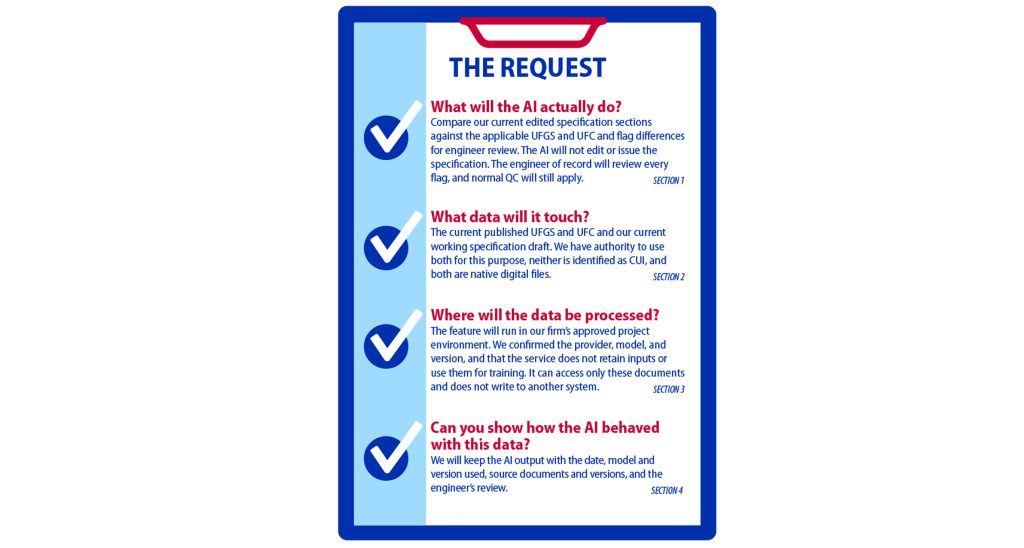
Figure 1. The updated request. The engineer’s original question, rewritten using the four questions.
SCOPE AND TERMINOLOGY
Many SAME members support Department of War projects, so this paper frequently uses DOW requirements such as DFARS clauses and the CMMC program as examples and treats them in more depth than a generic federal overview would. Those requirements do not apply uniformly across the federal government.
DOW and DOD: Since 2025, the department has used Department of War as a secondary designation while its legal name remains the Department of Defense. This paper uses Department of War (DOW) in its own text. It retains DOD when it is part of the official name of a requirement, standard, system, or source, such as the DOD Cloud Computing Security Requirements Guide or DOD Impact Levels.
AI and SI: A September 2026 Executive Order directs executive agencies to use Super Intelligence (SI) in place of Artificial Intelligence (AI). This paper retains AI because, as of publication, most requirements, standards, contracts, and other sources referenced here still use that term.
Contractor use, not AI as a deliverable: This paper focuses on contractors using AI to deliver design, construction, and operations and maintenance work. When AI itself is the deliverable, additional agency AI governance checks and reviews apply. Although agency requirements vary, the paper’s four questions and supporting data governance checks address many of the same core concerns.
Table of Contents
What will the AI actually do?
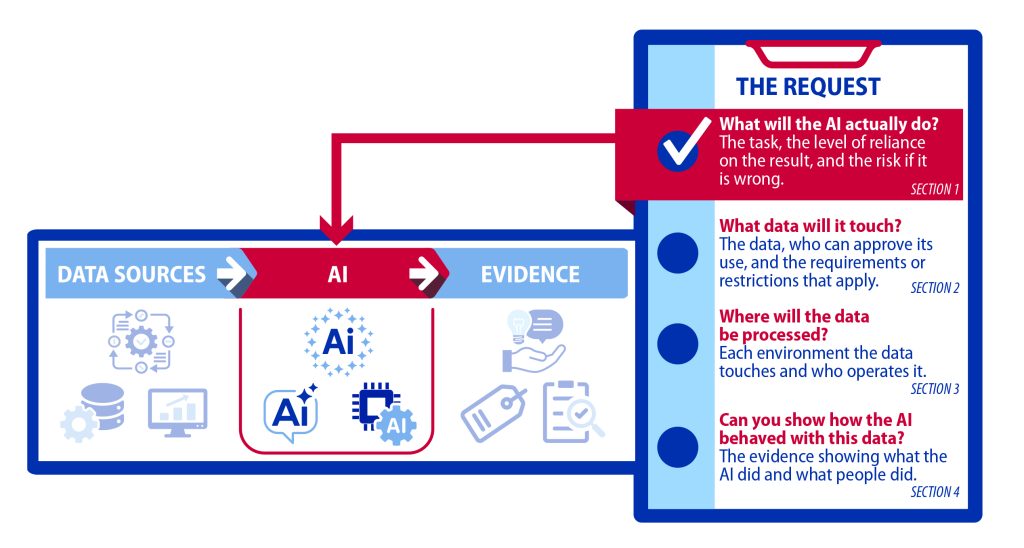
Figure 2. Where the request stands: Question 1.
Before a reviewer can consider the data, the system, or the requirements that apply, they need to understand what the team is proposing to do. The first question is: What will the AI actually do?
The team should be able to describe the use case in plain language, including the task, the project, and the documents involved. Starting there, before getting into products or platforms, keeps the conversation on the work rather than the tool. Once the use case is clear, the reviewer can start to understand how much scrutiny the request may need.
One way to think about that is along two axes.
- The first is AI governance risk: how much the AI is allowed to do on its own and how much the team relies on the result. A tool that produces a draft for a person to review sits lower on that scale. One that acts on its own, or produces a result that is used without review, sits higher.
- The second is data governance risk: what restrictions or requirements apply to the data and how many systems or services it has to move through. Data with few restrictions that stays in one environment sits lower on that scale. Restricted data, or data that has to move into another system or service, sits higher.
Figure 3 plots eight use cases on those two axes. Examples in the lower left generally raise fewer concerns. As a use case moves up or to the right, more review or coordination may be needed.
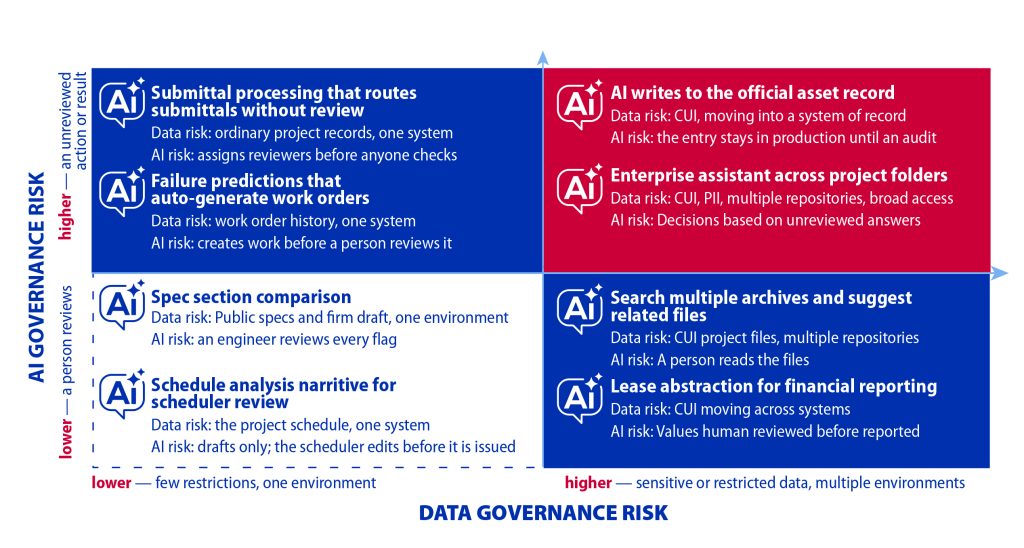
Figure 3. AI governance risk and data governance risk. Eight use cases plotted on the two axes. Red indicates higher risk, blue moderate risk, and white lower risk.
The chart is not meant to give a use case a fixed risk rating; instead, it helps show where the risk comes from. A team may be able to reduce that risk by narrowing the data the AI can access, limiting what it is asked to do, adding review before a result is used, or strengthening the quality control (QC) that catches a wrong result. Understanding those choices helps the team define the use case more clearly and gives a reviewer more options than a simple yes or no.
The data governance checks that follow in this section focus on what the AI is being asked to do, how and when its results are reviewed, what the impact is if the result is wrong, and what stops an error from spreading or standing.
1.1 Bounded or Open-Ended
The earlier example used a design use case, but the question is not specific to a discipline or a phase. Whether the use case is AI-assisted schedule analysis, submittal processing, reconciling a schedule of values against quantities in the issued model, or predicting equipment failure from work order history, the same data governance checks apply.
On the checklist:
- The use case is bounded: the task, the project, and the documents.
Bounding the use case does not mean accounting for every possible way the tool might eventually be used. It means giving the reviewer enough specificity to understand the use being proposed. “An AI chatbot over the firm’s SharePoint,” for example, does not say which files it can reach, which project it supports, or what it is supposed to do with the information. A request tied to a specific task, project, and set of documents gives the reviewer something much more concrete to evaluate.
There is a balance. If the use case is defined too narrowly, the team may be back for another review every time something small changes. If it is defined too broadly, the reviewer is left trying to account for uses that may never happen. The boundary should be broad enough to be useful, but clear enough that both the team and the reviewer know what is in scope and what is not.
1.2 Use Case Oversight
Once the proposed use case is clear, the team needs to explain how the AI’s results will be reviewed and where a person remains in the process. On the checklist:
- The review method and the reviewer are identified.
- The timing of review, before or after use, is set.
The amount and timing of human review are both important elements to articulate in the use case.
A result that helps one person prepare a draft and is reviewed before anyone else sees or relies on it carries less risk than one that supports a project decision, moves to another team, or enters an authoritative system automatically. The request should make clear who is responsible for review, what that review covers, and when it happens.
Review generally falls into two patterns. With review before use, a person checks the result before it is relied on or passed to another process. With review after use, the result moves forward automatically and is checked later through monitoring, sampling, or exception review. In the second case, the team should be able to explain how errors will be found, how quickly they can be contained, and who is responsible for correcting them.
A review before the result is used can stop an error from moving forward. A review afterward depends on the team being able to find and correct errors within a reasonable timeframe. The greater the potential impact of an error, the more quickly it needs to be identified and corrected. That becomes especially important as the potential impact of a wrong result increases, which leads to the next two checks.
1.3 Impact of a Wrong Result
The impact of a wrong result depends in part on what happens next. An error that is caught during an ordinary review may have little effect on the project. The same error can matter much more if the result is used to make a decision, passed into another process, or entered into an authoritative system. As the potential impact increases, more governance concerns may come into play, along with additional requirements or controls that can make the use case harder to move forward as proposed.
The request should therefore explain what could happen if the AI gets something wrong and what would keep that error from spreading or standing. The checklist addresses both.
On the checklist:
- The impact of a wrong result is understood.
- The check that stops a wrong result from spreading or standing is identified.
The renewal option that did not look wrong
Impact depends on how the result is used
A team uses AI to extract data from signed leases for reporting under current lease accounting standards. Some errors are relatively easy to catch. A misread property address, for example, may become obvious when the properties are mapped.
Rent, escalation terms, and renewal options are different. Those values affect the lease term and the amounts reported, and an incorrectly extracted renewal option may not look wrong on its own. If it enters the reporting data, the error can carry forward into later periods.
The impact also depends on how the data will be used. For forecasting, some extraction error may be acceptable when the alternative is incomplete data locked in scanned PDFs. The same tolerance may not be appropriate if the extracted values were used to make payments.
The team can account for those differences in its controls. Addresses may require spot checks, while rent and renewal terms receive additional validation. Extracted data can also be kept out of payment processes entirely. The controls reflect both the consequence of an error and how the result will be used.
Results from the same AI use case can have very different consequences. An incorrect sentence in a draft summary may be caught during an ordinary review. An incorrect value entered into an official asset record may affect derivative records and decisions. A request should identify which results people or systems will rely on, where those results will go, and how quickly an error is likely to be found. This gives the reviewer a clearer picture of the potential impact and the controls needed.
Projects already use checks to keep errors from spreading. These may include standard quality control reviews before a package is issued, an independent review of a calculation, comparison with the source document, or a validation rule before data enters an authoritative system. The request should identify which checks will apply to the AI’s results and when they will occur.
The team should also consider what happens if the AI is used outside the boundaries of the approved use case. Once an AI feature is available, it may be used for a different task, project, or set of data. The engineer in the opening example might use the same tool to draft new specification language rather than check existing sections. Training, tool settings, access controls, or periodic review of usage records can help keep use within the approved scope.
Together, this information helps the reviewer understand the potential impact of a wrong result, how errors will be contained, and whether additional controls are needed.
What data will it touch?
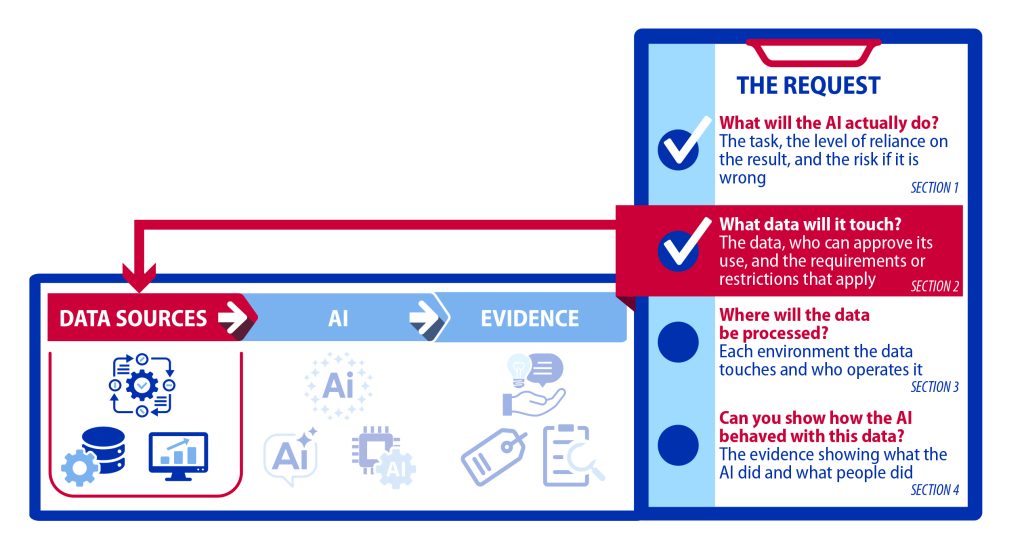
Figure 4. Where the request stands: Question 2.
A project folder rarely contains one kind of data. A single repository may hold public solicitation documents, contract deliverables, consultants’ proprietary models, and information with stricter handling requirements, including personnel or badge records. If an AI system is connected to that repository, it may be able to reach much more than the files needed for the task. The question for this section is: What data will it touch?
Answering that question means identifying the data the AI needs, what else it can reach, who controls it, and what requirements or restrictions apply. It also means determining whether the data is suitable for the proposed use. The example below shows what can happen when those questions are not answered before an AI system is given access.
The assistant that could read everything
The AI could reach data its users could not.
A firm creates an internal AI assistant to answer questions across its internal folders and content libraries. To get it
working, the integrator gives the assistant a service account with read access to the entire repository. A month later, an
employee asks about a project they are not assigned to. The assistant answers using documents the employee could not
have opened alone. The users’ permissions were configured correctly. The AI’s access was not.
Access to data does not necessarily mean the data can be used for the proposed purpose. The data governance checks in this section help the team work through that distinction. They identify what data the use case needs, who controls it, whether its use is permitted, and what restrictions apply. They also assess whether the data is fit for purpose and whether the AI can access data beyond the intended boundaries. The team also needs to determine whether the data is good enough for the proposed use.
In some organizations, much of this information may already be available through a data catalog or other governance systems. When those systems are connected to source systems and maintained with useful metadata, they may identify a dataset’s owner or steward, classification, access rules, privacy considerations, and other requirements. That can substantially reduce the work required to describe the data behind an AI use case.
However, that information is not always available in one place, and the presence of a governance system does not guarantee its metadata is complete or current. Project data may still sit across document management systems, model files, shared folders, and other repositories with limited or low-quality metadata. In those cases, the team may need to confirm the answers through the contract and its clauses, the data owner or steward, the privacy office, the system owner, or other authoritative sources. The checks below identify the information needed regardless of where the answer comes from.
2.1 Identifying the Data
Before anyone can say who owns the data or whether the AI may use it, the team has to say what data the use case needs. That is harder than it sounds. Teams either describe it so broadly that it reads as “everything in the project folder,” which is the unbounded request from earlier, or so precisely, field by field, that the request breaks the moment a schema changes.
On the checklist:
- The data needed for the use case is clearly identified.
One way to do this is to use groupings the project already recognizes. These might be the issued specification sections, the current submittal register, work order history for a group of buildings over a defined period, or the leases for a particular portfolio. The request can also identify where the data is stored, the period it covers, and its approximate size. That gives the data owner enough information to recognize what is being requested and gives the team a reasonable boundary for the access, requirements, and quality checks that follow.
REAL, EXEMPLAR, DUMMY, AND SYNTHETIC DATA
Real project data is not always needed to start testing an idea. A team may be able to begin with a small sample of real data (exemplar data) or avoid real project data altogether by using dummy or synthetic data. Dummy data is made up to look like the real thing, while synthetic data is generated to reproduce useful characteristics of the real data without copying its records. Starting this way can let the team test whether an idea works before introducing data that carries additional requirements or restrictions.
2.2 Data Ownership
Once the team can name the data, it can find out who owns it and who can approve the use of it.
On the checklist:
- The person or organization responsible for the data, and the person who can approve this use, are identified.
The answer may come from the contract, data rights, privacy requirements, or responsibilities assigned to a data owner or steward. Those roles are not always interchangeable. A steward may manage the data without having authority to approve a new use, and access to the data does not by itself establish permission to use it for another purpose.
The team should confirm that the proposed AI use case fits the authority under which the data was collected or shared and the terms that apply to the project. The source of that permission and any conditions on it should be recorded so they can be traced with the data. An AI use case may also raise questions that existing terms do not answer directly. The service may retain input, create derived records, or produce outputs that the team wants to keep after the project ends. The review should address those outcomes and identify who can approve them.
For DOW projects, the contract is a good place to start. Its data rights clauses help establish what rights the government has in project data and what restrictions may apply. For many architect-engineer contracts and construction contracts involving architect-engineer services, DFARS 252.227-7022 grants the government unlimited rights in drawings, designs, specifications, notes, and other works developed under the contract. Other project data may be subject to different rights or restrictions.
Those rights do not necessarily transfer unchanged to a contractor, consultant, or AI provider that receives the data. That distinction becomes especially important when an AI provider may retain project data, use it to improve a service or model, or otherwise use it beyond a specific project task. The team should identify where the authority for the proposed use comes from and any conditions that apply. Depending on the data, that answer may come from the contract, existing governance information, the data owner or steward, the COR, or the contracting officer.
The team also needs to know how those conditions will be enforced. An AI system may be able to reach more data than a particular use case allows, so technical access alone does not define what the AI is permitted to use. The next check looks at how access is controlled to stay within the approved use.
2.3 Permission and Access
Once the proposed use has been approved, the team needs to understand how access to the data will be managed. An AI system may be able to reach more data than it needs for a particular task, so the team should be clear about what data it is permitted to use and how that permission is enforced.
On the checklist:
- The data is approved for this use, and the approval is recorded.
- The AI’s access is appropriate for the approved use.
- The AI returns to each user only what that user is allowed to see.
Permission and access are related, but they are not the same. Some AI systems operate within the individual user’s permissions. Others use service or machine accounts, connectors, or search indexes that can reach more data than a particular task requires. Broader reach is not automatically a problem. The team needs to understand that reach and how the AI is prevented from using or returning data in ways that have not been approved.
The opening example shows why these matters. The assistant could search the entire repository, but it did not account for the permissions of the person asking the question. As a result, it returned information the user could not have opened directly. An AI system may have legitimate access to a larger collection of data, but its responses still need to respect the role and permissions of the person making the request.
The team should compare the data approved for the use case with what the AI can actually reach through its accounts, connectors, indexes, or other connections. Anything outside the approved use should be understood and accounted for. Depending on the system, that may mean narrowing access, limiting what the AI can use for the task, or controlling what it can return to the user. The same comparison should be revisited when connections, permissions, or the underlying data change.
Recording how permission and access are addressed also provides a record of what was approved and how it was implemented. Section 4 returns to that record when it looks at what the team needs to show about the AI’s behavior.
Permission and access is only one part of the picture. The data itself may carry requirements that affect how it can be used, which is the focus of the next section.
2.4 Data Handling Restrictions
Some data comes with rules for how it can be accessed, used, shared, stored, or retained. Those rules may come from contract clauses, agency policy, privacy law, records requirements, data rights, or another party’s proprietary terms. For unclassified federal contract work, the checklist focuses on three areas that commonly affect how project data can be handled.
On the checklist:
- Any FCI in the data is identified.
- Any CUI in the data is identified.
- Any PII in the data is identified.
A single record may be subject to more than one set of requirements. A badge access log may contain personally identifiable information and may also be designated as Controlled Unclassified Information. A consultant’s BIM may be proprietary while also being a contract deliverable for which the government has specified rights. Applying one set of handling rules to an entire repository can leave some records inadequately protected while placing unnecessary limits on others. Before an AI use case is approved, the team should identify which requirements apply to the data within scope and document how that determination was made.
- Federal Contract Information (FCI) is information provided by or generated for the government under a contract to develop or deliver a product or service and not intended for public release. FCI must be safeguarded. FAR 52.204-21 establishes basic safeguarding requirements, while additional requirements depend on the contract and the systems involved. Section 3 addresses how those requirements apply to the systems in which AI processes the data, and Section 5 discusses requirements that are changing.
- Controlled Unclassified Information (CUI) is information the government creates or possesses, or that another organization creates or possesses for or on behalf of the government, that a law, regulation, or government-wide policy requires or permits an agency to protect through safeguarding or dissemination controls. The authorized categories and their legal authorities appear in the CUI Registry maintained by the National Archives.
- Personally Identifiable Information (PII) is information that can be used to distinguish or trace an individual’s identity, alone or when combined with other linked or linkable information. Privacy and CUI requirements can overlap, but meeting one does not necessarily satisfy the other. If personal information will be processed in a federal system, or the use changes how an agency collects, uses, or shares it, the request may also need agency privacy review.
2.4.1 What FCI Looks Like in Practice
The contract context matters when deciding whether information is FCI. Table 1 provides common examples, but the terms of the contract and the reason the information was created still need to be considered.
| Likely FCI when non-public and tied to contract performance | Usually outside the FCI definition |
|---|---|
| Contractual Documents: Non-public statements of work, proposals, and contract modifications. | Publicly Available Information: Government published or approved for public release data. This includes public solicitations, agency press releases, and information on public-facing websites. |
| Communications: Emails, meeting minutes, and memos between the contractor and the government agency regarding the execution of the contract. | Simple Transactional Information: Basic administrative data required to process payments, such as standard banking routing numbers or generic invoice headers. |
| Deliverables: Drafts and final versions of reports, studies, or designs generated specifically for the government under the contract. | Independent Corporate Data: A company’s internal HR policies, general marketing materials, and internal corporate financials (when not generated for a government contract). |
| Operational Data: Performance metrics, project schedules, and programmatic charts related specifically to the contract’s execution. | Commercial Off-The-Shelf Data: Standard user manuals or product specifications for commercially available items. |
| Financials: Detailed billing, invoicing, and pricing models that reveal non-public aspects of the contract or the agency’s operations. |
Table 1. Common examples of FCI. These are examples only, not official determinations.
2.4.2 The Difference Between FCI and CUI
FCI and CUI can overlap, but they are not interchangeable. CUI held by the government may have no connection to a contract and therefore may not be FCI. Information handled by a contractor may meet both definitions when it is provided by or generated for the government under a contract and belongs to a CUI category. FCI does not become CUI simply because it is sensitive or not intended for public release. CUI status must be supported by a law, regulation, or government-wide policy and communicated through the contract or other government direction. FCI generally receives the basic safeguards required by FAR 52.204-21. CUI may require additional safeguards, including NIST SP 800-171 when the applicable contract clause requires it.
For a proposed AI use case, the team should record which designations apply, why they apply, and what handling requirements follow. If the designation is unclear, the team should ask the contracting officer or designated agency contact rather than make the decision on its own.
The assistant in the example could not reliably distinguish between data with different access or handling requirements. AI can sometimes help identify sensitive information, such as a Social Security number, but that does not replace the underlying governance work. Different kinds of data can bring different requirements for access, storage, marking, handling, privacy review, and the systems allowed to process it. The team needs to identify those requirements before the use case moves forward so it can see which controls, approvals, or other conditions apply. Working through that information early also gives reviewers a clearer picture of what is required and where additional review may be needed.
NOTE ON TERMINOLOGY
Sensitive But Unclassified (SBU) and For Official Use Only (FOUO) may still appear on older federal project information, but they should not be treated as current CUI designations. For DOW information, legacy markings should prompt the team to confirm whether the information now qualifies as CUI and what handling requirements apply. DOW does not require all legacy documents to be re-marked, but new documents created from legacy information must be marked as CUI if the information qualifies.
Other types of information, including protected health information, may carry separate handling requirements. Classified information is outside the scope of this paper.
2.5 Data Quality
Having permission to use data does not mean the data is going to work for the task. The team also needs to understand whether the data is accurate, complete, current, and usable by AI.
A clean answer from the wrong document
Authoritative is not the same as current.
During the design phase for a facility, a team asks an AI assistant to check the current mechanical model against the project specification. It produces a clear list of conflicts. Weeks later, someone notices that the list cites requirements revised two bulletins ago. The assistant had access to the full project folder and retrieved a superseded specification because it ranked highly in the search. Nothing was breached, and the tool worked as designed. The problem was the source. The assistant did not distinguish the current issued specification from older versions, whether because of the available data, its instructions, or how it interpreted the information.
AI can produce a convincing answer from incomplete, outdated, or poorly prepared data. Before relying on the result, the team should understand whether the source data is good enough for the task and whether the AI can read it accurately.
On the checklist:
- The governing version of the data is identified.
- The data suits the proposed use case.
- The data’s source, change history, and last update are known.
- The AI can read the data accurately enough for the task.
- Important data preparation and transformation decisions are recorded.
Project data often contains several versions and views of the same work, including design submissions, issued sets, record drawings, approved and rejected submittals, official inventories, and working files maintained alongside them. Projects already use naming conventions, submittal registers, issue records, version histories, and other controls to establish which information governs. An AI system will not necessarily understand those controls simply because it has access to the files. The team, and the AI, needs to know which source governs and whether it is accurate, complete, and current enough for the proposed use.
The history of the data matters as well. In data management, this is often described through provenance, pedigree, lineage, and timeliness. These terms address where the data came from, who has handled or changed it, what happened to it along the way, and when it was last updated. Much of that history may already be captured in transmittals, submittal registers, model issue records, version histories, or a data governance system. The team does not need to recreate information that is already documented, but it should be able to trace important data far enough to understand what it represents and whether it can support the proposed use.
A traceable history alone does not make the data suitable for the task. Record drawings from an earlier renovation, for example, may be valid project records with a well-documented history but still lack the detail or currency needed for a utilization study.
The AI also must be able to read the data well enough for the task. Scanned records, plan images, inconsistent model parameters, and differently maintained asset spreadsheets may require extraction, mapping, cleaning, or standardization. Optical character recognition (OCR) can make information in scanned records easier for a system to use, but it does not determine which scanned set governs or resolve conflicting values.
Preparing the data can also introduce decisions that affect the result. Someone may need to decide how to handle missing values, reconcile different naming conventions, map fields between systems, or correct information that appears to be wrong. Important transformations, assumptions, and corrections should be recorded, particularly when an AI tool performs several of these steps together. The team should be able to identify who made significant cleanup decisions and what was changed.
Data quality can be considered while access and other reviews are underway. Finding out early that the available data is incomplete, outdated, or difficult for the AI to interpret gives the team an opportunity to correct the data, narrow the use case, or identify another source. If the project data is not yet ready for the proposed use, dummy or synthetic data may also be useful for early development and testing.
With the data and its requirements identified, Section 3 examines where the data may be processed, stored, and transmitted.
Where will the data be processed?
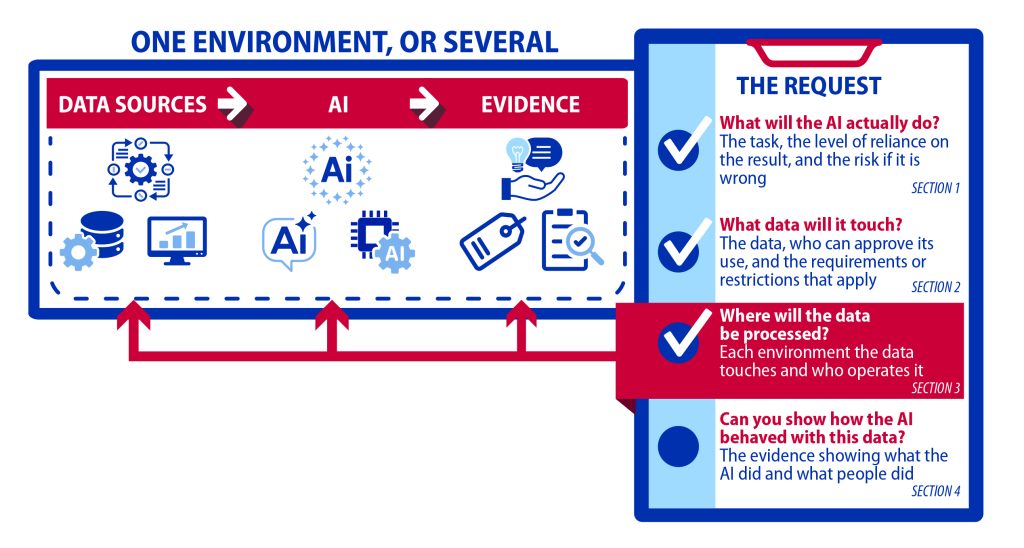
Figure 5. Where the request stands: Question 3.
The next question is where the AI will use the data. The same AI capability may be available through a public service, an enterprise tenant, a government environment, or a system operated by a contractor, each with different controls and data flows. The question for this section is: Where will the data be processed?
For the purposes of this paper, “processes” includes storing, processing, or transmitting data. That may include less visible copies created in indexes, caches, logs, or other supporting services. Understanding where the data goes helps identify which requirements apply and who or what may have access to it.
On DOW contracts, this may also connect to the Cybersecurity Maturity Model Certification (CMMC) program when FCI or CUI is involved. CMMC assessments consider the systems, services, and other assets that process, store, or transmit that information. An AI capability may therefore need to be considered along with the infrastructure, applications, data connections, and supporting services it relies on.
This section follows the data through the systems and services the AI relies on, including the requirements that apply along the way.
3.1 How Existing Requirements Apply to the AI Use Case
Using AI does not replace the requirements that already apply to the data or the systems handling it. The team needs to understand how the proposed AI environment fits within those existing requirements.
On the checklist:
- Each environment is authorized for this data and this AI use case.
For DOW contracts involving FCI or CUI, that may include understanding how the AI environment fits within the contractor’s CMMC scope and existing safeguards. The team needs enough information about the environment to understand where the data goes, where the application and model are hosted, and what accounts, connections, and supporting services can access it. If those details are not available, it may be difficult to determine how the environment fits within the contractor’s existing security controls and CMMC scope.
The CMMC assessment schedule is changing, as discussed in Section 5, but the underlying safeguarding requirements may already apply through the contract. FAR 52.204-21 establishes basic safeguarding requirements for covered contractor information systems, while DFARS 252.204-7012 establishes additional requirements for covered defense information and covered contractor information systems.
Depending on the contract and how the AI environment is used, two federal cloud frameworks may also be relevant.
- FedRAMP: FedRAMP provides a government-wide approach to assessing cloud services for federal use. For DOW contractors, an external cloud provider that stores, processes, or transmits CUI must meet security requirements equivalent to the FedRAMP Moderate baseline. This can be met through a qualifying FedRAMP service or DOW’s documented Moderate equivalency process. Under DOW CIO guidance, equivalency requires an independent assessment against the full FedRAMP Moderate baseline and supporting evidence for the contractor to evaluate. FedRAMP is currently updating its terminology, so teams may see both the existing Moderate terminology and the newer Class C and FedRAMP Certification terminology during the transition.
- DOD Cloud Computing Security Requirements Guide (CC SRG): The CC SRG assigns Impact Levels to cloud services based on the information and mission they support. Impact Level 4 is commonly associated with CUI in DOD cloud environments. Whether an Impact Level applies to a proposed use depends on the contract, the agency’s direction, and the cloud service provided.
The team should confirm which requirements apply with the contracting activity or person responsible for cybersecurity compliance.
Cloud authorizations and Impact Levels apply to defined services and system boundaries. Teams should understand which existing security controls cover the proposed AI application and whether additional controls are needed. The application’s configuration, identities, permissions, connections, and handling of inputs and outputs still need to be addressed. The same is true in a government-provided environment. The team should confirm that the specific AI use case and the data it will handle are supported within that environment.
The vendor who said “FedRAMP equivalent”
How the system is used determines what evidence is needed.
A project team wants to use an AI assistant to search design files that include CUI. The vendor says the service is “FedRAMP equivalent.” Before relying on that statement, the team needs to understand how the system will be used, which requirements apply, and what evidence supports the claim.
As a rule of thumb, systems operated by or on behalf of the government must meet applicable agency authorization and security requirements. A contractor using a cloud service for its own contract work must ensure the service meets the requirements that apply to the contract. For DOW contractors handling covered defense information in an external cloud service, those requirements generally include meeting the FedRAMP Moderate security baseline or DOW’s requirements for equivalency.
Teams can verify a qualifying FedRAMP authorization in the FedRAMP Marketplace. For an equivalent service, the provider must supply the required third-party assessment and supporting evidence for the contractor to evaluate. A marketing statement alone is not enough.
FedRAMP terminology is changing, so teams may encounter both existing and newer terms during the transition. Regardless of terminology, teams still need to know which service handles the data, what evidence supports its status, what that evidence covers, and which responsibilities remain with the customer.
3.2 Trace the Data Through the System
Authorization addresses each environment individually, while tracing the data shows how they work together. The team should follow the data from its source through the full workflow, including repositories, connectors, retrieval services, the model, indexes, temporary storage, logs, outputs, and the systems where those outputs are saved or used. The trace should include both places where data is stored and the services that move or transform it.
On the checklist:
- Every environment the data touches, and its operator, is listed.
- Each point where the data leaves the team’s control is marked.
- The model, its version, and its provider are identified.
- A way to learn of model or service changes is in place.
- Controls inherited from each provider, and those retained by the team, are identified.
The trace should show each component the data reaches and who operates it. This connects to the authorization by showing how data moves between environments and where another organization or service becomes involved. For CUI, the same information can also help the contractor determine which components need to be considered as part of its CMMC assessment scope.
The AI itself also needs to be identifiable. The team should know which model and version are being used, who provides it, and which major services support it. Those details can change overtime. A provider may update a model, retrieval service, or other component without changing the project’s intended use, so the team should know how it will learn about changes that could affect the data or the controls protecting it.
Tracing the data through the system also helps separate controls provided by others from those the team still needs to address. A cloud or service provider may supply controls for its environment, while the team remains responsible for its own configuration, accounts, permissions, connections, and other parts of the implementation. The team should understand that division rather than assuming the provider’s authorization covers the full use case.
Much of the information needed to trace the data may already exist. Provider architecture and data-flow documentation can show what happens within the provider’s environment, while the firm’s IT or security team can identify connectors, accounts, and other connections on its side. Provider terms and data-processing agreements may provide additional information about retention and handling. Where documentation leaves a gap, the team may need to confirm the flow with the provider or through testing.
The trace establishes where the data goes and which requirements apply at each point. For FCI, CUI, and other protected information, the team may also need evidence that the required safeguards are in place and operating as expected. Section 4 addresses that evidence and how the team can show that the AI use case operates as described.
Can the team show how the AI behaved with this data?
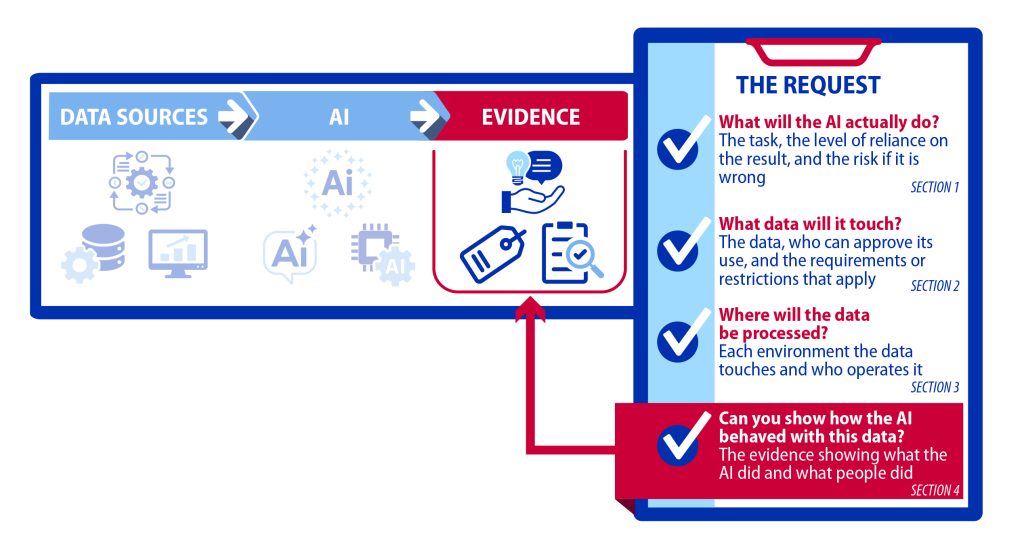
Figure 6. Where the request stands: Question 4.
Section 3 identifies where the data should go, who and what can reach it, and which controls should apply. The next step is preserving enough evidence to show what happened. The question for this section is: Can the team show how the AI behaved with this data? The data governance checks that answer it are in the two subsections below: what evidence to keep for each of the earlier questions, and how to keep it trustworthy.
This is a records question before it is a technology question, and A/E/C projects are already good at it. Transmittals, submittal logs, RFI histories, and change records all exist so that someone can reconstruct a decision later. An AI use case adds automated steps to that record that may not be visible to the person making the request. The AI may retrieve documents, retry a request, call another service, or create and move an output. The record needs to distinguish those actions from the actions taken by a person.
The evidence should be sufficient to reconstruct how the AI was used, what data it used, what it did, and where the result went. The use case, the data involved, and the potential impact of the result will help determine how much detail needs to be preserved.
4.1 Evidence for Each Question
The first three sections establish how the AI is intended to be used, what data it will access, and where that data will go. This section builds on those questions by identifying the records teams need to capture during use, including the request, the data involved, the system’s actions, and the resulting outputs.
On the checklist:
- The request is recorded: what was asked, by whom, when, and under which approved use case.
- The data the AI read or retrieved, and its designations, are recorded.
- The model or service that did the work, and the actions the AI took on its own, are recorded.
- The AI’s output and where it went are recorded, and the records can be tied together to reconstruct one use.
- Decisions about what evidence to keep, and why, are recorded.
Together, these records should make it possible to reconstruct a use from request to result. That includes identifying the approved use case, the data the AI used, the model or service involved, what the AI produced, where the result went, and where people reviewed or acted on it.
Evidence may come from several places, including logs, application records, source citations, review records, and project documentation. Together, those records should provide enough information to reconstruct the use and distinguish the actions taken by the AI from those taken by a person. The team should be able to connect the records across the workflow so that automated actions, data access, reviews, and results can be traced to the same use.
The example below shows what happens when that connection is missing.
The insider threat that turned out to be a retry loop
The log could not tell one question from twenty attempts.
An organization brought data into an enterprise platform, modeled it there, and connected the platform’s AI chatbot so users could ask questions in plain language. A review of the audit logs turned up what looked like a serious problem. The same employee appeared to be querying the same restricted records over and over in slightly different ways, as if probing for data their role did not allow them to see. It looked like an insider threat.
But the user had only asked once. The chatbot had been rewriting and retrying the question behind the scenes to get a better answer, and every retry was logged as a separate attempt to access records the user’s role blocked. No data was exposed, and the access controls worked as intended. The problem was that the logs could not distinguish one user request from twenty automated attempts, or the person’s actions from those of the AI.
The example highlights the importance of capturing the right information in audit logs. Teams need to be able to distinguish between actions taken by a person and those performed by AI on their behalf, with enough detail to understand what happened. That does not necessarily mean retaining every prompt and output. Doing so may create additional copies of CUI, PII, or other sensitive information without serving a defined purpose. How much evidence is needed depends on the use case, the information involved, applicable records requirements, and what would be needed to investigate a problem.
Once the team determines what evidence needs to be kept, it also needs to make sure that evidence remains protected, trustworthy, and available for as long as it is needed.
4.2 Protect and Retain Evidence
Evidence may need to be available months after an AI use occurred, particularly if a result is questioned or an incident needs to be investigated. The records need to remain available and protected from unauthorized access, modification, or deletion for as long as they are required. For systems within the CMMC Assessment Scope, audit records and logging functions are also subject to specific security requirements. The team should consider the following when deciding how that evidence will be protected and retained.
On the checklist:
- The evidence is protected at the level required for its most sensitive content.
- Only authorized people can view the evidence or manage the logging function.
- Unauthorized changes to or deletion of the evidence are prevented or detected.
- The retention period for the evidence is known.
- Disposal of the evidence at the end of the retention period is planned.
Evidence can contain sensitive information even when it was created only to record what AI did. Logs may capture prompts, filenames, user information, retrieved passages, outputs, or other information from the underlying data. The team should understand what the evidence contains and protect it accordingly. Access to the evidence and the logging functions that create it should also be controlled. Records should be protected from unauthorized changes or deletion, potentially by storing audit records separately to preserve their integrity. Depending on the system, separating audit records from the system being monitored may help protect their integrity.
The team also needs to know how long the evidence must be kept and what happens when that period ends. Contract terms, records requirements, assessment needs, incident response procedures, and the requirements that apply to the information itself may all affect retention and disposition.
Together, these records give the team a way to show how the AI was used, what it did, and where people were involved. They can support project review, security monitoring, incident investigation, and other oversight without relying on someone to reconstruct the use from memory. The same records may be useful to the agency, the prime contractor, and the firm’s own leadership.
HOW AI CAN HELP WITH THIS CHECK
AI can help teams review large volumes of evidence by correlating records across systems, identifying gaps, and flagging activity for review. It can also trace events across logs that would otherwise require manual comparison. Results should link to the underlying logs and source records so reviewers can verify the findings.
Using AI to review the evidence may also bring additional data or systems into scope. If an external cloud service processes, stores, or transmits CUI as part of that review, the cloud and CMMC considerations may also apply.
The evidence creates a record of how the use case was approved and how it operated. It also gives the team something to return to when the use, data, system, or applicable requirements change. At this point, the team has the information needed to put the request in front of the appropriate reviewers. Section 5 looks at several requirements that are changing and how the four questions can still be used as those requirements evolve.
What is changing?
Federal policies, technologies, and requirements for AI and data governance continue to evolve, and these changes may affect how teams answer the four questions in this paper. They may change which data requires additional handling, which environments can be used, what evidence is required, or who needs to review the request. A change to an assessment process or program schedule does not necessarily change requirements already included in a contract. Teams should confirm the current requirements as they work through the four questions rather than rely on an earlier review or assumption.
The three areas below are changing now and are particularly relevant to federal A/E/C projects.
5.1 CMMC Assessment Requirements
| What is changing | On July 13, 2026, the department suspended CMMC Phase II requirements, which had been scheduled to take effect on November 10, 2026, while it conducts a broader review of the program. Phase I self-assessment requirements remain in place. Under the current implementation guidance, requiring activities may designate Level 1 or Level 2 self-assessments, while Level 2 C3PAO and Level 3 DIBCAC assessment requirements are suspended. The department also established a CMMC Reform Task Force to review the program and provide recommendations to the DOW CIO within 60 days. As of this publication, those recommendations have not been made public and the Phase II suspension remains in effect. |
| Why it is changing | DOW is reviewing the cost and administrative burden of the program, particularly for small, medium, and non-traditional businesses, while maintaining requirements to protect government information. The suspension did not remove the safeguarding requirements already established through contracts. FAR 52.204-21 continues to establish basic safeguarding requirements where applicable, and DFARS 252.204-7012 continues to require protection of covered defense information, including applicable NIST SP 800-171 requirements. Phase I CMMC self-assessment and affirmation requirements also remain in place |
| Navigating the changes | The team should keep a dated list that separates the safeguarding requirements in each contract from its current CMMC assessment requirement. The list should include the applicable clauses, the assessment status, and the official source used to confirm it. When the department issues new guidance, the team can update the part that changed without reevaluating everything. |
Table 2. Changes to CMMC assessment requirements.
5.2 FedRAMP Requirements
| What is changing | FedRAMP published its Consolidated Rules for 2026 at the end of June. Optional adoption began on July 4, 2026, and the rules generally become mandatory on January 1, 2027, although some requirements have their own transition dates. FedRAMP is moving to the term FedRAMP Certification and introducing new certification classes, more machine-readable information, reusable security evidence, and updated approaches to continuous monitoring. The existing Rev5 process remains available during the transition, but FedRAMP plans to stop accepting applications for new Rev5 Certifications in June 2027. |
| Why it is changing | FedRAMP has historically relied heavily on document packages and periodic reviews. The changes are intended to reduce manual work, make security information easier to share and reuse, and provide more current information about how a cloud service operates. The terminology, processes, and form of the evidence are changing, while the program continues to address critical areas like access control, vulnerability management, incident response, data protection, and continuous monitoring. |
| Navigating the changes | The team should record the exact cloud service offering used by the project, its current FedRAMP Marketplace status, the services covered by that status, and the date the information was checked. Tracking the specific offering rather than only the vendor makes it easier to recognize when its certification status, including services, or other relevant information changes. |
Table 3. Changes to FedRAMP requirements.
5.3 AI-Specific Requirements
| What is changing | The FY2026 NDAA requires DOW to develop a risk-based security framework for AI and machine learning systems acquired by the department and to implement related contractor requirements through the DFARS or similar action. The framework is intended to build on existing cybersecurity requirements, including CMMC and the NIST SP 800 series, rather than create a separate security program. The specific requirements are still being developed. Federal restrictions can also apply to specific AI products or providers used in performing DOW contracts. Those restrictions may change over time, so teams should confirm the current requirements for the AI capability they plan to use rather than rely on a fixed list. |
| Why it is changing | Congress identified AI-specific security concerns including data poisoning, tampering, supply chain risks, and unintended exposure or theft of AI systems and data. The new framework is intended to address those risks through the department’s existing cybersecurity structure where possible. |
| Navigating the changes | The team should keep a dated record of the AI capabilities used on the project, including the product or service, provider, and model when available. For AI built into design, construction, or project-management software, the record should identify the AI capability as well as the larger product. When a provider, model, or requirement changes, revisit the four questions to see whether the task, data, processing environment, or evidence requirements have changed. |
Table 4. Changes to AI-specific requirements.
Beyond DOW-specific requirements, federal agencies also have government-wide responsibilities for the use and acquisition of AI under the Advancing American AI Act and OMB Memoranda M-25-21 and M-25-22. Additional requirements may apply to specific AI acquisitions, including requirements for procured large language models under OMB Memorandum M-26-04. The review process varies by agency and may involve program, acquisition, privacy, cybersecurity, legal, data, and AI governance officials.
The requirements around a use case will continue to change, but the four questions give teams a consistent way to work through those changes. A new assessment requirement, cloud status, model restriction, or agency policy may change what the AI can do, what data it can use, where that data can be processed, or what evidence needs to be kept. Returning to those four questions helps the team identify which part of the request needs to be reviewed again and what supporting information needs to be updated.
Conclusion
Federal project teams cannot predict every new AI model, policy, acquisition clause, or cybersecurity requirement. They can establish a consistent way to evaluate a proposed use as those things change. This paper offers an approach to navigating data governance challenges when using AI on federal projects, organized around four questions.
- What will the AI actually do?
- What data will it touch?
- Where will the data be processed?
- Can the team show how the AI behaved with this data?
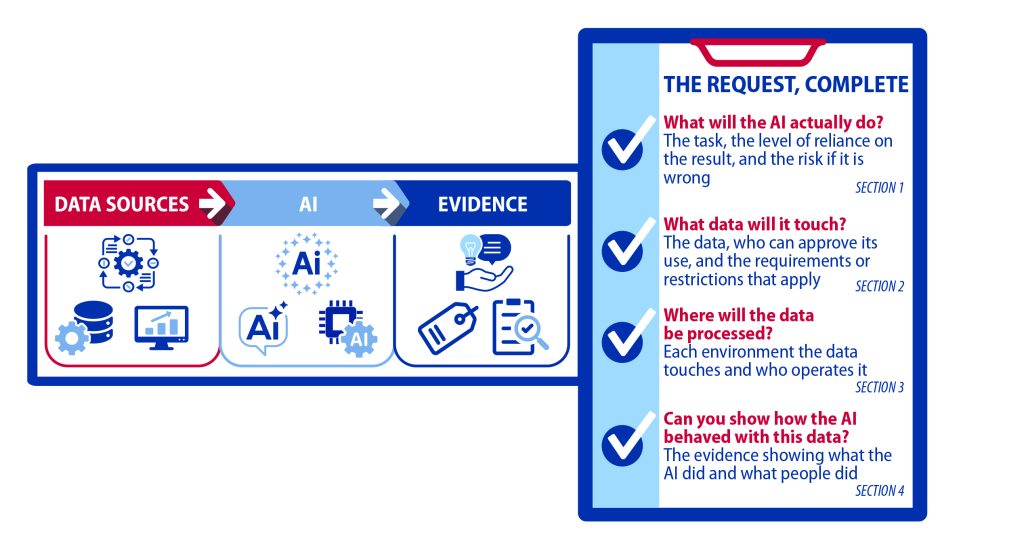
Figure 7. The request, complete.
The four questions turn a broad request to use AI into a specific use case that can be reviewed. They also give the project team a record it can return to as the use, data, system, or requirements change. That becomes especially useful as assessment schedules, cloud programs, AI security requirements, contract terms, and agency policies continue to evolve. When something changes, the team can return to the same four questions, identify which part of the request is affected, and update the supporting information and controls that go with it. The same structure can then be used again for the next review rather than rebuilding the request from scratch.
For federal A/E/C teams, data governance is often where an AI use case starts to feel difficult. Questions about CUI, access, data rights, cloud environments, records, and security can quickly turn a simple idea into a much more complicated review. Those issues are real, but they can be worked through. The four questions and the checks in Appendix A give the team a method for identifying what is known, what still needs an answer, and who needs to provide it. When teams understand what is permitted, what requires additional review, and how to address those requirements, governance becomes more than a way to manage risk. It provides the clarity needed to increase AI adoption and move promising use cases forward.
On projects supporting national infrastructure and government missions, from defense and diplomacy to public safety and beyond, the potential impact of AI can be significant. Used well, it can reduce time and cost, help teams work through large volumes of information, and make better use of data that already exists. The same capabilities can create security, legal, contractual, and operational risks when the data, systems, or results are not well understood. Those risks are why many of the requirements discussed in this paper exist. These requirements do not have to prevent teams from using AI on federal projects. By working through the challenges methodically and using governance checks as a guide, teams can find a path forward.
AI can deliver real value on federal projects. The questions and governance checks in this paper help teams address one of the most commonly cited barriers to AI adoption—data governance—and put AI to use on their projects.
Appendix A: Data Governance for AI Checklist
Appendix B: Terms and Acronyms
What the terms and abbreviations in this paper mean. Where a term is also a document the paper cites, its full citation is in Appendix C.
| A/E/C | Architecture, engineering, and construction. |
| AI | Artificial intelligence. This paper uses the federal statutory definition (15 U.S.C. 9401(3), adopted by OMB Memorandum M-25-21): a machine-based system that can, for a given set of human-defined objectives, make predictions, recommendations, or decisions influencing real or virtual environments. In practice that covers the AI features built into the tools a project team already uses as well as separate assistants and agents. |
| Authoritative system | The system a project treats as the source of truth for a given kind of information, such as the official asset record or the issued model. |
| BIM | Building Information Model. |
| C3PAO | CMMC Third-Party Assessment Organization. An organization authorized to conduct CMMC Level 2 certification assessments. |
| CC SRG | DOD Cloud Computing Security Requirements Guide. See Appendix C. |
| CFR | Code of Federal Regulations. |
| CIO | Chief Information Officer. The DOW CIO issues the department’s cloud and FedRAMP equivalency guidance referenced in this paper. |
| CMMC | Cybersecurity Maturity Model Certification. The DOW program for verifying that contractors have implemented the safeguards required for FCI and CUI. Level 1 covers FCI, Level 2 covers CUI, and Level 3 adds requirements for the most sensitive programs. |
| CMMC Phase I | The first step of the rollout, which began on November 10, 2025. It allows requiring activities to include Level 1 or Level 2 self-assessment requirements in solicitations and contracts, and it remains in effect. |
| CMMC Phase II | The second step of the rollout, which would add Level 2 certification assessments by a C3PAO. It was scheduled to begin on November 10, 2026, but the department suspended it on July 13, 2026 while it reviews the program. |
| CO | Contracting Officer. The government official with authority to enter into, administer, and modify a contract, and the source for confirming data designations and clause requirements. |
| Connector | A software link that lets an AI system read from or write to another system, such as a document repository. Like a service account, its permissions help define what the AI can reach. |
| COR | Contracting Officer’s Representative. The government’s designated day-to-day point of contact for a contract. |
| CUI | Controlled Unclassified Information. Information the government creates or possesses, or that another organization creates or possesses for the government, that a law, regulation, or government-wide policy requires or permits an agency to protect. Categories are listed in the CUI Registry. |
| Data governance | The decisions and records that control how data is defined, used, protected, shared, retained, and disposed of, and who is accountable for each. |
| Data steward | The person responsible for the day-to-day management of a defined set of data, including helping maintain its quality, metadata, access, and appropriate use. A steward may support or recommend a decision without having authority to approve every new use. |
| DFARS | Defense Federal Acquisition Regulation Supplement. The DOW supplement to the FAR. |
| DIBCAC | Defense Industrial Base Cybersecurity Assessment Center. The DOW organization that conducts CMMC Level 3 assessments. |
| DOD, DOW | Department of Defense, which since 2025 has also used Department of War as a secondary designation. This paper uses DOW in its own text and keeps DOD where it is part of the name of something cited. |
| DODI | Department of Defense Instruction. |
| FAR | Federal Acquisition Regulation. |
| FCI | Federal Contract Information. Information provided by or generated for the government under a contract to develop or deliver a product or service and not intended for public release. |
| FedRAMP | Federal Risk and Authorization Management Program. The government-wide program for assessing and authorizing cloud services used by federal agencies. |
| FedRAMP Certification | The term FedRAMP is adopted for an authorized service under its 2026 Consolidated Rules, which also introduce certification classes. |
| FedRAMP Marketplace | FedRAMP’s public list of cloud services and their authorization status. |
| FedRAMP Moderate | The FedRAMP baseline for systems where a loss of confidentiality, integrity, or availability would have a serious effect. The level generally required for cloud services that handle CUI. |
| FedRAMP Moderate equivalency | The DOW standard under which a cloud service that is not FedRAMP authorized may be treated as meeting the Moderate baseline. See Appendix C. |
| FOUO | For Official Use Only. A legacy marking retired by the CUI program that still appears on older documents and system banners. See 2.4 and Appendix C. |
| Impact Level | The CC SRG’s categories for cloud services based on the sensitivity of the information they hold. Impact Level 4 is commonly associated with CUI. |
| Model | The trained AI component that generates a result. Providers issue new versions, and a version change can alter how data is handled. |
| NDAA | National Defense Authorization Act. The annual law that sets DOW policy and authorizes its programs. |
| NIST | National Institute of Standards and Technology. |
| OCR | Optical character recognition. Software that converts scanned images of text into machine-readable text. |
| OMB | Office of Management and Budget. |
| PII | Personally Identifiable Information. Information that can be used to distinguish or trace an individual’s identity, alone or when combined with other linked or linkable information. |
| QC | Quality control. The project’s existing reviews that catch errors before a deliverable is issued or a result is relied on. |
| Requiring activity | The government organization that needs the work and defines the requirement for a contract. |
| Retrieval service, search index | Components that find and return passages from a repository so the model can use them in an answer. A search index holds a copy of the text it indexed. |
| RFI | Request for Information. On a project, a formal question from the contractor to the designer or owner, with the answer kept as a project record. |
| SAME | Society of American Military Engineers. |
| SBU | Sensitive But Unclassified. A legacy civilian-agency marking retired by the CUI program. See Appendix C. |
| Service account | An account used by software rather than a person. Its permissions define what a connected AI can reach. |
| SI | Super Intelligence. The term a September 2026 Executive Order directs executive agencies to use in place of AI. See the Scope and Terminology box in the Executive Summary. |
| UFC | Unified Facilities Criteria. The system of technical documents, maintained jointly by the Army, Navy, and Air Force, that sets planning, design, construction, and sustainment requirements for DOW facilities. |
| UFGS | Unified Facilities Guide Specifications. The DOW master guide specifications that project teams edit to produce project specifications; they implement the requirements in the UFC. |
Appendix C: Regulations, Clauses, and Standards
The regulations, clauses, standards, and other sources this paper refers to directly, with the section where each appears. Plain-language definitions of the terms are in Appendix B.
| 15 U.S.C. 9401(3), definition of artificial intelligence | The statutory definition of AI established by the National Artificial Intelligence Initiative Act of 2020 and used in subsequent federal AI policy. |
| 32 CFR Part 2002, Controlled Unclassified Information | The National Archives regulation implementing the government-wide CUI program and replacing legacy designations such as SBU as agencies implement CUI. |
| Advancing American AI Act | The federal law that assigns AI governance responsibilities to agencies. |
| CMMC Program | The CMMC Program rule (32 CFR Part 170) and its assessment guides. |
| CUI Registry (National Archives and Records Administration) | The list of authorized CUI categories and the legal authorities behind each one. |
| DFARS 252.204-7012, Safeguarding Covered Defense Information and Cyber Incident Reporting | The DOW clause requiring NIST SP 800-171 safeguards for covered defense information on applicable contractor systems, along with FedRAMP Moderate-equivalent security and additional obligations for external cloud providers handling that information. |
| DOD Cloud Computing Security Requirements Guide | The DOW guide that assigns Impact Levels to cloud services based on the information and mission they support. |
| DOD OIG Report No. DODIG-2021-135, Management Advisory Regarding the Continued Use of Unauthorized “For Official Use Only” Markings | The 2021 DOD Inspector General advisory found FOUO still in wide, unauthorized use across DOD components after DODI 5200.48 took effect. |
| DOD standard for FedRAMP Moderate equivalency | DOD CIO guidance defining the assessment and evidence required for a non-FedRAMP-authorized cloud service offering to be considered equivalent to FedRAMP Moderate under DFARS 252.204-7012. Federal Risk and Authorization Management Program Moderate Equivalency for Cloud Service Provider’s Cloud Service Offerings, December 21, 2023. |
| DODI 5200.48, Controlled Unclassified Information | The DOW instruction that implements the CUI program for the Department. |
| FAR 52.204-21, Basic Safeguarding of Covered Contractor Information Systems | The government-wide clause that sets the basic safeguarding requirements for contractor systems that hold FCI. |
| FedRAMP | FedRAMP program guidance, including the Marketplace, certification requirements, and Consolidated Rules for 2026. |
| FY2026 National Defense Authorization Act | Directs the department to develop a cybersecurity and physical security framework for covered AI and machine learning technologies. |
| NIST SP 800-171, Protecting Controlled Unclassified Information in Nonfederal Systems and Organizations | NIST security requirements for protecting CUI in nonfederal systems, as incorporated into applicable contracts and CMMC requirements. |
| OMB Memorandum M-25-21 | OMB guidance to agencies on the use and governance of AI. |
| OMB Memorandum M-25-22 | OMB guidance to agencies on the acquisition of AI. |
Appendix D: SAME AI Working Group
Authors and Reviewers
- Lauren Frank, PMP, LEED AP – Department of State
- Pooja Jain – Innov8 Consulting
- Lynn Kessler, PG, PMP – HGL
- Alyssa Lapan
- Zachary Pesicka, P.E., PMP – WSP
- Jonathan Petry, AIA, PMP, LEED AP BD+C – Office of the Secretary of War
- Michael Ramos – Raymond Global Inc.
- Peter Veenstra – Terracon
SAME AI Working Group Members
- Pooja Jain – Innov8 Consulting (AI Working Group Chair)
- Lt. Cdr. Karl Coulson, P.E., CEC, USN – U.S. Navy
- Cdr. Timothy Dahms, P.E., CEC, USN – NAVFAC
- Ben Graf – Matrix Design Group
- Alyssa Lapan
- Benjamin Matthews, P.E., F.SAME – AtkinsRealis
- Victoria Mechtly – GFT
- Thai Nyugen – Hensen Phelps
- Matthew Parks – USACE
- Zachary Pesicka, P.E., PMP – WSP
- Jonathan Petry, AIA, PMP, LEED AP BD+C – Office of the Secretary of War
- Michael Ramos – Raymond Global Inc.
- Dylan Spriggs – Black & Veatch Special Projects Corp.
- Greg Tuite, P.E., PMP – Gallant Project Solutions
- F. Charlene Watson – Pond, an Enercon Company
About SAME
Established in 1920, SAME unites public and private sector professionals from across the A/E/C and national security communities. With more than 22,000 members and over 100 Posts worldwide, SAME strengthens partnerships, develops leaders, and delivers solutions in support of national security. Learn more at same.org.
About SAME Perspectives
SAME Perspectives are knowledge products researched and authored by subject matter experts within SAME. The reports are intended to inform and educate stakeholders, professionals, and decision-makers within the federal A/E/C sector and joint engineering community on topics and issues of importance and interest to national security.