A four-year National IGE Project successfully delivered actionable information on addressing PFAS challenges.
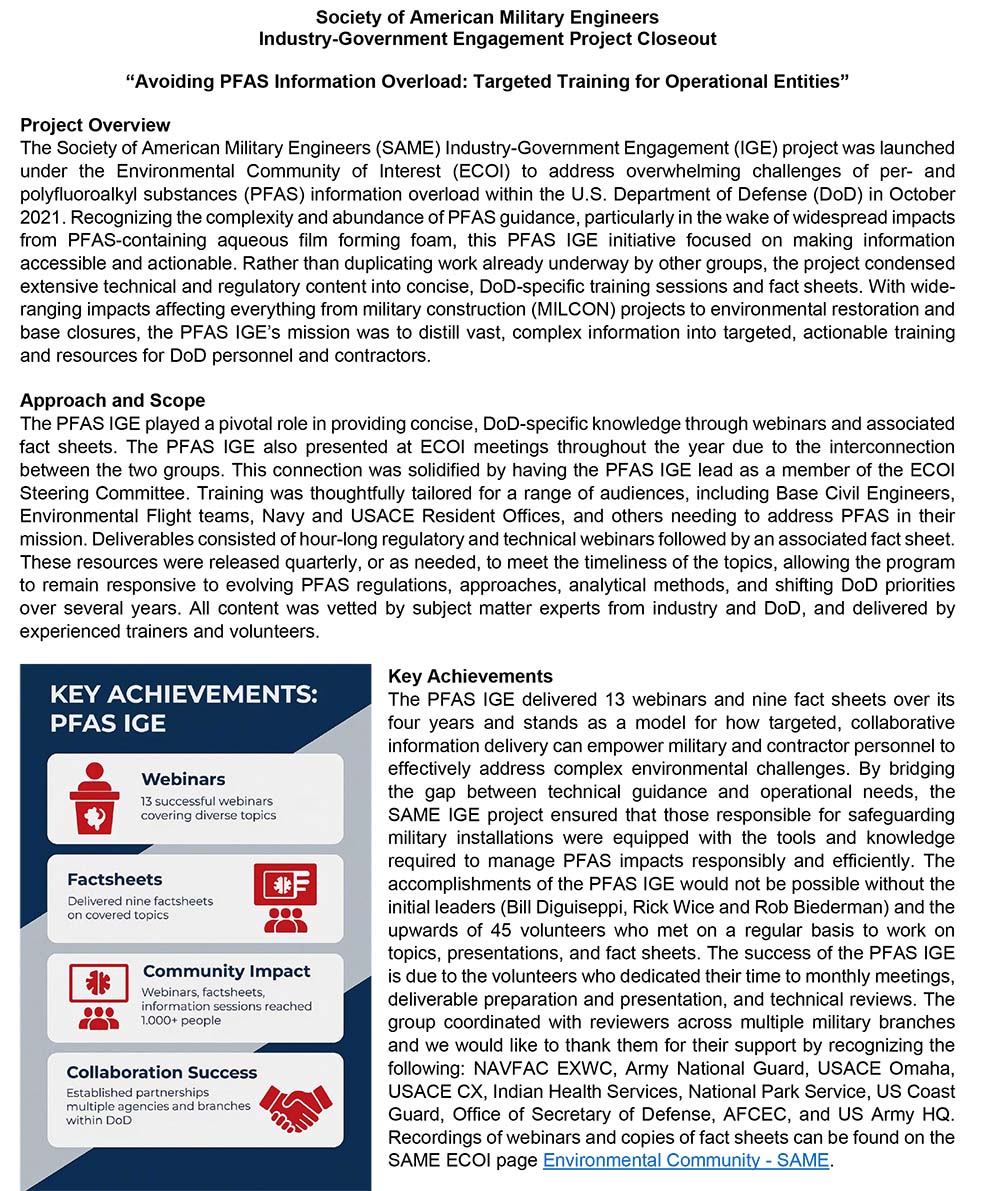
In 2021, SAME’s Environmental Community of Interest (COI) began an initiative to study the rapidly shifting and highly technical world of per- and polyfluoroalkyl substances and the challenges of condensing this vast body of knowledge into accessible and practical guidance for Department of Defense (DOD) personnel. After 13 webinars and nine fact sheets, the National PFAS Industry-Government Engagement (IGE) project has ended its four-year effort, leaving behind a wealth of actionable information.
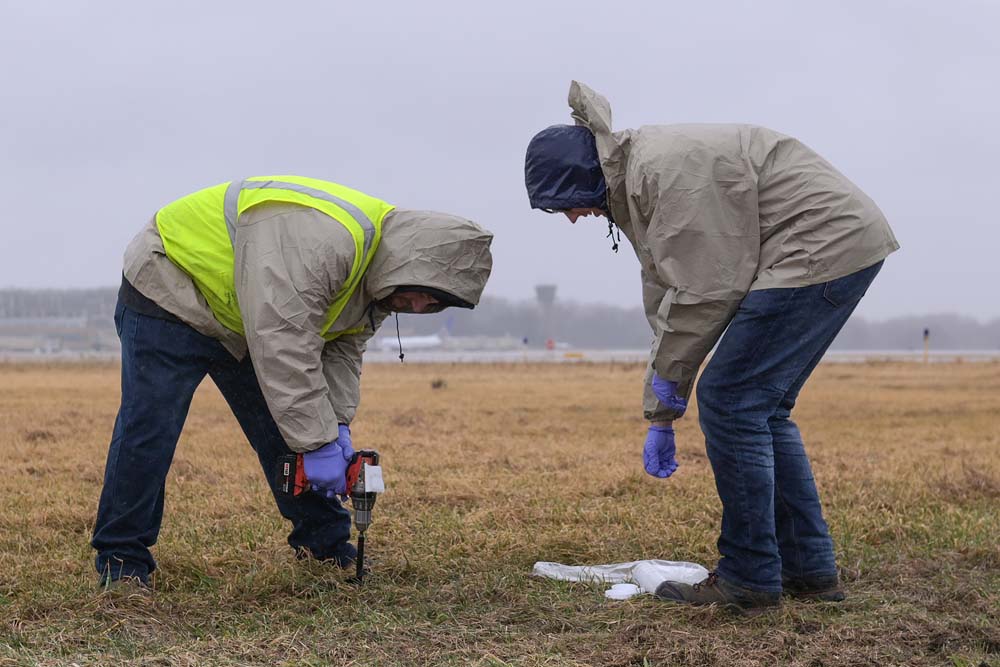
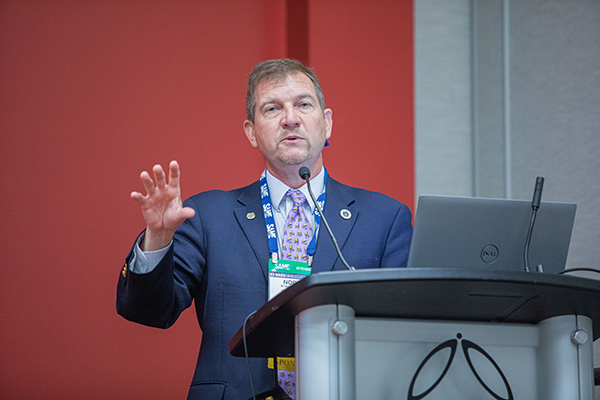
Lisa Kammer, Vice President and Technical Director, Weston Solutions, has been involved with PFAS for over 10 years. Lisa joined the Environmental COI in 2021 and later took over leadership of the PFAS IGE project. “PFAS is really like the soup du jour,” she said. “Although it’s been around for quite a while, once it became a widespread problem among professional circles, everyone realized that a lot of work needed to be done.”
Simplifying Complexity
The IGE project launched at a time when PFAS moved from technical circles to the public consciousness with headlines and conversations about “forever chemicals.” “[The public] needed to understand not only what PFAS were and where they came from, but also how they behaved in the environment. The public became a really strong advocate for themselves, which drove a lot of the activity and research that was done,” said Lisa.
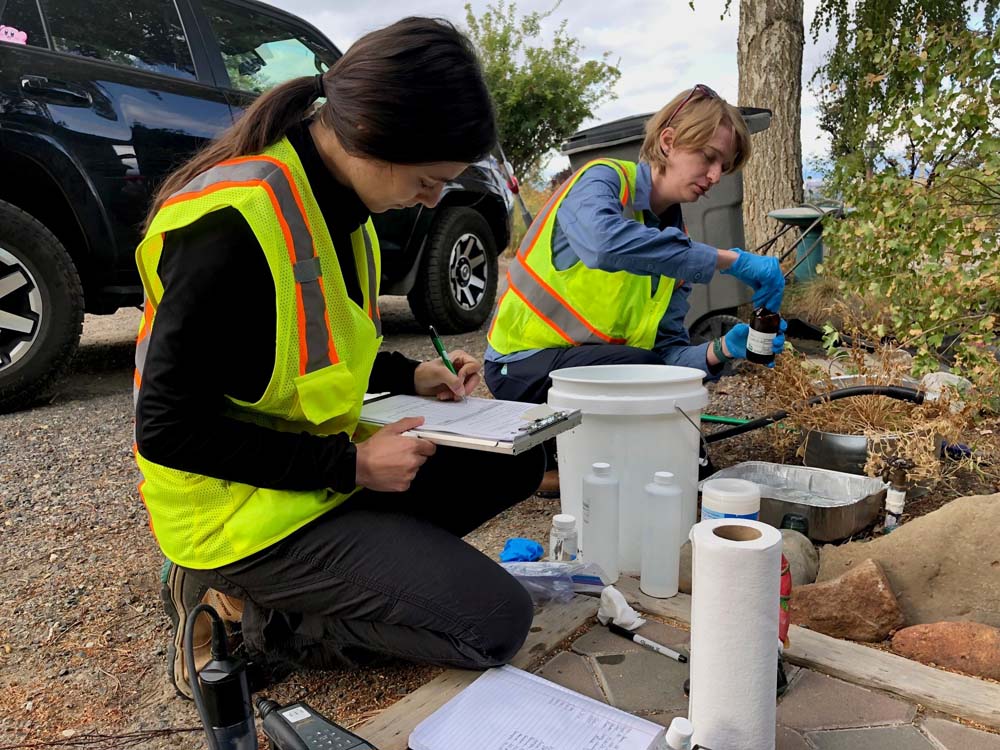
The Environmental COI became a bridge between the complex, technical discussions of industry experts and a nontechnical audience searching for information. “We just had a true information overload of PFAS,” Lisa said. “It was in the news. People were talking about it. Forever chemicals were everywhere, they’re in your blood, they’re in your dental floss. Everyone was concerned.”
The information overload extended to DOD. The department has a considerable stake in understanding PFAS impacts, as the chemicals have been closely linked to the use of aqueous film-forming foam, which had been used in firefighting and training exercises on military installations.
With all of this in mind, the PFAS IGE project set out to distill the massive amounts of technical and regulatory content into concise, actionable resources that would help guide DOD personnel and contractors working with the agency and deliver timely technical guidance to the stakeholders.
“A lot of the information out there can be confusing, hard to follow, and overly scientific. And so, the goal was to ask, how can we take this really complex, all-encompassing situation and break it down to show why you should care, this is how it impacts you, and this is what you can do about it.”
Practical Guidance
The team behind the PFAS IGE project represented a breadth of expertise, including members of DOD and industry. The goal was to build guidance that would support, not conflict, with existing directives. “We didn’t want to come across as being DOD guidance, because they have official guidance,” she said. “It was a coordinated effort to make sure that it only helped and built on that guidance.”
Over four years, the project produced 13 one-hour-long technical webinars and nine companion fact sheets designed to translate the complex regulatory and scientific discussions into practical, field-ready guidance. The webinars were followed by a concise summary highlighting key take-aways for DOD personnel and contractors. “We really wanted to provide DOD personnel and their contractors digestible bits of information that were practical to the work that they actually do,” Lisa said.
“And so, the goal was to ask, how can we take this really complex, all-encompassing situation and break it down to show why you should care, this is how it impacts you, and this is what you can do about it.”
Overall, the effort created an effective forum where DOD representatives and industry experts could work together to impact official guidance on this important and complex topic. Ultimately, the information gathered will provide installation personnel and project teams with clearer context and practical tools when regulations, public scrutiny, and technical information is rapidly changing.
SAME’s National IGE projects offer collaborative platforms for government and industry to come together on the most pressing engineering issues facing our nation, such as PFAS. “I think it’s a really good format and program to work on complex subjects like PFAS,” Lisa said. “Although it was time to sunset the IGE, the Environment COI is the perfect place to continue the discussion as it becomes relevant.”
Professionals and experts across industry and government find value in the combined expertise available in SAME’s COIs. “We have a really good and diverse group of people that have a lot of information to share that is relevant to all the work we do,” Lisa said. “So, if you’re interested, just sign up!”
Read More About the ECOI PFAS IGE
Related News
-

National IGE Report: November-December 2023
SAME’s National IGE Report for November-December 2023 covers IGE projects from national and international posts, and current engagements. -
National IGE Report: September-October 2023
SAME’s National IGE Report for September-October 2023 covers two new national IGE projects kicked off in August. -
National IGE Report: July-August 2023
SAME continues to address pressing issues facing the joint engineering community through industry-government engagement. Recently, this has included premier collaborative training opportunities at the 2023 JETC in San Antonio.

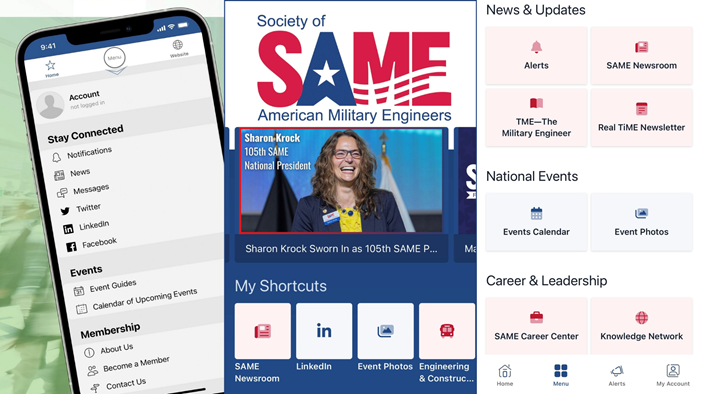
Stay up to date on all SAME news and more; download SAME Mobile today!