A Program Approach to Collaborative Delivery
By Heather Dorner, M.SAME, Edward Novak, PMP, and Korey Mullins, PMP
In support of the B-21 beddown at Ellsworth AFB, managing the military construction requirements as an integrated enterprise program has helped improve collaboration, streamline decision-making, and accelerate mission delivery.
At Ellsworth AFB, S.D., the beddown of the B-21 Raider has been managed as an integrated enterprise program—helping to align agency stakeholders, designers, contractors, and trade partners. Photo by Tina Hammond.
Programs such as the B-21 Raider beddown require a highly coordinated approach to deliver the interconnected facilities that support these systems. Meeting this challenge calls for partnership that moves beyond the traditional project-by-project management mindset and takes a deliberately different approach to program delivery.
As the initial B-21 beddown began to take shape at Ellsworth AFB, S.D., the opportunity was viewed not as a series of independent projects but as a long-term installation modernization. By understanding the government’s long-term objectives, the team led by Conti Federal approached participation with an enterprise mindset. Using a proprietary execution operating system (Warrior Lean®), Conti Federal integrated planning, communication, resource management, and lessons learned across the portfolio while complying with the requirements of each individual contract.
Establishing Alignment
Successful program delivery begins with partnering. At Ellsworth, partnering was approached as the operational framework for aligning the government, designer-of-record, project teams, and trade partners around a common vision. This resulted in the formation of an integrated project delivery team (IPDT).
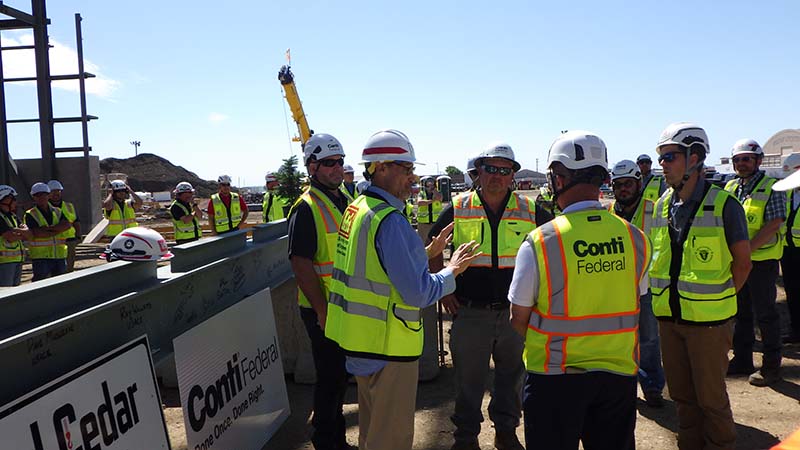
The IPDT established communication protocols, decision pathways, and collaboration expectations. These standards were then reinforced through partnering sessions, coordination meetings, and daily engagement. The approach helps identify questions early, discuss solutions openly, and maintain alignment before potential issues arise.
At Ellsworth, partnering meetings were structured to reflect this philosophy. For instance, technical coordination sessions brought together the government owner, contractor, and designer-of-record to review building information modeling, clash detection results, and constructability questions before they affected field operations. Many technical questions that could result in requests-for-information were resolved collaboratively through direct communication. When required, formal documentation continued through the appropriate contractual process, preserving contractual accountability.
The environment structured through the IPDT shaped how the team worked with the government stakeholders. Through a partnering kick-off and refresh sessions there was a clear emphasis on open dialogue and shared problem-solving. As the portfolio expanded, enterprise leadership consolidated cross-contract issues into a single, consistent dialogue—reducing redundancy and improving visibility into installation-wide priorities and constraints.
- Leveraging partnering can establish a cohesive operating framework and improve the speed and frequency of communication. At Ellsworth, this delivered measurable benefits.
- Established early mission vision alignment and shared objectives across the IPDT.
- Created clear communication pathways that helped accelerate technical decision-making.
- Aligned stakeholder expectations before work in the field.
- Proactive collaboration with the government and designer-of-record.
- Improved transparency into risks, constraints, and opportunities.
- Strengthened accountability through a shared project charter and clearly defined team responsibilities.
Prioritizing Mission Value
Managing the Ellsworth portfolio as an enterprise program allowed for work to be prioritized by mission value rather than individual contract schedules. That approach can be broadened by evaluating how activities across multiple program contracts contribute to the installation’s mission and readiness objectives.
As additional projects are awarded, opportunities arise to create scope and execution efficiencies. Leadership evaluates how work can be coordinated to improve program performance. The enterprise then applies resources, lessons learned, and proven processes where they provide the greatest program value while maintaining each project’s contractual commitments.
This body of knowledge enables solutions developed to benefit other projects. Because enterprise leadership maintains visibility across the portfolio, alternative solutions can quickly be developed that maintain performance while minimizing schedule impacts.
Embracing program-level planning transforms how trade partners are managed and enables the team to integrate work across the portfolio. This allows work to be scheduled in a way that reduces stress on individual trade partner workforces while also reducing repeated mobilization efforts. Over time, trade partners build familiarity with installation requirements, quality expectations, and safety standards. This cohesion creates a more predictable workflow and improving overall performance.
Consolidating Information
In delivering the B-21 program, the team is maintaining a unified operational picture that connects government stakeholders, project teams, corporate leadership, and trade partners. This governance structure creates a single source of truth for categorizing lessons learned, resources, and priorities.
The integrated approach changes how decisions are made. Rather than addressing issues on an isolated basis, information is consolidated and coordinated solutions are implemented across the portfolio. Improved visibility into upcoming work also allows trade partners to transition efficiently between projects.
Integrating Partnership
The B-21 beddown reflects a broader shift in how the U.S. military delivers complex installation modernization programs. As portfolios grow in size, complexity and urgency, success increasingly depends on coordinating multiple contracts and resources within a unified operational framework.
The experience at Ellsworth demonstrates how enterprise program management can enable that large-scale coordination. By integrating partnering, mission-driven planning, and enterprise governance, teams can effectively manage independent contracts as a coordinated operational program while respecting the requirements of each award.
Portfolio Modernization
For Conti Federal, its B-21 portfolio at Ellsworth has grown to 10 concurrent projects. These include the RF Hangar, Phase Maintenance Hangar, Fuel Systems Maintenance Dock 80, Dock 81, Weapons Loader Training Facility, 60 Row Environmental Protection Shelters (EPS) North, 60 Row EPS South, 80 Row EPS, ADD Flight Simulator, and Alert Facility. Although each project remains an independent contract, the execution reflects an enterprise model contained in the original vision.
The approach changes how work is executed by applying proven solutions across the portfolio. Incrementally, lessons learned, procurement strategies, and construction sequencing carry forward. Resources can be shifted to support critical milestones. Proactive communication keeps the project team and owner aligned, allowing issues to be resolved before they affect schedule or cost.
The experience has demonstrated a scalable, repeatable approach that can be applied to future mission-critical modernizations—with three principles emerging as the basis of successful enterprise program management: an early IPDT; mission-driven planning that prioritizes activities; and enterprise-level governance.
Together, they are able to transform a collection of individual construction projects into a coordinated mission delivery program, where success is vital to national security—and efficiencies gained in schedule are a mission advantage.
Heather Dorner, M.SAME, is Senior Marketing Manager, Edward Novak, PMP, is Project Executive, and Korey Mullins, PMP, is Vice President, U.S. Operations, Conti Federal Services. They can be reached at hdorner@contifederal.com; enovak@contifederal.com; and kmullins@contifederal.com.
Published in the November-December 2026 issue of The Military Engineer
Check Out Related Articles From TME
-

Innovative PFAS Remediation at Camp Grayling
For project stakeholders and remediation managers confronted with PFAS, Regenesis demonstrates the efficacy of using Regenesis’ PlumeStop® colloidal activated carbon (CAC) at Camp Grayling, Michigan. -
A Standardized Approach to Aircraft Fire Training Infrastructure
To support enterprise-wide airmen readiness, the U.S. Air Force is modernizing its standard design for aircraft fire training facilities—introducing digital controls, dual-fuel systems, and PFAS-conscious infrastructure. -
Delivering Energetic Materials Manufacturing Facilities
Designing and constructing facilities that manufacture, process, handle, or store explosives and energetic materials present some of the most challenging defense projects—requiring technical experience, strict safety protocols, and a comprehensive understanding of regulatory frameworks. -
Forging Tradition and Innovation: A New Design Standard at Camp Lejeune
The II MEF Headquarters at Camp Lejeune blends Georgian Revival architecture with modern sustainability—delivering durability, efficiency, and precision that meets contemporary functional requirements while honoring heritage. -

Balancing Efficiency and Fiscal Responsibility
The continuing contracts clause offers the U.S. Army Corps of Engineers a way to improve project delivery and enhance fiscal responsibility by aligning funding with project execution. -
Next Steps for Digital Twin Development
U.S. Forces Japan is laying the groundwork for future integration of digital twin technology in order to validate and collect data that will offer comprehensive insights into utility conditions at installations and enhance overall decision-making, efficiency, and resilience.