Accelerating Mission Readiness Through Coastal Resiliency
By Alyssa Agustin, PMP, M.SAME
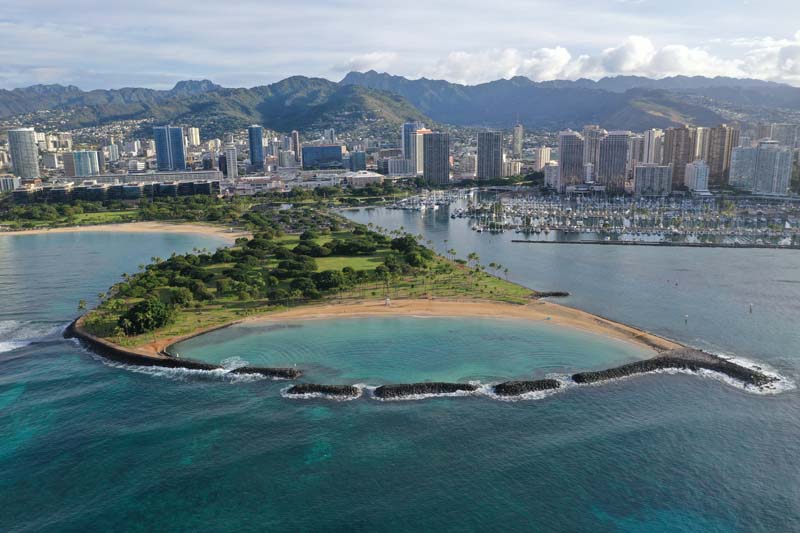
Throughout the Pacific, coastal science and engineering are being applied to strengthen shoreline resilience, sustain critical infrastructure, and accelerate mission readiness.
Across the Pacific, the coastline is more than a geographic boundary—it is a strategic front line. The collection of ports, airfields, refueling sites, and installations in Hawaii, Guam, and across Micronesia underpin U.S. defense posture, logistics, and humanitarian response. These assets face mounting natural challenges: chronic erosion, sea-level rise, and intensifying storms that complicate construction, maintenance, and long-term resilience planning. Increasing logistical constraints across the vast tyranny of distance further strains planning and execution.
Across the region, service leaders consistently emphasize the same priority: readiness is needed faster, in more locations, and under increasingly complex conditions.
The embrace of coastal science and engineering plays a critical role in meeting this growing demand. By applying disciplined execution, sound data, and context-appropriate solutions, resiliency efforts can directly support operational continuity and mission success across the Pacific.
Vulnerable Sites
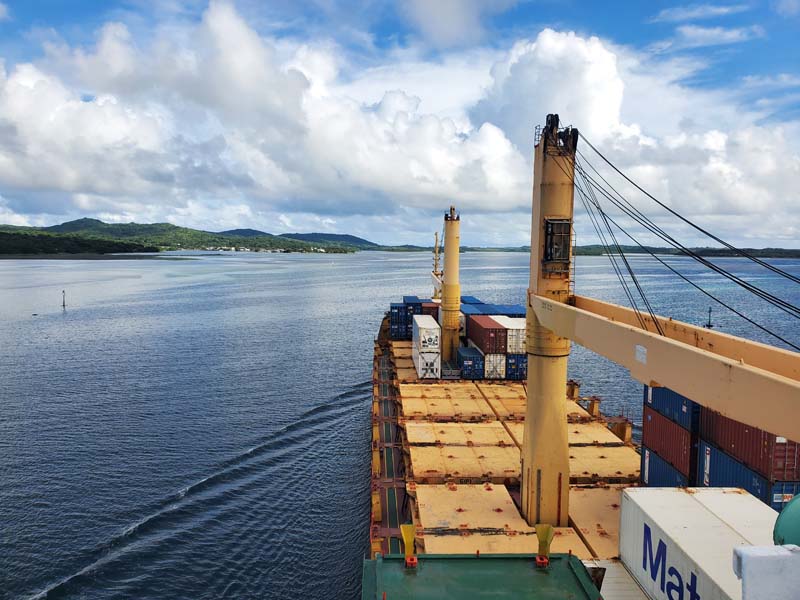
The realities of island environments amplify engineering complexity. Construction materials and equipment often must travel thousands of miles. Delivery schedules often become dictated by weather, port capacity, and limited local infrastructure. Environmental sensitivity adds another layer. Coral reefs, mangroves, and culturally significant sites must be protected even as shorelines are reinforced. At the same time, operational requirements such as dry dock availability, fuel security, navigation aids, and reliable access routes leave little tolerance for prolonged downtime.
Resiliency is foundational to operational continuity. In Hawaii, approximately 85 percent to 90 percent of food is imported; commercial stocks typically last only five to seven days. Disruption at a major port would ripple across civilian and military supply chains. Similar vulnerabilities exist throughout the Pacific, where a single storm can sever lifelines for weeks.
These risks are accelerating. Global mean sea level is rising at approximately 3.1-mm per year. Regionally, rates vary—averaging about 1.54-mm annually in Hawaii and up to 8.6-mm per year in Guam. This trend compounds extreme weather events and pushes infrastructure beyond original design thresholds.
By applying disciplined execution, sound data, and context-appropriate solutions, resiliency efforts can directly support operational continuity and mission success across the Pacific.
Island coastlines are shaped by complex interactions. Waves arrive from multiple directions, each with their own period and frequency; they also interact with varying reef morphologies that transform wave energy and influence the forces acting on the shoreline. These processes are further shaped by variables that ebb and flow like the tides: ocean currents with changing intensity, shoreline geology that responds differently to incoming forces, geostrophic eddies that alter background water levels, winds influenced by island topography, and severe storms that can override typical conditions altogether. Together, these interacting factors drive localized coastal behavior, underscoring the need for site-specific data, modeling, and design approaches when planning resilient infrastructure in island environments.
The Right Balance
Coastal projects in Hawaii and across the Pacific are among the most heavily regulated in the United States. They routinely require coordination across federal, state and county agencies. These processes can extend timelines beyond the pace at which conditions are changing. Planning, designing, engineering, and constructing with urgency is paramount. Both owners and contractors must get solutions approved on the correct schedule.
Resiliency efforts of the military need to coexist with environmental stewardship. On a project in Hawaii for the U.S. Coast Guard, corals were relocated in coordination with the National Oceanic & Atmospheric Administration and the National Marine Fisheries Service prior to tower replacement. The construction windows were aligned with ecological calendars to protect spawning and nesting cycles as well.
With tight schedules for construction and delivery, priority is often given to measures that deliver immediate risk reduction. Conducting rapid, drone-based shoreline surveys and targeted oceanographic assessments informs near-term decisions while establishing baselines for future work. Temporary berms or flood barriers can protect critical access routes, while resilient power backups help keep mission-critical assets operational.
Within island settings, coastal adaptation alternatives typically fall into three categories: protection, accommodation, or relocation.
- Protection strategies may be “hard,” such as engineered shoreline armoring, or “soft,” incorporating nature-based solutions that reduce wave energy and erosion.
- Accommodation accepts some level of coastal change and focuses on reducing impacts to a level that infrastructure and operations can tolerate.
- Relocation removes assets from hazard areas altogether, eliminating exposure.
In practice, military and federal projects in the Pacific often apply a combination of these approaches. Determining which, or what combination to use, is selected based on mission criticality, constructability, regulatory feasibility, and available timelines. In support of the Pacific Deterrence Initiative, which was instituted by the Defense Department in 2021 to enhance military posture and deterrence capabilities in the region, overarching emphasis is frequently placed on solutions that can be implemented quickly, minimize operational disruption, and maintain environmental stewardship while building local capacity.
Leveraging Resources
Within the framework of the Pacific Deterrence Initiative, coastal adaptation strategies are being advanced under tight timelines and stringent environmental requirements. While project specifics often require client approval before public release, the engineering approaches applied across military and federal projects share common principles.
America’s national security is dependent on getting critical infrastructure ready, and keeping it ready. In the Pacific, this means designing under uncertainty, executing in challenging environments, and protecting natural systems that support both local communities and military installations.
The most successful projects leverage what island environments can provide organically. Where permitted, the use of local rock and sand sources can reduce schedule risk and reliance on long supply chains. These approaches are supported by early planning and design efforts, such as benthic surveys, and by construction-phase best management practices, such as turbidity controls and water quality monitoring. Prefabricated components shipped in smaller lots and assembled with light equipment can assist in accelerating construction. Beneficial reuse of dredged material for beach nourishment or habitat restoration avoids costly disposal while also supporting community resilience.
Additionally, predicting shoreline response to new infrastructure, sediment placement, or sea level rise requires robust modeling and validation. Wave models can simulate wind-driven wave generation and energy dissipation across reefs, validated with field data such as currents, waves, bathymetry, and water levels.
Based on over a decade of coastal work in Hawaii and the Pacific, several principles consistently improve outcomes.
- Data collection should be targeted to answer specific design questions.
- Regulatory constraints should be identified early on to narrow adaptation pathways to feasible, permittable options.
- Early engagement with resource agencies reduces surprises and fosters trust.
- Local knowledge often provides insight into storm pathways, sediment behavior, and ecological change that complements technical data.
Leaning Forward
America’s national security is dependent on getting critical infrastructure ready, and keeping it ready. In the Pacific, this means designing under uncertainty, executing in challenging environments, and protecting natural systems that support both local communities and military installations.
The engineering sector should lean forward, execute with discipline, be relentless in learning, and maintain proficiency in fundamental skills. When these basics are done well, innovation follows. The coast is moving, but the mission cannot. By leaning forward together, the United States can remain ready at the water’s edge.
Adaptation Planning in Practice
On the island of Molokai, adaptation planning highlights the importance of integrating technical analysis with community priorities. Its success can serve as a model for other locales and military bases facing similar outlooks with respect to coastal vulnerabilities. The Molokai Climate Change and Sea Level Rise Adaptation and Resiliency Master Plan evaluated risks associated with low-lying public infrastructure. Approximately 2.2-mi of coastal roads were identified as increasingly susceptible to flooding, jeopardizing critical ingress and egress for multiple communities.
Chronic roadway flooding affects emergency response, goods movement, and regional connectivity. In addition, many Native Hawaiian cultural and historical resources are located near the shoreline. While not always classified as critical infrastructure, these assets are regarded as such by local communities and must be incorporated into adaptation planning.
Alyssa Agustin, PMP, M.SAME, is Senior Coastal Scientist and Project Manager, GHD; alyssa.agustin@ghd.com.
Published in the May-June 2026 issue of The Military Engineer
Check Out Related Articles From TME
-

Innovative PFAS Remediation at Camp Grayling
For project stakeholders and remediation managers confronted with PFAS, Regenesis demonstrates the efficacy of using Regenesis’ PlumeStop® colloidal activated carbon (CAC) at Camp Grayling, Michigan. -
A Standardized Approach to Aircraft Fire Training Infrastructure
To support enterprise-wide airmen readiness, the U.S. Air Force is modernizing its standard design for aircraft fire training facilities—introducing digital controls, dual-fuel systems, and PFAS-conscious infrastructure. -
Delivering Energetic Materials Manufacturing Facilities
Designing and constructing facilities that manufacture, process, handle, or store explosives and energetic materials present some of the most challenging defense projects—requiring technical experience, strict safety protocols, and a comprehensive understanding of regulatory frameworks. -
Forging Tradition and Innovation: A New Design Standard at Camp Lejeune
The II MEF Headquarters at Camp Lejeune blends Georgian Revival architecture with modern sustainability—delivering durability, efficiency, and precision that meets contemporary functional requirements while honoring heritage. -

Balancing Efficiency and Fiscal Responsibility
The continuing contracts clause offers the U.S. Army Corps of Engineers a way to improve project delivery and enhance fiscal responsibility by aligning funding with project execution. -
Next Steps for Digital Twin Development
U.S. Forces Japan is laying the groundwork for future integration of digital twin technology in order to validate and collect data that will offer comprehensive insights into utility conditions at installations and enhance overall decision-making, efficiency, and resilience.