Addressing Emerging Threats Through Innovative Bunker Design
By 1st Lt. Nick Listermann, M.SAME, USA
The 41st Engineer Battalion, deployed in southern Syria, designed a bunker with local materials to confront unmanned aerial systems—but further support is needed to fully address this emerging threat in forward operating locations.
In October 2023, a one-way unmanned aerial system (UAS), the KAS-04, broke through the defenses of Al Tanf Garrison in southern Syria and detonated directly on a bunker in which 20 servicemembers were taking shelter. All survived, but the bunker was a complete loss.
An Iranian-built UAS containing a 40-lb warhead, the KAS-04 had cracked the concrete C-channel longitudinally. It could have been worse. Only a week earlier, a soldier with the 41st Engineer Battalion had noticed that the bunker was in unsatisfactory condition. In seeking repairs, he struggled to find relevant information or recommendations in either the Joint Forward Operating Base Force Protection Handbook or ATP 3-37.34 Survivability Operations. Instead, he used lessons learned from 15 years of experience to improve the bunker’s safety features, which, fortunately, were enough to save lives. In the aftermath, the engineers at Al Tanf Garrison discovered a disturbing gap between the conceptual planning for survivability systems in doctrine and their actual employment in defeating UAS.
In downrange environments especially, and even on enduring installations, engineering resources and capabilities for survivability operations must address emerging threats like UAS. Greater collaboration between researchers and engineers at the small-unit level will help drive these necessary improvements.
Tactical Innovation
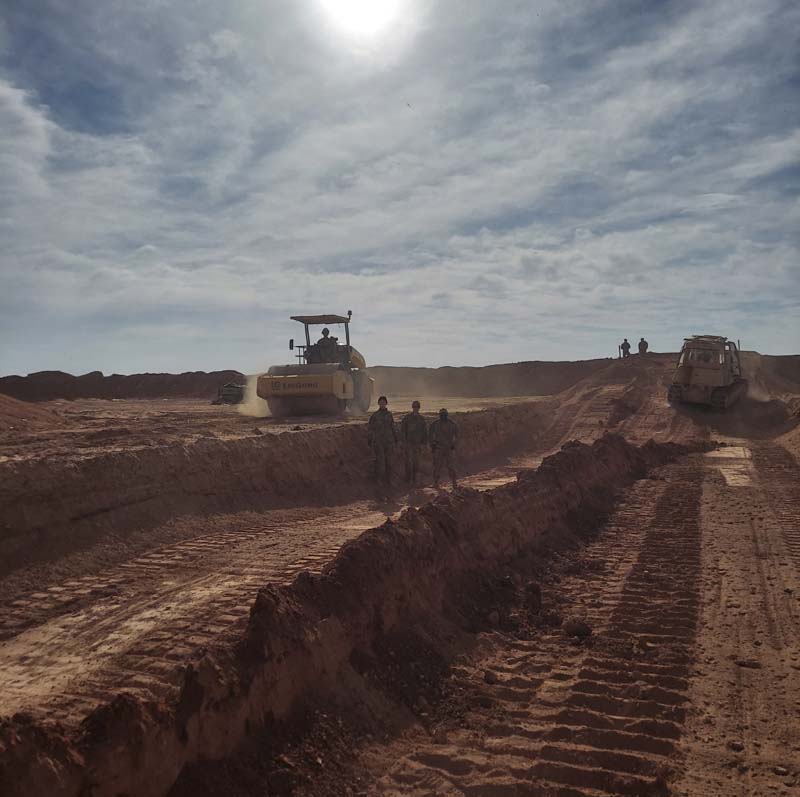
The 41st Engineers strove to overcome the gap they discovered with their bunker designs, but with limited logistical support, little understanding of the threat they faced, and insufficient assistance from doctrine, they had to pioneer new methods in their remote outstation. The only solution became a bunker of their own design.
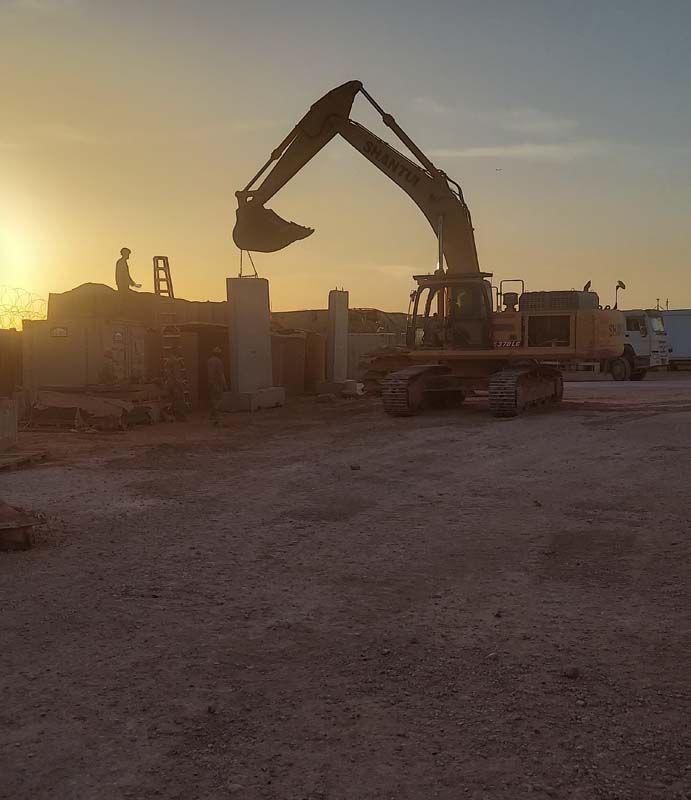
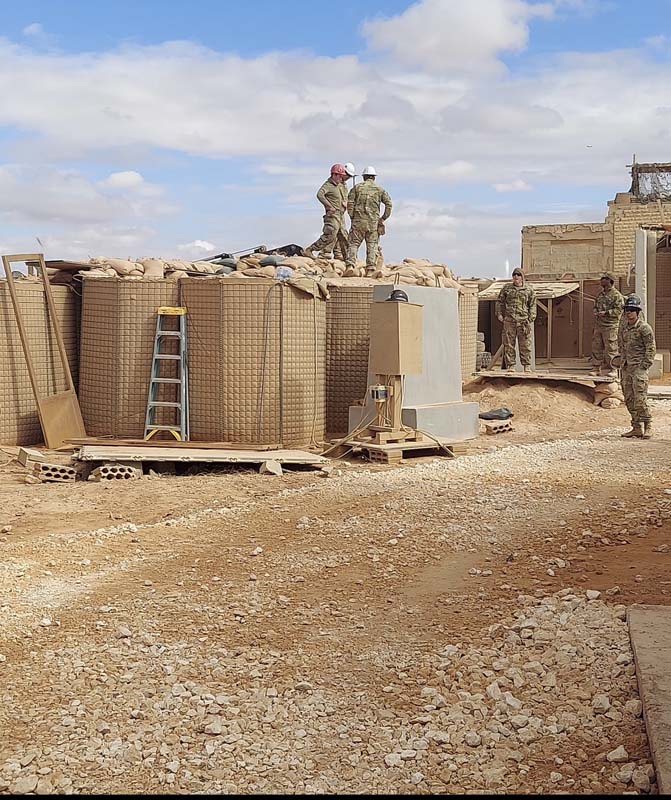
The battalion started with a concrete C-channel, reinforced with soil-filled HESCO gabions, and added specially designed overhead cover and entrances. The brigade engineer purchased concrete C-channels through Jordanian contractors. The 41st Engineers transported the material through self-supported armed convoys once they arrived at a joint American-Jordanian base.
HESCO gabions and soil were the only items in plentiful supply at Al Tanf. Considerable effort was put into maximizing their use to not only reinforce the concrete C-channel but to create a standoff between the concrete C-channel and the point of impact.
The 41st Engineers specially designed pre-detonation roofing to act as a sacrificial layer, preventing detonation directly on the bunker. Aluminum-based AM2 matting was used to create overhead cover at entrances. Typically used for helicopter landing pad construction, this system was chosen for its tendency not to create shrapnel when damaged and its surprisingly high ductility.
The entrances to the bunker were designed to minimize fragmentation and the amplification of blast overpressure in confined areas from near-miss detonations while also creating unimpeded entry points for soldiers utilizing the bunker in blackout conditions. Despite an abundance of ingenuity and caution in the design, there were still gaps in understanding important aspects of how the bunker could protect inhabitants, specifically in the minimizing of overpressure. Neither the force protection handbook nor ATP 3-37.34 provides insight into minimizing overpressure within structures.
Validation Testing
Without a solid understanding of the threat they faced, the 41st Engineers decided to replicate an attack and find out for themselves.
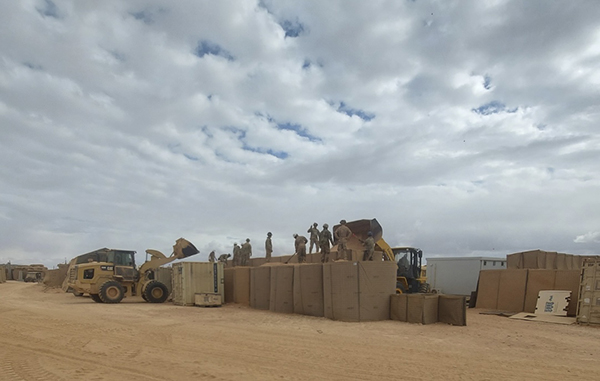
Operationally, UAS use bulk munitions, relying on a large amount of explosives to create pressure. To understand how the bunker design mitigated overpressure and verify its structural integrity and the viability of building materials, the 41st Engineers planned and executed Operations Bunker Buster 1 and 2.
In Bunker Buster 1, the engineers built a bunker off-base and rigged it with charges analogous to the KAS-04 warhead. They validated the structural integrity of the concrete C-channels, overhead protection, and AM2 matting. Despite repeated explosions, the concrete C-channel did not crack, and the previously mentioned building materials produced relatively little shrapnel.
For Bunker Buster 2, the battalion coordinated with the 332nd Air Expeditionary Wing to use glide munitions comparable to the KAS-04 on another bunker built off-base. This testing identified improvements and further validated the overall effectiveness of the design and the materials used to withstand bulk munition explosions and protect inhabitants from shrapnel. The testing also had a remarkable positive psychological effect on those who regularly used the bunkers during an attack.
While the tests were successful in some respects, they were less so in others. Rudimentary data indicated that the design prevented lethal amounts of overpressure from entering the bunker. However, quantifiable data on the amount of pressure inside the bunker at the time of detonation was never fully captured nor of how the design reduced the likelihood of non-lethal traumatic brain injuries or other blast-related injuries. All data was self-produced, but ideally it would have come from U.S. Army research institutions.
In downrange environments especially, and even on enduring installations, engineering resources and capabilities for survivability operations must address emerging threats like UAS. Greater collaboration between researchers and engineers at the small-unit level will help drive these necessary improvements.
Greater Collaboration
Through the Army’s Engineering Research & Development Center, the Reachback Operations Center, and doctrine published by the Maneuver Support Center of Excellence, more resources and capabilities are now available to Army engineers than ever before. However, many of the current resources still fail to adequately address the problems associated with the emergence of UAS as the preferred method of warfare from Iranian-backed proxy forces in theater.
Issues related to blast overpressure caused by large bulk munitions and the fact that much of the construction is conducted in austere locations far from logistical hubs, using only locally available building materials, continue to be outstanding. For example, the seventh edition of the force protection handbook dedicates only seven pages to bunker construction, four of which discuss underground, timber, and hardened alternative trailer system bunkers. These bunkers are tested and sound designs, but they are impractical for a remote desert outpost. In Syria, the 41st Engineers lacked the equipment to dig more than a few feet deep. Dense, rocky soil drains poorly, making underground bunkers unsuitable during the rainy season. Continuously, the battalion was plagued by logistics issues, making timber scarce and any specially built systems nearly impossible to get.
Through the Army’s Engineering Research & Development Center, the Reachback Operations Center, and doctrine published by the Maneuver Support Center of Excellence, more resources and capabilities are now available to Army engineers than ever before. However, many of the current resources still fail to adequately address the problems associated with the emergence of UAS as the preferred method of warfare from Iranian-backed proxy forces in theater.
Evolving Challenge
In developing, testing, and constructing the bunker from a self-produced design, the 41st Engineers endeavored to bridge the gap between the conceptual planning discussed in doctrine and the actual employment of survivability systems in a deployed environment. However, the divide remains. The UAS threat is rapidly evolving. Engineering solutions in remote outstations will continue to pose challenges for future units.
The disconnect between theoretical and practical engineering is not a problem unique to the Army. What is unique is a capacity to rectify the issue. Creating user-friendly, collaboration-driven doctrine designed to give combat engineers on the ground the information they need to make informed design decisions is the first step to addressing this security threat. Ensuring greater safety and security for warfighters on the front lines is the objective.
Strengthening Capabilities
Both the joint force protection handbook and ATP 3-37.34 are suited for producing semi-permanent or permanent structures that are based on outdated threats. In a kinetic setting, the 41st Engineers needed timely assistance with design requirements and data to address emerging threats in the context of construction at forward-deployed and remote outstations, using only readily available building materials. The current resources do not adequately address the emerging threat or enable the forward-deployed engineer to make informed decisions.
Driven by greater collaboration between researchers writing doctrine and Army engineers at the small-unit level, a “How-To Guide” would be the most effective means of bridging this gap. New doctrine should be general enough to apply to fully developed or primitive outstations, while specific enough to provide guidelines for mitigating risks posed by specific hazards, such as overpressure. It must explain the threats that UAS pose, as they differ significantly from direct and indirect fires. It must elaborate on how to defeat these threats while recognizing that the best approach is not always possible in remote outstations. It should continue recommending proven prefabricated kits and designs but also recommend effective guidelines for designing new protective structures when prefabricated kits are not available. It also should provide the upper limits of the materials that engineers are likely to have at their disposal—to determine optimal decisions based on tensile strength, yield strength, and compressive strength.
All of this should be tied to greater collaboration between the Army researcher and the Army engineer on the ground. Specifically, small-unit leaders should conduct site visits at research centers to participate in demonstrations of emerging technology intended for use on the battlefield and provide feedback. Army researchers also need to conduct site visits and observe engineers in training to understand an operational unit’s composition, disposition, and capabilities. Doing so creates a shared understanding of issues and threats as well as the tools available to solve them effectively.
1st Lt. Nick Listermann, M.SAME, USA, was Platoon Leader, 41st Engineer Battalion; nicholas.a.listermann.mil@army.mil.
Published in the July-August 2026 issue of The Military Engineer
Check Out Related Articles From TME
-

Innovative PFAS Remediation at Camp Grayling
For project stakeholders and remediation managers confronted with PFAS, Regenesis demonstrates the efficacy of using Regenesis’ PlumeStop® colloidal activated carbon (CAC) at Camp Grayling, Michigan. -
A Standardized Approach to Aircraft Fire Training Infrastructure
To support enterprise-wide airmen readiness, the U.S. Air Force is modernizing its standard design for aircraft fire training facilities—introducing digital controls, dual-fuel systems, and PFAS-conscious infrastructure. -
Delivering Energetic Materials Manufacturing Facilities
Designing and constructing facilities that manufacture, process, handle, or store explosives and energetic materials present some of the most challenging defense projects—requiring technical experience, strict safety protocols, and a comprehensive understanding of regulatory frameworks. -
Forging Tradition and Innovation: A New Design Standard at Camp Lejeune
The II MEF Headquarters at Camp Lejeune blends Georgian Revival architecture with modern sustainability—delivering durability, efficiency, and precision that meets contemporary functional requirements while honoring heritage. -

Balancing Efficiency and Fiscal Responsibility
The continuing contracts clause offers the U.S. Army Corps of Engineers a way to improve project delivery and enhance fiscal responsibility by aligning funding with project execution. -
Next Steps for Digital Twin Development
U.S. Forces Japan is laying the groundwork for future integration of digital twin technology in order to validate and collect data that will offer comprehensive insights into utility conditions at installations and enhance overall decision-making, efficiency, and resilience.