Advancing Resilience Against Accelerating Threats
By Ram Mohan, Ph.D., P.E., F.ASCE, M.SAME, Joshua Burnam, MPH, D.Env., M.SAME, and Joe Rieger, M.SAME
To counter increasing challenges from coastal flooding, erosion, and natural disasters, military installations can employ natural systems and hybrid infrastructure.
The United States operates military installations in some of the world’s most demanding physical environments. Many are located along coastlines, rivers, or estuaries, where infrastructure must withstand a range of hazards that can threaten mission-critical assets, systems and people.
Both military engineers and installation planners face dual challenges of preventing damage and maintaining operational capability before, during, and after disruptive events. While traditional approaches such as seawalls, bulkheads, and revetments play an essential role in protecting infrastructure, increasingly, practitioners recognize that combining conventional systems with natural processes can improve outcomes.
The emergence of natural and hybrid infrastructure (NHI) is part of a broader solutions-toolbox that can strengthen resilience and sustain readiness while helping to preserve critical operational areas at the same time.
Nature-Based Solutions
Consisting of engineered systems that incorporate natural processes into infrastructure design, NHI frequently is deployed in combination with conventional hard infrastructure.
Within the military setting, similar nature-based approaches are commonly framed through Engineering With Nature, an initiative of the U.S. Army Corps of Engineers that aligns natural and engineering processes while also supporting sediment management and habitat stability.
Common applications of NHI within the military include living shorelines that combine offshore rock sills or breakwaters with marsh vegetation and sediment fill to reduce wave energy and stabilize shorelines. Dune and beach nourishment systems can buffer storm surge and protect coastal facilities from wave impacts. Strategic sediment placement rebuilds marsh elevations or restores protective shoreline features where erosion or subsidence has reduced natural defenses.
In practice, these approaches may be combined into hybrid configurations that integrate structural elements with natural features. For instance, rock sills, revetments, or reef structures can provide immediate wave attenuation while vegetation and sediment processes can contribute to long-term stability as conditions evolve. Like conventional infrastructure, NHI is designed and evaluated using established engineering criteria. This includes hydrodynamic modeling, structural stability, constructability, and lifecycle performance. The key distinction lies in how these approaches perform over time. In contrast to conventional “gray” infrastructure, which often delivers its highest level of performance immediately after construction, natural and hybrid approaches may improve as vegetation establishes and sediments accumulate.
Not all locations are suitable for nature-based solutions. In many locations, conventional structures do remain necessary. The central challenge for planners and engineers is determining how to combine traditional approaches and natural elements to achieve reliable performance under site-specific conditions.
Process Considerations
In evaluating NHI opportunities, the design process closely parallels traditional infrastructure. Projects begin with examination of site conditions to understand how waves, water levels, and sediment movement shape the shoreline over time. These analyses help determine how natural processes interact with existing infrastructure and where protective features may be most effective. Field surveys, water-level data, and shoreline monitoring characterize local conditions and identify areas where nature-based infrastructure may provide protective benefits. They also support the evaluation of long-term shoreline trends, including how erosion, sediment transport, and storm impacts may influence performance over time.
Based on these assessments, designers will consider a range of shoreline features that can reduce wave energy and stabilize sediments while remaining constructable within the constraints of an active installation. Many shoreline investments must be built in tidal environments or accessed by water, which affects staging, sequencing, and material placement. The goal is to identify solutions that complement existing infrastructure while supporting reliable long-term performance. Incorporating them early in planning phases also allows engineers to consider a broader set of solutions.
Readiness at Yorktown
Weapons Station Yorktown, located along the southeastern coast of Virginia, provides a strong example how NHI can support installation resilience and mission readiness.
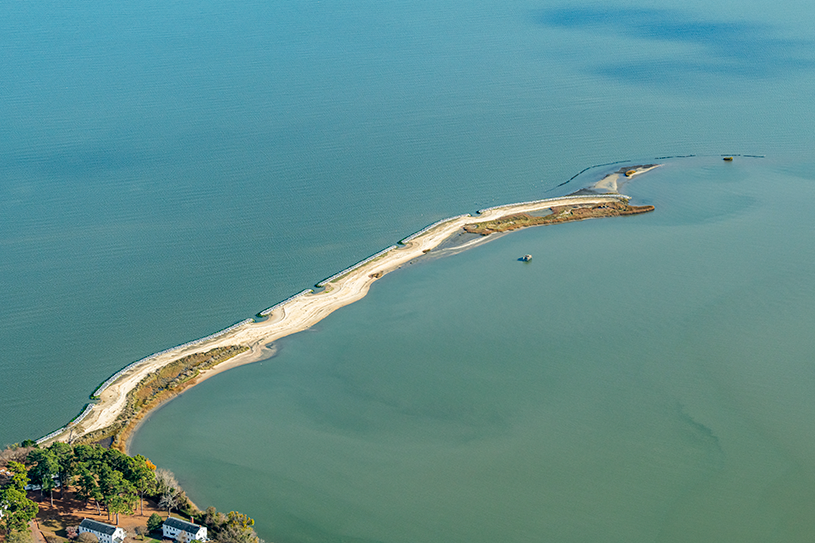
Weapons Station Yorktown has experienced shoreline change over time. Erosion has reduced the extent of protective landforms and increased exposure to wave energy. At the Penniman Spit offshore from the base, historical analysis showed a substantial loss of land area over several decades, leaving previously sheltered military property more vulnerable to tidal forces and storm-driven wave action.
To address these conditions, engineers developed a hybrid living shoreline that integrates both structural and natural components. Rock sills positioned offshore reduce incoming wave energy while sand placed behind the structures is graded to support marsh establishment. The shoreline then was planted with native marsh grasses, creating a system that dissipates wave energy and supports shoreline stability.
The design incorporates multiple sill segments with gaps that allow water movement and ecological connectivity while still limiting wave impacts. Over time, vegetation growth and sediment accumulation will further stabilize the shoreline and enhance system performance.
The project restored approximately 1,700-ft to 1,950-ft of shoreline using approximately 10,000-T of rock, 24,000-T of sand, and more than 40,000 marsh plants.
In addition to Penniman Spit, the collaboration of Anchor QEA and Naval Facilities Engineering Systems Command is designing similar shoreline approaches across multiple sites at the installation. These projects reflect a broader strategy of using NHI to protect defense assets, maintain training areas, and support long-term shoreline stability.
In some locations, conventional structures like seawalls or revetments continue to be the most appropriate choice. In others, hybrid approaches that incorporate marsh systems, sediment placement, or offshore features could provide effective wave attenuation and improve long-term performance. The key is not selecting a single approach over another but determining how complementary tools can be used together to support immediate protection and long-term performance.
These multi-faceted efforts often involve collaboration among installation managers, federal agencies, local communities, universities, and other partners. In many cases, natural and hybrid strategies align with existing programs focused on land management, navigation, and ecosystem rehabilitation.
The key is not selecting a single approach over another but determining how complementary tools can be used together to support immediate protection and long-term performance.
Long-Term Readiness
For the defense community, resilient infrastructure is essential to mission readiness. The composition of shorelines, transportation networks, utilities, power projection, training ranges, and operational areas must withstand disruptive events while supporting rapid recovery. NHI offers additional options for achieving long-term resilience. When applied thoughtfully and supported by sound engineering analysis, these approaches can strengthen infrastructure performance, reduce erosion risks, and support the durability of installation assets.
The strategic necessity of siting military installations along water will not change. With the advantageous position it offers, however, comes with the need for adjusting to an evolving environment. The continued application of NHI strategies will be important to improve understanding of long-term performance and operations as well as maintenance considerations—particularly because these systems rely on adaptive management to provide flexibility amid emerging conditions. As experience grows across the military enterprise, NHI is likely to contribute significantly to advancing resilience and preparedness.
Ram Mohan, Ph.D., P.E., F.ASCE, M.SAME, is Principal Engineer, Joshua Burnam, D.Env., M.SAME, is Principal, and Joe Rieger, M.SAME, is Senior Managing Professional Scientist, Anchor QEA. They can be reached at rmohan@anchorqea.com; jburnam@anchorqea.com; and jrieger@anchorqea.com.
Published in the July-August 2026 issue of The Military Engineer
Check Out Related Articles From TME
-

Innovative PFAS Remediation at Camp Grayling
For project stakeholders and remediation managers confronted with PFAS, Regenesis demonstrates the efficacy of using Regenesis’ PlumeStop® colloidal activated carbon (CAC) at Camp Grayling, Michigan. -
A Standardized Approach to Aircraft Fire Training Infrastructure
To support enterprise-wide airmen readiness, the U.S. Air Force is modernizing its standard design for aircraft fire training facilities—introducing digital controls, dual-fuel systems, and PFAS-conscious infrastructure. -
Delivering Energetic Materials Manufacturing Facilities
Designing and constructing facilities that manufacture, process, handle, or store explosives and energetic materials present some of the most challenging defense projects—requiring technical experience, strict safety protocols, and a comprehensive understanding of regulatory frameworks. -
Forging Tradition and Innovation: A New Design Standard at Camp Lejeune
The II MEF Headquarters at Camp Lejeune blends Georgian Revival architecture with modern sustainability—delivering durability, efficiency, and precision that meets contemporary functional requirements while honoring heritage. -

Balancing Efficiency and Fiscal Responsibility
The continuing contracts clause offers the U.S. Army Corps of Engineers a way to improve project delivery and enhance fiscal responsibility by aligning funding with project execution. -
Next Steps for Digital Twin Development
U.S. Forces Japan is laying the groundwork for future integration of digital twin technology in order to validate and collect data that will offer comprehensive insights into utility conditions at installations and enhance overall decision-making, efficiency, and resilience.