AI, China, and the Race for Nuclear Data Centers
By Capt. Soren Hoffman, P.E., M.SAME, USAF
The emergence of advanced nuclear reactors capable of meeting future national electrical needs as demand spikes is encouraging, but close government-industry partnerships are critical to properly researching, developing, and implementing the innovative technology at scale.
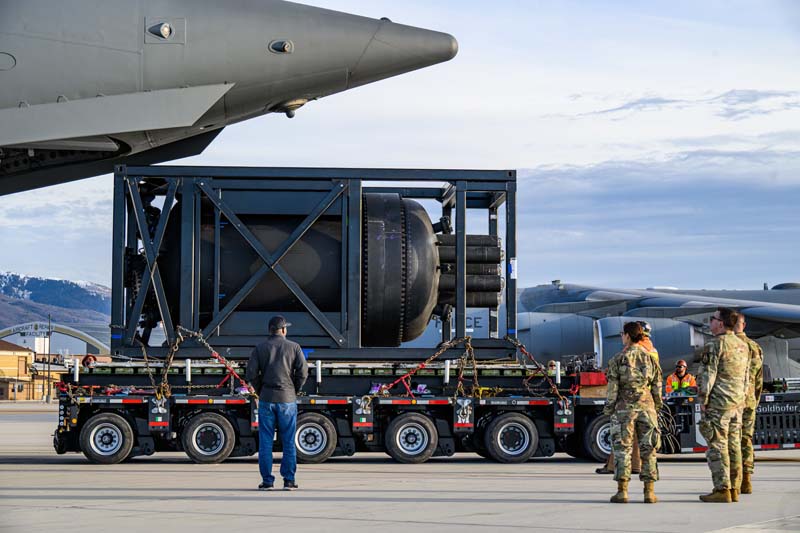
Advanced nuclear reactors could help meet growing energy demands domestically while providing resilient, reliable power for military installations and other critical infrastructure. U.S. Air Force photo by R. Nial Bradshaw.
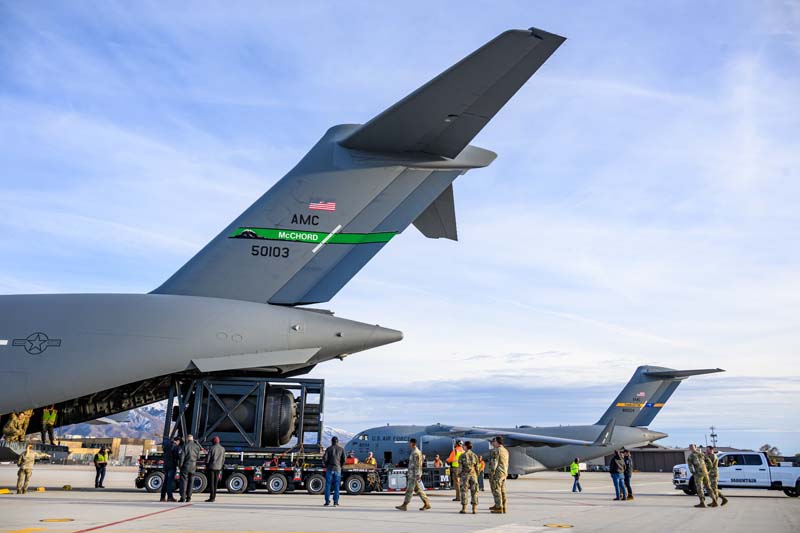
The U.S. Air Force airlifted a nuclear microreactor for the first time last year. Flying in February 2025 from March ARB in Southern California to Hill AFB, Utah, the advanced reactor was transported without fissile material. The mobilization of its core and vessel represents a significant milestone for the technology. Leaders from the Department of War and Department of Energy (DOE), along with industry representatives, welcomed the C-17 on arrival in a display of the collaboration now fueling the revival of nuclear energy in the United States. Most noteworthy, the advanced reactor’s passive safety features make it physically safer than traditional nuclear power, eliminating the possibility of a meltdown and positioning it to support remote operations for the U.S. military.
The advent of deployable nuclear power has obvious benefits for operational energy. It cuts the cord of petroleum dependence in logistically constrained areas such as the Arctic and Pacific. For onsite installation energy, it provides islanding capability from an electrical grid that was not designed to support modern bases. Moreover, the increasingly technical, energy-intensive nature of warfare will continue creating exceptionally high availability demand, a reality that makes advanced nuclear energy a promising resilience solution.
Leading Solutions
In a broader sense, the United States needs reliable energy access to remain competitive with China in the race for dominance in the accelerating realm of artificial intelligence (AI).
In 2023, data centers in the United States consumed 4.4 percent of the nation’s electricity. That number is projected to double or triple by 2028, according to Lawrence Berkeley National Laboratory. Additionally, the interconnection queue (the waitlist for projects to connect to the grid) can extend up to five years. The domestic electrical transmission network was not built to handle high, concentrated computational loads. This, combined with the electrification of American life and the push to reindustrialize the economic base on home soil, has strained the grid. The resulting bottleneck threatens the continued growth of hyperscalers. The scenario is clear: Infrastructure must keep pace with the demands of AI for the nation to remain a global leader.
The development of fourth-generation nuclear technologies, including microreactors, up to 50-Mwe, and small modular reactors (SMRs), up to 300-Mwe, offer the possibility of solving long-term AI energy needs. Unlike traditional nuclear power plants, advanced reactors require a smaller footprint, effectively reducing construction complexity. While the concept of modular reactors dates back to the 1940s, high up-front development costs historically made the larger built-projects more economical. Recent innovations in fuel and design alter this assumption.
With further testing and supply chain maturation, the passive safety features of advanced reactors and their modular nature could allow them to be manufactured more quickly and at scale. Modular reactors and integrated energy systems co-located on data center campuses, for instance, could allow baseload power to be generated continuously on-site, reducing the burden on transmission infrastructure.
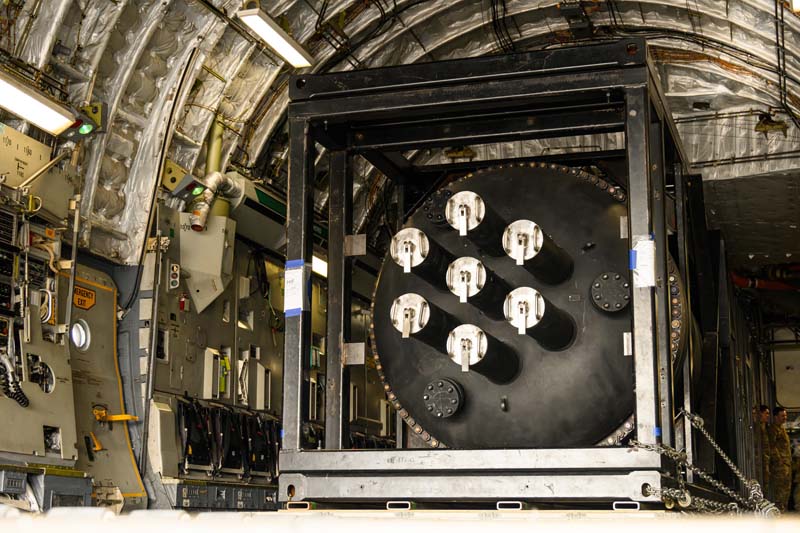
Continued government-industry collaboration is critical to advancing reactor development, strengthening supply chains, and accelerating deployment of nuclear technologies within the United States. U.S. Air Force photo by R. Nial Bradshaw.
National Initiatives
The race for AI has reinforced China’s strategic focus on nuclear energy. With 30 traditional plants under construction, it has been investing significantly in advanced nuclear research and development. This year, China will begin commercial operations of the world’s first small modular reactor approved by the International Atomic Energy Agency. The near-pear competitor’s recently completed five-year plan directed the construction of 150 additional reactors, with the goal of producing 200-GW of nuclear power by 2035. While the United States still leads in nuclear energy production overall, with 94 operational reactors compared to China’s 57, China is developing new plants at an unprecedented rate. Of note, its lead in SMRs largely is due to state-directed and subsidized development of the technology.
The lessons associated with this increased production and the efficiencies gained from economies of scale position China to take the lead in advanced nuclear energy—and the key sectors that depend on it. The U.S. government is sprinting to catch up. In 2025, four executive orders were published to kickstart the American nuclear industry through advanced nuclear innovation, licensing reforms, supply chain build-out, and technology exports.
In 2023, data centers in the United States consumed 4.4 percent of the nation’s electricity. That number is projected to double or triple by 2028, according to Lawrence Berkeley National Laboratory. Additionally, the interconnection queue (the waitlist for projects to connect to the grid) can extend up to five years.
The administration’s plans call for adding 300-GW of new nuclear power by 2050 to support these goals—quadrupling current output. Already, advanced nuclear initiatives at the federal level include significant investments and aspirations.
The U.S. Army’s Janus Program identified nine candidate sites to deploy microreactor power plants by 2030.
The Department of the Air Force’s Advance Nuclear Power for Installations recently matched three bases with three leading microreactor vendors to commence operations of a reactor by 2030, using military demand to catalyze development.
DOE’s Nuclear Reactor Pilot Program, designed to showcase nuclear technology at several sites nationwide and eventually build to fast-track commercial licensing, was initiated in 2025 with a target of going critical by July 2026.
Several changes also have been made to streamline bureaucracy and reinforce a domestic industrial base required for nuclear energy deployment. The Nuclear Regulatory Commission (NRC), in 2025, committed to keep commercial license approval timelines to 18 months. In January 2026, DOE announced the award of $2.7 billion in task orders to support domestic uranium enrichment activities over the next 10 years. NRC also released a new licensing pathway, Part 53, that is specifically designed for advanced nuclear technology rather than legacy systems. This is the first major regulatory change in initial reactor licensing since 1989. In addition, the commission proposed Part 57, a framework to accelerate the safe, high-volume deployment of new reactors.
Incentivizing Development
While the concept of modular reactors dates back to the 1940s, high up-front development costs historically made the larger built-projects more economical.
Within the United States, the deployment of nuclear energy long has been stagnant due to heavy regulation, technical constraints, and negative public perception. Today, the situation is changing. Advanced reactors present an opportunity to provide a sustainable source of clean power. This supports the U.S. military, which requires reliable energy, and the domestic electric grid, which was not designed for AI-driven demand. Both investment and innovation are needed to develop the technology and strengthen supply chains to make advanced nuclear accessible and affordable.
Our country is at a critical juncture in the nuclear energy race. The United States must work within a free-market system to incentivize the development of the nuclear industry. Stakeholders within government and industry must embrace partnership to make advanced nuclear power a mature, viable solution—for both mission resilience and national leadership in the AI revolution.
The Path to Meet Demand
The potential for fourth-generation nuclear presents a chicken-and-egg problem for the United States. Government (particularly the military) wants to procure affordable, modular nuclear energy. Industry needs regulatory clarity and early demand signals to develop the technology that will deliver the results and become more cost-viable. But government depends on industry adoption to build supply chains and reduce manufacturing and fuel costs. While pilot programs across the services and DOE can help in diversifying and innovating through competition, standardization of key design features will be necessary to achieve the savings and scalability associated with manufacturing.
Unlike China, the United States does not have a state-directed economy: it must rely on cooperation, trust, partnership, and risk to make institutional progress happen. A surge of money has started to flow into nuclear energy, with industry titans investing billions to meet the rapidly rising energy demands of hyperscale data centers. In 2024, Microsoft signed a 20-year power purchase agreement to restart the 835-MWe nuclear plant at Three Mile Island, Pa.. In January 2026, Amazon, Google, Meta, Microsoft, OpenAI, Oracle, and xAI signed the Ratepayer Protection Pledge, agreeing to provide power generation for their data centers. Microsoft also announced a deal in March with NVIDIA to use domain-specific AI to streamline permitting and accelerate the development of nuclear projects.
The commercial sector is driving to make nuclear data centers a reality. The government should continue reducing friction to build a safe, secure energy future. SMRs in particular offer an ideal solution, benefiting from a smaller footprint, high baseload output, and scalability.
Capt. Soren Hoffman, P.E., M.SAME, USAF, is Air Force Institute of Technology Education with Industry Fellow at Microsoft; soren.hoffman.1@us.af.mil.
Published in the September-October 2026 issue of The Military Engineer

Check Out Related Articles From TME
-

Innovative PFAS Remediation at Camp Grayling
For project stakeholders and remediation managers confronted with PFAS, Regenesis demonstrates the efficacy of using Regenesis’ PlumeStop® colloidal activated carbon (CAC) at Camp Grayling, Michigan. -
A Standardized Approach to Aircraft Fire Training Infrastructure
To support enterprise-wide airmen readiness, the U.S. Air Force is modernizing its standard design for aircraft fire training facilities—introducing digital controls, dual-fuel systems, and PFAS-conscious infrastructure. -
Delivering Energetic Materials Manufacturing Facilities
Designing and constructing facilities that manufacture, process, handle, or store explosives and energetic materials present some of the most challenging defense projects—requiring technical experience, strict safety protocols, and a comprehensive understanding of regulatory frameworks. -
Forging Tradition and Innovation: A New Design Standard at Camp Lejeune
The II MEF Headquarters at Camp Lejeune blends Georgian Revival architecture with modern sustainability—delivering durability, efficiency, and precision that meets contemporary functional requirements while honoring heritage. -

Balancing Efficiency and Fiscal Responsibility
The continuing contracts clause offers the U.S. Army Corps of Engineers a way to improve project delivery and enhance fiscal responsibility by aligning funding with project execution. -
Next Steps for Digital Twin Development
U.S. Forces Japan is laying the groundwork for future integration of digital twin technology in order to validate and collect data that will offer comprehensive insights into utility conditions at installations and enhance overall decision-making, efficiency, and resilience.