Building Beddown Facilities for the
Next-Generation Bomber
By Andrew Temeyer, RA, LEED AP, M.SAME, Naomi Gabriel, and Andrew Mashek, M.SAME
The B‑21 beddown at Ellsworth AFB demonstrates how close industry-government collaboration can successfully deliver highly secure facilities for mission-essential aircraft while facing tightly restricted program details.
The B-21 Raider, the widely anticipated addition to America’s strategic bomber fleet, is poised to change the nature of global deterrence. With the capability to penetrate tough defenses and deliver precision strikes with both conventional and nuclear munitions, the B-21 is central to the nation’s efforts to modernize its nuclear triad. The next-generation bomber is also resetting the stage for beddown facility requirements within the U.S. Air Force.
With two B-21s already flying, the Air Force is currently actively refining sustainment operations, designing maintenance processes, and building a repository of technical and logistics data. Meanwhile, work is simultaneously progressing on construction of more than $1 billion in new facilities and related beddown infrastructure at Ellsworth AFB, S.D. And because the base is the first beddown site for the B-21, the master plan for Ellsworth also will serve as the foundation for a decade of similar projects at Whiteman AFB in west-central Missouri and Dyess AFB, near Abilene, Texas.
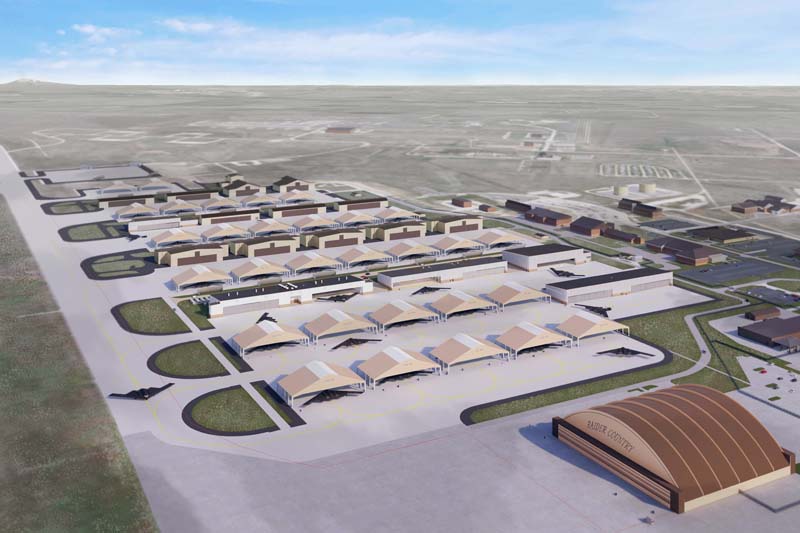
At Ellsworth, about two dozen new facilities will be added on a 400-acre footprint that already has 60 existing facilities. The base, now over 70 years old, has been home to B-1 aircraft for some time. Originally Ellsworth had a nuclear capability, and although that function was later removed, the B-21 is a dual-capable conventional and nuclear weapons delivery system, which revitalized the nuclear mission for the base. This is a significant strategic move by the Air Force.
Reintroducing the expertise needed to elevate high-security readiness is a heavy lift that includes many non-negotiable requirements and functions that have not been part of the base’s mission for decades. Given the urgency of today’s global threat environment, the B-21 program at Ellsworth will be a centerpiece of America’s warfighting posture.
Building in Flexibility
As part of the U.S. deterrence strategy, strike and stealth technology developed over more than three decades has been integrated into an advanced weapons platform that must be accommodated at state-of-the-art beddown facilities at Ellsworth. With near-term milestones coming closer, work on key hangars and an operational command center has been largely completed. Additional work is still underway on facilities that must be completed to meet the full scope of new mission requirements.
The unique systems and responsibilities of all military aircraft make planning and design of beddown facilities more than a cookie-cutter exercise. The process becomes especially complex when the structures must be designed to support an aircraft platform that is still under development, as the B-21 is.
To overcome this situation, all initial supporting facilities at Ellsworth AFB were planned and designed for maximum flexibility. The primary Low Observable Restoration Facility offers a good example. The project has been in close collaboration involving the Air Force Rapid Capabilities Office, Air Force Global Strike Command, Air Force Civil Engineer Center, Detachment 10 of the Air Force Installation & Mission Support Center, the Ellsworth B-21 Program Integration Office, 28th Civil Engineer Squadron, the U.S. Army Corps of Engineers, and Burns & McDonnell. Together, they tackled this extraordinary challenge by planning and designing hangar facilities as well as the sophisticated infrastructure within them before having precise knowledge of what would be needed. Compounding that challenge was the fact that Ellsworth AFB remains home to a B-1B bomber squadron, whose active mission cannot be disrupted while the new B-21 facilities are being built.
Classified Details
An extensive planning effort to support the Low Observable Restoration Facility began before 2019. A detailed assessment of existing facilities and infrastructure needed for the aircraft platform was catalogued, as well as the design of the new and renovated assets that will be needed to meet the full scope of mission requirements. Approximately 30 military construction and sustainment, restoration and modernization projects were identified to successfully insert the new weapons system at Ellsworth. An average construction cost of $250 million/year, spanning six federal fiscal budget years, was originally projected for these requirements.
By 2019, intensive planning and design had then gotten underway. This effort included formal taskings to the Corps of Engineers, which triggered the award of planning and design contracts to multiple architect-engineering firms. However, at that time, the B-21 was only four years into development. That early-stage reality, combined with the highly classified nature of the novel weapons system, meant that certain information needed for precise design specifications was simply not available.
The situation would require the large, integrated design team to utilize best surrogate aircraft and educated estimates for approximately two years until personnel from the Global Strike Command could unveil more specific features that would eliminate much of the guesswork. All these refinements kept the team marching forward with more refined construction documents, keeping the project on schedule.
Trio of Deliverables
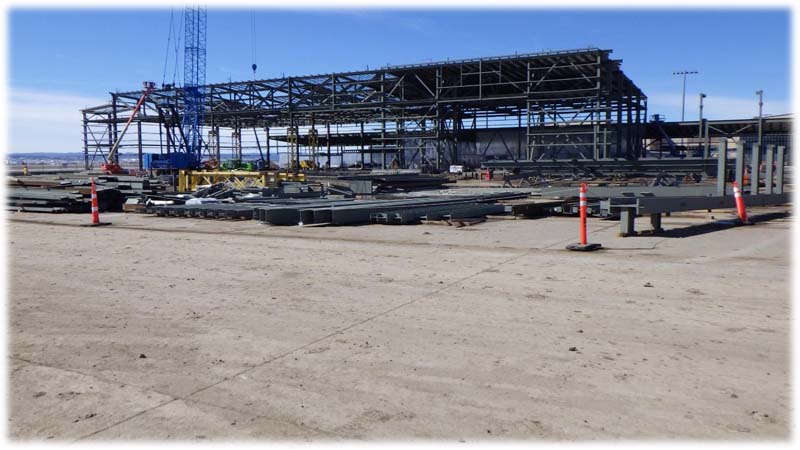
The first three primary projects included the Low Observable Restoration Facility, the Mission Operations Planning Facility, and the Washrack and General Maintenance Hangar. All these required extra diligence because the sites were adjacent to one another as well as active airfield operations.
These three developments formed the centerpiece of the B-21 beddown and had to be successfully executed to create the trajectory for the remainder of the program. During early phases of planning and design, there was a push for rapid progress. However, the team reached a point when it became apparent that an overall master plan would be needed for the full slate of base modifications to be tackled over the succeeding years. This document was developed concurrent to design development of the first six military construction projects.
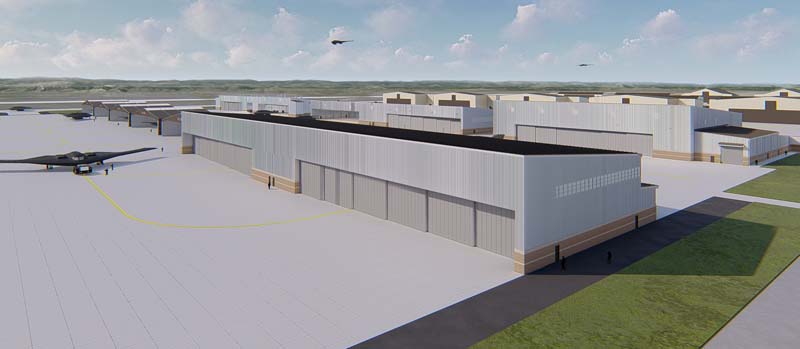
The Low Observable Restoration Facility was the first deliverable on the task list. This multipurpose, 90,000-ft² facility was the anchor project, featuring two bays and a number of systems needed to support the maintenance of low observable technology that has advanced far beyond earlier stealth weapons systems. During the early design stages, the team was faced with the prospect of creating design specifications well before the requisite details of the new aircraft were known. Additionally, each bay had to be engineered with separate infrastructure that was particularly focused on paint booth type capabilities to support sensitive applications for the coatings that make the aircraft survivable while in flight.
The 50,000-ft² Mission Operations Planning Facility was another key piece to setting the program in the right direction. It is highly secure, incorporates advanced technology and communications infrastructure, and connects a wide variety of other B-21 facilities and functions on Ellsworth.
The third facility in the group of projects was a 56,000-ft² dual-bay facility that allows base personnel to perform general maintenance and airframe wash activities.
The unique systems and responsibilities of all military aircraft make planning and design of beddown facilities more than a cookie-cutter exercise. The process becomes especially complex when the structures must be designed to support an aircraft platform that is still under development, as the B-21 is.
Communication is Key
An unexpected variable emerged in early 2020 when the COVID pandemic struck. This required a number of workarounds to maintain schedule discipline, like sending smaller groups to Ellsworth AFB after passing defense-level protocols. All members of the project team also participated in what became frequent virtual meetings, in addition to the visits to the installation.
Another crucial aspect was information-sharing. With most team members familiar only with security requirements for strategic weapons systems that were developed and installed on earlier projects, all assumptions needed to be examined to be sure that the expectations for the new B-21 system would be met. Extensive discussions covered whether assumptions were correct for how sites would be secured, how security personnel would be deployed, and how construction progress would be monitored in a highly classified setting. This required immense teamwork and communication to move past occasionally frustrating moments.
Model for Excellence
The embrace of exceptional communications and close relationships were hidden factors in the success of the beddown at Ellsworth. Despite a global pandemic, a highly classified environment, and a next-generation weapons system that was still under development when construction began, the program has succeeded in becoming a model that will be used on the remaining rollout at B-21 bases.
The collaboration between government and industry has been fundamental in helping overcome challenges in the quest for successful completion. Thanks to the leadership and vision of the many Air Force agencies involved and a commitment to partnership from beginning to end, the conditions for excellence were set.
Andrew Temeyer, RA, LEED AP, M.SAME, is Ellsworth AFB B-21 Beddown Program Manager, USACE Omaha District; andy.c.temeyer@usace.army.mil.

Andrew Mashek, M.SAME, is Vice President, Burns & McDonnell; mashek@burnsmcd.com.

Naomi Gabriel is Project Manager, Air Force Civil Engineer Center; naomi.gabriel@us.af.mil.
Published in the May-June 2026 issue of The Military Engineer

Check Out Related Articles From TME
-

Innovative PFAS Remediation at Camp Grayling
For project stakeholders and remediation managers confronted with PFAS, Regenesis demonstrates the efficacy of using Regenesis’ PlumeStop® colloidal activated carbon (CAC) at Camp Grayling, Michigan. -
A Standardized Approach to Aircraft Fire Training Infrastructure
To support enterprise-wide airmen readiness, the U.S. Air Force is modernizing its standard design for aircraft fire training facilities—introducing digital controls, dual-fuel systems, and PFAS-conscious infrastructure. -
Delivering Energetic Materials Manufacturing Facilities
Designing and constructing facilities that manufacture, process, handle, or store explosives and energetic materials present some of the most challenging defense projects—requiring technical experience, strict safety protocols, and a comprehensive understanding of regulatory frameworks. -
Forging Tradition and Innovation: A New Design Standard at Camp Lejeune
The II MEF Headquarters at Camp Lejeune blends Georgian Revival architecture with modern sustainability—delivering durability, efficiency, and precision that meets contemporary functional requirements while honoring heritage. -

Balancing Efficiency and Fiscal Responsibility
The continuing contracts clause offers the U.S. Army Corps of Engineers a way to improve project delivery and enhance fiscal responsibility by aligning funding with project execution. -
Next Steps for Digital Twin Development
U.S. Forces Japan is laying the groundwork for future integration of digital twin technology in order to validate and collect data that will offer comprehensive insights into utility conditions at installations and enhance overall decision-making, efficiency, and resilience.