Building for the Future: Completing the Transformation of Tyndall AFB
By Col. Robert Bartlow Jr., M.SAME, USAF
The recovery effort at Tyndall AFB following Hurricane Michael has served as a catalyst for innovation—where nontraditional acquisition, next-generation technologies, and integrated resilience strategies have reshaped how the military approaches installation planning and established a model for the future.
Editor’s Note: This is the fifth and final article in a series detailing the recovery and rebuild of Tyndall AFB following Hurricane Michael, which struck the Florida Panhandle on Oct. 10, 2018. The multi-part feature has looked at the engineering challenges encountered by the U.S. Air Force, U.S. Army Corps of Engineers, and multiple private sector A-E firms and contractors to not only restore the base to operational status, but to transform it into the “Installation of the Future.”
In the aftermath of Hurricane Michael, which laid waste to Florida’s Tyndall AFB in fall 2018, a new vision for military installations soon began to form. As Col. Brian Laidlaw, USAF, Commander of the 325th Fighter Wing, put it while surveying the catastrophic damage with Gen. James Holmes, USAF, Commander of Air Combat Command, there for a site visit: “Sir, we are going to build the base we need, not the base we had.” That proclamation became a foundational principle for the rebuild that resonated to the highest levels of the U.S. Air Force, with Secretary of the Air Force Heather Wilson championing the opportunity to forge Tyndall into the “Installation of the Future”—a blueprint for a 21st-century military base.
This vision motivated the multi-year recovery effort, providing a sense of optimism and purpose to the personnel at the base and across the entire service.
The core tenets of the “Installation of the Future” were woven early on into the Tyndall Master Plan and Installation Facility Standards. Throughout, a primary focus was on resilience, in all its forms.
- Structural designs were engineered to withstand certain wind speeds and flooding.
- Coastal resiliency projects were initiated to protect against storm surges.
- Planners sought to reduce operating costs and enhance efficiency by co-locating complementary functions into campuses; they also improved perimeter security and safety while streamlining traffic flow to create a more walkable community.
Turning these nascent ideas into a viable plan fell, in part, to the Innovation Cell within the newly established Program Management Office (PMO). This incubator environment, led by Lowell Usrey, while challenging, granted the freedom to explore truly groundbreaking solutions with a testbed for new concepts, laser-focused on delivering impacts that would extend far beyond Tyndall.
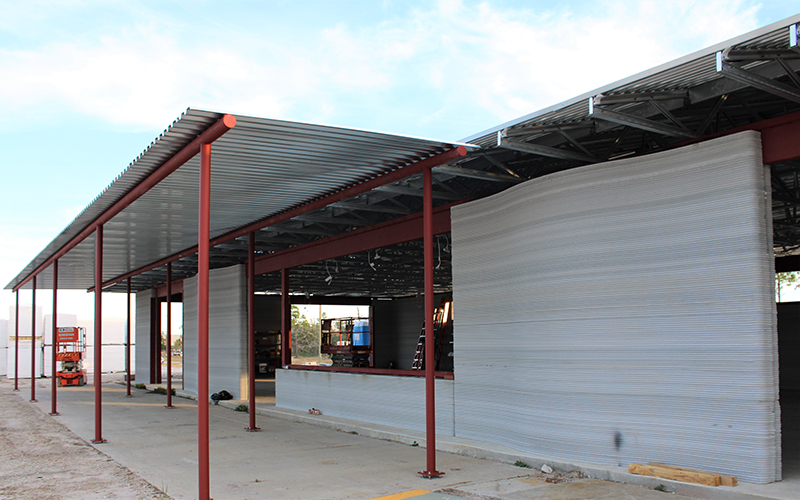
U.S. Air Force photo by Christine Alombro Walker.
Accelerating Innovation
To fast-track the integration of next-generation technology, then-PMO Executive Director Brig. Gen. Patrice Melançon, USAF, recommended partnering with AFWERX, the Air Force’s innovation arm. A significant advantage offered by the collaboration would be expertise in non-traditional contracting methods, particularly other transactional authorities (OTAs). These contractual vehicles provide the flexibility to engage innovators and non-traditional partners in industry and enable access to solutions from a broader, more agile network of contractors. This approach, combined with programs like the Commercial Solutions Opening that created a pre-screened list of vendors to speed contract awards, perfectly matched the compressed timelines of the Tyndall rebuild.
The collaboration kicked off in earnest with a Technology Integration Focus Workshop in June 2019. The sessions that followed, including engagements at the AFWERX hub in Las Vegas, refined concepts into specific problem statements for industry to address. These ranged from base security and resiliency to operational effectiveness and well-being of airmen and families.
The kickoff workshop also proved to be a significant milestone for forging connections. The PMO invited Lance Marrano, a technical director from the U.S. Army Engineer Research & Development Center (ERDC), who had been involved in the Army’s own program evaluating “installations of the future” concepts. His expertise and experience were invaluable. The meeting initiated a unique arrangement. Marrano would later join the Tyndall PMO as a Science and Technology Advisor while remaining a USACE employee. He served as a vital bridge to the vast resources and knowledge of ERDC for the next five years while helping synchronize innovation efforts between the services.
Collaborating with Industry. From the problem statements developed at the workshops, the PMO team issued a “Base of the Future” challenge, which drew an unprecedented response from industry. AFWERX received a record-breaking 1,692 submissions. After a rigorous evaluation process involving a virtual trade show and presentations to over 100 judges, the Air Force moved to contract technologies valued at approximately $15.6 million.
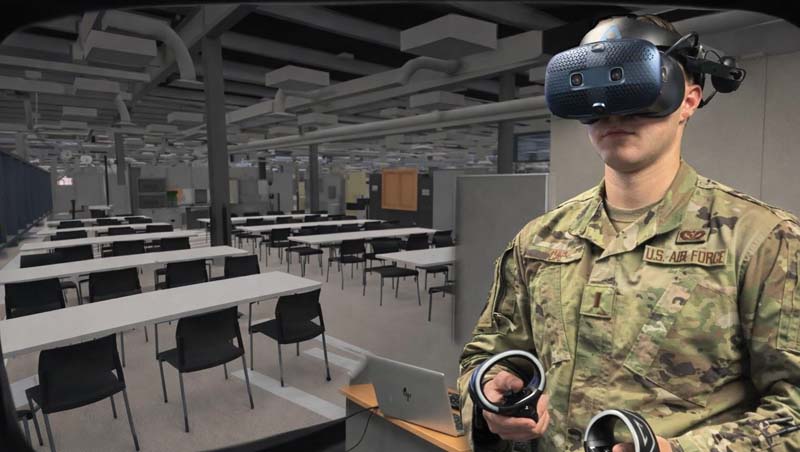
Among the most significant developments was a $10 million award to Booz Allen Hamilton/Ares for a digital twin of Tyndall AFB. This was a virtual representation of the entire installation, the first of its scale in the Air Force, and designed to plan, model, simulate, and monitor a vast array of base functions. By importing building information models from the new construction phases, the digital twin offered planners the ability to conduct virtual walkthroughs to detect design flaws and give personnel a way to see infrastructure behind walls. This capability dramatically improved efficiency for completed facilities. Additionally, security forces at Tyndall used the digital twin to evaluate incident scenarios, then table-top various responses and adjust their security responses for improved effectiveness.
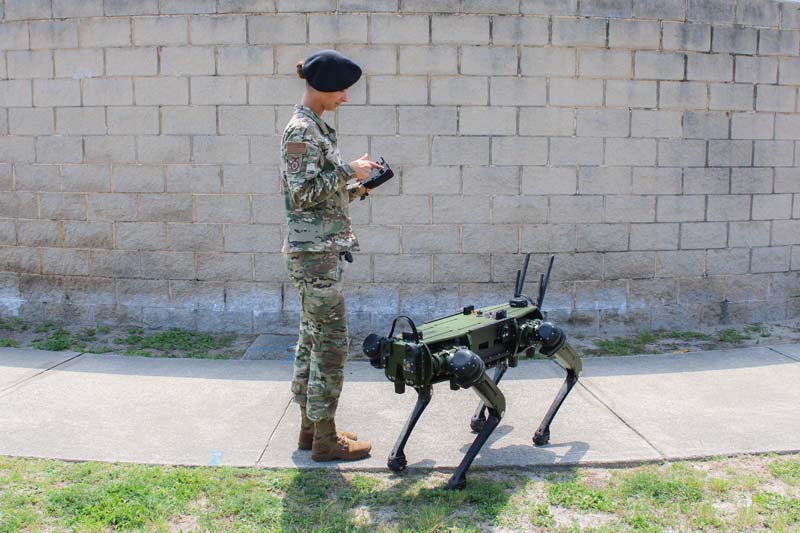
Other contracts focused heavily on enhancing base security. These included an advanced threat detection sensor package for the flightline at Tyndall; quadrupedal unmanned ground vehicles, or “robot dogs,” designed for semi-autonomous patrols in remote areas of the base; and a vehicle and cargo inspection system capable of scanning 120 vehicles/hour (a 300 percent improvement over manual searches).
From the problem statements developed at the workshops, the PMO team issued a “Base of the Future” challenge, which drew an unprecedented response from industry. AFWERX received a record-breaking 1,692 submissions.
Building on the initial success with AFWERX, a “Flightline of the Future” initiative was launched in early 2021. This effort focused on innovations in airfield maintenance, flightline security, and aircraft operations. This challenge garnered 627 submissions and resulted in nine contracts for technologies such as self-healing concrete, a system for applying optical fiber onto pavement without trenching, a truck-mounted foreign object debris detection system, and software that used existing security cameras to detect firearms.
Resilience and Response. Other infrastructure readiness efforts introduced at Tyndall included a new disaster response capability and a coastal resilience program. Using lessons learned from the hurricane recovery at Tyndall and flooding at Offutt AFB, Brig. Gen. John Allen Jr., USAF, then-Commander of the Air Force Civil Engineer Center (AFCEC), identified the need for a standing service-wide response capability. The Air Force Installation & Mission Support Center subsequently established the Initial Response Team to provide rapid, specialized support to damaged installations.
In 2021, as part of that implementation, AFCEC’s Disaster Recovery Response Team became the civil engineering element responsible for rapid deployment, damage assessments, and recovery planning. The unit’s first major deployment was in 2023 in the aftermath of Typhoon Mawar at Andersen AFB, Guam, where it assessed 539 facilities. In 2024, the Initial Response Team was replaced with Task Force Agile Mission Support, and its teams deployed to support Moody AFB, Ga., and MacDill AFB, Fla., after consecutive hurricanes hit the Southeast.
System of Systems
An influential aspect of the rebuild focused on long-standing efforts to move from scheduled preventive maintenance to a more efficient condition-based or predictive model. The goal was to aggregate data from the many sensors already present in modern facility equipment (sensors that could detect a failing motor’s vibration signature or a leak in a water line, for instance) to identify maintenance needs and timing that would reduce manual inspection costs, minimize repairs, and extend the life of the infrastructure.
While the sensor technology was mature, the integration into a secure, cyber-resilient IT network was the primary challenge. At the June 2019 workshop, the idea for a system of systems began to take shape. Planners recognized that such a platform could not only serve civil engineering needs but integrate with security forces systems, unlocking previously siloed data to enhance situational awareness for base defense. Leveraging his experience, Marrano shared the Army’s parallel efforts, and the concept for what would become the Installation Resilience Operations Command & Control was born. This technology center was designed as a government-owned, cloud-based common data platform: a virtual dashboard that could fuse key data streams and provide advanced analytics, all at the forefront of zero trust cybersecurity mandates.
In September 2020, the PMO selected SimpleSense/Novetta for the contract, awarding a 36-month, $9 million OTA arrangement. The selection was strategic: the vendor was already working with security forces, and the solution was well on its way to receiving an Authority to Operate on Air Force networks, a significant hurdle. The initial plan was to test the operations center system on a handful of buildings, but the team soon expanded the project to cover more than 100 facilities. The successful implementation and dual Authority to Operate between civil engineer and security forces systems proved the concept. Soon, the program received interest from other locations. In 2024, the Installation Resilience Operations Command & Control System received $20 million in funding to deploy the capability to five additional installations, including sites for the Army and U.S. Space Force, validating its enterprise-level potential.
Embracing the Coastline
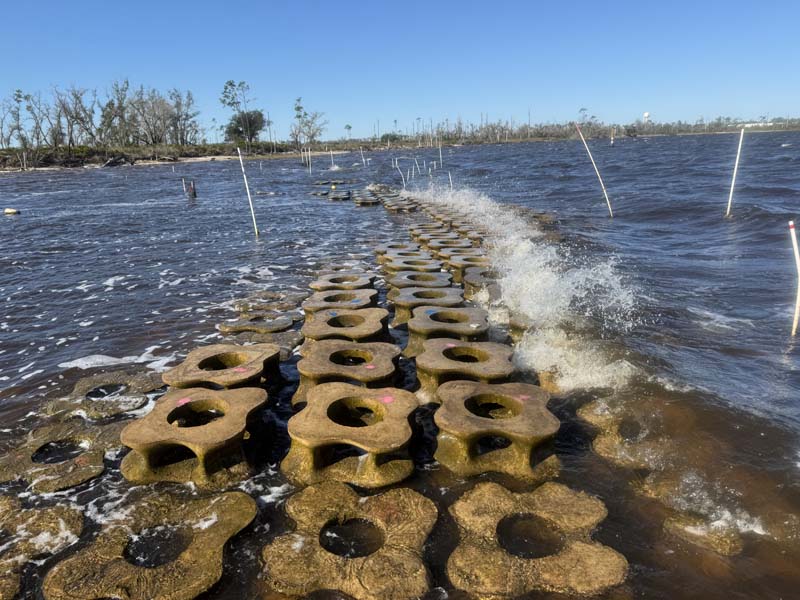
As part of the multi-year rebuilding program at Tyndall, the base pioneered a coastal resilience strategy to use a defense approach that combines engineered structures with nature-based solutions such as restoring dunes, marshes, and oyster reefs. Through a collaborative Coastal Resilience Working Group involving federal, state, and private stakeholders, Tyndall developed the Coastal Resilience Implementation Plan, a first-of-its-kind roadmap for the Air Force that was years ahead of official guidance. The plan outlines a “coastal resilience triad,” balancing nature-based solutions, structural, and non-structural solutions, to protect the base and enhance the local environment.
Having already secured over $13 million in grants, Tyndall is implementing several pilot projects, including living shorelines and oyster reef breakwaters, which serve as a model for other coastal installations and ensure the base’s operational viability for decades to come.
Embedded Viewpoints
The success of the overall program cannot be attributed solely to technological innovation or grand strategy. The PMO benefited immensely from having contracting officers embedded directly within its organization. Rich Osterland, Tiffany Hoover, and Jack Hahne served in unique roles, providing agile advice on navigating groundbreaking acquisition processes, managing large-scale purchases, and working with AFWERX to execute agreements at speed. Similarly, the presence of a dedicated staff attorney, Karen White, presented essential legal guidance on complex issues such as environmental regulations, legislative interpretation, contracting procedures, and negotiations.
The “Installation of the Future” was not a destination but a bold process of vision, acquisition, integration, and rigorous testing.
To ensure the lessons from Tyndall were preserved and fostered a continuous cycle of improvement, an Innovation Working Group was established in April 2021. This coalition quickly grew to include more than 90 organizations and was designed to capture and share advancements and best practices across the entire Air Force. The Innovation Working Group became a vital mechanism for evaluating the results of the various technology pilots and for helping promising ideas navigate the “Valley of Death” from prototype to a fully sustained, fielded capability.
An Enduring Legacy
The reconstruction of Tyndall AFB has been a transformative journey, an operational experiment in real time, and a collaborative endeavor that has reshaped the Air Force’s approach to installation management, resilience, and technological integration.
The “Installation of the Future” was not a destination but a bold process of vision, acquisition, integration, and rigorous testing. Through its successes, its valuable setbacks, and the dedicated work of countless individuals, the rebuild has forged a new paradigm, creating a powerful and enduring legacy that will shape the development of military installations for decades to come. Through it all, the investments of time, talent, and treasure have also restored Tyndall’s valuable role in the nation’s defense.
Failing Forward
As part of the multi-year rebuilding program, the testbed that emerged at Tyndall, while invaluable, revealed that not all innovations would succeed. For example, the robot dogs were effective demonstration items but came with significant sustainment costs. Streetlight systems with facial recognition capability could not detect faces at the distances and speeds required; they were repurposed as time-lapse cameras for construction sites. The vehicle and cargo inspection systems were effective, but reliability issues and occasional damage ensued, often requiring lengthy factory repairs. Other systems faced insurmountable hurdles, such as radio frequency interference, security concerns over their manufacture, or an inability to work around specific aircraft.
A firearm detection software presented a complex use-case. It was successfully installed and could identify weapons, but also generated several false positives each day, a rate the local security forces squadron found unable to manage. An advanced, separate gunshot detection sensor system was so new it was not covered in Air Force policy and became entangled in a disagreement over whether it could be funded with military construction funds.
These experiences served to provide useful data and observational insights, underscoring the critical need to consider long-term sustainment costs, manpower, and the intricate realities of operational environments.
Col. Robert Bartlow Jr., M.SAME, USAF, is Chief, Natural Disaster Recovery Division,
Air Force Civil Engineer Center, Tyndall AFB, Fla.; robert.bartlow@us.af.mil.

Sydney Russell, M.SAME, AFCEC Natural Disaster Recovery Division, contributed to this article.
Published in the May-June 2026 issue of The Military Engineer

Check Out Related Articles From TME
-

Innovative PFAS Remediation at Camp Grayling
For project stakeholders and remediation managers confronted with PFAS, Regenesis demonstrates the efficacy of using Regenesis’ PlumeStop® colloidal activated carbon (CAC) at Camp Grayling, Michigan. -
A Standardized Approach to Aircraft Fire Training Infrastructure
To support enterprise-wide airmen readiness, the U.S. Air Force is modernizing its standard design for aircraft fire training facilities—introducing digital controls, dual-fuel systems, and PFAS-conscious infrastructure. -
Delivering Energetic Materials Manufacturing Facilities
Designing and constructing facilities that manufacture, process, handle, or store explosives and energetic materials present some of the most challenging defense projects—requiring technical experience, strict safety protocols, and a comprehensive understanding of regulatory frameworks. -
Forging Tradition and Innovation: A New Design Standard at Camp Lejeune
The II MEF Headquarters at Camp Lejeune blends Georgian Revival architecture with modern sustainability—delivering durability, efficiency, and precision that meets contemporary functional requirements while honoring heritage. -

Balancing Efficiency and Fiscal Responsibility
The continuing contracts clause offers the U.S. Army Corps of Engineers a way to improve project delivery and enhance fiscal responsibility by aligning funding with project execution. -
Next Steps for Digital Twin Development
U.S. Forces Japan is laying the groundwork for future integration of digital twin technology in order to validate and collect data that will offer comprehensive insights into utility conditions at installations and enhance overall decision-making, efficiency, and resilience.