Augmenting Combat Feeding Systems for Extreme Cold
By Justine Yu and Dylan Pasley
To counter the risk of equipment failure in cold-weather environments, researchers with the U.S. Army partnered with industry to develop an insulation technology that could augment existing feeding systems, serving to enhance warfighter resilience and reduce fuel consumption.
As the United States reinforces its strategic posture in the Arctic, possessing the ability to sustain forces in extreme cold weather is paramount. The harsh environment at the top of the world poses significant logistical and operational challenges that directly impact preparedness.
Carrying out long-duration operations in Arctic environments requires stable and consistent food temperature management, including storage and transport. The U.S. Army’s standard Multi-Temperature Refrigeration Container System (MTRCS) is ill-equipped to operate in Arctic extreme cold weather conditions, with temperatures dropping below -25°-F. The limited capabilities of the MTRCS in the Arctic would force Army units to obtain contracts for loud, cumbersome commercial refrigerators that require additional logistical equipment to move—an option that is not feasible in real-world scenarios.
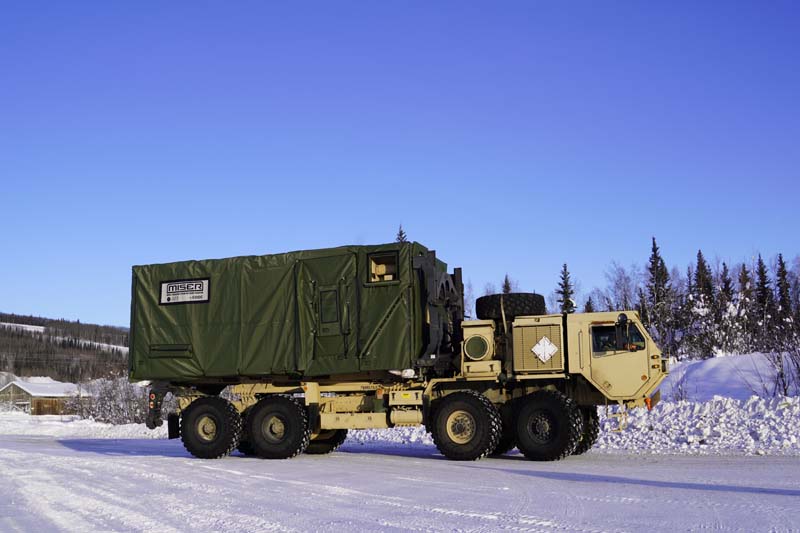
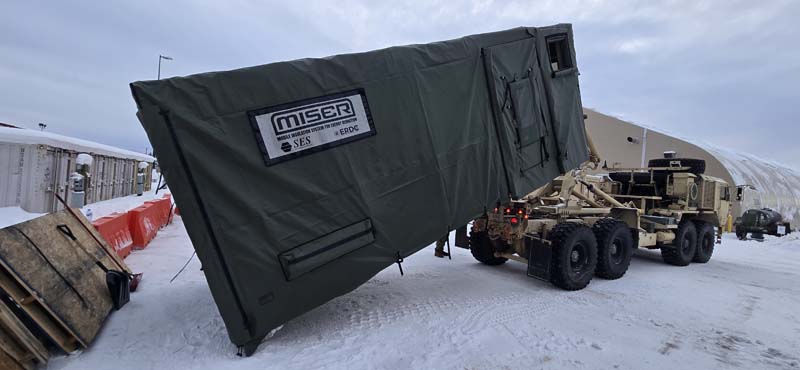
In response to this need, the Army’s Engineer Research & Development Center (ERDC), working with Select Engineering Services (SES), have pioneered a transformative solution: the Mobile Insulation System for Energy Reduction (MISER). As an appliquéd insulation technology designed to augment existing program of record equipment, MISER enables sustained operations without costly redesigning or limiting the system’s mobility requirement.
Sustaining the Force
The failure of essential equipment for soldiers operating in the Arctic is not an inconvenience; it is a direct threat to mission success and survival. The 11th Airborne Division’s “Statement of Need” highlights a critical vulnerability: the inability of the MTRCS and other essential combat feeding equipment to function when temperatures plummet. This failure has historically forced a reliance on contracted solutions and inefficient field-expedient methods, increasing logistical tails and fuel consumption. The 11th Airborne’s “Food Service 2030 White Paper” further emphasized that achieving self-sufficiency and ensuring food security are paramount for projecting combat power in the region.
The challenge was clear: the Army needed a solution that was rapid, cost-effective, and adaptable. The answer was not to reinvent the wheel, but to winterize it.
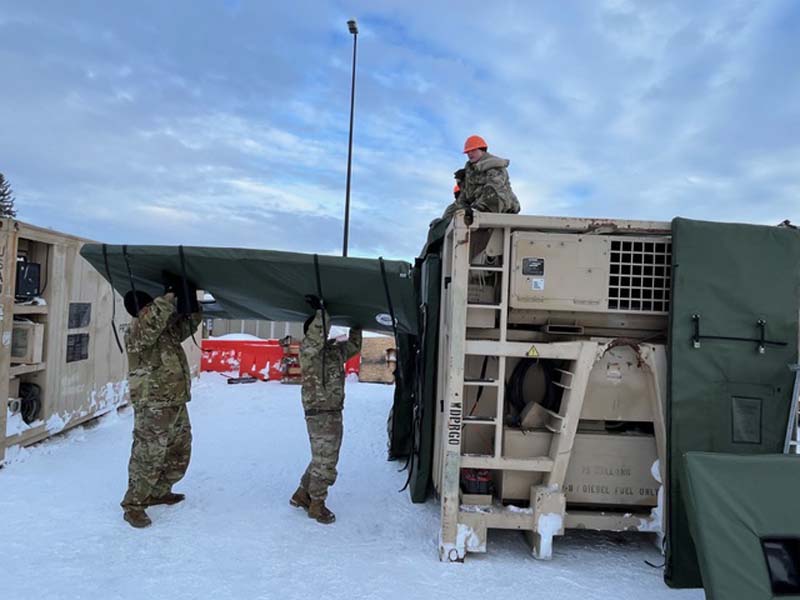
MISER is comprised of modular insulative panels measuring about 4-ft by 8-ft; they zip together with an outer weatherproof covering that is installed on the exterior of existing equipment. The system provides a thermal barrier that reduces the energy required to heat or cool the interior of a container. Once installed on the MTRCS, the kit provides enhanced insulation, enabling it to operate at temperatures below -25°-F. This insulation kit shows reduced energy consumption greater than 30 percent—an important metric since energy efficiency immediately reduces the strain on logistics and fuel convoys while improving resilience and security.
Demonstrated Benefits
In February 2026, at Fort Wainwright, Alaska, ERDC and SES partnered with the 1st Infantry Brigade Combat Team, 11th Airborne Division, to conduct a demonstration prior to the Joint Pacific Multinational Readiness Center (JPMRC). The demonstration ahead of the exercise included performance testing and verification of the effectiveness of the insulation system and mobility adaptations. To facilitate soldier involvement, the training used two MTRCS, which enabled teams to compare installations side by side.
Data was collected on energy consumption and temperature, outside ambient temperature/moisture, durability, and qualitative inputs from end-users on ease of install and removal and performance. The MTRCS systems were equipped with 11 temperature sensors and four humidity sensors for data collection on the interior and exterior of the system. By following a paired sensors approach, a framework was produced that engineers, soldiers, and evaluators used to describe benefits, improve installation instructions, and document future improvements in production.
During the demonstration, the MISER-equipped MTRCS successfully maintained its required internal temperature. The technology proved durable and resilient, withstanding the rigors of transport at speeds up to 37-mph on a load handling system vehicle. After the mobility portion of the demonstration, both systems remained in operation at Fort Wainwright, as originally outlined in the demonstration plan, and were utilized later for a field feeding competition in which it showed continued success.
The challenge was clear: the Army needed a solution that was rapid, cost-effective, and adaptable. The answer was not to reinvent the wheel, but to winterize it.
Increased Self-Sufficiency
The demonstration at Fort Wainwright confirmed that MISER technology can be successful for Arctic logistics and warfighter readiness. As stated in the 11th Airborne Division’s formal endorsement, the solution directly addresses a critical “materiel and non-materiel gap” that has historically degraded readiness in extreme cold. In preventing equipment failure, the MISER ensures that soldiers have reliable access to food and climate-controlled shelters—a fundamental requirement for sustained operations. Prior testing had also validated MISER energy savings on Force Provider rigid wall shelters by showing how reduced logistics enhanced force protection and mission assurance.
By transitioning from a reliance on external contractors to an organic, soldier-installed capability, the Army gains critical self-sufficiency. The ability to apply this technology onto existing program of record systems like the MTRCS and Force Provider rigid walled shelters provides commanders the flexibility to adapt and overcome challenges in any environment. Similar adaptations may fit in kitchen units, mobile medical suites, and mortuary and emergency recovery spaces.
Expanding Capabilities
The successful demonstration and fielding of the MISER at Fort Wainwright is a promising advancement in warfighter engineering and the development of the technology provides a testament to the power of collaborative innovation. MISER fundamentally enhances the Army’s resilience and preparedness in cold-weather regions and provides a simple, robust, and cost-effective solution to a complex problem.
This appliquéd technology empowers warfighters, reduces logistical dependencies, and ensures mission-critical systems can perform in the most demanding environments. As the Army continues to prioritize its Arctic strategy, technologies like MISER both augment and improve existing fielded systems.
Justine Yu is Research Architect, and Dylan Pasley is General Engineer, Construction Engineering Research Laboratory – U.S. Army Engineer Research & Development Center. They can be reached at justine.a.yu@usace.army.mil; and dylan.pasley@usace.army.mil.
Published in the July-August 2026 issue of The Military Engineer
Check Out Related Articles From TME
-

Innovative PFAS Remediation at Camp Grayling
For project stakeholders and remediation managers confronted with PFAS, Regenesis demonstrates the efficacy of using Regenesis’ PlumeStop® colloidal activated carbon (CAC) at Camp Grayling, Michigan. -
A Standardized Approach to Aircraft Fire Training Infrastructure
To support enterprise-wide airmen readiness, the U.S. Air Force is modernizing its standard design for aircraft fire training facilities—introducing digital controls, dual-fuel systems, and PFAS-conscious infrastructure. -
Delivering Energetic Materials Manufacturing Facilities
Designing and constructing facilities that manufacture, process, handle, or store explosives and energetic materials present some of the most challenging defense projects—requiring technical experience, strict safety protocols, and a comprehensive understanding of regulatory frameworks. -
Forging Tradition and Innovation: A New Design Standard at Camp Lejeune
The II MEF Headquarters at Camp Lejeune blends Georgian Revival architecture with modern sustainability—delivering durability, efficiency, and precision that meets contemporary functional requirements while honoring heritage. -

Balancing Efficiency and Fiscal Responsibility
The continuing contracts clause offers the U.S. Army Corps of Engineers a way to improve project delivery and enhance fiscal responsibility by aligning funding with project execution. -
Next Steps for Digital Twin Development
U.S. Forces Japan is laying the groundwork for future integration of digital twin technology in order to validate and collect data that will offer comprehensive insights into utility conditions at installations and enhance overall decision-making, efficiency, and resilience.