Delivering a Secure Learning Environment
By J.J. Tang, FAIA, F.SAME, Bill Vondenkamp, AIA, M.SAME, and Anthony Cady, PMP., M.SAME
The U.S. Army Cyber Center of Excellence sets a new standard for a secure, flexible education environment, integrating human‑centered design alongside layered security measures.
The emergence of cyberspace as a contested operational domain has reshaped the military’s approach to defense, infrastructure, and education. Over the past decade, the U.S. Army has accelerated investments to meet this rapidly evolving domain. These efforts are anchored at Fort Gordon, Ga., where a former Vietnam-era signal school is undergoing a comprehensive transformation into a forward-leaning 21st-century, academic training campus for the Army and the intelligence communities: the Cyber Center of Excellence (CCoE).
In 2017, the Savannah District of the U.S. Army Corps of Engineers (USACE), following a competitive, qualifications-based selection process, contracted for the execution of this transformational effort to HDR. For the better part of a decade, through partnership with the Savannah District and a CCoE transformation cell, the integrated design team has been guided by a strong sense of mission, pride, and shared responsibility in delivering this landmark campus.
With completion of the CCoE master plan back in 2019 (the first phase of this transformational initiative), the vision for the campus was established. The master plan defines an academic quad at the campus core and creates a pedestrian-oriented, mission-focused, and secure learning environment. Following this effort, the HDR team delivered full architectural and engineering services for three new academic and administrative headquarters buildings, along with the renovation of two major general instructional facilities.
- Building 1 is a 140,000-ft², four-story specialized Cyber Electronics Instructional Facility. It also houses a network center and the Cyber School command headquarters.
- Building 2 comprises 221,000-ft² across four stories and serves as a specialized Signal Electronics Instructional Facility, network center, and the CCoE command headquarters.
- Building 3 is a 240,000-ft² facility that supports automation-aided instruction, the university registrar, and the Signal School command headquarters. In addition, the renovations of Vincent Hall and Brant Hall provide a combined 215,000-ft² of modernized academic, instructional, and administrative space.
The design and construction of these major facilities realize the blueprint for the future of Army cyber education. They embody the principles of higher learning in a secure environment and set a new standard for cyber-focused educational facilities across government, academia, and industry.
A Visual Identity
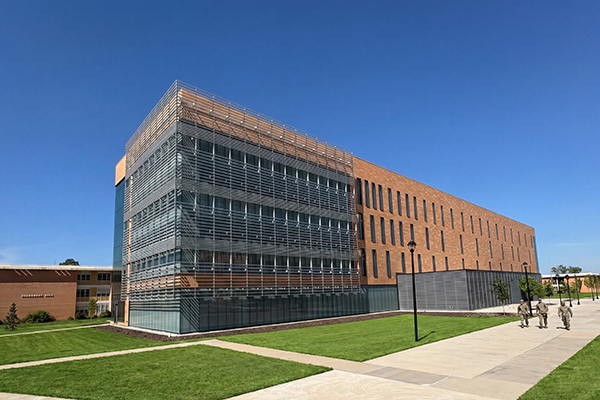
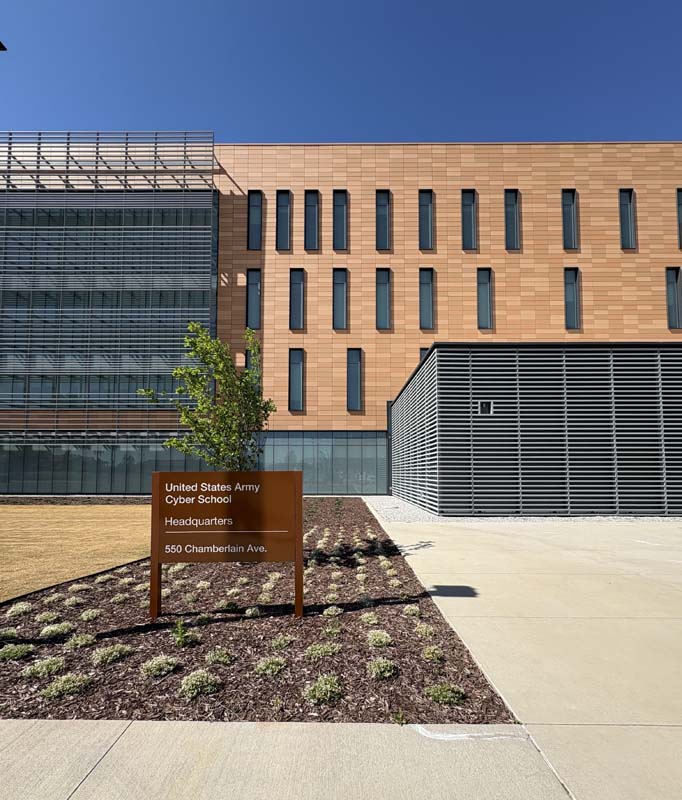
The exterior design of all three of the new buildings commissioned through the CCoE master planning draws inspiration from binary code to create a visual representation of the institution’s mission.
A terracotta cladding system forms the primary façade material. Its color and tonal variation pay homage to the predominant brick buildings in the installation. Through a carefully composed rhythm of window placement and sizes, the façade fenestration responds to interior functions and also evokes the binary logic of ones and zeros—allowing the cyber mission to be read in material and form.
Conceptual Balance. The design program has followed a binary-inspired approach that is reinforced through contrasting materials, layered façade depth, and carefully articulated openings that respond to environmental performance requirements. Shaded glazing, recessed elements, and patterned wall assemblies contribute to solar control, daylight harvesting, and energy efficiency. As daylight conditions shift, the façade evolves visually, reflecting the dynamic nature of data and information flow.
Through this purposeful architectural articulation, a lasting campus visual identity is established, embedding the cyber mission into a secure, durable, and timeless building form.
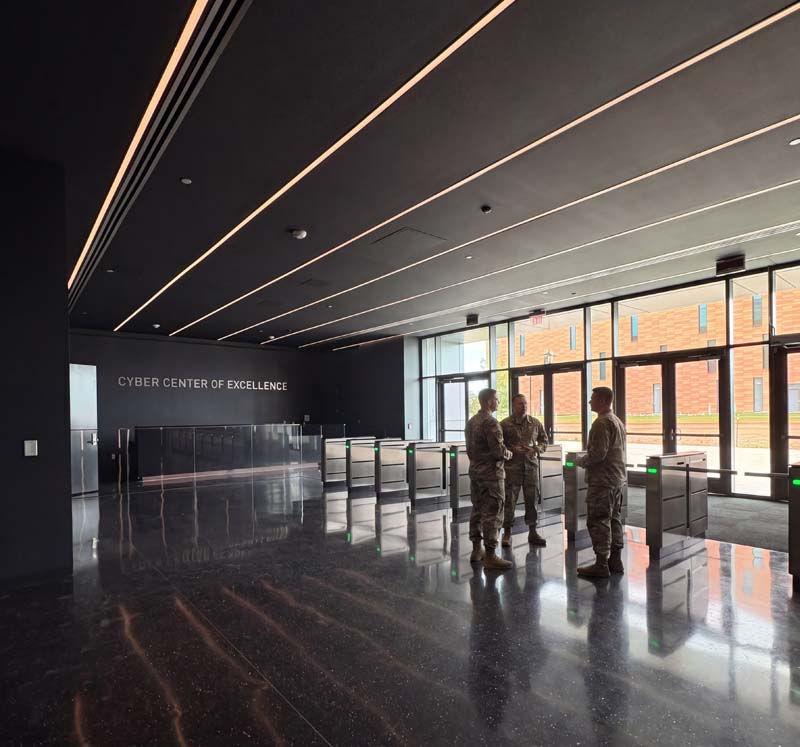
Practical Aesthetic. From a functional perspective, the secured, exterior envelope acts as a “virtual” container that houses the cyber-technology and signal-technology box within. Embracing clean, simple, and minimalistic finishes reinforces the virtual experience. The progressive rhythm of natural daylight and interior lighting, designed along the perimeter circulation spaces, encourages movement in the academic box, which houses program components such as classrooms, labs, and instructor spaces.
Together, the building envelope, interior architecture, and lighting strategy create an immersive learning environment that aligns the spatial experience with cyber education and its evolving nature. This integrated approach balances security, performance, and clarity to support focused learning and mission readiness.
Delivering in Phases
Delivering a multi-facility academic campus within an active installation demanded a strategy that protected training continuity while enabling rapid transformation. The CCoE program was sequenced so training operations, secure networks, and base logistics could continue uninterrupted. The approach taken by the design team combined rigorous preplanning, secure-by-design logistics, and adaptive execution to resolve dependencies among new builds, major renovations, and technology cutovers.
Design Phasing Strategy. Overall, the design phasing strategy was conceived with a singular priority: training continuity. Unlike conventional academic setting projects, this effort demanded a framework that could adapt to shifting operational requirements while maintaining security and instructional integrity. Every design decision was guided by a principle that cyber education is dynamic, mission-driven, and deeply integrated with secure infrastructure.
To achieve this vision, the team developed a coordinated approach that balanced three critical priorities.
Sequential MILCON Procurement: Buildings 1, 2, and 3 were procured separately and scheduled in overlapping phases to compress overall duration and accelerate delivery. This required constant recalibration of design documents to align with procurement timelines and evolving mission needs, ensuring that each facility could be brought online without delaying subsequent phases.
Overall, the design phasing strategy was conceived with a singular priority: training continuity. Unlike conventional academic projects, this effort demanded a framework that could adapt to shifting operational requirements while maintaining security and instructional integrity.
Standardized Design: A robust basis-of-design framework established guiding principles, setting the design foundation of all facilities. This approach created a kit-of-parts playbook that enabled consistency in operational functionality across classrooms, laboratories, and collaborative spaces while accommodating diverse training modalities. By standardizing core elements, the team achieved efficiency without sacrificing flexibility or security.
Flexible Learning Environment: Recognizing that cyber training is inherently dynamic, the design team incorporated modular layouts, adaptable infrastructure, and scalable technology platforms. This future-focused vision ensures that teaching spaces can be reconfigured with minimal downtime, supporting emerging technologies and new operational requirements without disrupting ongoing education.
Living system
The CCoE campus, by following a disciplined design framework, became more than a collection of buildings—it became a living system, capable of adapting to the changing landscape of cyber warfare and education.
Construction Phasing Strategy. Executing a multi-phase construction program at Fort Gordon also required a mission-first approach that mirrored military precision. The complexity of phased construction was a critical operational requirement. To achieve this, the design implemented a secure-by-design construction phasing strategy, focused on mitigating any sequential interdependence that could negatively influence each project. This regulated project management ensured that new facilities could come online while existing classrooms and laboratories remained fully functional to preserve the integrity of ongoing cyber training.
Paths of Travel: The aspect of safe and efficient movement was emphasized as part of the construction phase planning strategy, which prioritized clearly defined pathways and controlled access routes to facilitate the daily movement of more than 4,000 personnel. These circulation strategies allowed students, faculty, and construction workers to coexist without compromising security or instructional continuity.
Gravity Shift: Rather than dispersing construction across the broader installation, all new construction for Buildings 1, 2, and 3 was concentrated within the core of the operational campus. This strategic shift created a new center of gravity—establishing a more cohesive and integrated central campus arrangement. Additionally, this minimized disruptions to mission-critical activities while enabling the rapid integration of new infrastructure to fortify the established network.
Minimized Downtime: Utility cutovers were planned with precision to avoid downtime in secure networks and critical systems. Redundant power and data pathways maintained operational resilience during transitions. Secure staging areas and material delivery protocols were developed to maintain the integrity of the installation while supporting the multiple, simultaneous construction schedules.
Model for Education
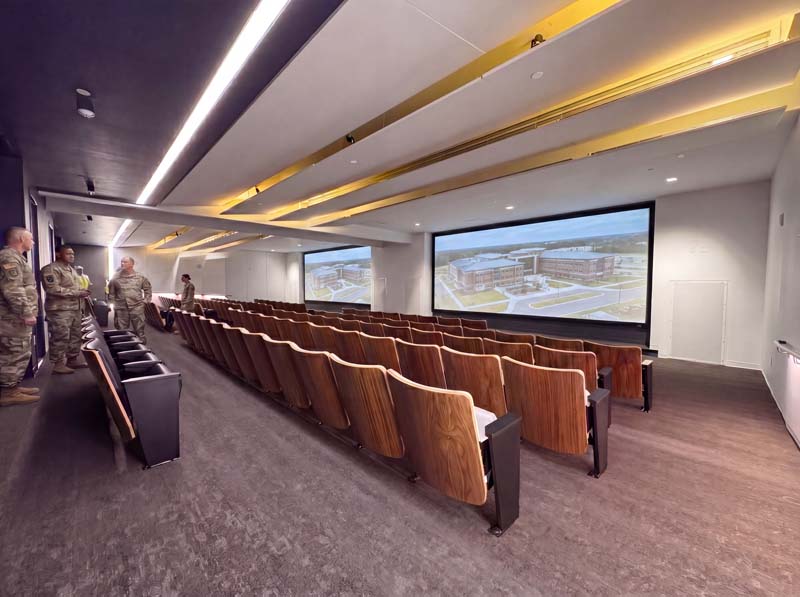
The Army Cyber Center of Excellence at Fort Gordon stands as a transformative benchmark for secure, technology-driven learning environments. By integrating layered security, human-centered design, and resilient infrastructure, the campus redefines what higher education in a classified setting can achieve.
The CCoE demonstrates that security and flexibility are not competing priorities but complementary forces that, when harmonized, create an environment where innovation thrives. The campus exemplifies how government, academia, and industry can converge to deliver a secure, adaptive, and resilient educational ecosystem will influence cyber education for decades to come.
Human-Centered Learning
The design team approached the CCoE with a clear understanding that cyber learning and training, especially within the defense community, is fundamentally different from traditional classroom instruction. Inherently, cyber education is highly dynamic, team oriented, and cognitively intensive, while also operating within a secured facility. The pedagogy requires instructional spaces equipped with secure digital and building infrastructure to support multiple learning modalities like lecture-based instruction, group collaboration, simulation that replicates real-world cyber battlefields, and independent analytical work. Maintaining flexible classroom layouts, modular furnishings, and adaptable infrastructure allows students to shift seamlessly between instructional formats to hands-on training.
Security is not an add-on at the CCoE; it is embedded into the architecture. The design integrates layered security strategies that are intentionally designed to be unobtrusive to users. Secure zones, controlled access points, and compartmentalized planning allow academic learning, training, and administrative activities to occur smoothly without compromising security measures.
J.J. Tang, FAIA, F.SAME, is Senior Vice President, Director of Federal Facilities, and Bill Vondenkamp, AIA, M.SAME, is Vice President, Director of Classified Facilities, HDR. They can be reached at junjian.tang@hdrinc.com; and bill.vondenkamp@hdrinc.com.

Anthony Cady, PMP, M.SAME, is Chief, Military Programs & Project Management Branch, USACE Savannah District; anthony.e.cady@usace.army.mil.
Published in the May-June 2026 issue of The Military Engineer

Check Out Related Articles From TME
-

Innovative PFAS Remediation at Camp Grayling
For project stakeholders and remediation managers confronted with PFAS, Regenesis demonstrates the efficacy of using Regenesis’ PlumeStop® colloidal activated carbon (CAC) at Camp Grayling, Michigan. -
A Standardized Approach to Aircraft Fire Training Infrastructure
To support enterprise-wide airmen readiness, the U.S. Air Force is modernizing its standard design for aircraft fire training facilities—introducing digital controls, dual-fuel systems, and PFAS-conscious infrastructure. -
Delivering Energetic Materials Manufacturing Facilities
Designing and constructing facilities that manufacture, process, handle, or store explosives and energetic materials present some of the most challenging defense projects—requiring technical experience, strict safety protocols, and a comprehensive understanding of regulatory frameworks. -
Forging Tradition and Innovation: A New Design Standard at Camp Lejeune
The II MEF Headquarters at Camp Lejeune blends Georgian Revival architecture with modern sustainability—delivering durability, efficiency, and precision that meets contemporary functional requirements while honoring heritage. -

Balancing Efficiency and Fiscal Responsibility
The continuing contracts clause offers the U.S. Army Corps of Engineers a way to improve project delivery and enhance fiscal responsibility by aligning funding with project execution. -
Next Steps for Digital Twin Development
U.S. Forces Japan is laying the groundwork for future integration of digital twin technology in order to validate and collect data that will offer comprehensive insights into utility conditions at installations and enhance overall decision-making, efficiency, and resilience.