Developing Resiliency Through Hydrogen-Based Energy Systems
By Franklin Holcomb, Carol Bailey, PMP, and Michael Bradford, Ph.D.
The U.S. Army’s Hydrogen Energy Research Operation is leading the development of hydrogen production, storage, and fuel cell technologies to improve installation resilience and support critical mission requirements.
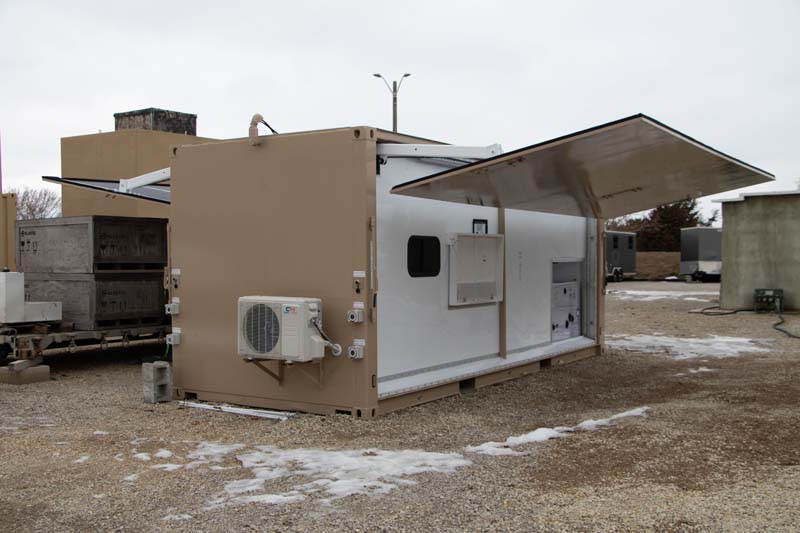
The Engineer Research & Development Center’s Construction Engineering Research Laboratory is evaluating hydrogen-based technologies to enhance energy resilience. Photo courtesy CERL.
The U.S. Army’s policy on Energy and Water Resilience requires that installations sustain energy and water supply that support critical facilities for a minimum of 14 days.
To meet this capability and also to replace outdated heating and power systems, the Army is exploring advanced hydrogen and fuel cell energy solutions through the Engineer Research & Development Center’s Construction Engineering Research Laboratory (ERDC-CERL).
Integrating Solutions
As the Department of War’s principal research organization for installation energy and infrastructure, ERDC-CERL is actively validating emerging technologies against stringent military requirements. The solutions aim to integrate hydrogen and hydrogen blends across the entire energy value chain.
As part of its efforts, ERDC-CERL has partnered with GTI Energy on the Hydrogen Energy Research Operation (HERO), a program to develop and study integrated hydrogen systems.
Phased Approach
By serving as the critical interface between industry innovators and military host sites, ERDC-CERL’s role in the program ensures that the systems developed through HERO are technically viable, operationally practical, and ready for deployment.
Focused initially at GTI’s research facility in Des Plaines, Ill., HERO is being executed across four strategic phases.
Testing and Validation. The foundational phase of HERO centers on rigorous prototype testing and validation. Because safety, reliability, and performance are paramount before deploying new power technologies on a military base, ERDC-CERL is working closely in this phase to ensure all integrated equipment meets strict operational criteria and facility engineering standards.
Researchers are currently evaluating a comprehensive suite of hardware, including hydrogen production methodologies and advanced solid-state storage solutions. The development of end-use applications has been a major focus, with testing underway on proton exchange membrane fuel cells for building power and hydrogen combustion boilers for thermal heating.
A significant success in this phase has been the durability testing of fuel cell-powered logistics vehicles. For over two years, fuel cell forklifts have been operated at the GTI facility, logging more than 100 operational hours, including operating the vehicles outdoors in sub-freezing temperatures. This phase also established robust safety protocols, engineering design standards, and a digital twin virtual reality training tool to prepare base personnel for the incoming technologies.
Pilot Deployment. Phase 2 focuses on deploying a turnkey prototype solution at the Illinois Army National Guard’s site in North Riverside. The demonstration will feature a comprehensive microgrid infrastructure, including an underground hydrogen pipeline for building distribution, compressed hydrogen storage, hydrogen boilers for thermal heating, and proton exchange membrane fuel cells to provide continuous installation power.
Initial elements of this phase are underway. In 2025, the fuel cell forklifts thoroughly vetted in Phase 1 were successfully demonstrated at the installation. The forklifts were filled with hydrogen and delivered to North Riverside, where they operated seamlessly for up to four weeks.
During this stage, ERDC-CERL’s role in interfacing directly with the host site is vital. By closely monitoring the deployment, it can actively develop “lessons learned” regarding permitting, infrastructure integration, and daily operability. The complete system design for the broader infrastructure is ongoing; site preparation and full system installation are slated for 2027. This phase will include a fully functional hydrogen refueling infrastructure capable of supporting 350-bar and 700-bar fueling for intra-installation fuel cell vehicles.
Advancing Domestic Production. For the military, logistical independence requires cost-effective, on-site fuel generation. Phase 3 of HERO will introduce a next-generation production methodology, Sorbent Enhanced Reforming of Critical H2 (SERCH). Rather than relying on traditional steam methane reforming, SERCH aims to scale up a novel hydrogen generation plant utilizing domestic natural gas.
This phase is critical for the private sector, as it targets massive improvements in production economics. The SERCH process is projected to generate hydrogen with 20 percent greater efficiency than traditional methods. Furthermore, it is expected to lower capital infrastructure costs by 43 percent, ultimately achieving a 19 percent reduction in the total cost of the produced hydrogen.
Operational Assessment. The final phase of the HERO program involves a comparative demonstration of advanced power systems. The Defense Department requires empirical, data-driven comparisons to determine the optimal mix of technologies for diverse operational environments. As a result, the HERO Heat and Power Challenge will serve as a comprehensive assessment to guide future military infrastructure investments.
Engineers will directly compare performance, reliability, and logistical footprint of hydrogen storage paired with proton exchange membrane fuel cell systems against modern battery energy storage systems and hybrid energy configurations. The data gathered during this challenge will provide planners with the operational baselines needed to procure and deploy the right microgrid technologies to specific installations based on their unique mission requirements and geographic constraints.
Path to Deployment
By methodically moving from controlled prototype validation to active pilot deployment, ERDC-CERL is actively de-risking advanced energy technologies before widespread implementation.
Through a rigorous validation processes, direct engagement with host sites, and diligent capture of lessons learned, ERDC-CERL is charting widespread technology transition pathways to benefit the defense community.
Technological Benefits
A fuel cell is an electrochemical device that combines fuel and an oxidant to produce electricity, heat, and water. In a hydrogen-based system, hydrogen serves as the fuel while oxygen from the ambient air acts as the oxidant. Unlike internal combustion engines, fuel cells do not burn fuel to generate power. By converting energy electrochemically rather than through combustion, fuel cells bypass traditional thermal limits, making them exceptionally quiet, clean, and highly efficient.
Beyond its use as a reactant in a fuel cell, hydrogen can be combusted directly or blended with other fuels such as natural gas and used in conventional combustion appliances, including boilers, furnaces, and hot water heaters. For example, Germany aims to blend locally produced hydrogen through the existing natural gas infrastructure for use through its “Hydrogen Initiative.” This effort is, in part, driven by a desire to reduce its dependence on foreign (and increasingly unstable) sources of energy.
For vehicular and portable applications, fuel cells can offer tactical advantages that incumbent battery technologies cannot match. Portable military fuel cell systems can deliver lightweight, nearly silent power for critical communication gear and sensors. In vehicular, drone, and robotic applications, fuel cells can provide longer range and rapid refueling capabilities, all while emitting significantly less heat and noise, which vastly improves stealth and survivability in the field. Also, electrolyzers can generate and store hydrogen locally from water, directly tackling the logistical vulnerabilities of transporting liquid fuels over long distances.
In stationary environments like defense sites, fuel cells can improve resilience and mitigate grid vulnerabilities. The Department of War has a congressional mandate to maintain a minimum 99.9 percent energy availability at critical installations, along with a requirement for a minimum of 14 days of energy and water supply for facilities that support critical missions. While stationary fuel cell power plants have been commercially available since the 1990s, today’s modernized fuel cells and electrolyzers can form the basis of reliable microgrids that ensure continuous, secure power during commercial grid outages or cyberattacks.
Franklin Holcomb is Senior Researcher, and Carol Bailey, PMP, is Senior Project Manager, Construction Engineering Research Laboratory – U.S. Army Engineer Research & Development Center. They can be reached at franklin.h.holcomb@usace.army.mil; and carol.j.bailey@usace.army.mil.

Michael Bradford, Ph.D., is Senior Program Manager, GTI Energy; mbradford@gti.energy.
Published in the September-October 2026 issue of The Military Engineer
Check Out Related Articles From TME
-

Innovative PFAS Remediation at Camp Grayling
For project stakeholders and remediation managers confronted with PFAS, Regenesis demonstrates the efficacy of using Regenesis’ PlumeStop® colloidal activated carbon (CAC) at Camp Grayling, Michigan. -
A Standardized Approach to Aircraft Fire Training Infrastructure
To support enterprise-wide airmen readiness, the U.S. Air Force is modernizing its standard design for aircraft fire training facilities—introducing digital controls, dual-fuel systems, and PFAS-conscious infrastructure. -
Delivering Energetic Materials Manufacturing Facilities
Designing and constructing facilities that manufacture, process, handle, or store explosives and energetic materials present some of the most challenging defense projects—requiring technical experience, strict safety protocols, and a comprehensive understanding of regulatory frameworks. -
Forging Tradition and Innovation: A New Design Standard at Camp Lejeune
The II MEF Headquarters at Camp Lejeune blends Georgian Revival architecture with modern sustainability—delivering durability, efficiency, and precision that meets contemporary functional requirements while honoring heritage. -

Balancing Efficiency and Fiscal Responsibility
The continuing contracts clause offers the U.S. Army Corps of Engineers a way to improve project delivery and enhance fiscal responsibility by aligning funding with project execution. -
Next Steps for Digital Twin Development
U.S. Forces Japan is laying the groundwork for future integration of digital twin technology in order to validate and collect data that will offer comprehensive insights into utility conditions at installations and enhance overall decision-making, efficiency, and resilience.