Driving Infrastructure Delivery in the Pacific Through Cultural Intelligence
By Paul Baron, P.E., M.SAME, and Camille Gozum Colling, P.E., M.SAME
Ongoing investments to improve ports and harbors in Palau and Yap under the Pacific Deterrence Initiative demonstrate the vital importance of collaboration and local partnerships in delivering successful infrastructure in remote locations.
The Pacific Deterrence Initiative represents one of the most significant U.S. defense infrastructure investments in recent history. With projected spending to exceed $60 billion through 2030, the program will enhance America’s military presence, strengthen prepositioning capabilities, and improve readiness across the Indo-Pacific. Through partnerships that include Japan, Australia, the Philippines, and the Quad Nations, the Pacific Deterrence Initiative comprises a shared commitment among allies to a free and open region.
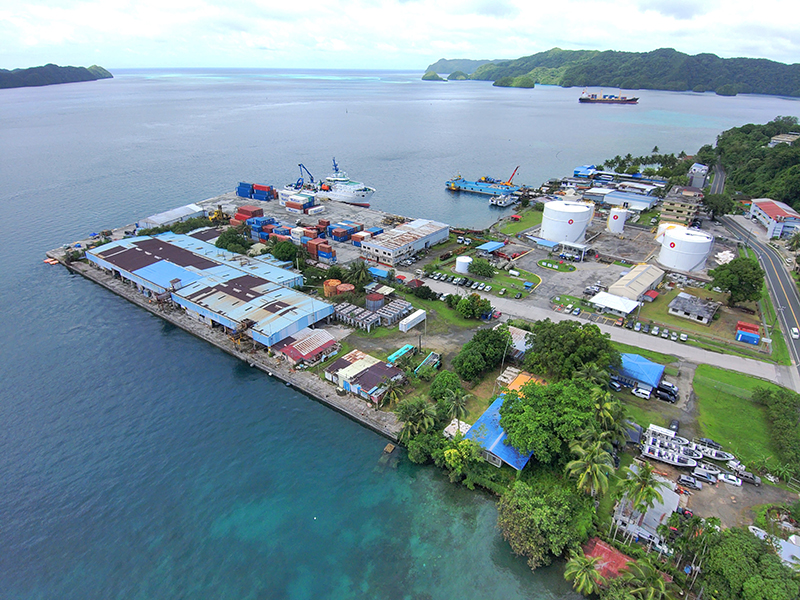
As part of the expansive decade-long effort, GHD, in a joint venture with COWI, is delivering critical port and harbor improvements on Malakal Island in Palau and on the island of Yap in the Federated States of Micronesia. These island nations have distinct cultures and governance structures, as well as unique relationships with the United States through the Compact of Free Association and Status of Forces Agreement. The tranche of projects include port upgrades and expansion, dredging and disposal design, new navigation aids, joint-use facilities, and road improvements. The work requires coordination across multiple U.S. agencies (U.S. Navy Pacific Fleet, Joint Posture Management Office, Joint Region Marianas, U.S. Army Engineer Research & Development Center, and Naval Facilities Engineering Systems Command Southwest) as well as host nation governments, Indigenous community leaders, and international partners.
In the unforgiving environment of the world’s largest ocean, technical execution alone is insufficient. Successfully delivering military and federal projects in culturally complex regions requires disciplined engagement to avoid schedule disruption, permitting delays, and reputational exposure.
Integrating Teams
The presence of cultural protocols in places like Palau and Yap are not obstacles to navigate around; instead, they can serve as frameworks for progress. To achieve success in these locations, project teams must become part of the local community. That integration, however, does not occur quickly. It requires deep local knowledge and actively managing relationships.
For the projects on Palau and Yap as part of the Pacific Deterrence Initiative, the first step was hiring local engineers with current connections. Even longstanding professional contacts required renewal and active engagement to remain effective. Communication among many groups required similar discipline. The team coordinated continuously between internal staff, agency clients, host nations, regulatory bodies, and local communities. Each stakeholder required a distinct approach to ensure clarity, maintain positive relationships, and prevent misunderstandings that could affect field activities or site investigations.
Navigating Protocols
In Palau, cultural protocols directly shaped project decisions. During an engagement with the Council of Elders regarding the use of a local gathering place, Ice Box Park, as a potential reclamation area for dredged material disposal, it became clear that residents had personal ties to the location and there was historical importance to the site.
Rather than limiting engagement to consultation, the team incorporated community leaders into the design process. The park’s boundaries were adjusted to avoid legal disputes with adjacent families; feedback also was integrated throughout design development. These adjustments reduced the likelihood of future disputes that could affect permitting or construction progress.
Having a team member from Palau who could bridge communication gaps proved critical. During meetings, elders shifted into speaking Palauan to express complex concerns. Effective engagement required someone who understood the native language and could translate technical issues into terms that were clear and accessible. Highly technical explanations, such as structural considerations related to lateral loading, required simplification as well. Visual tools and renderings supported that effort by showing, rather than describing, proposed conditions.
These tools were not supplemental: they were necessary to ensure shared understanding before work advanced. Detailed renderings and videos of the proposed infrastructure helped stakeholders understand what was being planned. The response was positive and aided in strengthening transparency.
In Yap, stakeholders requested physical buoys be placed in the water to mark dredging areas because drawings alone were insufficient. The team incorporated this request and began planning boat tours supported by GPS and ROV footage. This provided a tangible understanding of project scope and impact. While the measures required additional effort, they reduced uncertainty and reinforced local confidence in the operation.
Measurable Impact
Cultural intelligence directly reduces construction risk. When stakeholders are integrated into solution development, projects experience fewer disruptions. The local communities understand and support what is being built from the outset. Increasingly, military and federal clients are institutionalizing this approach. and risk management documentation now includes the consideration of potential reputational impacts from public engagement.
For U.S.-led projects overseas, cultural intelligence is becoming integral to infrastructure delivery, particularly in strategically sensitive regions.
Teams operating in culturally complex environments should prioritize local expertise at the outset. If qualified personnel with regional knowledge are available internally, they should be engaged. If not, securing that expertise should become an immediate priority.
Allocation of sufficient time and resources for relationship-building must be incorporated into planning. While the time needed may be hard to predict, early investment reduces the likelihood of later delays, shutdowns, or reputational exposure.
Hiring qualified area personnel for critical tasks and maintaining transparency when challenges arise builds trust. Managing expectations openly, particularly when adjustments are required, strengthens long-term project stability.
Local stakeholders are not peripheral to execution. Their input can result in tangible changes, leading them to developing ownership of outcomes. That reduces friction and strengthens project resilience, and partnerships, over time.
Avoiding Delays
A failure to follow cultural protocols can halt projects entirely. In one instance overseas, surveying activities led by an industry contractor were initiated without securing proper permissions. The oversight resulted in a 30-day project shutdown.
Avoiding such outcomes again would require the early involvement of local liaisons and the securing of permissions before any fieldwork began. The application of “over-communication” became a deliberate strategy to prevent misunderstandings and mitigate costly surprises during investigations or construction mobilization. The client recognized the value of this approach and increased the budget allocated to stakeholder engagement. More early investment reduced the downstream risk.
Operational Requirement
As military/federal projects increasingly involve international partnerships and Indigenous communities, cultural intelligence is shifting from differentiator to requirement. The scope of U.S. investment overseas is only projected to grow.
The capability to deliver technically sound structures and systems will depend on the ability to communicate clearly, secure permissions, maintain trust, and prevent avoidable disruption as much as it on engineering expertise and skill. The question is no longer whether to invest in cultural intelligence but whether mission-critical infrastructure can advance without it.
Paul Baron, P.E., M.SAME, is Project Manager, and Camille Gozum Colling, P.E., M.SAME,
is Civil Engineer, GHD. They can be reached at paul.baron@ghd.com; and camille.gozum@ghd.com.
Published in the July-August 2026 issue of The Military Engineer
Check Out Related Articles From TME
-

Innovative PFAS Remediation at Camp Grayling
For project stakeholders and remediation managers confronted with PFAS, Regenesis demonstrates the efficacy of using Regenesis’ PlumeStop® colloidal activated carbon (CAC) at Camp Grayling, Michigan. -
A Standardized Approach to Aircraft Fire Training Infrastructure
To support enterprise-wide airmen readiness, the U.S. Air Force is modernizing its standard design for aircraft fire training facilities—introducing digital controls, dual-fuel systems, and PFAS-conscious infrastructure. -
Delivering Energetic Materials Manufacturing Facilities
Designing and constructing facilities that manufacture, process, handle, or store explosives and energetic materials present some of the most challenging defense projects—requiring technical experience, strict safety protocols, and a comprehensive understanding of regulatory frameworks. -
Forging Tradition and Innovation: A New Design Standard at Camp Lejeune
The II MEF Headquarters at Camp Lejeune blends Georgian Revival architecture with modern sustainability—delivering durability, efficiency, and precision that meets contemporary functional requirements while honoring heritage. -

Balancing Efficiency and Fiscal Responsibility
The continuing contracts clause offers the U.S. Army Corps of Engineers a way to improve project delivery and enhance fiscal responsibility by aligning funding with project execution. -
Next Steps for Digital Twin Development
U.S. Forces Japan is laying the groundwork for future integration of digital twin technology in order to validate and collect data that will offer comprehensive insights into utility conditions at installations and enhance overall decision-making, efficiency, and resilience.