Engineering Diplomacy in Palau
By Capt. Jon Furlong, M.SAME, USA
As part of a recent deployment to the Republic of Palau, the U.S. Army’s Civic Action Team 84-10 completed a series of community-focused engineering projects that not only delivered critical infrastructure support but strengthened trust and host-nation relationships in an important strategic area of the globe.
During a recent deployment to Palau, Civic Action Team 84-10 demonstrated how community-focused projects can strengthen relationships and support U.S. partnerships in the Indo-Pacific. Photo by Sgt. Austin Riel, USA
The role of engineering units is not limited to kinetic objectives or completing strategic infrastructure work; they can also achieve civil-military objectives. By incorporating community-focused efforts into their missions, these forces can transform construction projects into tools of diplomacy.
When military engineering units engage positively with local communities, they build public trust and create conditions conducive to long-term strategic partnerships.
During a six-month rotation to the Republic of Palau in the Western Pacific Ocean as part of a Civic Action Team (CAT), soldiers from the 84th Engineer Battalion discovered that their skills and efforts could have a significant impact beyond physical infrastructure. By training local workers and supporting community initiatives, CAT 84-10’s civil-military accomplishments demonstrate how engineering units can leverage their expertise to enhance public sentiment in partner nations and support a long-term U.S. presence in key Indo-Pacific countries.
Although the team’s primary mission was community construction support, its overall purpose involved strengthening ties with local citizens and area stakeholder organizations.
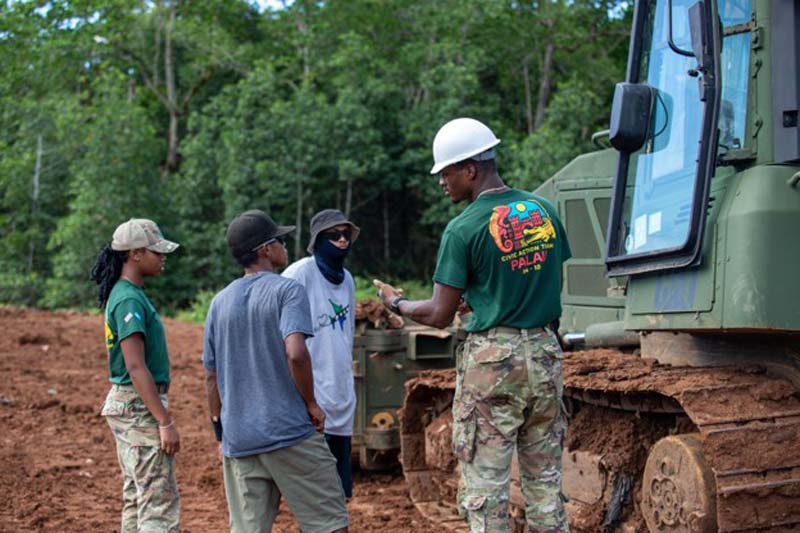
The deployed engineers trained local apprentices in construction trades to help build host-nation capacity and continuity after U.S. forces left. Photo by Capt. Jon Furlong, USA.
Focused on Community
Since 1969, CATs composed of U.S. military personnel have supported Palau under the terms of the Compacts of Free Association. These teams not only complete small community construction projects but they manage a community relations program, a trades apprenticeship for locals, medical outreach initiatives, and maintain World War II monuments.
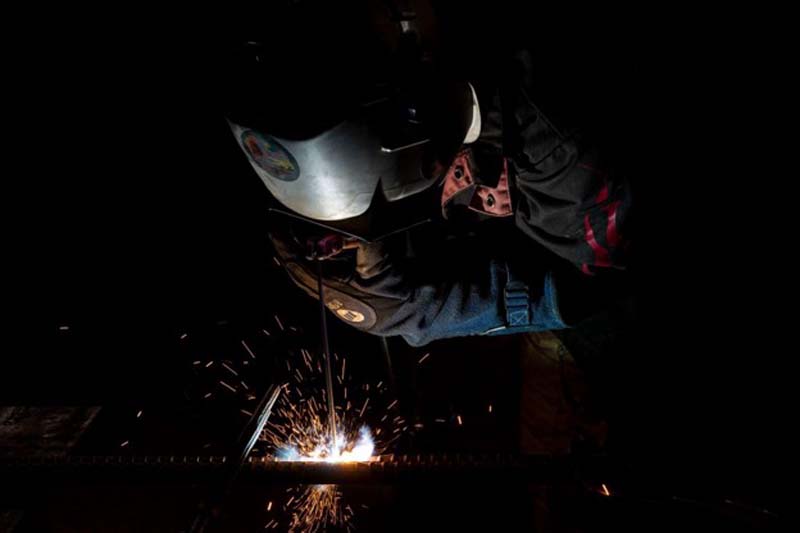
CAT 84-10 was involved in several key projects in Palau, notably the construction of a playground for Koror Elementary School. The engineers demolished the old structure and built a safer prefabricated playground. Additionally, the team focused on improving local infrastructure, including building an 850-m access road to Palau’s only recycling plant and welding more than 15 anchors for the Palau Bureau of Fisheries’ Pelagic Fishing Initiative, a program critical to coral reef health and food security.
CAT 84-10 also prioritized community outreach in Angaur and Ngaraard, where Tactical Multi-Mission Over-the-Horizon Radars are being constructed. Once complete, these systems will strengthen early warning capabilities in the Pacific, but challenges exist because many residents view the projects as disruptive to their everyday lives. In partnership with the U.S. Embassy Palau, the servicemembers met with local leaders in both communities to identify needs they could assist with. The team ended up supporting initiatives ranging from fitness programs to improvements at area schools.
During the rotation, a two-year wait for an earthmoving permit for Ngaraard was successfully resolved and traditional chiefs in Angaur publicly supported the over-the-horizon radar project. While these outcomes were not solely due to CAT 84-10, its efforts helped improve perceptions of the military as a community partner.
Strong Connections
While small in size, island nations such as Palau play an outsized role in U.S. strategic access throughout the Indo-Pacific, making strong relationships with host-nation communities and governments increasingly important. Lessons from CAT 84-10’s deployment can inform future engineering projects across the region, emphasizing the importance of community engagement alongside infrastructure development.
Train the Local Workforce in Engineering Skills. CAT 84-10 employed 10 local apprentices who learned essential trades like carpentry, welding, electrical work, plumbing, and heavy equipment operation. These individuals contributed to the construction projects and helped ensure continuity after CAT 84-10’s departure. For example, one of the team’s former apprentices was contacted to repair a malfunctioning solar light that had been installed at an elementary school. For U.S. engineer units abroad, leadership should prioritize training local workers to maintain projects after U.S. forces leave, as sustainable infrastructure relies on the host nation’s capability to uphold it. Additionally, this training helps to train the local workforce to take on projects of their own.
Leverage Organic Medical Capabilities. In rotations alongside engineering units, medical personnel supporting the missions often experience downtime, which can be used to benefit the community directly. By collaborating with local medical systems, they can provide expertise and enhance healthcare. Physicians with CAT not only assisted the military units in Palau, they also ran a free community clinic and trained staff at a nearby hospital, identified gaps in healthcare education, and partnered with a local radio station to host a weekly “Doc Talk” to teach about diabetes and hypertension. Providing medical support like this addresses immediate community needs while also demonstrating a long-term U.S. investment in the health and well-being of the local population.
Align with Local Institutions and Organizations. Engaging the local community is most effective when it supports area institutions. Throughout the deployment, CAT 84-10 organized projects and outreach efforts with Palau’s Civic Action Coordinating Committee and other organizations, including the embassy, to ensure alignment with island priorities. By collaborating with established groups and governing bodies, the unit helped increase community buy-in and strengthened existing systems instead of replacing them.
Offer to Maintain Local Memorials and Culturally Significant Locations. A rewarding way to build trust with the community is to show respect for culture and history. U.S. engineering units are uniquely positioned to do this since their equipment can be used to maintain local memorials and culturally significant sites. In Palau, a recurring outreach effort involved maintaining World War II memorials and historical sites, including weeding, mowing, and repainting.
Support Small-Scale Technical Assistance Projects. Often, large-scale construction projects attract the most attention on civic action deployments. CAT 84-10’s experience in Palau showed that smaller initiatives can have a more significant impact on community relationships. While the unit did successfully complete large projects, many of its most effective contributions were minor technical assistance. These efforts included installing a new toilet and water tank for the fire department, upgrading the security camera systems at the Palau Civic Center, and setting up solar-powered lighting at several area schools. Though these projects were smaller scale individually, together they demonstrated how CAT 84-10 was genuinely invested in addressing the everyday concerns of the citizenry.
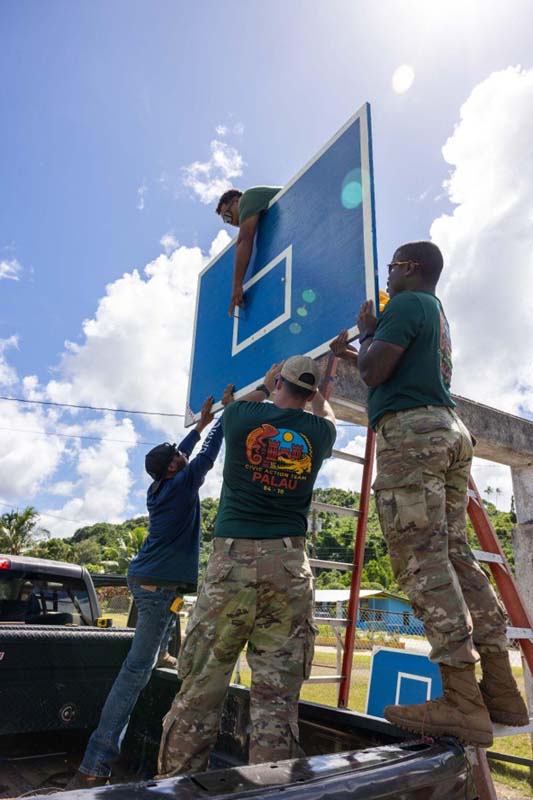
Community-focused engineering can reinforce long-term partnerships in critical regions like the Indo-Pacific by demonstrating a thoughtful, sustained U.S. commitment. Photo by Sgt. Austin Riel, USA.
Strategic Benefits
U.S. military units must ensure that local communities perceive their arrival as a valuable contribution to daily life rather than an interruption. Building that level of support requires engineers to carefully consider how their activities affect surrounding communities and how they can leverage their unique capabilities to enhance civil-military relations.
In an era of increasing competition in the Indo-Pacific, public sentiment and community trust can significantly influence host-nation cooperation and long-term strategic access. For instance, in Palau, local opposition had delayed approval of the Ngaraard over-the-horizon radar earthmoving permit for two years.
Many countries in the Indo-Pacific, including Palau, have a long history of partnership with the United States. These relationships though should not be viewed as guaranteed. Unlike major allies such as Japan, where the U.S. presence is supported by longstanding political and economic ties, access and public perception in smaller island nations are often influenced by local sentiment and economic development. In recent years, countries such as the Solomon Islands, Kiribati, and Nauru have moved closer to China after feeling both somewhat ignored by the United States and receiving significant economic assistance from China. The contributions of engineers offer unique capabilities to address the needs of such communities and improve regional relationships.
Building Trust
As the United States competes for influence in the Indo-Pacific, it is critical that island nations see a clear distinction between American engagement and China’s competing model. Efforts like CAT Palau demonstrate partnership centered on capacity building and community investment. In doing so, they reinforce the value of maintaining close ties with the United States beyond infrastructure. They offer communities in the Indo-Pacific a visible contrast to the political pressure and corruption concerns associated with Chinese engagement.
As other U.S. engineer units complete construction projects throughout the world’s largest geographic expanse, they can adopt many of the tactics CAT 84-10 employed during its mission to improve public sentiment. Because military engineers do more than build infrastructure: they build the trust and relationships that maintain the partnerships the United States relies on.
Capt. Jon Furlong, M.SAME, USA, formerly Officer in Charge of Civic Action Team Palau, is Staff Officer, 130th Engineer Brigade; jonfurlong57@gmail.com.
Published in the September-October 2026 issue of The Military Engineer
Check Out Related Articles From TME
-

Innovative PFAS Remediation at Camp Grayling
For project stakeholders and remediation managers confronted with PFAS, Regenesis demonstrates the efficacy of using Regenesis’ PlumeStop® colloidal activated carbon (CAC) at Camp Grayling, Michigan. -
A Standardized Approach to Aircraft Fire Training Infrastructure
To support enterprise-wide airmen readiness, the U.S. Air Force is modernizing its standard design for aircraft fire training facilities—introducing digital controls, dual-fuel systems, and PFAS-conscious infrastructure. -
Delivering Energetic Materials Manufacturing Facilities
Designing and constructing facilities that manufacture, process, handle, or store explosives and energetic materials present some of the most challenging defense projects—requiring technical experience, strict safety protocols, and a comprehensive understanding of regulatory frameworks. -
Forging Tradition and Innovation: A New Design Standard at Camp Lejeune
The II MEF Headquarters at Camp Lejeune blends Georgian Revival architecture with modern sustainability—delivering durability, efficiency, and precision that meets contemporary functional requirements while honoring heritage. -

Balancing Efficiency and Fiscal Responsibility
The continuing contracts clause offers the U.S. Army Corps of Engineers a way to improve project delivery and enhance fiscal responsibility by aligning funding with project execution. -
Next Steps for Digital Twin Development
U.S. Forces Japan is laying the groundwork for future integration of digital twin technology in order to validate and collect data that will offer comprehensive insights into utility conditions at installations and enhance overall decision-making, efficiency, and resilience.