Maintaining Mission Readiness at Travis AFB
By Guy Simmons, Scott Lawrence, and Chris Bronny
A project to reconstruct Runway 21R/03L at Travis AFB leveraged technical expertise and constant communication to deliver uninterrupted operations amid strict environmental constraints and unforeseen subsurface conditions.
Home to the 60th Air Mobility Wing, Travis AFB in Solano County, Calif., between Sacramento and San Francisco, supports approximately 42,000 aircraft operations annually. The base, constructed in 1942, serves as the West Coast terminal for aeromedical evacuation aircraft that are returning injured or ill servicemembers from the Pacific.
Travis is served by two primary runways, Runway 21R/03L and Runway 03R/21L. Together, they handle more cargo and passenger traffic than any other military air terminal in the United States. 21R/03L is the base’s only precision instrument approach runway and is critical to sustaining 24‑hour, all‑weather operations in support of global airlift missions. However, a full reconstruction of the 11,000‑ft runway was needed to meet updated Unified Facilities Criteria and evolving aircraft performance requirements.
Undertaking what would be a $130 million reconstruction represented among the largest and most detailed runway upgrades executed on an active U.S. Air Force installation in the western United States in the past decade. The expansive scope was driven by a nearly 200-acre footprint, unique site conditions, and performance within a continuously operating airfield supporting Air Mobility Command.
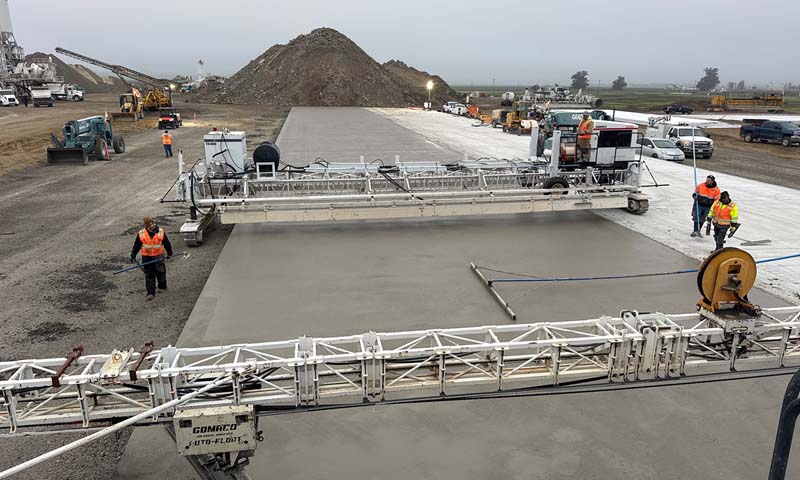
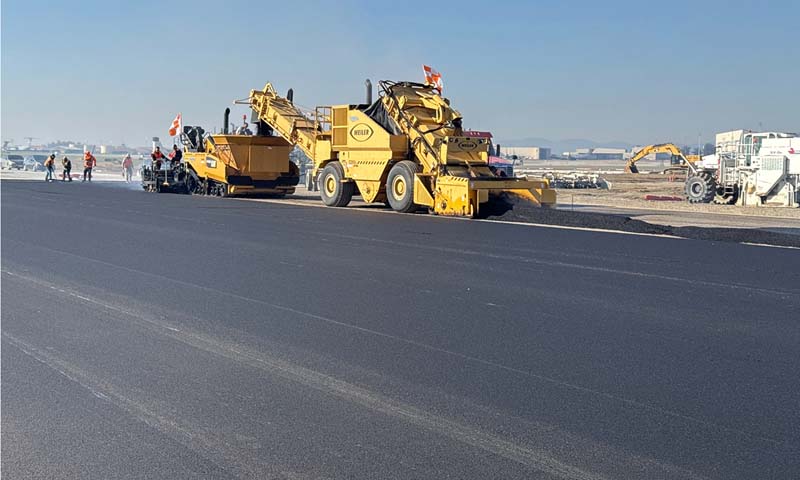
The design-bid-build task order awarded to ECC was executed between March 2022 and April 2026. The work included the demolition of 387,300-yd² of existing runway pavement and asphalt shoulders and placement of more than 100,000-yd³ of new concrete. The project also replaced and upgraded airfield lighting and visual navigation systems, including runway and taxiway edge lights, threshold light bars, precision approach path indicator systems, runway end identifier lights, and associated electrical infrastructure.
To implement the construction, the team managed more than 350 plan sheets across three design volumes—progressing across pavement demolition and replacement, drainage installation, geometric control, and airfield lighting systems. Maintaining alignment between grades, elevations, pavement transitions, and lighting installs demanded precise sequencing and continuous verification to meet safety and operational tolerances.
Paving Challenges
The work at Travis was executed under challenging wind conditions and often poor air quality while maintaining aircraft safety and operational continuity. The persistence of high winds and other environmental factors during concrete placement can accelerate surface moisture loss and convective cooling, leading to early-age cracking and degradation of long-term pavement performance. In response, the project team for 21R/03L leveraged concrete paving modeling software to optimize concrete performance, factoring in wind conditions, ambient temperatures, concrete mix properties, and pavement thickness as well as joint spacing, subbase restraint, and curing methods.
The introduction of advanced technologies, in conjunction with strategic equipment positioning and tightly controlled construction planning, helped streamline the paving process to promote the long-term, enhanced resiliency of the runway. Additionally, robust foreign object debris and dust control measures were enforced onsite, such as dust abatement on access roads, continuous vacuuming, and strict access controls, to protect aircraft, personnel, and operations.
Conservation Measures
A defining constraint of the runway project was compliance with a U.S. Fish & Wildlife Service Biological Assessment, prepared under Section 7 of the Endangered Species Act. The area for Runway 21R/03L lies adjacent to a network of vernal pools and associated seasonal wetlands supporting multiple federally listed species, including California tiger salamanders and vernal pool fairy shrimp.
Site-Specific Plan. Given the sensitivity of the surrounding habitat, Travis AFB pursued a project-specific consultation that translated regulatory requirements into clear, enforceable constraints on how construction could proceed. These requirements shaped how ECC planned for and sequenced work and managed access and monitoring throughout the project.
The Air Force Environmental Resources Management, in coordination with the Fish & Wildlife Service and the California Department of Fish and Wildlife, implemented a pitfall trapping program that safely captured and relocated approximately 3,500 California tiger salamander adults and metamorphs outside the construction footprint. The project team installed physical measures and continuous exclusionary fencing, including straw wattles placed along the limits of disturbance, to prevent salamander ingress into active construction areas.
Coordinated Approach. During phased execution, the team managed environmental compliance directly in the field, coordinating with base environmental staff and regulatory agencies as construction progressed. A Fish & Wildlife Service-approved biologist, trained in how to properly identify and handle California salamanders, supported this effort by translating permit requirements into daily construction decisions and directing protective actions as the site conditions changed.
The biologist prepared crews on how to identify endangered species and vernal pools through a mandatory environmental training and weekly environmental updates in alignment with operations and site conditions. Twice‑daily biological patrols, conducted before and after the work day, focused on exclusion fencing, open trenches, and other potential entrapment hazards. Monitoring intensified during rain events and nighttime operations when salamander movement risk increased. Defined haul routes further limited exposure to sensitive areas.
Over nearly four years of construction adjacent to sensitive habitat, the runway project achieved zero biological incidents while maintaining full regulatory compliance. Through long-term monitoring efforts during construction, the team also expanded the installation’s biological inventory, documenting previously unrecorded native and non-native plant species and reinforcing baseline ecological data for future planning.
Aligning Stakeholders
The commitment to a collaborative partnership was a critical component of success, not only in managing the project’s size, scale, and complexity, but in navigating the constraints of a busy airfield adjacent to an environmentally sensitive area with challenging weather conditions. Because the runway was an active taxiway for a portion of the work, the entire team was in constant communication, including the Air Force Civil Engineer Center, the contractor, Title II Inspectors, work crews, sweepers, tower staff, base operations, airfield management, security forces, electrical, and other stakeholders.
Through consistent efforts, the team reduced schedule risk during construction and minimized operational impacts. Close coordination streamlined access, approvals, and outage planning for time‑sensitive paving and airfield tie‑in activities. With client approval, ECC proactively rephased work to place an alternate taxiway into service sooner than anticipated: this allowed earlier demolition to proceed once the runway was no longer required for taxi operations. The open, responsive communication channels between the company and service leadership built a relationship that allowed the team to adapt to changing circumstances and were a key source of success.
Overcoming the Unexpected
During the demolition stage for the runway project at Travis, AFB construction crews encountered an unexpected 1,125-linear-ft, 20-in thick, legacy runway pavement system beneath the existing runway structure. This legacy pavement system was not fully documented in the available as-built records and its presence introduced uncertainty regarding structural capacity, material properties, and historical construction methods.
After encountering the legacy runway pavement system, the team immediately suspended localized demolition activities in order to conduct an engineering assessment of the underlying pavement. Working with design engineers, crews evaluated whether the legacy materials could be reused or integrated, or if they required full removal. Based on this evaluation, it was decided to reuse and recycle as much of the legacy runway as possible, crushing the old pavement with horizontal crushers and incorporating salvaged materials into the new pavement section as backfill. Construction sequencing was adjusted to maintain progress along the critical path while ensuring the reconstructed runway met performance and safety requirements.
Rapid collaboration and flexible execution strategies discussed between the owner, design team, end users, and contractor allowed the condition to be assessed and resolved quickly, expediting a change order that minimized impacts to the schedule.
Partners in Resilience
The reconstruction of Runway 21R/03L at Travis AFB showcases how close collaboration can enable large‑scale airfield construction within an active and environmentally sensitive setting. Throughout the work, decisions were made that balanced regulatory requirements, evolving site conditions, and continuous mission demands, with ecosystem protections established early and reinforced through daily field practices.
This coordinated approach supported effective monitoring, rapid responses to changing conditions, and resolution of unanticipated subsurface issues. Construction proceeded without biological incidents or material schedule impacts. By modernizing critical infrastructure through an integrated partnership, the runway project has strengthened stewardship and sustained operational readiness for Air Mobility Command.
Guy Simmons is Senior Project Manager, and Scott Lawrence is Project Manager, ECC. They can be reached at gsimmons@ecc.net; and slawrence@ecc.net.

Chris Bronny is Service Approved Biologist, Biological Resources Services LLC; chrisbronny@protonmail.com.
Published in the July-August 2026 issue of The Military Engineer

Check Out Related Articles From TME
-

Innovative PFAS Remediation at Camp Grayling
For project stakeholders and remediation managers confronted with PFAS, Regenesis demonstrates the efficacy of using Regenesis’ PlumeStop® colloidal activated carbon (CAC) at Camp Grayling, Michigan. -
A Standardized Approach to Aircraft Fire Training Infrastructure
To support enterprise-wide airmen readiness, the U.S. Air Force is modernizing its standard design for aircraft fire training facilities—introducing digital controls, dual-fuel systems, and PFAS-conscious infrastructure. -
Delivering Energetic Materials Manufacturing Facilities
Designing and constructing facilities that manufacture, process, handle, or store explosives and energetic materials present some of the most challenging defense projects—requiring technical experience, strict safety protocols, and a comprehensive understanding of regulatory frameworks. -
Forging Tradition and Innovation: A New Design Standard at Camp Lejeune
The II MEF Headquarters at Camp Lejeune blends Georgian Revival architecture with modern sustainability—delivering durability, efficiency, and precision that meets contemporary functional requirements while honoring heritage. -

Balancing Efficiency and Fiscal Responsibility
The continuing contracts clause offers the U.S. Army Corps of Engineers a way to improve project delivery and enhance fiscal responsibility by aligning funding with project execution. -
Next Steps for Digital Twin Development
U.S. Forces Japan is laying the groundwork for future integration of digital twin technology in order to validate and collect data that will offer comprehensive insights into utility conditions at installations and enhance overall decision-making, efficiency, and resilience.