Minimizing Pile Driving Generated Sound at Coast Guard Base Kodiak
By Ian Putnam, M.SAME
A recent study conducted by Coast Guard Civil Engineering Unit Juneau suggests the vibratory installation of polymeric piles is quieter than previously modeled, paving the way for reduced marine mammal shutdown zones.
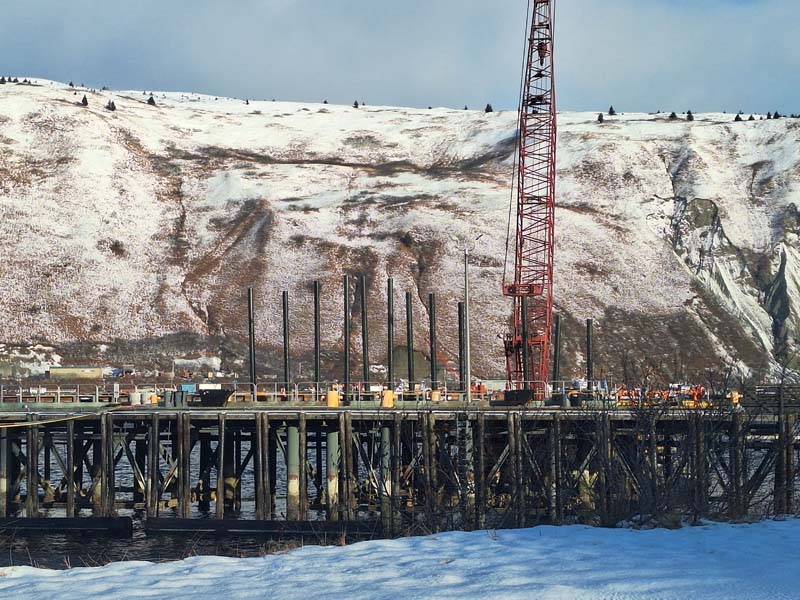
A study conducted at Base Kodiak in Alaska by Coast Guard Civil Engineering Unit Juneau found that vibratory installation of 13-in polymeric piles generated substantially less underwater noise than previous data sets had suggested. Photo by Robert Mills, JASCO Applied Sciences.
The U.S. Coast Guard has an operational requirement to modernize and maintain its waterfront infrastructure, acknowledging the reality that every mission begins and ends at a shore installation. At Coast Guard Base Kodiak, Alaska, the largest homeport in the service, this resource investment is most critical.
Daily operations initiating from the installation are vital to national security and readiness in the northern Pacific and Arctic region. In practice, the ongoing maintenance and repair of Base Kodiak’s waterfront is an essential component in accomplishing the Coast Guard’s statutory responsibilities.
Much of the maintenance and repair at Kodiak, however, occurs in a marine environment shared with protected marine species and their critical habitat. Many of these species can experience physiological or behavioral changes when exposed to the excessive noise generated from pile driving. To mitigate potential harm to these species, the Coast Guard, along with the National Marine Fisheries Service, implement shutdown zones when the species are present during in-water work. The shutdown zone distances are calculated using existing sound data and acoustic modeling.
A recent sound field verification study conducted at the base provided mutually beneficial data for both the Coast Guard and protected marine species. The measured sound from vibratory pile driving of 13-in polymeric piles was significantly lower than previously available proxy data suggested. This offers new pathways to smaller marine mammal shutdown zones, more efficient construction, and a smaller overall sound footprint.
Challenges of Stoppages
The impact of shutdowns stemming from marine mammals pose a significant challenge to operations. For example, the Coast Guard required temporary moorage of the 282-ft cutter Alex Haley while its nearby permanent mooring at the cargo wharf underwent major improvements and renovations. To accommodate the Alex Haley, a significant number of 13-in polymeric piles, 80 in total, were added to the fuel pier’s fender system to increase the waterfront’s structural strength and its ability to withstand storm events. To maintain operational readiness, this work needed to be completed in a short timeframe of less than a year.
Any delays in construction from marine mammal shutdowns would leave Base Kodiak, Alex Haley, and the Coast Guard vulnerable to lapses in mission capability.
In addition to diminished mission capability, marine mammal shutdowns also result in costly delays. In March 2026, vibratory driving of steel piles was occurring at the adjacent cargo wharf. The project would involve 30-in steel piles with a much louder sound profile than those used on the fuel pier. During in-water work, Northern Sea Otters, a federally listed endangered species, entered the marine mammal shutdown zone and halted all work. This stoppage lasted nearly 15 days. The Coast Guard estimates the standby time incurred an additional $75,000 per day, with an estimated total of $1.1 million in standby costs.
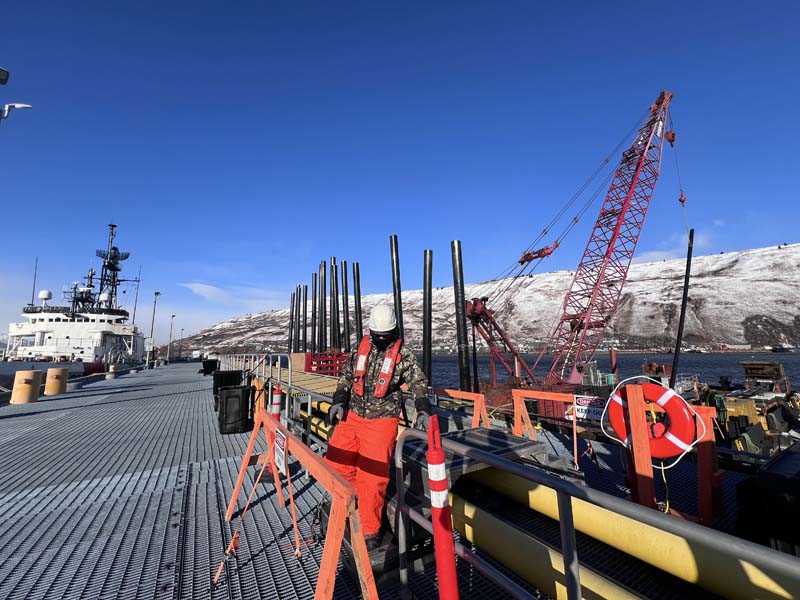
Results from acoustic monitoring supported a 45 percent reduction in the marine mammal shutdown zone. Photo by Alex Gross, JASCO Applied Sciences.
Seeking Quiet Solutions
Methods for pile installation at Base Kodiak typically involve impact or vibratory hammer techniques. Vibratory installation is most often used, given that the marine sediment is composed of sand and gravel with trace amounts of silt and clay. The vibratory pile approach is generally considered to be quieter than impact methods but still produces noise levels capable of causing both physiological harm and behavioral changes in marine species.
Previous sound source verification studies provide robust data on the vibratory installation of steel and timber piles. Far less data exists on the installation of polymeric piles. In one instance, at Napa Bridge in Solano County, Calif., sound data was collected from four 13-in polymeric piles installed via impact hammer. This dataset acted as the proxy for establishing an exclusion zone of 1,585-m for polymeric pile installation at the Base Kodiak fuel pier. Overall, existing data shows vibratory installation of piles is generally quieter than impact driving with timber and steel. Coast Guard Civil Engineering Unit Juneau, which led the effort at Base Kodiak, predicted that vibratory installation of polymeric piles would follow the same trend.
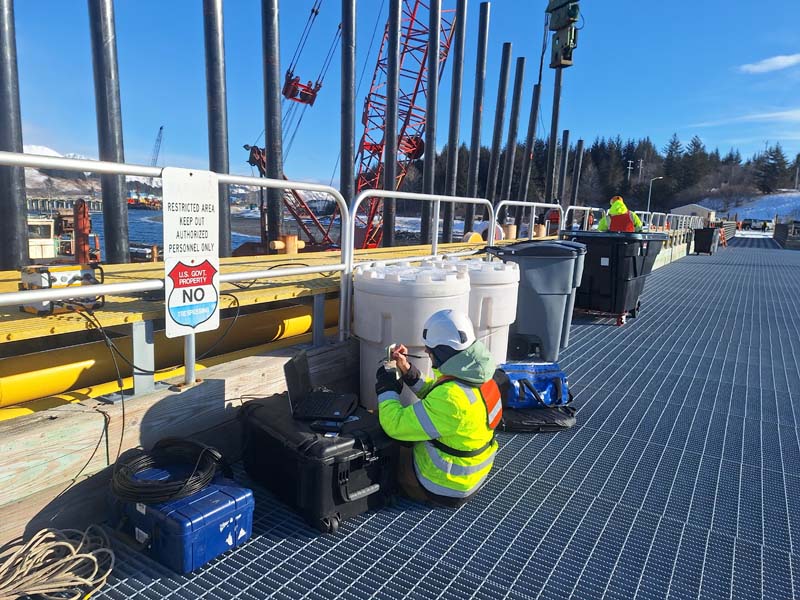
The study at Coast Guard Base Kodiak demonstrates how project-specific environmental data can support construction delivery and operational readiness while protecting marine species. Photo by Robert Mills, JASCO Applied Sciences.
Testing for Sound
The Coast Guard hypothesized that vibratory installation of 13-in polymeric piles would be quieter and fill a smaller area with sound than originally modeled using the Napa Bridge proxy data. To test this idea, personnel measured the underwater sound generated during the vibratory installation of seven 13-in polymeric piles.
In early March 2026, Civil Engineering Unit Juneau partnered with Ahtna Infrastructure and Technologies, Fairweather Sciences, and JASCO Applied Sciences to collect sound data during pile driving. The scope of work included deploying one real-time and two autonomous acoustic recorders at set distances from each individual pile being driven (12.5-m, 200-m, and 1,000-m).
The team then measured and analyzed the sound levels generated from the installation of the seven piles. Specifically, the group looked at distances where sound levels dropped below physiological injury and behavioral change thresholds. (Physiological thresholds are defined as sound levels ranging between 181-decibels and 201-decibels that have the potential to harm or injure the species. Behavioral thresholds are sound levels exceeding 120-decibels for marine mammals and 150-decibels for fish and have the potential to modify behavior.)
After the data collection had gotten underway, the Coast Guard found that the distances to physiological thresholds to be less than 10-m from pile installation. This is consistent with previous data from polymeric piles. For behavioral thresholds, distances were significantly smaller than the Napa Bridge proxy data.
Among the seven piles where data was collected, the distance in which sound levels dropped below the behavioral threshold ranged from 650-m to 1,020-m, with an average of 870-m. While one pile did produce sound resulting in a behavioral threshold distance of 5,610-m, this result was considered an outlier, as vibratory pile driving of 30-in steel piles was occurring concurrently at the adjacent cargo wharf. After coordination with the National Marine Fisheries Service, the Coast Guard was able to reduce the marine mammal shutdown zone to 870-m, resulting in a 45 percent size reduction from the previous shutdown zone.
Behavioral threshold distances for fish (150-db) were also measured, ranging between 20-m and 60-m. Although these are larger than predicted using the Napa Bridge data set (15.8-m), they still present a low risk for future work stoppages at Base Kodiak.
The measured sound from vibratory pile driving of 13-in polymeric piles was significantly lower than previously available proxy data suggested. This offers new pathways to smaller marine mammal shutdown zones, more efficient construction, and a smaller overall sound footprint.
Environmental Stewardship
The reduced shutdown zones will turn out to be mutually beneficial for the marine environment and the maintenance and repair needs of the Coast Guard. Smaller shutdown zones will help to minimize work stoppages and improve cost savings. The results display a willingness within the Coast Guard to implement project-based data to gain more precise environmental mitigation measures where they are most needed.
Base Kodiak is an example of how data-driven engineering and design can align operational needs with environmental stewardship. The results are helping the service lean forward in more cost-effective and environmentally sound construction methods.
Ian Putnam, M.SAME, is Physical Scientist, Civil Engineering Unit Juneau, Alaska; ian.e.putnam@uscg.mil.

The views expressed herein are those of the author and are not to be construed as official or reflecting the views of the Commandant or of the U.S. Coast Guard.
Published in the September-October 2026 issue of The Military Engineer

Check Out Related Articles From TME
-

Innovative PFAS Remediation at Camp Grayling
For project stakeholders and remediation managers confronted with PFAS, Regenesis demonstrates the efficacy of using Regenesis’ PlumeStop® colloidal activated carbon (CAC) at Camp Grayling, Michigan. -
A Standardized Approach to Aircraft Fire Training Infrastructure
To support enterprise-wide airmen readiness, the U.S. Air Force is modernizing its standard design for aircraft fire training facilities—introducing digital controls, dual-fuel systems, and PFAS-conscious infrastructure. -
Delivering Energetic Materials Manufacturing Facilities
Designing and constructing facilities that manufacture, process, handle, or store explosives and energetic materials present some of the most challenging defense projects—requiring technical experience, strict safety protocols, and a comprehensive understanding of regulatory frameworks. -
Forging Tradition and Innovation: A New Design Standard at Camp Lejeune
The II MEF Headquarters at Camp Lejeune blends Georgian Revival architecture with modern sustainability—delivering durability, efficiency, and precision that meets contemporary functional requirements while honoring heritage. -

Balancing Efficiency and Fiscal Responsibility
The continuing contracts clause offers the U.S. Army Corps of Engineers a way to improve project delivery and enhance fiscal responsibility by aligning funding with project execution. -
Next Steps for Digital Twin Development
U.S. Forces Japan is laying the groundwork for future integration of digital twin technology in order to validate and collect data that will offer comprehensive insights into utility conditions at installations and enhance overall decision-making, efficiency, and resilience.