Modernizing Ammunition Manufacturing
By Mike Chiles, LEED AP, M.SAME
The newly completed 6.8-mm Cartridge Manufacturing Facility at the Lake City Army Ammunition Plant shows how careful planning, environmental coordination, and flexible construction approaches can support modernization of critical ammunition production sites.
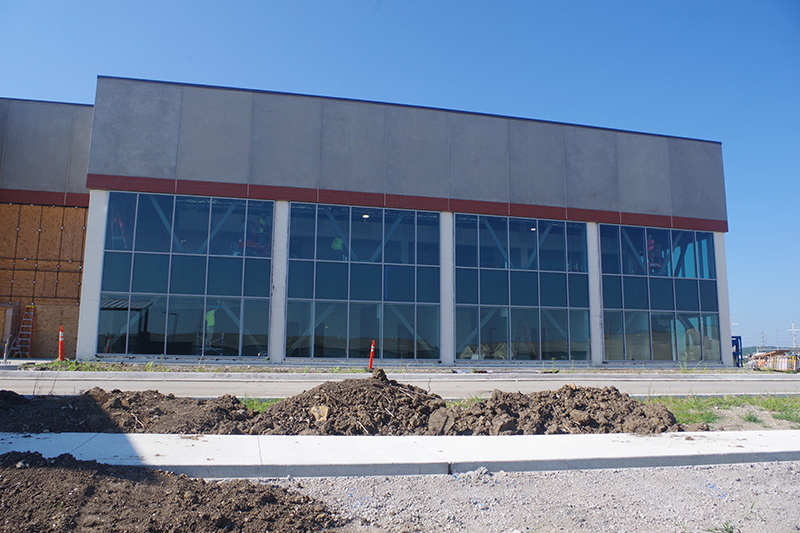
Construction of a new 6.8-mm Cartridge Manufacturing Facility at the Lake City Army Ammunition Plant will help modernize ammunition production capabilities while supporting evolving operational requirements. Photos courtesy JE Dunn.
Across the United States, many of the military’s long-standing ammunition-production facilities were designed during an earlier era, when security, separation of operations, and the requirements of the period guided site and building planning. As often is the case with legacy industrial sites, redevelopment planning requires close attention to existing site conditions and applicable environmental regulations.
The complexities of managing around existing utilities, established site layouts, environmental conditions, and constrained work areas add layers of challenges when integrating new facilities into an operating industrial campus. At Lake City Army Ammunition Plant in Independence, Mo., the construction of a new 6.8-mm Cartridge Manufacturing Facility illustrates an effective approach to planning and delivering a modern ammunition-production facility.
The ongoing modernization efforts at Lake City Army Ammunition Plant, a 3,935-acre property located in the western edge of Missouri, will support updated ammunition manufacturing capabilities, with the work being delivered through collaboration among the U.S. Army, the plant operator, design team, and contractor. The new 450,000-ft² Cartridge Manufacturing Facility demonstrates how thoughtfully planned assets can improve production flow, strengthen infrastructure, and provide clear separation between energetics, testing, and administrative functions.
Completing work at the site required balancing established operational and security considerations with opportunities to improve building flow, infrastructure, and construction performance. The new facility, being built by JE Dunn, represents a significant step forward in how ammunition manufacturing facilities can be planned and constructed.
Preparing the Site
Rather than building on a greenfield location, the project involved the redevelopment of a former World War II-era structure, with demolition completed by the Army Corps of Engineers prior to construction. This phase required careful site planning and environmental coordination, including appropriate testing, material-management procedures, and documentation. Other than a five-year period during the war in the 1940s, the Lake City complex has produced and tested ammunition continuously for eight decades.
The team developed a site-specific approach to manage materials and maintain construction progress within the project’s requirements. Simply hauling soil away and starting fresh was not an option. The approach incorporated material-management practices and construction sequencing intended to support both site conditions and the new facility’s requirements. Close coordination among project partners, together with careful sequencing and documentation, supported the redevelopment for the new facility.
When site materials require management, project teams evaluate available options in accordance with applicable requirements, constructability considerations, and project-specific conditions.
Designed with Precision
The facility is being constructed to support the production of 6.8-mm small-caliber ammunition. To meet the precision manufacturing and safety, quality, and operational requirements associated with ammunition production, the new complex will incorporate a carefully coordinated approach to layout and internal process flow. The design organizes key functions to support appropriate separation, circulation, and workflow. The arrangement of the layout is directly intended to strengthen operational performance while maintaining necessary separation and security considerations.
The facility’s layout also incorporates considerations related to the workforce and daily processes and procedures, aimed to bolster circulation and facilitate efficient movement throughout.
Foundational Partnership
Constructing the facility required substantial concrete placement, including below-grade foundations and footings. To create an effective foundation that met the schedule, constructability, and site condition requirements, aggregate piers were used. This approach helped limit material handling during foundation construction, increased the efficiency of installation, and aligned with project-specific site and logistical considerations.
- Structural systems were designed to meet applicable operational, safety, and security requirements. The facility incorporates precast concrete, reinforced masonry, structural steel, and concrete foundations, slabs, and walls.
- Utility and building systems were also coordinated to support the facility’s operational requirements.
- Subsurface conditions required careful planning and coordination throughout the project. The project team worked closely with partners and stakeholders to develop an approach that supported facility requirements while accounting for site conditions, constructability, and environmental considerations.
Carrying out the work in the field required a high level of coordination. Facing challenges around site access and delivery needs pushed the team to evaluate alternative approaches for how to place the concrete, with the final decision being to use an on-site batch plant. This solution enabled crews to produce and pour concrete in coordination with planned work activities; the total volume of concrete placed has totaled more than 47,000-yd³.
The batch plant also helped reduce delivery dependencies, supported quality-control processes, and gave the team flexibility in sequencing concrete placements.
Purpose-Built Project
When finished, the Cartridge Manufacturing Facility will support the Army’s increasing demands for ammunition while delivering high-quality production flow, worker safety, and responsible site-management practices. The project demonstrates how a purpose-built facility can support the U.S. military’s evolving requirements. Carrying out the design and construction of this mission-enabling asset, however, has required a carefully coordinated approach to planning and alignment, and a commitment to innovative approaches.
The work at Lake City illustrates the value of aligning engineering, construction, and operational requirements in the delivery of a complex industrial facility critical to national defense.
Historical Legacy, Modern Mission
First established in 1940 as Lake City Arsenal, today the Lake City Ammunition Plant is the Defense Department’s largest producer of small-arms munitions, with a yearly production of more than 1-billion rounds. Like many military sites built during the years surrounding World War II, Lake City’s facility and infrastructure portfolio contains many aging assets in need of repair or replacement.
The Army-owned installation, which is operated by Olin-Winchester and organized under Army Sustainment Command, issued a contract for the new 6.8-mm Cartridge Manufacturing Facility in 2023. The facility, when finished, is expected to sustain an annual production of “385 million cases, 490 million projectiles, and 385 million load-assemble-pack operations.”
Given its historical manufacturing practices, Lake City endured environmental contamination and in 1987 was placed on the National Priorities List as a Superfund Site. However, because Lake City is the only major small arms manufacturing facility for the Army, there are no plans to change its critical mission. According to the Missouri Department of Natural Resources, future land use will “remain industrial at each of the operable units and facility manufacturing areas.” Additionally, “land-use restrictions implemented by the Army will remain in place”; the overarching intent is to maintain the land for manufacturing and other industrial or commercial activities.
Mike Chiles, LEED AP, M.SAME, is Project Director, JE Dunn Construction; mike.chiles@jedunn.com.
Published in the November-December 2026 issue of The Military Engineer

Check Out Related Articles From TME
-

Innovative PFAS Remediation at Camp Grayling
For project stakeholders and remediation managers confronted with PFAS, Regenesis demonstrates the efficacy of using Regenesis’ PlumeStop® colloidal activated carbon (CAC) at Camp Grayling, Michigan. -
A Standardized Approach to Aircraft Fire Training Infrastructure
To support enterprise-wide airmen readiness, the U.S. Air Force is modernizing its standard design for aircraft fire training facilities—introducing digital controls, dual-fuel systems, and PFAS-conscious infrastructure. -
Delivering Energetic Materials Manufacturing Facilities
Designing and constructing facilities that manufacture, process, handle, or store explosives and energetic materials present some of the most challenging defense projects—requiring technical experience, strict safety protocols, and a comprehensive understanding of regulatory frameworks. -
Forging Tradition and Innovation: A New Design Standard at Camp Lejeune
The II MEF Headquarters at Camp Lejeune blends Georgian Revival architecture with modern sustainability—delivering durability, efficiency, and precision that meets contemporary functional requirements while honoring heritage. -

Balancing Efficiency and Fiscal Responsibility
The continuing contracts clause offers the U.S. Army Corps of Engineers a way to improve project delivery and enhance fiscal responsibility by aligning funding with project execution. -
Next Steps for Digital Twin Development
U.S. Forces Japan is laying the groundwork for future integration of digital twin technology in order to validate and collect data that will offer comprehensive insights into utility conditions at installations and enhance overall decision-making, efficiency, and resilience.