Restoring Drinking Water Resilience at Bee Tree Reservoir
By Rinku Shah CQMC, PMP
After Hurricane Helene overwhelmed the William DeBruhl Water Treatment Plant and cut potable water to residents, USACE Wilmington District led the rapid deployment of a turbidity reduction system to restore treatment.
In September 2024, Hurricane Helene caused record rainfall in the western parts of North Carolina. The region endured landslides, flooding, and damage to roads and utilities. In a single day, the City of Asheville received 13-in of rain, with surrounding areas getting up to 31-in, resulting in urgent challenges for restoring services amid disrupted access and supply chains.
Most significantly impactful to daily life was the loss of drinking water production at the William DeBruhl Water Treatment Plant, which draws from Bee Tree Reservoir. A surge of mudslides and storm runoff carried high concentrations of sediment into the reservoir, pushing turbidity levels to exceed 500-NTU, far beyond the plant’s 5-NTU treatment capacity. The reservoir’s influent shifted from stable high-quality water to highly turbid with variable composition due to the rapidly increasing water and turbidity levels. The spillway stage gates for the dam partially opened to relieve elevated water levels and pressure, which saved the structure from catastrophic failure. The outage left 156,000 residents without potable water for more than seven weeks.
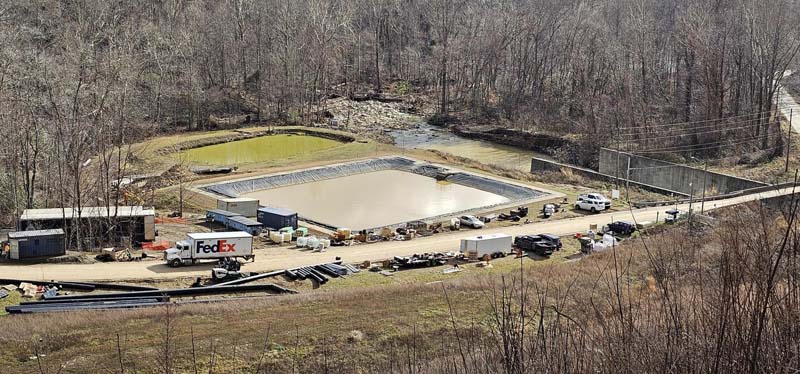
The Wilmington District of the U.S. Army Corps of Engineers (USACE), under a FEMA Mission Assignment, implemented a temporary turbidity reduction pretreatment system to pretreat up to 5-mgd of water prior to entering the municipal water treatment plant. The objective was to remove extreme suspended solids and deliver stabilized effluent that would allow the municipal facility to restart and produce potable water within regulatory limits.
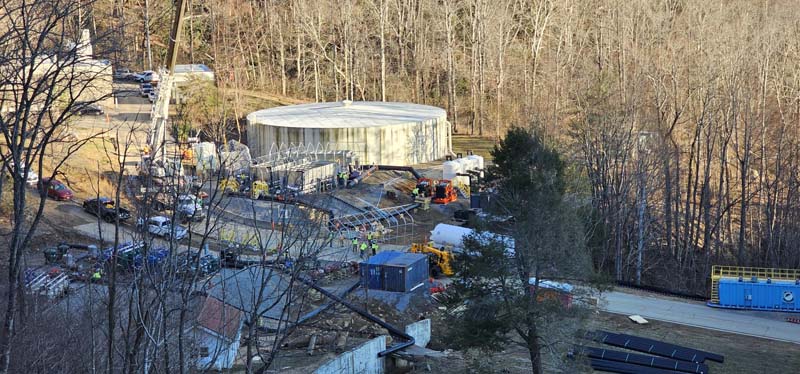
Execution of the project was further constrained by regional storm damage that disrupted utility services, transportation routes, and increased competition for labor, materials, and equipment. The Bee Tree site presented steep terrain, limited staging space, and restricted access; these variables required tightly sequenced deliveries and careful equipment placement. Dealing with winter weather challenges added intermittent stoppages and required protective measures for piping, treatment systems, and chemical operations to maintain safe and reliable progress.
Swift Deployment
Wilmington District structured the scope of work to support a compressed delivery schedule with defined performance objectives, disciplined coordination, and a fast-track design-build-operate model. The project team, under a Bering-Weston JV, mobilized within 48 hours of award—completing, during this initial period, preliminary safety, staffing, and construction planning. The construction work operated continuously. Site preparation began immediately, placing 160,000-yd³ of stone in seven days. Generators were installed in 96 hours, providing power for construction activities and subsequent continuous operations.
The expedited schedule relied on concurrent engineering and construction. Onsite, engineers refined system design while crews prepared equipment pads, installed piping, and built electrical distribution systems. This integrated approach allowed field conditions to be incorporated into the design nearly simultaneously, which proved essential given the constrained footprint and the need to adjust layouts when site conditions differed from initial assumptions.
Logistics became a core component of execution. The effort required coordination across 12 major suppliers and nine subcontractors, and was supported by daily meetings with federal, state, and local stakeholders. More than 24 semi-truck loads of major equipment and over 100 additional deliveries were sequenced into a site with limited access and minimal staging capacity.
The new system ultimately reduced turbidity to below 5-NTUs and operated with 99 percent uptime, enabling the treatment plant to restart and sustain compliant drinking water production under highly variable raw water conditions.
Near-Term, Long-Term
Beyond the initial recovery, renovating the William DeBruhl Water Treatment Plant demonstrated key resilience principles. Importantly, it was shown that modular pretreatment can be integrated quickly into an existing facility, serving as an operational bridge while long-term capital improvements are planned and funded.
Even temporary systems can be designed with redundancy and maintainability that improve uptime and reliability. During the work in North Carolina, continuous monitoring and operator-driven adjustments proved essential, since raw water conditions fluctuated significantly following the storm.
Reducing Turbidity
The treatment approach was designed as an integrated pretreatment train that combined rapid solids removal with downstream polishing. Dissolved air flotation served as the primary separation step. A group of four units, equipped with internal flocculation tubes, enabled the system to manage significant swings in incoming water quality. Chemical feed systems applied drinking-water-approved coagulants, caustic for pH adjustment, and polymers to bind fine particles and improve separation. This configuration advanced regulatory compliance while giving operators the flexibility to respond to changing conditions. Dosing rates were adjusted as turbidity and pH shifted, with refinements guided by field sampling and performance monitoring to maintain consistent treatment results.
After flotation, additional filtration stages were used to continuously meet final turbidity targets.
- Modular, parallel treatment trains allowed for maintenance without stopping production.
- Residuals management supported continuous operations. An 18,100-gal mixed equalization tank prevented solids settling and stabilized feed to two plate-and-frame filter presses, with contingency capacity available to handle variable sludge volumes.
- Damaged piping was repaired and isolation valves added to improve operational flexibility.
- Temporary high-density polyethylene piping and valves created a controlled conveyance path from reservoir intake through pretreatment and to the plant influent connection. Pipe sizes ranged from 8-in to 24-in, with instrumentation and sampling points installed to verify performance.
- Sand filters provided high-capacity polishing, with automated backwash cycles based on pressure and runtime. Bag filters added final polishing and redundancy.
All engineering documents were signed and sealed by state-licensed professional engineers and coordinated on an expedited basis with regulators to support rapid deployment while maintaining design accountability and monitoring oversight.
Continuing Operations
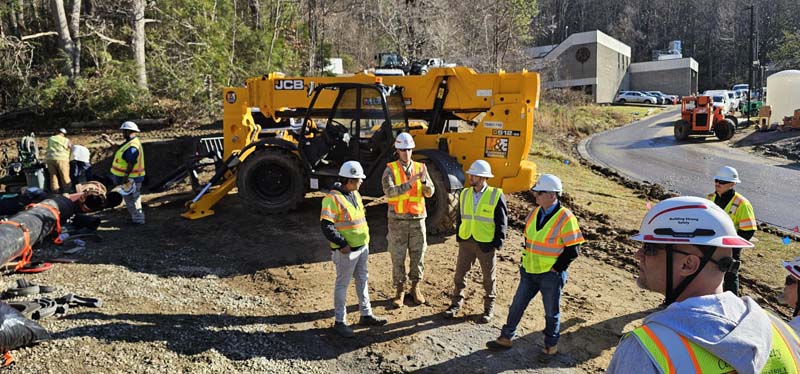
To track project progress, performance goals centered on reducing turbidity to levels that would allow the water treatment plant to restart operations and maintain compliance. The pretreatment system reduced incoming turbidity from levels as high as 250-NTU to 1.5-NTU before the water entered the treatment plant, achieving a 99.4 percent reduction under peak conditions and maintaining turbidity below 1-NTU during sustained operations. Its operating uptime exceeded 99 percent: the built-in redundancy, continuous monitoring, and disciplined maintenance supported stable, around-the-clock treatment.
As a resilience measure, power and controls were designed to operate independently of the grid. A pair of 1,000-kW generators, supported by switchgear and a centralized control panel, carried the full system load. The system included a 12,000-gal diesel tank to sustain continuous operations. The electrical distribution allowed for maintenance and operational transitions without interrupting treatment.
During the work, crews logged more than 35,000 safe hours without a lost time incident while they sustained extended shifts in constrained terrain and winter weather, reflecting structured oversight and disciplined field practices.
Phasing Coordination
The project schedule illustrates how rapid response delivery depends on sequencing as much as it depends on engineering. Within 48 hours of contract award, personnel mobilized and began site preparation, power installation, equipment delivery, and system construction in parallel with design finalization. Construction was completed by Jan. 12, 2025, and the system was operational just four days later.
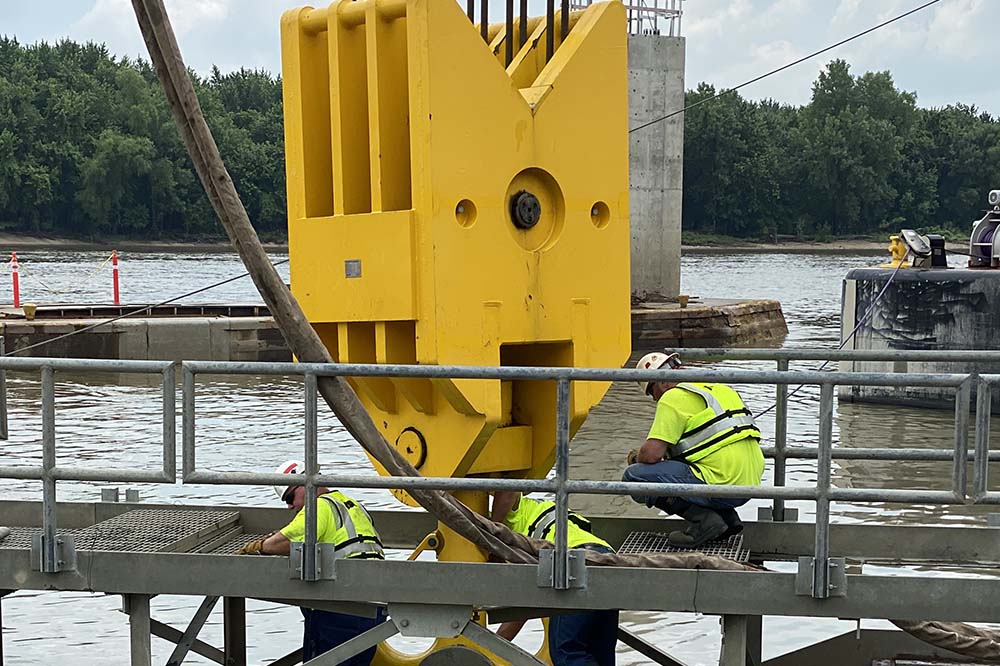
Throughout the response, coordination was both continuous and multi-layered. USACE leadership aligned federal objectives with state regulatory requirements and municipal operational needs, while the project team managed daily synchronization across vendors, suppliers, and subcontractors to maintain delivery tempo and resolve constraints. Logistics were shaped by limited on-site space, constrained access, and the need to crane-set large process components and preassembled piping in tight locations. This required careful delivery scheduling and lift planning.
Gaining Resilience
The immediate benefit of the mission was the restoration of stable pretreatment that allowed the William DeBruhl Water Treatment Plant to restart and sustain drinking water production for the Asheville service area. With 5-mgd of pretreatment capacity and consistent turbidity reduction to required levels, the temporary system stabilized operations, protected public health, and enabled essential services to resume.
Although the system in Asheville serves a civilian population, the project aligned with a resilience principle shared across civil works and defense-adjacent infrastructure: when conditions exceed an operating envelope, preparedness depends on rapidly deployable surge capacity that restores function and maintains stable operations as hazards evolve.
The project also produced operational data to guide future upgrades. The city is currently designing permanent improvements to the water treatment plant and plans to begin construction in 2026. These improvements will provide additional redundancy and resilience based on data developed during the system operation and lessons learned from the joint response after Helene.
Rinku Shah CQMC, PMP, is Principal Project Manager, Weston Solutions; rinku.shah@westonsolutions.com.
Published in the July-August 2026 issue of The Military Engineer

Check Out Related Articles From TME
-

Innovative PFAS Remediation at Camp Grayling
For project stakeholders and remediation managers confronted with PFAS, Regenesis demonstrates the efficacy of using Regenesis’ PlumeStop® colloidal activated carbon (CAC) at Camp Grayling, Michigan. -
A Standardized Approach to Aircraft Fire Training Infrastructure
To support enterprise-wide airmen readiness, the U.S. Air Force is modernizing its standard design for aircraft fire training facilities—introducing digital controls, dual-fuel systems, and PFAS-conscious infrastructure. -
Delivering Energetic Materials Manufacturing Facilities
Designing and constructing facilities that manufacture, process, handle, or store explosives and energetic materials present some of the most challenging defense projects—requiring technical experience, strict safety protocols, and a comprehensive understanding of regulatory frameworks. -
Forging Tradition and Innovation: A New Design Standard at Camp Lejeune
The II MEF Headquarters at Camp Lejeune blends Georgian Revival architecture with modern sustainability—delivering durability, efficiency, and precision that meets contemporary functional requirements while honoring heritage. -

Balancing Efficiency and Fiscal Responsibility
The continuing contracts clause offers the U.S. Army Corps of Engineers a way to improve project delivery and enhance fiscal responsibility by aligning funding with project execution. -
Next Steps for Digital Twin Development
U.S. Forces Japan is laying the groundwork for future integration of digital twin technology in order to validate and collect data that will offer comprehensive insights into utility conditions at installations and enhance overall decision-making, efficiency, and resilience.