Smarter Resilience Through Unified Data
By Kirk Phillips
The Air Force Office of Energy Assurance is investing in efforts to increase the energy resilience of facilities across the enterprise while improving the accuracy and expediency of decision-making through a refresh of the Resilient Energy Assessment Framework.
In support of the Department of the Air Force, with a responsibility to strengthen energy and water resilience across installations worldwide, the Air Force Office of Energy Assurance works to tailor solutions that achieve this requirement while remaining both innovative and cost-effective. Among the primary tools the organization is currently leveraging to address the evolving challenges throughout its portfolio is the Resilient Energy Assessment Framework (REAF).
The REAF model provides a standardized method to assess how well installations and mission-sets are positioned to withstand, respond to, and recover from energy disruptions. By directly linking infrastructure readiness to mission execution, REAF transforms energy risk into operational insight that leaders can act on. In particular, the model enables the Air Force Installation & Mission Support Center (AFIMSC), in its role to deliver integrated services and systems that enhance warfighter readiness and lethality for air and space forces, to consistently evaluate resilience, identify gaps, and align resources to mission-critical needs.
Recently, REAF underwent a modernization effort to bolster support for real-time decision-making. Through this initiative led by the Office of Energy Assurance, the model now operates as a centralized application with greater capabilities for fast, precise resilience data down to the individual building level.
Scorecards For Action
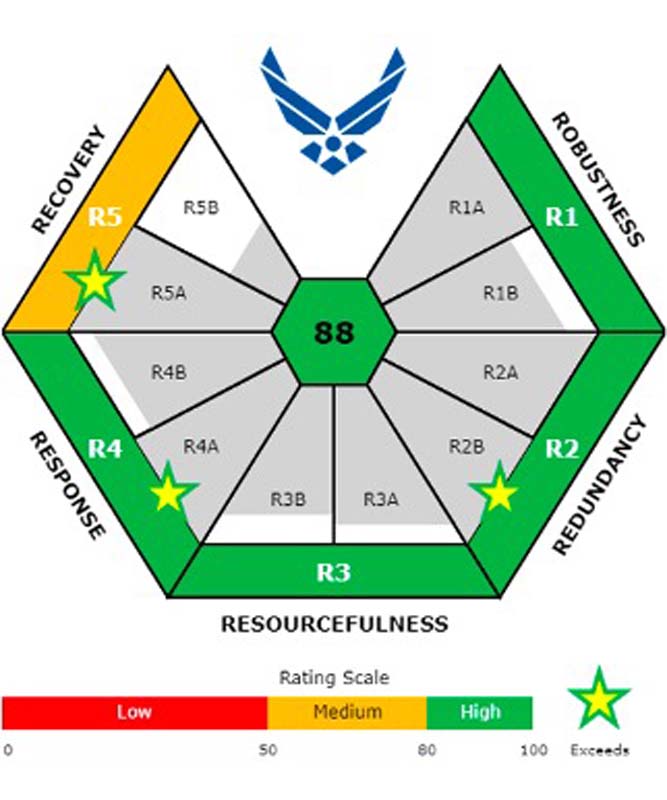
The REAF model works by each installation and sub-mission receiving a score out of 100 based on five key attributes: robustness, redundancy, resourcefulness, response, and recovery. These scores establish a repeatable baseline that AFIMSC can then utilize to compare resilience across installations and mission areas using a common framework.
A visual scorecard highlights potential investment shortfalls at a glance—enabling civil engineers, planners, and leaders to quickly identify areas of vulnerability, align priorities, and communicate risk. This improves consistency, transparency, and accountability.
The objectivity of REAF scores, combined with Resilient Solution Reports and Installation Energy Plans (IEPs), provide defensible data to support programing, budgeting, and investment decisions. The framework helps installations quantify resilience gaps, prioritize solutions, and demonstrate to leadership the operational value of resilience investments.
As a repeatable framework, REAF’s value lasts beyond a single planning cycle. It allows a base to track progress over time, validate the impact of resilience projects, and adapt plans as mission and threat environments evolve. Standardized scoring and reporting strengthen AFIMSC’s ability to advocate for enterprise-wide energy resilience that supports mission assurance.
Refresh Opportunity
Between 2024 and 2025, the Office of Energy Assurance, which operates within the Air Force Civil Engineer Center (AFCEC), led a “REAF Refresh” to modernize legacy tools and improve how resilience data supports real-time decision-making. The team embraced stakeholder feedback and focused working groups to drive updates that improved model functionality and standardized data across the enterprise. The refreshed approach is built on three key pillars (centralization, increased precision, and standardization) that directly support AFIMSC’s need for scalable, repeatable, and auditable processes.
As a repeatable framework, REAF’s value lasts beyond a single planning cycle. It allows a base to track progress over time, validate the impact of resilience projects, and adapt plans as mission and threat environments evolve.
As part of the refresh process, the Office of Energy Assurance modernized the REAF framework through the consolidation of more than 70 separate Excel models into a single, centralized application, which will soon be deployed on a government cloud platform. This web application will eliminate stand-alone files and provide a single resource for updates, analysis, and reporting. The result will streamline workflows, improve accessibility, and enable faster retrieval of resilience data across installations.
The enhancements to REAF significantly improve the precision of resilience data and design planning available to AFIMSC leadership. Previously, the tool summarized facility-level resiliency at the mission- and installation-level groupings. With the redesign, the REAF application allows the tagging of individual buildings, including their existing status and planned infrastructure improvements. This heightened precision gives planners the ability to track intended and actual infrastructure upgrades over time, down to the facility-level.
Before the refresh, resilience data collected through multiple processes like site visits, IEPs, and energy resilience readiness exercises often resulted in siloed data that was difficult to integrate. The updated REAF application standardizes these inputs into a single framework. And by leveraging artificial intelligence and large language model tools, resilience opportunities are now consistently mapped to predefined solution sets.
For the service, this approach provides a reliable, enterprise-wide view of ongoing resilience needs and their severity, in order to support more consistent prioritization across portfolios.
Long-Term Readiness
The updated REAF web application and new assessment tools built on artificial intelligence capabilities are shaping the future of resilience management.
Having access to centralized, standardized data delivers clearer insight into risk. The refreshed REAF tool allows leadership to get a better picture of potential investment shortfalls and enables faster, more informed decisions that strengthen installations, protect mission-critical infrastructure, and increase readiness.
Kirk Phillips is Director, Air Force Office of Energy Assurance; kirk.phillips.3@us.af.mil.
Published in the July-August 2026 issue of The Military Engineer

Check Out Related Articles From TME
-

Innovative PFAS Remediation at Camp Grayling
For project stakeholders and remediation managers confronted with PFAS, Regenesis demonstrates the efficacy of using Regenesis’ PlumeStop® colloidal activated carbon (CAC) at Camp Grayling, Michigan. -
A Standardized Approach to Aircraft Fire Training Infrastructure
To support enterprise-wide airmen readiness, the U.S. Air Force is modernizing its standard design for aircraft fire training facilities—introducing digital controls, dual-fuel systems, and PFAS-conscious infrastructure. -
Delivering Energetic Materials Manufacturing Facilities
Designing and constructing facilities that manufacture, process, handle, or store explosives and energetic materials present some of the most challenging defense projects—requiring technical experience, strict safety protocols, and a comprehensive understanding of regulatory frameworks. -
Forging Tradition and Innovation: A New Design Standard at Camp Lejeune
The II MEF Headquarters at Camp Lejeune blends Georgian Revival architecture with modern sustainability—delivering durability, efficiency, and precision that meets contemporary functional requirements while honoring heritage. -

Balancing Efficiency and Fiscal Responsibility
The continuing contracts clause offers the U.S. Army Corps of Engineers a way to improve project delivery and enhance fiscal responsibility by aligning funding with project execution. -
Next Steps for Digital Twin Development
U.S. Forces Japan is laying the groundwork for future integration of digital twin technology in order to validate and collect data that will offer comprehensive insights into utility conditions at installations and enhance overall decision-making, efficiency, and resilience.