
Speeding Up Federal Facilities Through Alternative Authorities
By Hillary Bassett, M.SAME, Debra Edwards, and John Broughton, M.SAME
With acceleration to completion becoming the foremost priority of federal acquisition, mechanisms beyond FAR-based procurement are increasingly seeing use across the sector—offering capabilities to unlock private capital, accelerate timelines, and reignite stalled projects.
In Southern California, Edwards AFB signed an Enhanced Use Lease to garner the support of the private market in delivering a solar array.
The delivery of federal facility projects stall for a handful of predictable reasons. Maybe agency priority shifts, funding falls through, or a requirement emerges that does not fit neatly into the acquisition playbook. When this happens, the instinct for most program managers is to wait for appropriations to align, approvals to catch up, or a window to emerge in the strict processes governed by the Federal Acquisition Regulation (FAR).
Waiting can come at a cost: financial and otherwise. Deferred projects mean deferred capability. In environments where mission readiness is nonnegotiable, that is a risk most installations cannot afford to accept. For many delayed projects, waiting for a FAR-based procurement is not the only choice—and recognizing this can reveal a broader range of options than most federal teams expect.
Looking to “Non-Standard”
For the majority of what the federal government purchases, the FAR provides a consistent, auditable framework that protects public funds and keeps procurement accountable. The issue arises when the document becomes a constraint rather than a guide—when a project’s specific conditions do not align with what the process was designed to handle.
- Appropriated funds may not be available.
- The path to funding may not be clear.
- A requirement might be new, with no predefined solution and no obvious contract vehicle to attach it to.
- Sometimes, the timeline does not allow for a multiyear procurement cycle.
- In other instances, a military installation may be sitting on underutilized assets or sharing requirements with a neighboring municipality.
These “non-standard” scenarios are the types of situations that alternative procurement authorities were designed to help solve. The challenge becomes that most federal teams are more comfortable with the FAR than anything else (even with its extensive stipulations), since the FAR is backed by decades of policy, training, and institutional memory. Venturing into less familiar territory can feel risky, especially without a clear sense of how the process works or what guardrails are in place.
What changes the calculus and makes alternative authorities more appealing is having partners who understand these tools to make the unfamiliar feel accessible, experts who grasp both what the government needs and what the private sector can provide—and who can connect the two in ways that stand up to scrutiny.
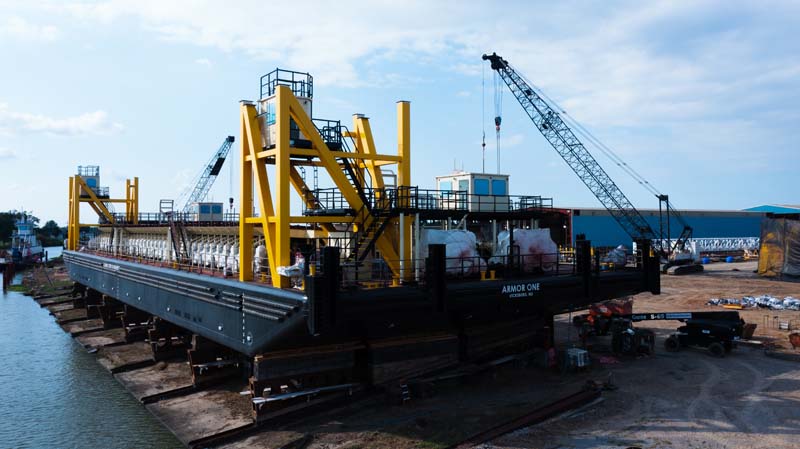
The utilization of Other Transaction Authority enabled the development of ARMOR ONE, a first-of-its-kind robotic system built to accelerate bank and levee repair along the Mississippi River. Photos courtesy Salas O’Brien.
Innovative Tools Emerge
Not every non-FAR acquisition tool fits every situation. Understanding which option best matches the problem at hand is key. Often, federal clients are looking for creative, innovative approaches to leverage Title 10 authorities and address evolving infrastructure and base operating support requirements. A trio of mechanisms have emerged that have shown value across a range of federal facility challenges: Other Transaction Authority (OTA), Intergovernmental Support Agreements (IGSAs), and Enhanced Use Leases (EULs).
Each of these vehicles falls under the broader framework of public-private partnerships, which are contractual arrangements that bring private capital, expertise, or resources to bear on public needs. All three operate differently depending on the underlying problem, but the end results enable greater contracting flexibility and access to alternative sources of funding.
Other Transaction Authority. OTA allows the government, when knowing what outcome it needs but is not yet able to describe the solution, the latitude to explore potential options in an open environment. Rather than a request-for-proposals, an agency issues a request for white papers, inviting industry to pitch technical solutions and conceptual designs. A partner is selected, then the specifics of scope, team, and funding are worked out collaboratively. The process can move from solicitation to award in as few as 120 days. Funding can be drawn from appropriated dollars, private investment, grants, or a combination of.
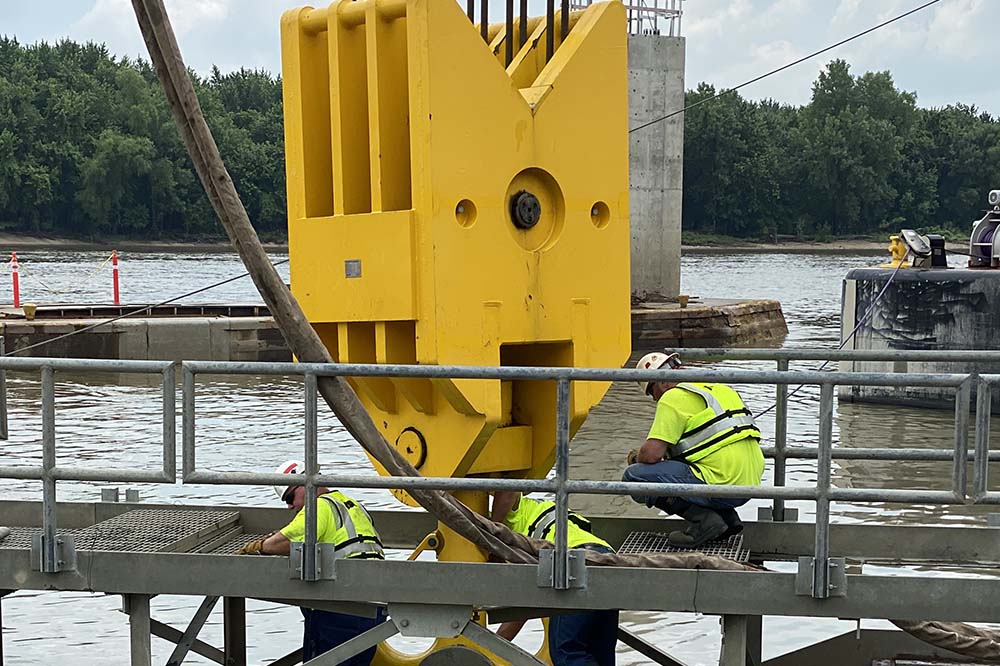
Recently, the U.S. Army Corps of Engineers turned to OTA for a persistent infrastructure challenges: controlling erosion along the banks and levees of the Mississippi River. For decades, that has meant large crews working in hazardous conditions. Under an OTA with Vicksburg District and the Marine Design Center, a team is designing, testing, and building ARMOR ONE—a first-of-its-kind robot that, when complete, will be the largest in the world and expected to be capable of matching the output of nearly 200 laborers in half the time. This kind of solution could not have been specified in advance under more traditional processes, but OTA created the space to invent it. And through OTA’s production clause, successful prototypes can scale the authority, making a long-term asset rather than a one-time workaround.
Intergovernmental Support Agreements. IGSAs permit military installations and surrounding communities to address similar needs at the same time, which is often quicker and more cost-effective than doing it alone. Congress has broadened IGSA authority in recent years, and the results are beginning to show.
In San Antonio, an IGSA involving multiple military bases and the city expanded the municipal landscaping contracts to encompass the installations within the region, a move that led to nearly 30 percent cost savings over previous agreements. Over 10 years, San Antonio enhanced its purchasing power while the military obtained needed services at reduced costs. The approach is being replicated in several states, demonstrating the potential of coordinated procurement around common goals rather than isolated procedures.
Enhanced Use Leases. EULs allow military installations to lease underutilized, non-excess property to a nonfederal tenant for up to 50 years. Developers compete for the lease, bringing in private capital. When the consideration is in-kind rather than cash, the base keeps all of it rather than receiving only half of any cash payments, with the remainder going to higher headquarters.
The potential positives and challenges of EULs are demonstrated at Edwards AFB, Calif. A previous lease arrangement failed because of an inflated fair market value and financial terms that did not withstand private-sector review. After carefully reengaging the market and realigning expectations, the service secured a 50-year lease on 4,000-acres to Terragen for a 1,300-MW solar array.
The in-kind consideration included an advanced microgrid that enhances energy security and resilience. The key difference between the failed and successful attempts was understanding what the market would realistically support, then structuring the deal accordingly.

In San Antonio, an IGSA involving multiple military bases and the city expanded the municipal landscaping contracts to encompass the installations within the region, a move that led to nearly 30 percent cost savings over previous agreements.
The Bigger Picture
OTAs, EULs, and IGSAs carry their own oversight structures, and the government retains control over outcomes throughout. The risk calculus is not “FAR versus uncharted territory.” It is a evaluating a choice between a known process that may not fit the problem and a less familiar one that might.
The OTA, EUL and IGSA authorities are not niche workarounds reserved for unusual circumstances. They are legislatively supported tools that have delivered results across a range of federal facility challenges. As Congress expands the usability of alternative authorities and more agencies gain experience with them, the conversation around federal procurement is slowly broadening. The next question is whether program managers will start planning early enough to use them—and work to keep critical projects moving when the standard path runs out of road.
Hillary Bassett, M.SAME, is Principal, Debra Edwards is Senior Portfolio Manager, and John Broughton, M.SAME, is Senior Vice President, Salas O’Brien. They can be reached at hillary.bassett@salasobrien.com; debra.edwards@salasobrien.com; and john.broughton@salasobrien.com.
Planning Ahead
To put alternative federal contracting authorities to use is only part of the equation. To leverage them to their full extent, teams must consider the complete timeline and internal variables.
OTAs are designed to move fast. The process can go from solicitation to award in four months, making it among the few procurement mechanisms that can genuinely outpace a FAR-based timeline. In practice, however, internal alignment and lack of leadership familiarity can slow the process down. That is a change management challenge, not a structural one.
EULs and IGSAs are slower, and typically require closer to 18 months lead time. Teams need to get familiar with an unfamiliar process, build the internal alignment needed to move forward, and engage the market in ways that surface genuine interest and realistic terms. Skipping that groundwork can produce the same result as the first EUL attempt at Edwards AFB: a technically valid effort that does not succeed for other reasons.
Published in the September-October 2026 issue of The Military Engineer
Check Out Related Articles From TME
-

Innovative PFAS Remediation at Camp Grayling
For project stakeholders and remediation managers confronted with PFAS, Regenesis demonstrates the efficacy of using Regenesis’ PlumeStop® colloidal activated carbon (CAC) at Camp Grayling, Michigan. -
A Standardized Approach to Aircraft Fire Training Infrastructure
To support enterprise-wide airmen readiness, the U.S. Air Force is modernizing its standard design for aircraft fire training facilities—introducing digital controls, dual-fuel systems, and PFAS-conscious infrastructure. -
Delivering Energetic Materials Manufacturing Facilities
Designing and constructing facilities that manufacture, process, handle, or store explosives and energetic materials present some of the most challenging defense projects—requiring technical experience, strict safety protocols, and a comprehensive understanding of regulatory frameworks. -
Forging Tradition and Innovation: A New Design Standard at Camp Lejeune
The II MEF Headquarters at Camp Lejeune blends Georgian Revival architecture with modern sustainability—delivering durability, efficiency, and precision that meets contemporary functional requirements while honoring heritage. -

Balancing Efficiency and Fiscal Responsibility
The continuing contracts clause offers the U.S. Army Corps of Engineers a way to improve project delivery and enhance fiscal responsibility by aligning funding with project execution. -
Next Steps for Digital Twin Development
U.S. Forces Japan is laying the groundwork for future integration of digital twin technology in order to validate and collect data that will offer comprehensive insights into utility conditions at installations and enhance overall decision-making, efficiency, and resilience.